

Why Study in USA for International Students 2026: Academic Excellence, OPT & Career Scope
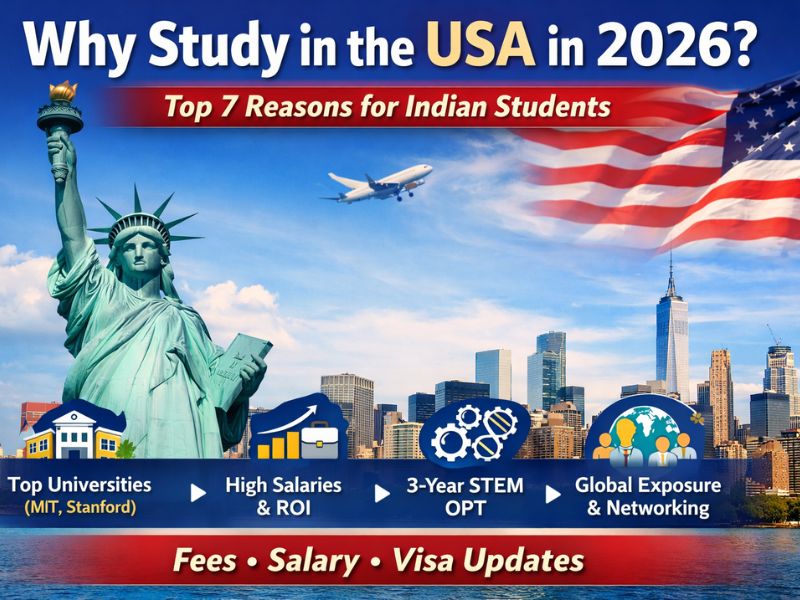
Table of Contents
Why Study in the USA: Highlights 2026
Largest destination for Indian students: The Open Doors 2025 report counted 363,019 Indian students in the US in 2024/25, up 10% on the year before. India is the top sending country, ahead of China (265,919)
World-class universities: MIT ranks #1 in the QS World University Rankings 2026, and one summary of those rankings counts 8 of the global top 10 as American institutions
Post-study work rights: OPT gives 12 months of work authorisation after graduation, and eligible STEM degrees add a 24-month extension, for up to 3 years in total
Popular fields: Computer science, engineering, business, data science, and health sciences
2026 reality check: Conditions have tightened. Visa screening is stricter, F-1 students are now admitted for a fixed period instead of “duration of status” (effective September 15, 2026), and Indian enrollment has dipped (down about 6.9% by February 2026 per the Ministry of External Affairs). A proposed rule published in October 2026 would charge large fees for OPT, but it is a proposal, not final.
Who it suits best: Students with a clear STEM or career plan, strong finances or funding, and the flexibility to handle policy uncertainty
Top Reasons to Study in the USA for International Students
Academic excellence and research: US universities lead in research output and offer access to advanced labs, funding, and faculty working at the frontier of their fieldsFlexible curriculum: You can often explore subjects before declaring a major, combine majors and minors, and shape your degree
Choice and variety: Thousands of institutions, from large research universities to small liberal arts colleges and specialised technical schools
Industry connections: Strong links with employers, internships, co-op programs, and career centres
Work experience after graduation: OPT lets you work in your field, and STEM graduates get up to 36 months in total
Diverse, global campuses: Students from around the world, plus active student organisations, which helps with networking and adaptation
Funding routes: Merit scholarships, and research or teaching assistantships especially for master’s and PhD students
Honest caveats: Costs are high, visa rules are changing, and 63% of surveyed US institutions expected lower international enrollment in 2026-27. Plan for uncertainty and check current rules before you commit
Benefits of Studying in the USA for Indian Students
Large Indian community: With 363,019 Indian students in 2024/25, you will find Indian student associations, cultural events, and peer networks on most major campuses
Strong fit for STEM and tech careers: US tech, finance, and engineering employers hire heavily from top programs. Computer science is the most popular pick, and Carnegie Mellon is reported to host about 1,700 Indian students.
Extended OPT for STEM: A STEM degree can give up to 36 months of work authorisation, which provides more time to gain experience and pursue employer sponsorship
Graduate funding: Assistantships and fellowships can offset tuition for research-oriented MS and PhD students
Global brand value: A degree from a recognised US university carries weight with employers in India and worldwide
Return options: Many graduates return to India with international experience, or use US experience to move into global roles
Costs and risks to weigh: Tuition and living expenses are high, so compare states (one source notes Texas, North Carolina, and Ohio as lower-cost than coastal hubs). H-1B is selective, a $100,000 fee applies to certain new petitions for workers abroad (students moving from OPT are generally treated differently), and rules may change again
Visa costs: One source lists total mandatory F-1 fees of about USD 785 (SEVIS, visa application, and a visa integrity fee)
Top Universities in the USA for International Students
MIT: #1 in the QS World University Rankings 2026, strongest for engineering, AI, and data science
Stanford, Harvard, Princeton, UPenn: Top-ranked for undergraduate study per QS, and very competitive (Harvard’s acceptance rate is reported below 4%)
Caltech and UC Berkeley: Leaders in science, engineering, and technology
Carnegie Mellon University: A top computer science school with one of the largest Indian student communities
Large Indian cohorts elsewhere: NYU, Johns Hopkins, University of Texas, Purdue, Illinois Urbana-Champaign, Northeastern, and University of Michigan are frequently cited
Other strong CS and data programs: Georgia Tech and UT Austin are often listed alongside CMU, UIUC, MIT, and Stanford
How to choose: Rankings help, but fit matters more. Compare program strength, funding, location, internship access, and STEM designation rather than choosing by brand alone
Popular Courses to Study in the USA
Computer Science: The top choice for Indian students
Data Science, AI, and Machine Learning: Fast-growing fields, with many universities updating curricula to include AI
Engineering: Electrical, mechanical, civil, chemical, and software engineering remain popular
Business and Management: BBA, MBA, finance, and business analytics
Health Sciences: Public health, nursing, biomedical sciences, and related fields
STEM advantage: STEM courses can qualify for the 24-month OPT extension, so check whether your program is on the DHS STEM list before enrolling
Newer areas: Emerging fields like environmental engineering and mechatronics have been mentioned as growing options, so check each program’s current STEM status
Education System and Teaching Methods in the USA
Degree levels: Associate (2 years), bachelor’s (typically 4 years), master’s (1-2 years), and doctoral programs
Credit and GPA system: Courses carry credits, and performance is measured on a GPA scale, commonly up to 4.0
Semesters or quarters: Most universities run two semesters a year, and some use quarters
Flexible majors: Many students take a broad core curriculum before choosing a major, and you can often change it
Continuous assessment: Grades usually combine assignments, quizzes, midterms, projects, participation, and finals, rather than a single end-of-year exam
Interactive teaching: Class discussion, group projects, presentations, and case studies are common, and students are expected to engage and ask questions
Support structures: Academic advisors, office hours, teaching assistants, and tutoring centres
Research and practical learning: Undergraduate research, labs, internships, and co-op programs are widely available
Academic integrity: Plagiarism and cheating are taken seriously, so learn your university’s citation and honour-code rules early
Fixed-term visa implication: Since students are now admitted for a fixed period tied to their I-20, plan your program length carefully, because extensions may require a formal application.n
Note: US visa, OPT, and H-1B rules are changing quickly, and some items above come from reports of proposed rules and aggregator summaries. Please verify current details with the university’s international office and official sources (USCIS, ICE, the State Department) before making decisions. Fees and rankings also vary by source and year.
Eligibility Criteria to Study ithe n USA
The United States welcomes international students for undergraduate, postgraduate and doctoral programs. Indian students can apply to US universities if they meet the academic, language and course-specific requirements.Academic Qualification: For bachelor's degree programs, students generally need to complete Class 12 from a recognised board. For master's programs, applicants usually need a recognised bachelor's degree in a relevant or accepted field.
Minimum Marks: There is no single minimum percentage applicable to all US universities. Some institutions accept students with moderate academic scores, while competitive universities may expect consistently strong grades.
Age Limit: There is generally no universal age limit for admission to US universities. Eligibility depends mainly on academic qualifications and the requirements of the chosen program.
Subject Requirements: Certain programs require students to have studied specific subjects. For example, engineering programs may expect mathematics and science, while business programs may have quantitative or academic prerequisites.
English Language Proficiency: International students whose previous education was not in English may need to demonstrate English proficiency through an accepted test such as IELTS, TOEFL or Duolingo English Test.
Financial Eligibility: Students applying for an F-1 student visa must demonstrate that they have sufficient funds to cover tuition fees and living expenses as required for their program.
Valid Passport: Applicants should have a valid passport for the admission and student visa process.
Admission Requirements for US Universities
US universities evaluate international applications through a combination of academic performance, test scores, personal achievements and other supporting documents. Requirements differ depending on the university, degree level and course.Academic Transcripts: Students must submit their Class 9–12 or bachelor's degree academic records, depending on the program. Some universities may also ask for official transcripts and certified English translations.
Educational Certificates: Class 10 and Class 12 certificates are generally required for undergraduate applications. Master's applicants usually need bachelor's degree certificates, mark sheets and other relevant academic records.
Statement of Purpose (SOP): An SOP explains the student's academic background, career goals, reasons for choosing the course and motivation for studying at that university.
Letters of Recommendation (LOR): Universities may ask for recommendation letters from teachers, professors, academic supervisors or employers who can explain the applicant's abilities and potential.
Resume or CV: A resume is commonly required for master's, MBA and other postgraduate programs. It should highlight education, work experience, internships, projects, achievements and relevant skills.
Standardised Test Scores: Depending on the institution and course, students may need SAT, ACT, GRE or GMAT scores. Some universities have test-optional or test-waiver policies.
English Language Test Scores: Applicants may need IELTS, TOEFL, PTE Academic or Duolingo English Test scores to demonstrate English proficiency.
Portfolio or Additional Documents: Students applying for design, architecture, arts or similar programs may need to submit a portfolio. Some courses may also require interviews, writing samples or entrance assessments.
Application Fee: Most universities charge an application fee, although fee waivers may be available to eligible applicants.
Application Process to Study in the USA in 2026
Applying to US universities requires careful planning because each institution may have different deadlines, application platforms and admission criteria.Step 1: Choose Your Course and University: Research universities according to your preferred course, academic profile, budget, location, career goals and scholarship opportunities.
Step 2: Check Eligibility and Requirements: Review the university's academic criteria, English language requirements, standardised tests, documents and application deadlines.
Step 3: Prepare for Required Exams: Take the SAT or ACT for undergraduate admission if required. Students applying for postgraduate programs may need GRE or GMAT scores, depending on the course and university.
Step 4: Prepare Application Documents: Arrange academic transcripts, certificates, SOP, LORs, resume, passport details and English proficiency test scores.
Step 5: Submit the Application: Apply through the university's official application portal or a platform such as the Common App, where accepted. Complete all sections and upload the required documents.
Step 6: Pay the Application Fee: Pay the university's application fee or request a fee waiver if eligible.
Step 7: Attend an Interview if Required: Some universities and programs conduct interviews to understand the applicant's academic interests, goals and suitability.
Step 8: Receive the Admission Decision: After reviewing the application, the university may offer admission, conditional admission, waitlist placement or rejection.
Step 9: Accept the Offer and Arrange Finances: Once admitted, review the offer letter, confirm your seat and complete the university's deposit or enrolment requirements.
Step 10: Obtain Form I-20: After completing the university's required steps and financial documentation, eligible students receive Form I-20 from their university for the F-1 student visa process.
Step 11: Apply for the F-1 Student Visa: Pay the applicable fees, complete the required visa application and schedule the visa interview according to current US visa procedures.
Step 12: Prepare for Departure: Once the visa is granted, arrange accommodation, travel, health insurance if required and other university enrolment formalities.
Entrance Exams Required to Study in USA
The entrance exams required to study in the USA depend on the degree level, university and chosen course. Not every university requires an entrance examination, so students should check the admission policy before registering.SAT: The SAT is commonly used for undergraduate admissions. It evaluates Reading and Writing and Mathematics skills. Some universities require SAT scores, while others follow test-optional policies.
ACT: The ACT is another undergraduate admission test accepted by many US universities. It assesses English, Mathematics, Reading and Science-related skills.
GRE: The Graduate Record Examination may be required for master's and doctoral programs, particularly in fields such as engineering, science, mathematics and some social sciences. Many universities also offer GRE waivers or do not require the test.
GMAT: The GMAT is commonly associated with MBA and other business-related postgraduate programs. However, some business schools accept GRE scores or offer test waivers.
LSAT: Students planning to pursue a Juris Doctor (JD) degree at certain US law schools may need to take the Law School Admission Test.
MCAT: Students applying to medical schools in the USA generally need the Medical College Admission Test, along with other academic and eligibility requirements.
University-Specific Tests: Some universities conduct their own assessments, interviews or additional examinations for particular programs.
Important: Entrance exam requirements are not the same for every university. Always check whether your selected course requires SAT, ACT, GRE, GMAT or another examination.
English Language Requirements for US Universities
English language proficiency is an important admission requirement for international students applying to US universities. Students may need to demonstrate their ability to understand lectures, participate in discussions, complete assignments and communicate effectively.IELTS Academic: Many US universities accept IELTS Academic scores. A score of 6.0–7.0 is a common planning range, although competitive programs may require higher scores.
TOEFL iBT: TOEFL is widely accepted by US universities. Many institutions set requirements around 80–100 or higher under the previous scoring scale. Since TOEFL introduced a revised scoring scale in January 2026, students should check the university's current score requirements and accepted score format.
Duolingo English Test (DET): Several universities accept the Duolingo English Test as proof of English proficiency. Requirements commonly fall around 105–120, but they vary by institution and program.
PTE Academic: Some US universities accept the Pearson Test of English Academic. The minimum score depends on the institution and course.
English Language Waiver: Certain universities may waive English test requirements for students who have studied in an English-medium institution or meet specific academic conditions. A waiver is not automatic and must be confirmed by the university.
Minimum Score Requirements: There is no single English language score accepted as the minimum by all US universities. Requirements may also differ between undergraduate, postgraduate and professional programs.
Conditional Admission: Some universities offer conditional admission to students who meet academic requirements but need additional English language preparation. Students may have to complete an approved language program before starting their degree.
Cost of Studying in the USA for Indian Students
The cost of studying in the USA depends on the university, degree, course, city and lifestyle. Private universities, professional programs and major metropolitan locations can be significantly more expensive than public universities and smaller cities.Undergraduate Tuition Fees: Bachelor's degree tuition at public universities may range from approximately $20,000 to $45,000 per year for international students. Private universities may charge around $30,000–$60,000 or more annually.
Postgraduate Tuition Fees: Master's degree tuition can range from approximately $20,000 to $50,000 per year. Costs vary considerably across fields such as engineering, computer science, business and healthcare.
MBA Fees: MBA programs can be more expensive than many other master's degrees. Tuition at leading business schools may exceed $60,000 per year, while other universities offer comparatively affordable options.
Accommodation Costs: University residence halls, shared apartments, and private accommodation have different costs. Students may spend approximately $8,000–$18,000 per year on housing, depending on the city and type of accommodation.
Food and Living Expenses: Groceries, meals, transportation, mobile services and personal expenses may cost approximately $5,000–$12,000 per year. Living in cities such as New York, Boston and San Francisco can require a higher budget.
Health Insurance: Many universities require international students to maintain health insurance. Annual costs vary according to the university's insurance plan and coverage.
Other Expenses: Students should also budget for books, study materials, university fees, visa-related expenses, travel and personal emergencies.
Estimated Total Annual Budget: As a broad planning estimate, Indian students may need around $30,000–$80,000 or more per year for tuition and living expenses combined. The actual amount can be lower or higher depending on the institution and location.
Scholarships and Financial Aid: Universities may offer merit-based scholarships, departmental awards and other forms of financial assistance to international students. Eligibility and funding availability vary by institution.
How to Reduce Study Costs: Students can compare public universities, explore scholarships, consider affordable cities, apply for assistantships where available and review the total cost of attendance before accepting an offer.
Important: These figures are indicative planning ranges, not fixed university fees. Students should calculate their budget using the university's latest tuition, accommodation and estimated living costs for the intended academic year.
Cost of Living inthe USA for International Students
The cost of living in the USA depends on the city, accommodation, lifestyle and university location. Indian students should plan their monthly expenses carefully before choosing a university.Accommodation Costs: Students living in university residence halls may spend approximately $8,000–$18,000 per year. Shared apartments can sometimes be more affordable, depending on the location and facilities.
Food and Groceries: Monthly food expenses may range from $250–$500. Cooking at home, sharing groceries and using student meal plans can help reduce costs.
Transportation: Public transportation may cost around $50–$150 per month in cities with good transit systems. Au-evwyve ofxhaskc may spend less on daily travel.
Health Insurance: Most universities require international students to maintain health insurance. The cost depends on the university's insurance plan and coverage.
Books and Study Materials: Students may need approximately $500–$1,500 per year for textbooks, software, stationery and other academic materials.
Personal Expenses: Mobile bills, clothing, entertainment, laundry and other personal expenses may add around $150–$300 per month.
Estimated Monthly Living Cost: A broad planning estimate is $1,000–$2,500 per month. Major cities such as New York, Boston, Los Angeles and San Francisco can be considerably more expensive.
Ways to Save Money: Students can choose shared accommodation, use student discounts, cook at home, use public transport and compare university housing options before travelling.
Scholarships for Indian Students in USA
Studying in the USA can be expensive, but Indian students can reduce their financial burden through scholarships, fellowships and university-funded financial assistance. Scholarship availability depends on academic performance, financial need, course selection and eligibility criteria.Fulbright-Nehru Fellowships: These fellowships support eligible Indian students pursuing selected master's, research and academic opportunities in the USA. Depending on the fellowship category, benefits may include tuition support, living expenses, travel and health coverage.
University Merit-Based Scholarships: Many US universities offer scholarships to international students based on academic performance, leadership qualities, extracurricular achievements and other selection criteria.
Need-Based Financial Aid: Some universities provide financial assistance based on a student's family income and financial circumstances. Availability for international students differs across institutions.
Graduate Assistantships: Master's and doctoral students may receive teaching assistantships or research assistantships. These opportunities may provide a stipend and, in some cases, partial or full tuition support.
Departmental Scholarships: Certain academic departments offer funding to students enrolled in specific programs, such as engineering, computer science, business, public health and other specialised fields.
Private and External Scholarships: Students can also explore scholarships offered by foundations, charitable organisations and education-focused institutions.
How to Apply for Scholarships: Check eligibility, prepare academic transcripts, SOP, recommendation letters and financial documents, and submit applications before the specified deadlines.
Scholarship Planning Tip: Students should apply to multiple suitable funding opportunities and compare the actual amount awarded with the university's total cost of attendance. A scholarship does not always cover the full tuition and living expenses.
Student Visa Requirements for USA
Indian students planning to pursue full-time academic studies in the USA generally require an F-1 student visa. The visa process begins after receiving admission from an eligible US institution.Admission to an SEVP-Certified University: Students must receive admission from a school certified by the Student and Exchange Visitor Program (SEVP).
Form I-20: After admission and completion of the university's required financial and documentation checks, the institution issues Form I-20. This document confirms the student's eligibility to apply for F-1 status.
Valid Passport: Students need a valid passport for the visa application and international travel.
DS-160 Application: Complete the Online Nonimmigrant Visa Application, Form DS-160, and keep its confirmation page for the visa interview.
SEVIS I-901 Fee: F-1 students generally need to pay the separate SEVIS I-901 fee of $350 and retain the payment confirmation.
Visa Application Fee: The standard F-1 visa application fee is $185. Students should check the latest payment instructions and any applicable additional charges before applying.
Financial Documents: Students should demonstrate that they have sufficient funds to cover tuition fees, accommodation, living expenses and other educational costs. Documents may include bank statements, education loan approvals, scholarship letters or sponsor financial records.
Academic Documents: Keep academic transcripts, certificates, entrance exam scores and English language test results ready, if applicable.
Visa Interview: Students may need to attend an interview at the US Embassy or Consulate. They should be prepared to explain their study plans, university selection, funding arrangements and educational goals.
Visa Approval: After approval, students can make travel arrangements. New F-1 students generally cannot enter the USA more than 30 days before the program start date mentioned on their documents.
Important: Receiving university admission does not guarantee a student visa. Visa decisions are made by US consular authorities after reviewing the application.
Part-Time Job Opportunities for International Students
International students in the USA can explore part-time employment opportunities while studying, but they must follow F-1 visa employment regulations. Working without the required authorisation can affect their immigration status.On-Campus Jobs: F-1 students may work in eligible on-campus positions such as library assistants, research assistants, teaching assistants, cafeteria staff and campus administrative roles.
Working Hours: Eligible F-1 students can generally work up to 20 hours per week while classes are in session. They may work full-time during official school breaks when otherwise eligible.
Off-Campus Employment: Students cannot simply take any off-campus job. Employment must fall under an authorised category, such as eligible Curricular Practical Training (CPT), Optional Practical Training (OPT) or certain specific regulatory provisions.
Curricular Practical Training (CPT): CPT allows eligible students to undertake practical training directly related to their major when it is an integral part of their established curriculum. It requires prior authorisation from the university's Designated School Official (DSO).
Popular Part-Time Job Options: Depending on availability and eligibility, students may find work in campus libraries, computer labs, research departments, student services, dining facilities and tutoring centres.
Income from Part-Time Jobs: Earnings depend on the state, university, employer, role and working hours. Students should treat part-time income as supplementary support rather than a guaranteed way to cover their complete tuition and living costs.
Important Work Restrictions: Students should not begin off-campus employment before receiving the required authorisation. They should consult their DSO before accepting any job or internship.p
Post-Study Work Opportunities and OPT ithe n US
The USA offers eligible international graduates opportunities to gain practical work experience through Optional Practical Training (OPT). This allows F-1 students to work in positions directly related to their major field of study, subject to immigration rules.
What Is OPT? Optional Practical Training is a temporary employment authorisation for eligible F-1 students. It helps graduates apply their academic knowledge in a professional working environment.
Pre-Completion OPT: Students may be eligible for practical training before completing their academic program. Employment must be related to their major and authorised under the applicable rules.
Post-Completion OPT: Eligible students can generally receive up to 12 months of OPT after completing their degree. Employment must be directly related to their field of study.
STEM OPT Extension: Students who graduate from eligible STEM degree programs may qualify for an additional 24-month extension after their initial OPT period. This can provide up to 36 months of total OPT, subject to eligibility and compliance requirements.
STEM Course Eligibility: Not every science, technology, engineering or mathematics course automatically qualifies for the extension. The degree's official CIP code must be included in the DHS STEM Designated Degree Program List.
OPT Application Process: Students generally need a recommendation from their university's DSO, followed by an application to USCIS using Form I-765. Students must receive the required employment authorisation before starting work.
Employment During OPT: Students must work in a role related to their major and follow reporting requirements. Unemployment limits apply during OPT and the STEM extension.
Career Opportunities After Graduation: Graduates may explore opportunities in technology, engineering, finance, healthcare, business analytics, research, consulting and other fields, depending on their qualifications and work authorisation.
H-1B Visa After OPT: Some graduates may seek an employer-sponsored H-1B visa to continue working in the USA after OPT. However, H-1B approval is subject to eligibility, employer sponsorship and applicable selection or cap requirements.
Important: OPT is temporary work authorisation, not a permanent residency pathway or a guarantee of long-term employment in the USA. Students should plan their careers and immigration options well before their OPT period ends.
Career Opportunities After Studying in the USA
The USA offers international graduates opportunities across industries such as technology, engineering, healthcare, finance, business, research and management. Students can benefit from practical learning, industry exposure and professional networking during their studies.Technology and IT: Graduates in computer science, information technology and related fields can explore careers as software developers, data analysts, AI engineers, cybersecurity specialists and cloud computing professionals.
Engineering: Students completing engineering degrees can pursue opportunities in mechanical, civil, electrical, electronics, aerospace and other specialised engineering fields.
Business and Management: MBA and business graduates can explore roles in marketing, finance, human resources, consulting, operations and business analytics.
Healthcare and Life Sciences: Graduates in biotechnology, public health, biomedical sciences and healthcare management can explore opportunities in research, healthcare organisations and pharmaceutical companies, subject to professional licensing requirements where applicable.
Finance and Accounting: Students can pursue careers in financial analysis, investment banking, accounting, risk management and financial consulting.
Research and Innovation: US universities provide research opportunities through laboratories, academic departments and industry collaborations. Students interested in research can also explore doctoral programs and research-based careers.
Post-Study Work Opportunities: Eligible F-1 graduates may apply for Optional Practical Training (OPT), generally allowing up to 12 months of practical work experience. Eligible STEM graduates may qualify for an additional 24-month extension.
Long-Term Career Growth: Graduates may explore employer-sponsored work visa options, such as H-1B, subject to eligibility and applicable immigration rules. Employment and long-term stay are not guaranteed.
2. Student Life and Accommodation in the USA
Student life in the USA offers opportunities to experience different cultures, participate in university activities and develop academic and professional skills. International students can choose from various accommodation options according to their budget and preferences.
On-Campus Accommodation: University residence halls are a popular option for international students. They offer convenient access to classrooms, libraries, dining facilities and campus activities.
Off-Campus Accommodation: Students can rent private apartments or shared housing near their universities. Sharing accommodation with other students can help reduce monthly expenses.
Homestay Accommodation: Some students prefer living with local families through organised homestay arrangements. This can provide cultural exposure and opportunities to practise English.
Campus Activities: US universities offer clubs, sports teams, cultural events, student organisations, volunteering opportunities and academic societies.
Cultural Diversity: Students from different countries and backgrounds study together, creating opportunities to understand new cultures and build international friendships.
Healthcare and Insurance: Universities generally provide information about health services and insurance requirements. Students should understand their coverage before arriving.
Food and Lifestyle: Students can find international restaurants, grocery stores and university dining facilities. Cooking at home is another way to manage expenses.
Safety and Support Services: Many universities provide international student offices, counselling services, campus security and academic support to help students adjust to their new environment.
USA vs Other Popular Study Abroad Destinations
The USA is one of the leading study abroad destinations, but countries such as the UK, Canada, Australia and Germany also attract international students. The right destination depends on academic goals, budget, preferred lifestyle and career plans.Factor
USA
UK
Canada
Australia
Germany
Course Duration
Bachelor's: 4 years; Master's: 1–2 years
Bachelor's: 3 years; Master's: often 1 year
Bachelor's: 3–4 years; Master's: 1–2 years
Bachelor's: 3–4 years; Master's: 1–2 years
Bachelor's: usually 3 years; Master's: 1–2 years
Tuition Fees
Generally high
Moderate to high
Moderate to high
Moderate to high
Often lower at public universities
Course Flexibility
High
More specialised
High
High
Depends on university and program
Popular Fields
Technology, Business, Engineering, Healthcare
Business, Finance, Law, Healthcare
IT, Engineering, Business
Healthcare, Engineering, Business
Engineering, Technology, Research
Work Opportunities
OPT and eligible STEM extension
Graduate Route subject to current rules
Post-Graduation Work Permit for eligible graduates
Temporary Graduate visa subject to eligibility
Post-study residence options subject to requirements
USA: Best suited for students seeking a wide choice of universities, flexible academic pathways, research opportunities and exposure to major industries.
UK: A popular option for students looking for shorter master's programs, established universities and international career exposure.
Canada: Attracts students interested in education, multicultural communities and eligible post-study work opportunities.
Australia: Offers a range of academic programs, multicultural student communities and post-study work options for eligible graduates.
Germany: Often considered by students looking for comparatively affordable public university education, particularly in engineering and technical fields. Some programs require German language proficiency.
Which Country Should You Choose? Students should compare tuition fees, living costs, course quality, university recognition, career opportunities and immigration rules before making a decision. The best destination is the one that matches their academic profile and long-term goals.
FAQs About Why Study in the USA
Q1. Why should Indian students choose the USA for higher education?The USA offers a wide range of universities, internationally recognised degrees, flexible academic options, research opportunities and exposure to global industries.
Q2. Is the USA good for Indian students?
Yes. The USA can be a suitable destination for Indian students seeking quality education, international exposure and professional development. The right choice depends on the student's course, budget and career goals.
Q3. What are the most popular courses to study in the USA?
Popular options include Computer Science, Artificial Intelligence, Data Science, Engineering, MBA, Finance, Business Analytics, Biotechnology and Healthcare Management.
Q4. How much does it cost to study in the USA?
The total annual cost, including tuition and living expenses, may range from approximately $30,000 to $80,000 or more, depending on the university, course and location.
Q5. Can Indian students get scholarships in the USA?
Yes. Indian students can explore university merit scholarships, need-based financial aid, graduate assistantships, fellowships and eligible external scholarships.
Q6. Is IELTS compulsory to study in the USA?
No. IELTS is not compulsory at every university. Many institutions accept TOEFL, Duolingo English Test or PTE Academic, while some may offer English proficiency waivers.
Q7. Can international students work while studying in the USA?
Eligible F-1 students can generally work up to 20 hours per week in authorised on-campus employment while classes are in session. Off-campus work requires specific authorisation.
Q8. Can students stay in the USA after completing their degree?
Eligible F-1 graduates may apply for OPT, which generally allows up to 12 months of practical training. Eligible STEM graduates may qualify for an additional 24-month extension.
Q9. Is SAT required for undergraduate admission in the USA?
Not always. Some universities require SAT scores, while others follow test-optional or test-free admission policies. Students should check individual university requirements.
Q10. Which intake is best for studying in the USA?
Fall intake, generally beginning in August or September, offers a wide range of university and course options. Spring intake, usually beginning in January, is another option at participating institutions.
5. Conclusion
Studying in the USA can be a valuable opportunity for Indian students seeking internationally recognised education, flexible academic choices, research exposure and global career opportunities. From undergraduate degrees to specialised master's programs and doctoral studies, US universities offer options across multiple academic fields.
However, students should carefully evaluate university rankings, course curriculum, tuition fees, scholarships, living expenses and post-study work policies before applying. Choosing the right university and preparing a strong application can make the overall study abroad journey more organised and rewarding.