







Scholarships for Indian Students to Study Abroad (2026 Complete Guide)
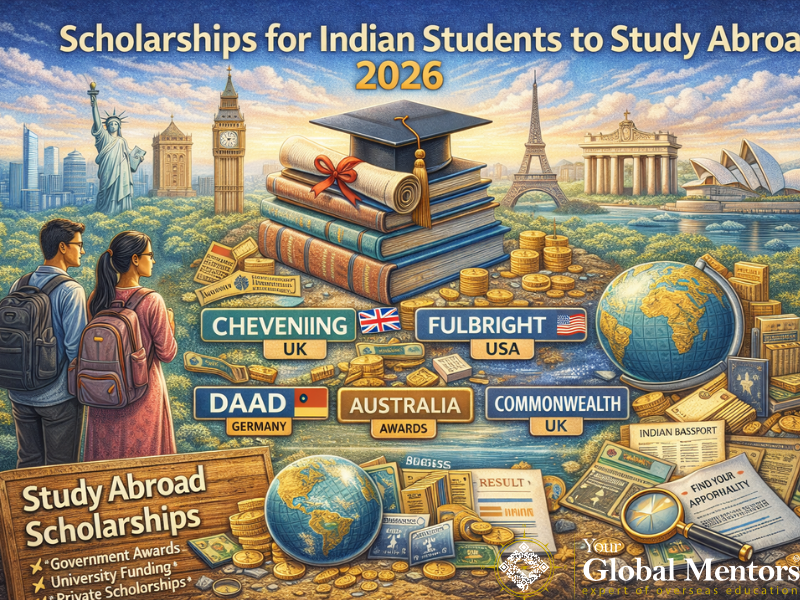
Table of Contents
Scholarships for Indian Students to Study Abroad – Complete 2026 Guide
For most Indian students, the dream of studying abroad is closely tied to one critical question:
“How will we afford it?”
With rising international tuition fees, living expenses, visa costs, and currency fluctuations, overseas education can seem financially overwhelming. This is exactly where scholarships for Indian students to study abroad play a transformative role.
However, scholarships are also one of the most misunderstood aspects of study abroad planning. Many students either:
Overestimate their chances and plan poorly
Or underestimate opportunities and never apply
This detailed guide is written to understand scholarships realistically, strategically, and practically, without false hopes or misinformation.
What Are Study Abroad Scholarships?
A scholarship is a form of financial support provided to students to reduce the cost of education. Unlike loans, scholarships do not need to be repaid.
Scholarships for Indian students studying abroad may cover:
Partial tuition fees
Full tuition fees
Living expenses
Travel costs
Insurance and academic expenses
However, very few scholarships cover everything. Most are designed to reduce the financial burden, not eliminate it.
Scholarships are support systems—not substitutes for financial planning.
Why Scholarships Matter for Indian Students
For Indian families, scholarships offer:
Reduced dependence on education loans
Lower long-term financial stress
Access to better universities
Improved ROI on overseas education
In many cases, scholarships can be the difference between choosing an average college and a globally respected university.
Important Reality Check About Scholarships
Before exploring scholarship options, students must understand a few critical truths:
Scholarships are competitive
They require early planning
Strong academics alone are not always enough
SOPs, profiles, and timing matter greatly
Many scholarships are partial, not full
Students who treat scholarships as a bonus, not a guarantee, plan far more effectively.
Types of Scholarships for Indian Students
Scholarships can be broadly classified into the following categories:
Government-funded scholarships
Foreign government scholarships
University-specific scholarships
Merit-based scholarships
Need-based scholarships
Course-specific and departmental scholarships
Each category serves a different student profile.
1. Government of India Scholarships
The Indian government supports overseas education through several schemes.
National Overseas Scholarship (NOS)
For students from economically weaker sections
Covers tuition, living expenses, and travel
Mainly for Master’s and PhD programs
Key points:
Highly competitive
Income-based eligibility
Limited number of slots
Scholarships by State Governments
Some Indian states offer:
Overseas education scholarships
Reimbursement-based support
Community-specific funding
Availability varies by state and year.
2. Foreign Government Scholarships
Many countries actively encourage international students, including Indians, through government-funded scholarships.
Chevening Scholarship (UK)
Funded by the UK government
Covers full tuition, living expenses, and airfare
For postgraduate study
Ideal for:
Students with leadership potential
Strong academic and professional profiles
Commonwealth Scholarships (UK)
For students from Commonwealth nations
Covers tuition and living costs
Mainly for Master’s and PhD programs
Fulbright-Nehru Scholarships (USA)
Jointly funded by the US and Indian governments
Covers tuition, living expenses, and travel
Focused on academic and research excellence
DAAD Scholarships (Germany)
Funded by the German government
Covers living expenses, insurance, and travel
Mostly for Master’s and PhD programs
Australia Awards Scholarships
Government-funded
Covers tuition and living costs
Highly competitive
3. University-Specific Scholarships
Most international universities offer institution-level scholarships for international students.
Characteristics
Merit-based or need-based
Partial fee waivers are common
Automatically considered as a separate application
Typical Coverage
10% to 50% tuition fee reduction
Occasionally, higher for outstanding profiles
Important counselling insight:
University scholarships are the most realistic and accessible for most Indian students.
4. Merit-Based Scholarships
Merit-based scholarships consider:
Academic performance
Test scores
Achievements
Leadership qualities
They are common at:
Universities in the USA
UK universities
Canadian institutions
Australian universities
5. Need-Based Scholarships
Need-based scholarshipsare consideredr:
Family income
Financial background
Socio-economic factors
These are more common in:
USA universities
Liberal arts colleges
Select European institutions
Country-Wise Scholarships for Indian Students (2026)
Scholarships to Study in the USA
Fulbright-Nehru
University merit scholarships
Departmental funding
Assistantships (PG & PhD)
Reality:
USA offers many partial scholarships, but very few full scholarships for coursework-based Master’s.
Scholarships to Study in the UK
Chevening
Commonwealth
University-specific awards
Department scholarships
UK scholarships are competitive but well-structured.
Scholarships to Study in Canada
University entrance scholarships
Provincial funding
Research assistantships
Limited full scholarships
Canada focuses more on affordable education + work opportunities than on full scholarships.
Scholarships to Study in Australia
Australia Awards
University scholarships
Destination Australia
Australia offers good partial funding, especially for regional universities.
Scholarships to Study in Germany
DAAD scholarships
Foundation scholarships
Research grants
Germany already offers tuition-free public education, making scholarships even more impactful.
Eligibility Criteria for Scholarships
While eligibility varies, common factors include:
Strong academic record
Relevant background for the chosen course
Clear career goals
Leadership or extracurricular involvement
Well-written SOP
Key insight:
Scholarships reward clarity of purpose, not just marks.
Scholarship Application Timeline (Very Important)
Stage | Timeline |
|---|---|
Research | 12–18 months before intake |
University applications | 10–12 months before intake |
Scholarship deadlines | 6–10 months before intake |
Results | 3–6 months before the course starts |
Late planning is the number one reason students miss scholarships.
How to Improve Your Scholarship Chances
Apply early
Shortlist universities strategically
Write a strong, honest SOP
Highlight leadership and impact
Avoid copy-paste applications
Common Myths About Scholarships
“Only toppers get scholarships” – False
“Scholarships are automatic” – False
“Low income guarantees funding” – False
“One scholarship is enough” – Rare
Scholarships vs Education Loans – Balanced Approach
Most Indian students use a combination of:
Partial scholarships
Education loans
Family funding
This approach:
Reduces loan burden
Improves financial safety
Allows better university choices
Mistakes Indian Students Make With Scholarships
Relying only on scholarships
Ignoring partial funding
Applying late
Weak SOPs
Poor university selection
Why Choose Your Global Mentors for Scholarship Guidance
Scholarships require strategy, profile positioning, and timing, not random applications. At Your Global Mentors, students receive experience-driven guidance on scholarship shortlisting, application planning, SOP strategy, and realistic funding expectations, ensuring they approach overseas education with clarity and confidence, not uncertainty.
Final Conclusion: Are Scholarships Realistic for Indian Students in 2026?
Yes—but only with the right approach.
Scholarships can:
Significantly reduce costs
Improve ROI
Open doors to better universities
But they require:
Early planning
Honest self-assessment
Strategic applications
Expert guidance
For Indian students, scholarships are not miracles—they are earned opportunities. When approached correctly, they can make studying abroad far more achievable and financially responsible.