
PGDM in Operations Management: Highlights 2026
PGDM in Operations Management is a specialised two-year postgraduate management program designed for students seeking careers managing the core operational engine of businesses — production, supply chain, logistics, quality control, and process optimisation. In 2026, this specialisation continues to gain strong relevance as India's manufacturing sector expands under government initiatives like "Make in India" and Production Linked Incentive (PLI) schemes, alongside the growing complexity of e-commerce and logistics networks, creating consistent demand for professionals who understand both business fundamentals and the technical dynamics of running efficient operations.
The program blends core management subjects — Finance, Marketing, HR, and Strategy — with specialised operations-focused coursework covering supply chain management, production planning, quality management systems, logistics and warehousing, and operations analytics. Students gain a comprehensive understanding of how organisations design, manage, and continuously improve the processes that deliver products and services efficiently.
Top institutes offering this specialization emphasize practical exposure through internships with manufacturing companies, logistics firms, and e-commerce operations teams, along with plant visits and simulation-based learning, ensuring graduates enter the workforce with genuine operational understanding rather than purely theoretical knowledge.
What is PGDM in Operations Management?
PGDM in Operations Management is a specialised postgraduate management diploma that combines core business administration principles with deep, technical knowledge of how organisations plan, produce, and deliver products and services efficiently.
Unlike a general MBA/PGDM, this program focuses specifically on preparing students to understand and optimise the operational backbone of any business — from manufacturing plants and supply chains to service delivery systems and logistics networks. The two-year curriculum typically covers both foundational management subjects and specialised operations business coursework.
Core subjects include Production and Operations Management, Supply Chain Management, Total Quality Management, Materials and Inventory Management, Logistics and Warehousing, and Operations Research and Analytics, alongside traditional PGDM subjects like Financial Management, Human Resource Management, Business Communication, and Strategic Management.
Students learn about the entire operations value chain — from procurement and production planning to quality assurance, inventory management, distribution logistics, and continuous process improvement methodologies like Lean and Six Sigma — while also gaining exposure to emerging areas like supply chain digitisation and sustainable operations practices.
Why Choose PGDM in Operations Management?
Considering this specialisation for your postgraduate degree? Here's why it makes strategic sense in 2026.
1. India's expanding manufacturing and industrial base
Government initiatives like "Make in India" and Production Linked Incentive (PLI) schemes continue driving domestic manufacturing growth, creating sustained demand for professionals who can manage complex production and supply chain operations.
2. Genuine cross-industry applicability
Unlike more narrowly focused specialisations, operations management skills apply across virtually every industry — manufacturing, retail, e-commerce, healthcare, pharmaceuticals, and services — providing broad career flexibility.
3. Growing complexity of e-commerce and logistics
As India's e-commerce sector continues expanding rapidly, companies increasingly need professionals who understand warehousing, last-mile delivery, and supply chain optimisation at scale.
4. Strong foundation for leadership roles
Operations knowledge is genuinely foundational to overall business leadership — many CEOs and senior executives built their early careers in operations roles, given the discipline's direct connection to organisational efficiency and profitability.
5. Consistent, stable industry demand
Unlike some specialisations tied to specific economic cycles, operations management remains consistently in demand since every organisation — regardless of economic conditions — needs to manage its core processes efficiently.
6. Growing emphasis on supply chain resilience
Following global supply chain disruptions in recent years, companies increasingly prioritise professionals who understand risk management, alternative sourcing, and building resilient operational networks.
7. Genuine technology integration opportunities
As automation, AI-driven demand forecasting, and IoT-enabled supply chain tracking reshape operations, professionals who combine operational knowledge with technology literacy become increasingly valuable.
The bottom line: If you want a management degree that combines practical, hands-on business understanding with genuinely stable, cross-industry demand, PGDM in Operations Management offers a smart, foundational path forward in 2026.
Eligibility Criteria for PGDM in Operations Management
Before applying for PGDM in Operations Management, make sure you meet the following eligibility requirements for 2026 admissions.
Educational qualification:
- A Bachelor's degree in any discipline from a recognised university, with a minimum aggregate score of 50% marks (45% for reserved category candidates, as per applicable institute norms)
Subject preference (where applicable)
- While most institutes accept students from any stream, candidates with an engineering, manufacturing, or technical background may find certain quantitative and process-oriented coursework more accessible, though this isn't typically a mandatory requirement
Entrance exam requirements:
- Most institutes require scores from recognised management entrance exams such as CAT, XAT, CMAT, MAT, GMAT, or NMAT
Work experience
- Generally not mandatory for full-time PGDM admission, though candidates with relevant industry experience (in manufacturing, logistics, or supply chain roles) may have an added advantage during interviews at certain institutes
Additional requirements:
- Statement of Purpose (SOP) explaining interest in operations management specifically
- Letters of Recommendation (LORs)
- Personal Interview and/or Group Discussion, often assessing analytical thinking and genuine interest in process-oriented business functions.
Our advice:
Since operations management coursework genuinely involves meaningful quantitative and analytical content — process optimisation, inventory modelling, logistics network design — students with strong quantitative aptitude (regardless of specific undergraduate stream) tend to find this specialisation more accessible, so honestly assess your comfort with numbers-driven coursework before committing for 2026 admissions.
Admission Process for PGDM in Operations Management 2026
Here's the step-by-step breakdown of what admission actually looks like.
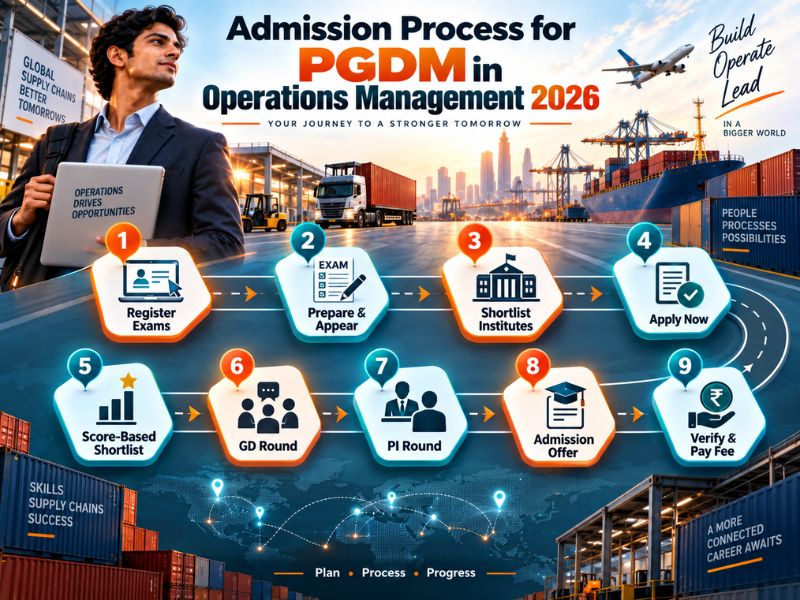
Step 1: Register for entrance exams
Begin by registering for relevant management entrance exams like CAT, XAT, CMAT, MAT, or NMAT, depending on your target institutes.
Step 2: Prepare and appear for exams
Dedicate sufficient preparation time for quantitative aptitude, logical reasoning, verbal ability, and general awareness sections — quantitative aptitude performance can be a particularly relevant signal for this specific specialisation.
Step 3: Research and shortlist institutes
Shortlist institutes based on genuine operations/supply chain industry partnerships, curriculum depth, and placement records specific to this specialisation.
Step 4: Apply to shortlisted institutes
Submit applications including academic transcripts, entrance exam scores, SOP, LORs, and updated CV/resume, highlighting any relevant technical, engineering, or operations-adjacent background.
Step 5: Shortlisting based on exam scores
Institutes shortlist candidates based on entrance exam percentiles, academic performance, and relevant profile strength.
Step 6: Group Discussion (GD) round
Shortlisted candidates participate in GD rounds, often centred on current manufacturing, supply chain, or logistics industry topics, testing awareness and analytical thinking about operational business trends.
Step 7: Personal Interview (PI) round
The PI assesses your motivation for pursuing operations management specifically, genuine industry interest, and career goals, often including questions on current developments in manufacturing, logistics, or supply chain technology.
Step 8: Final merit list and admission offer
Based on combined performance across entrance exams, GD, and PI rounds, institutes release merit lists and admission offers.
Step 9: Document verification and fee payment
Confirm your seat by completing document verification and paying the required admission fee within specified deadlines.
Our advice: Since this specialisation values genuine analytical and process-thinking ability, stay updated on current supply chain and manufacturing sector news — PLI scheme developments, e-commerce logistics trends, automation adoption — and demonstrate this awareness clearly during GD-PI rounds for your 2026 admissions.
Entrance Exams for PGDM in Operations Management
Getting into a good PGDM in Operations Management program depends largely on your target institute's specific admission approach. Here's what to expect in 2026.
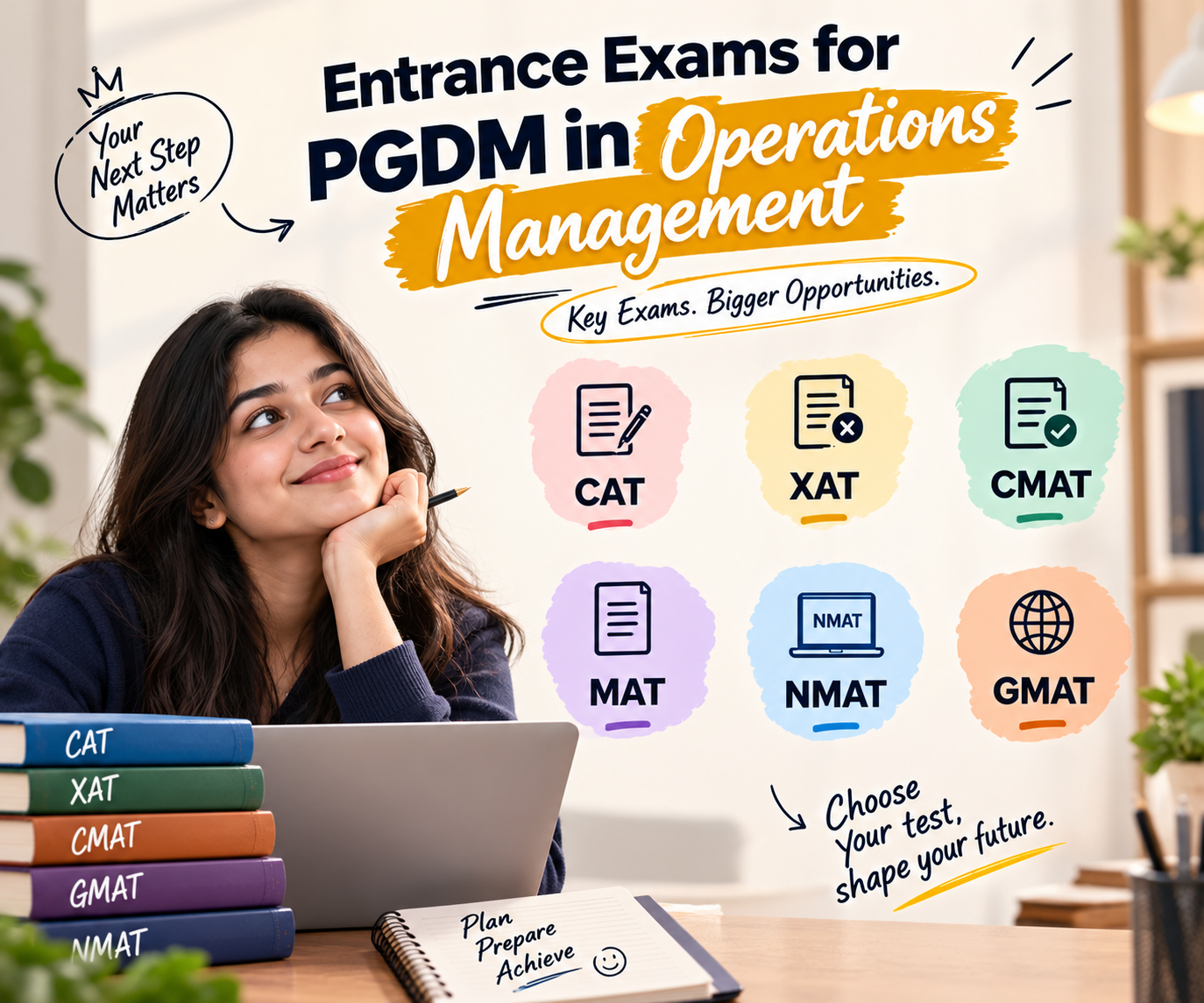
CAT (Common Admission Test)
The most widely recognised exam among India's top PGDM colleges, including institutions offering dedicated Operations Management specialisations — mandatory for IIMs and accepted by nearly every top-tier private institute.
XAT (Xavier Aptitude Test)
Accepted at several premier institutes offering Operations Management tracks, with XLRI Jamshedpur among the schools requiring this exam.
CMAT (Common Management Admission Test)
Widely accepted across a broader range of institutes, particularly useful for students seeking accessible entry points beyond CAT/XAT.
MAT (Management Aptitude Test) and NMAT
Also accepted at several institutes, offering multiple test windows throughout the year for added scheduling flexibility.
GMAT
Accepted at many top business schools for candidates with international profiles or those also considering global MBA options.
Quantitative aptitude weighting
Since Operations Management coursework is genuinely more numbers-driven than general management tracks, strong performance specifically in the quantitative aptitude sections of your chosen exam can meaningfully strengthen your profile for this specialisation.
Our advice: Since CAT offers the widest acceptance across India's top Operations Management-focused PGDM programs, treat it as your primary preparation focus — but given this specialisation's genuine analytical demands, dedicate extra prep time to quantitative aptitude sections specifically, since strong performance here signals genuine readiness for the program's technical coursework.
Top PGDM Colleges for Operations Management in India
Choosing the right college significantly impacts your industry connections and placement outcomes. Here are India's leading institutes offering this specialisation for 2026.
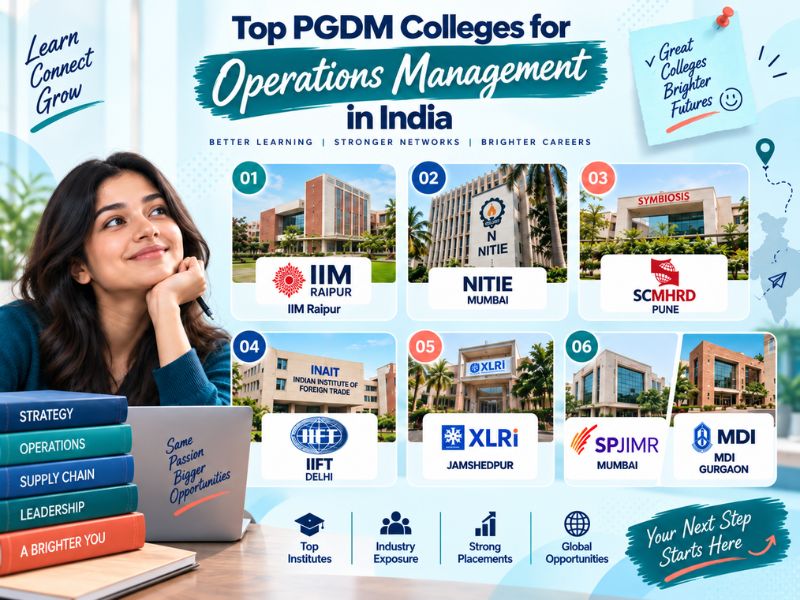
IIM Raipur
Offers Operations Management as one of four core specialisations within its flagship PGPM program (alongside Finance, Marketing, and HR), with strong industry connections through guest lecturers from Airbus, Morgan Stanley, and internship opportunities at JP Morgan, Adani, and HSBC. Ranked 15th nationally per NIRF Management 2025.
NITIE (National Institute of Industrial Engineering), Mumbai
India's most dedicated, specialised institute specifically for Industrial Engineering and Operations Management, genuinely purpose-built for this exact specialisation with deep manufacturing and operations research curriculum depth.
SCMHRD (Symbiosis Centre for Management and HR Development), Pune
A well-regarded institute offering strong operations and supply chain management coursework alongside its broader management curriculum.
IIFT Delhi
Particularly strong for students interested in the international trade and logistics dimension of operations management, given its foreign trade specialisation heritage.
XLRI Jamshedpur, SPJIMR Mumbai, MDI Gurgaon
While not exclusively operations-focused, these top-tier institutes offer genuinely strong Operations Management electives and specialisations within their broader PGDM programs, backed by tier-1 placement outcomes (₹28-35 LPA average per the 2024-25 cycle).
Our advice: If you want the deepest, most technically rigorous Operations Management training specifically, prioritise NITIE given its purpose-built industrial engineering focus. If you want operations as a strong specialisation within a broader, more versatile management degree, IIM Raipur, SCMHRD, or the top-tier general PGDM institutes offer genuinely excellent alternatives with stronger overall brand recognition.
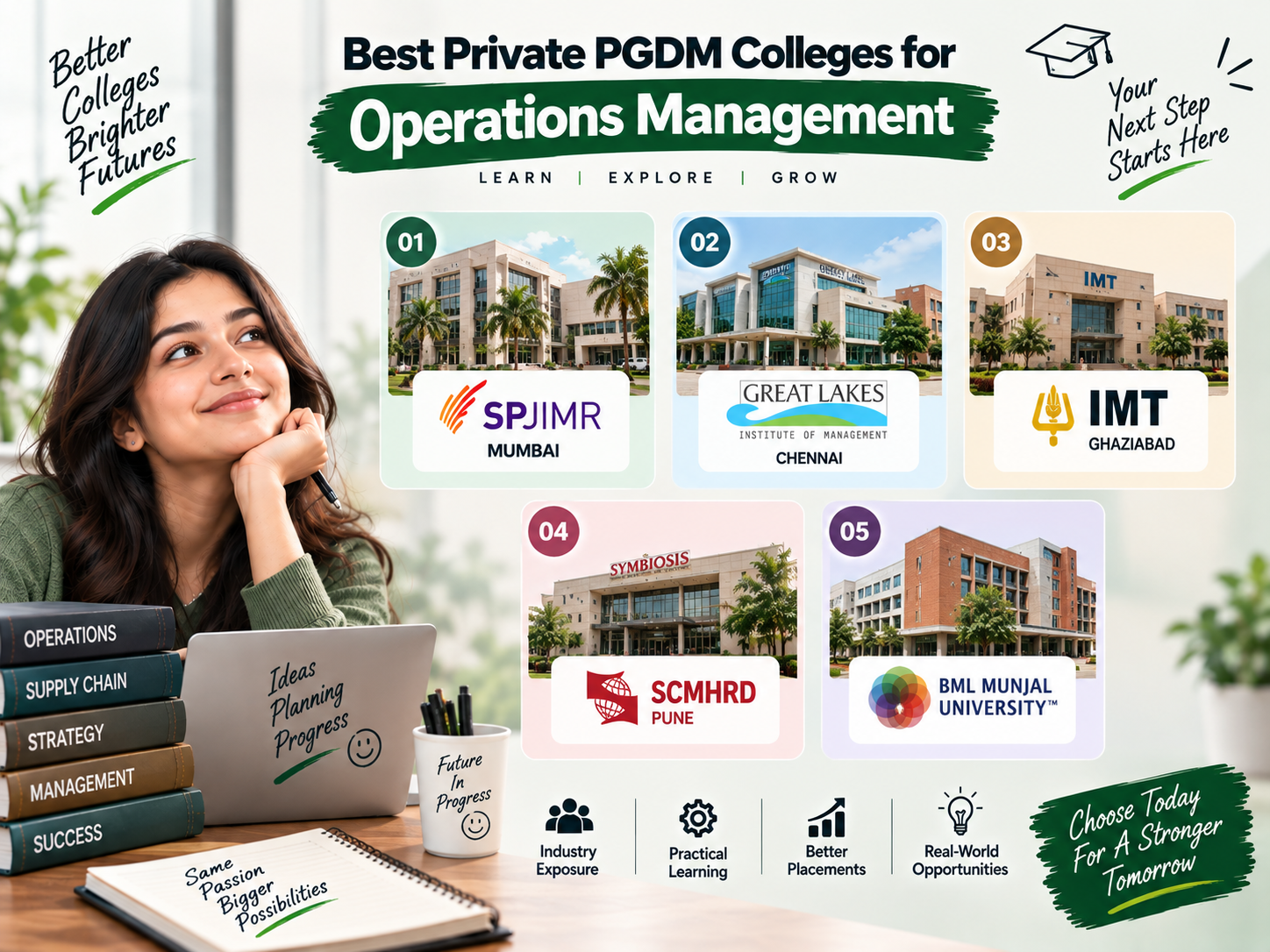
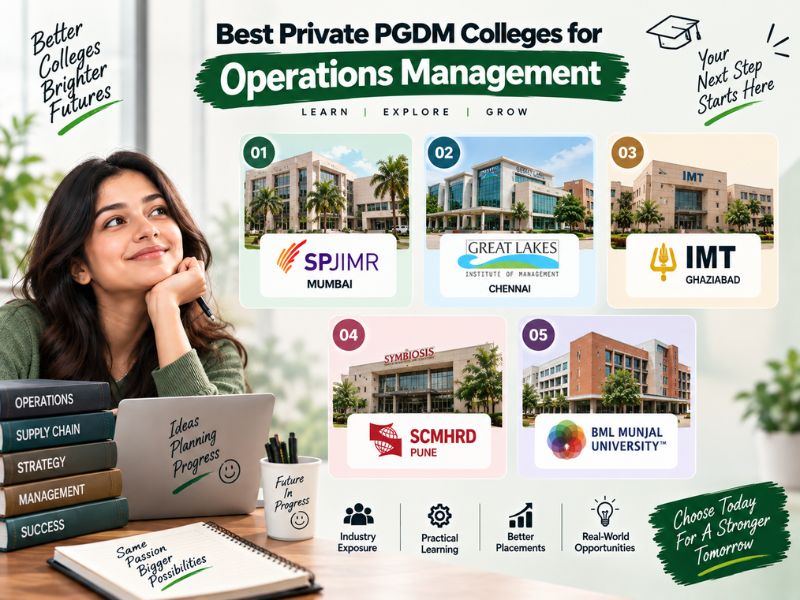
Best Private PGDM Colleges for Operations Management
Here are the standout private institutions worth considering specifically for this specialisation in 2026.
SPJIMR Mumbai
A top-tier private institute offering strong operations management coursework within its broader PGDM program, backed by tier-1 placement outcomes and genuine industry credibility.
Great Lakes Institute of Management, Chennai
Known for practical, industry-aligned coursework with genuine operations and supply chain management depth, offering solid mid-tier fees relative to its outcomes.
IMT Ghaziabad
A well-regarded private institute charging approximately ₹19-22 Lakh, offering strong operations-adjacent coursework alongside its broader management curriculum.
SCMHRD, Pune
Offers genuinely strong specialisation depth in operations and HR, backed by Symbiosis's broader institutional credibility and industry connections.
BML Munjal University
Offers PGDM programs with growing industry partnerships, particularly relevant given its promoter group's manufacturing and automotive sector background (Hero MotoCorp).
Our advice: When choosing between private institutes for this specialisation, prioritise genuine manufacturing, logistics, or supply chain industry partnerships and internship placement records over general institute prestige alone — operations management is a genuinely practice-heavy field where real industry exposure matters significantly for your eventual job readiness.
Government Colleges Offering PGDM in Operations Management
For students seeking quality education at more structured, often government-institute-backed fees, here's what's genuinely available in 2026.
IIM Raipur
A public business school established in 2010 by the Government of India, an Institute of National Importance under the IIM Act, 2017, governed by the Ministry of Education. Offers Operations Management as one of four specialisations within its flagship PGPM program, with total fees around ₹14.2 Lakhs for the complete two-year program (General category).
NITIE Mumbai
A government-established, specialised institute focused specifically on industrial engineering and operations management — genuinely the closest thing India has to a dedicated government institute for this exact specialisation.
IIFT Delhi
A government-backed institute with strong trade and logistics-adjacent operations coursework, particularly relevant for students interested in international supply chain management.
Other IIMs offering Operations specialisation
Several IIMs offer Operations Management as an elective or specialisation track within their broader two-year PGP/MBA programs, with IIM Ahmedabad, IIM Bangalore, and IIM Kozhikode topping the NIRF 2025 Management rankings among two-year PGP/MBA institutes overall.
Our advice: Since NITIE remains genuinely the most specialised government option specifically for Operations Management, prioritise it if pure specialisation depth matters most to you — while IIM Raipur offers a strong alternative combining the prestigious IIM brand with genuine Operations Management coursework within a broader, more versatile management education.
PGDM in Operations Management Fees
Planning your budget for this specialisation? Here's a realistic breakdown of costs for 2026.
Government/IIM tier
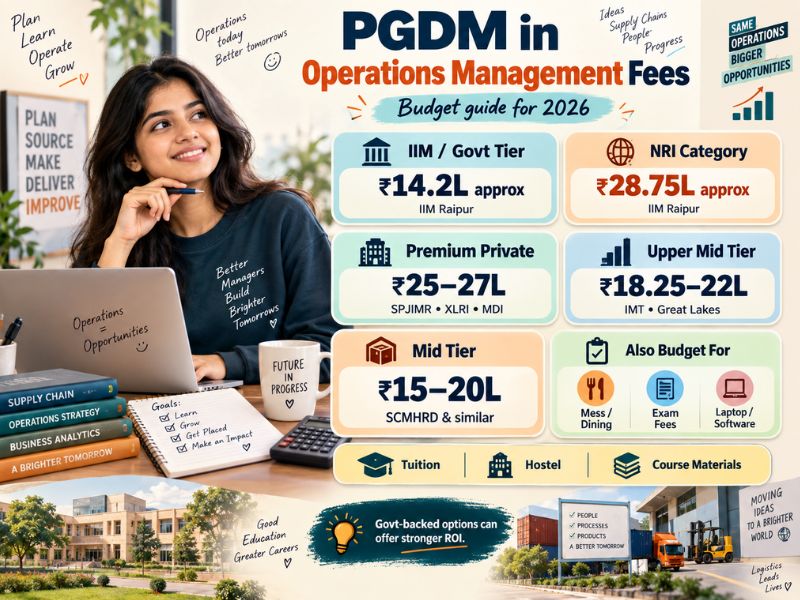
- IIM Raipur (PGPM, General category): Approximately ₹14.2 Lakhs total (₹7.28 Lakhs first year, ₹6.93 Lakhs second year)
- IIM Raipur (PGPM, NRI category): Approximately ₹28.75 Lakhs total
- NITIE Mumbai: Government-subsidised fee structure, generally lower than comparable private tier-1 institutes
Premium private tier
- SPJIMR, XLRI, MDI: Approximately ₹25-27 Lakhs for the full two-year programme
- IMT Ghaziabad, Great Lakes Chennai: Approximately ₹18.25-22 Lakhs total
Mid-tier institutes
- SCMHRD and similar institutes: Generally in the ₹15-20 Lakh range, varying by specific program and year
What's typically included
- Tuition and academic coursework
- Hostel and residential fees (often mandatory at top-tier residential campuses)
- Course materials and case study access
Additional costs to consider
- Mess/dining expenses, often excluded from headline fee figures (worth confirming separately)
- Application/entrance exam fees (CAT, XAT, CMAT registration costs)
- Laptop and software requirements for operations analytics coursework
Our advice: Since IIM Raipur's ₹14.2 Lakh total fee genuinely undercuts most top-tier private alternatives (₹18-27 Lakhs) while still delivering strong placement outcomes and the prestigious IIM brand, prioritise government-backed IIM options if pure ROI matters most to you — but always confirm whether mess/dining costs are included or charged separately, since this can meaningfully affect your actual out-of-pocket total for 2026 admission.
PGDM in Operations Management Syllabus
- Overall structure — A 2-year, 4-semester program combining core management fundamentals with specialised operations coursework, more industry-aligned and agile compared to a traditional theoretical MBA
- Core subjects covered — Operations strategy, quality management, project management, supply chain, process optimisation, and data analytics form the central pillars of the curriculum
- Semester-wise breakdown (typical structure):
- Semester 1: Principles of Management, Financial Accounting, Marketing Management
- Semester 2: HR Management, Operations Management, Business Communication
- Semester 3: Specialisation subjects, Business Analytics, Internship
- Semester 4: Project Work, Advanced Specialisation
- First-year foundational focus — The first-year syllabus largely concentrates on foundational topics related to the sphere of operations management, staying fairly consistent across most institutes.
- Practical, application-heavy approach — Unlike a traditional MBA, a PGDM operations management curriculum focuses heavily on real-world application, treating operations as a strategic, boardroom-level function rather than a purely "back office" topic
- Reference material support — Students are encouraged to supplement classroom learning with dedicated operations management textbooks, available through libraries, online resources, or purchase, to deepen specialisation in knowledge
Popular Specialisations in Operations Management
- Supply Chain Management — Covers procurement, logistics, and distribution network optimisation, a core specialisation given how tightly supply chains and operations overlap.
- Quality Management — Focused on process control, quality assurance frameworks, and continuous improvement methodologies
- Project Management — Covers planning, execution, and monitoring of large-scale organisational projects and initiatives.
- Process Optimisation — Focused on improving efficiency and productivity across manufacturing and service delivery processes
- Data Analytics (Operations-focused) — Increasingly integrated into the specialisation, reflecting the industry's shift toward data-driven operational decision-making
- Logistics Management — A distinct track within the broader operations umbrella, particularly relevant given India's growing e-commerce and manufacturing sectors
- Sector-wide relevance — Since operations management is required in every organisation — whether manufacturing or service, small or large — specialisation choice often aligns closely with the specific industry (consultancy, retail, healthcare, supply chain, logistics) a graduate wants to enter
PGDM in Operations Management: Course Duration
- Standard duration — 2 years, spread across 4 semesters, consistent with the general PGDM structure nationally
- Semester progression — Early semesters (1-2) focus on foundational management and operations subjects, while later semesters (3-4) shift toward specialisation electives, business analytics, internship, and a final project/advanced specialisation component.
- Internship integration — Typically scheduled in Semester 3, giving students real-world exposure before their final placement cycle
- Consistency with broader PGDM norms — This 2-year, 4-semester structure mirrors the standard PGDM format used across most specialisations (Marketing, Finance, HR, Operations), rather than following an extended or shortened timeline unique to operations management
Salary After PGDM in Operations Management
- Overall national average (PayScale-sourced) — Around ₹4-10 LPA for graduates specifically in this specialisation
- Broader PGDM salary benchmark for context — ₹4-8 LPA (entry-level), ₹8-15 LPA (mid-level), ₹15-30 LPA+ (senior roles) across PGDM programs generally
- Top-institute example — IMI Kolkata reported an average package of ₹8.55 LPA with a highest package of ₹20.7 LPA, illustrating the range even within a single strong-performing institute
- Salary-influencing factors — Experience, specific specialisation chosen within operations (supply chain vs. quality management vs. analytics), location, and the specific institute all meaningfully affect salary outcomes
- Growth trajectory — Graduates can increase their salary through internships and work placements, since these directly add to relevant experience valued by employers
- Emerging, growing field — Since operations management is described as an emerging and continuously growing field, the 2026 salary range for graduates can be quite attractive, particularly for those who build strong domain expertise (analytics, supply chain, or quality management) alongside their core PGDM training
- Fee-to-salary consideration — Given overall PGDM fees in this specialisation can range ₹8-20 lakh at various institutes, comparing the fee against the specific college's average placement package — rather than relying on broad national salary ranges alone — is the more useful evaluation approach.
Career Options After PGDM in Operations Management
- Operations Manager — Oversees day-to-day production or service delivery processes, ensuring efficiency and resource optimisation across the organisation
- Supply Chain Manager — Manages procurement, logistics, and distribution networks, particularly relevant given the tight overlap between supply chain and operations functions
- Quality Manager / Quality Assurance Lead — Responsible for process control, compliance, and continuous improvement frameworks
- Project Manager — Plans, executes, and monitors large-scale organisational initiatives across manufacturing or service environments
- Business/Operations Analyst — Applies data analytics to identify inefficiencies and optimise processes, aligning with the specialisation's growing digital/analytics integration
- Logistics Manager — Manages transportation, warehousing, and distribution, especially in retail, e-commerce, and manufacturing sectors
- Management Consultant (Operations focus) — Advises organisations on process improvement and operational strategy, a strong fit given consulting's prominent share of placements at top institutes
- Entrepreneurship — Since operations knowledge is foundational to running any business efficiently, many graduates apply this specialisation directly toward launching or scaling their own ventures
Top Recruiters for Operations Management Graduates
- Consulting & Financial Services — Deloitte and similar firms consistently form the majority share of offers at strong operations-management institutes
- Banking — HDFC Bank actively recruits operations management graduates into process and operational efficiency roles
- E-commerce & Retail — Amazon is a prominent recruiter, reflecting the strong overlap between operations management and e-commerce logistics/fulfillment needs.
- Manufacturing & Industrial — JSW Steel represents the traditional manufacturing sector's continued demand for skilled operations professionals
- Broader PGDM recruiter base (for context) — KPMG, Accenture, Infosys, HUL, and BCG round out the wider recruiting ecosystem that operations management graduates can also access through general PGDM placement drives
- Sector concentration overall — Consulting/financial services, banking, e-commerce, and manufacturing collectively form the strongest recruiting pillars specifically for operations management graduates, reflecting the universal applicability of this specialisation across industry types.
- Startup ecosystem hiring — Beyond large corporates, rapidly expanding startups are also consistently looking for operations professionals who can improve productivity and process efficiency as they scale
Skills Required for Operations Management Careers
- Analytical and strategic thinking — Core skill for identifying process inefficiencies and designing effective operational improvements
- Data analytics proficiency — Increasingly essential given the specialisation's growing integration with data-driven decision-making tools
- Process optimisation expertise — Understanding of quality management and continuous improvement frameworks to enhance productivity
- Project management capability — Needed for planning, executing, and monitoring complex, cross-functional organisational initiatives
- Supply chain and logistics understanding — Important given how closely operations management overlaps with procurement, warehousing, and distribution functions
- Communication and cross-functional coordination — Operations roles require close collaboration with sales, finance, HR, and other departments, making strong interpersonal skills essential
- Adaptability to organisational scale — Since operations management applies equally to large multinational corporations and rapidly expanding startups, graduates need the flexibility to adjust their approach based on organisational size and maturity
- Practical, real-world problem-solving — Given the program's emphasis on application over pure theory, hands-on experience through internships and live projects is a key skill-building component
Future Scope of PGDM in Operations Management
- Universal, sector-wide demand — Since operations management is required in every organisation — manufacturing or service, small or big — this specialisation offers durable, cross-industry relevance rather than dependence on a single sector's health.
- Growing across diverse sectors — Consultancy, retail, healthcare, supply chain management, and logistics all show strong and expanding scope for operations specialists, reducing overreliance on any one industry.
- From "back office" to boardroom — As global supply chains become more complex and consumer demands for instant gratification rise, the role of the operations expert has genuinely shifted from a support function to a strategic, leadership-level position
- Digital transformation integration — Growing use of data analytics and digital operations tools is reshaping the field, rewarding graduates who combine core operations knowledge with strong technical and analytical skills
- Startup ecosystem growth — India's rapidly expanding startup landscape continues to create fresh demand for operations professionals who can build efficient processes from the ground .up
- Steady long-term career path — Given operations management's essential, cross-industry nature and the sector's described growth trajectory, this remains a genuinely safe and promising career path for PGDM graduates heading into 2026 and beyond
- Higher studies and specialisation depth — Graduates can pursue further studies or specialised certifications to deepen expertise in supply chain, quality management, or analytics, opening pathways to more senior, strategic roles over time
PGDM in Operations Management vs MBA in Operations
- Practical vs. theoretical orientation — A PGDM in Operations Management is often more industry-aligned and agile, focusing heavily on real-world application, while an MBA in Operations, being university-affiliated, tends to be more theoretical
- Governing body distinction — PGDM is an AICTE-approved diploma offered by autonomous institutes; MBA is a university-affiliated degree under UGC oversight
- AIU equivalence — A PGDM from an AICTE-approved, AIU-recognized institute is considered equivalent to an MBA degree for most practical purposes, including further studies and employment
- Curriculum update frequency — PGDM programs, run by autonomous institutes, are typically updated more frequently to reflect evolving operational and supply chain industry needs than university-bound MBA syllabi
- Industry exposure and placement focus — If industry exposure and a placement-driven curriculum are priorities, PGDM is generally considered the stronger choice specifically for a hands-on operations management career
- Which to choose — PGDM suits candidates prioritising direct, practical, application-heavy training for immediate operations roles; MBA in Operations suits those wanting a broader theoretical management foundation with operations as one specialisation track among several
FAQs About PGDM in Operations Management
Q1. What is the average salary after PGDM in Operations Management?
The average salary is around ₹4-10 LPA per PayScale data, though top institutes like IMI Kolkata report averages closer to ₹8.55 LPA, with highest packages reaching ₹20.7 LPA.
Q2. What is the duration of this program?
It's a standard 2-year, 4-semester program, consistent with the general PGDM structure across most specialisations.
Q3. Which entrance exams are accepted for PGDM in Operations Management?
CAT, MAT, XAT, CMAT, or GMAT are the primary national-level tests accepted, typically followed by group discussions (GD) and personal interviews (PI).
Q4. What career options are available after this specialisation?
Graduates can pursue roles as operations managers, supply chain managers, quality managers, project managers, business/operations analysts, logistics managers, or management consultants.
Q5. Which are the top recruiters for operations management graduates?
Deloitte, HDFC Bank, Amazon, JSW Steel, KPMG, Accenture, Infosys, HUL, and BCG are among the most active recruiters.
Q6. Is PGDM better than MBA for a career in operations management?
If industry exposure, practical application, and a frequently updated, placement-driven curriculum are your priorities, PGDM is generally considered the stronger choice specifically for this field, though both remain valid, recognised qualifications.
Q7. What is the future scope of this specialisation?
Strong and growing — operations management is required in every organisation type, and the role has evolved from a back-office function to a genuine boardroom-level strategic position, especially as supply chains grow more complex and digital transformation reshapes the field.
Q8. What skills are most important for success in operations management?
Analytical thinking, data analytics proficiency, process optimisation expertise, project management capability, and strong cross-functional communication skills are the most valuable for career growth in this field.
Conclusion
PGDM in Operations Management offers a genuinely durable, cross-industry career pathway for students drawn to the strategic side of running efficient, productive organisations — a field that has evolved from a purely back-office function into a genuine boardroom-level priority as global supply chains grow more complex and digital transformation reshapes how businesses operate. With reported salaries ranging from ₹ 4- 10 LPA nationally (and considerably higher at top-performing institutes like IMI Kolkata, which reported an average of ₹8.55 LPA and a highest package of ₹20.7 LPA), and strong recruiter access spanning consulting, banking, e-commerce, and manufacturing, this specialisation offers solid, practical value for students prioritising hands-on, application-focused management training. Since operations management is required in every type of organisation — from established multinationals to fast-growing startups — graduates benefit from genuinely broad, sector-agnostic demand rather than dependence on any single industry's health.