M.Tech in Structural Engineering Eligibility, Fees, Admission, Syllabus & Career Scope
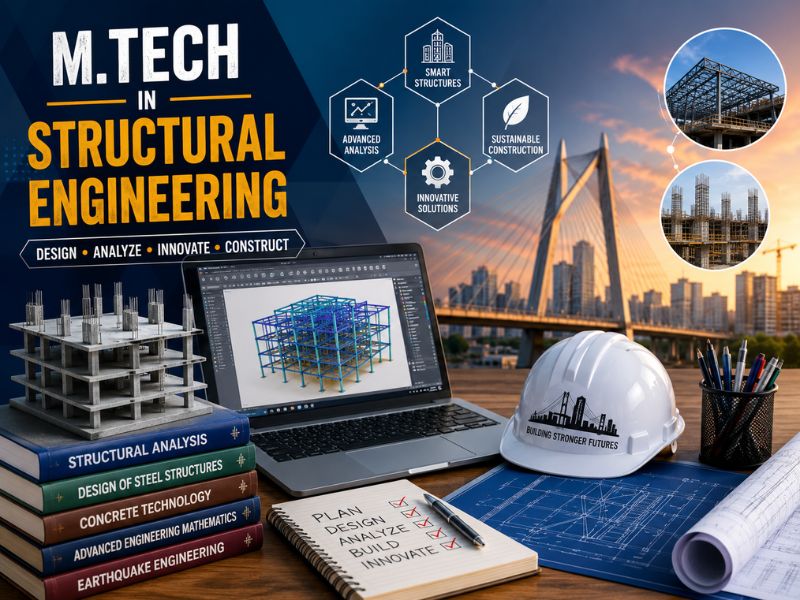
M.Tech in Structural Engineering Eligibility, Fees, Admission, Syllabus & Career Scope
August 12, 2026
19 min read
M.Tech Structural Engineering: Highlights 2026
Program focus — A 2-year postgraduate course focusing on the design, analysis, and construction of structures, including buildings, bridges, and dams
Primary entrance route — GATE (Graduate Aptitude Test in Engineering) is the most common and widely accepted entrance exam, with GATE 2026 results released March 19, 2026
GATE cutoff variation across IITs — Top IITs require GATE scores typically ranging from 250-775 depending on the institute; IIT Mandi's cutoff ranges 300-400, IIT Bhubaneswar's is 514-623, IIT Kharagpur's is 250-621, and IIT Roorkee's is 501-775
Fee range — Around ₹30,000-50,000 per annum at most institutes on average, though top IITs and private universities can range up to ₹3-8 lakh total depending on the specific college; IIT Kharagpur charges ₹63,800 for the full course
Alternative entrance exams — Some universities conduct their own tests — RUAS accepts RUAS AT, GATE, and CUET-PG; Manipal Institute of Technology uses the Manipal Entrance Test (MET)
Distance/part-time options — Available at institutes like IGNOU, Sri Venkateswara College, Thapar University, BIT Mesra, and Manipal University, with a similar 30% internal/70% end-semester evaluation structure as regular programs
Career scope — Graduates typically pursue careers across the construction industry, with positions available in both commercial and public sectors
What is M.Tech Structural Engineering?
What is M.Tech Structural Engineering?
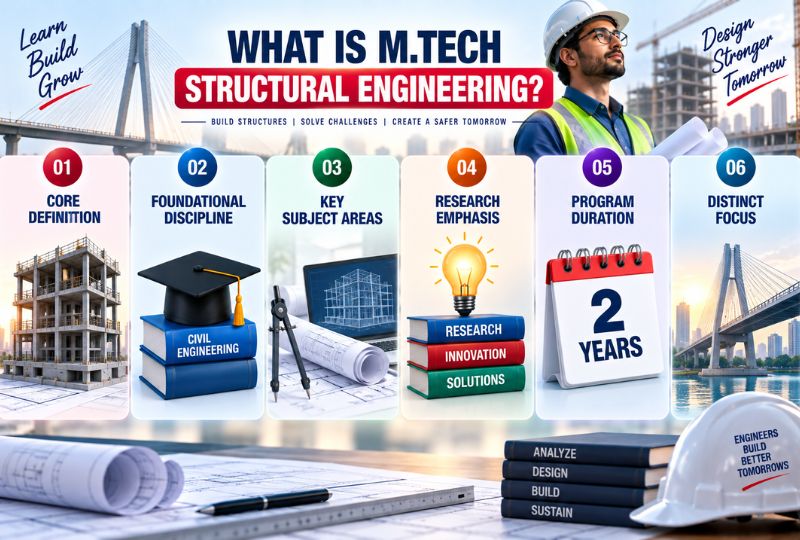
Core definition — A specialised postgraduate engineering degree focused on how structures are designed, analysed, and constructed to safely withstand loads, forces, and environmental conditions
Foundational discipline base — Builds directly on undergraduate Civil Engineering, going deeper into structural-specific theory and applied analysis.
Key subject areas — Advanced Structural Analysis, Finite Element Methods in Structural Engineering, Solid Mechanics in Structural Engineering, Structural Dynamics, and Theory of Concrete Structures
Research emphasis — First-year subjects generally align with the chosen specialisation to build foundational research knowledge before students move into more applied, project-based coursework
Program duration — Standard 2-year full-time program at most Indian institutes, with part-time/distance variants available for working professionals
Distinct from general Civil Engineering M.Tech — While broader Civil Engineering M.Tech programs cover transportation, environmental, and geotechnical streams, Structural Engineering specifically narrows focus to structural design, analysis, and material behaviour.
Why Study M.Tech Structural Engineering?
Why Study M.Tech Structural Engineering
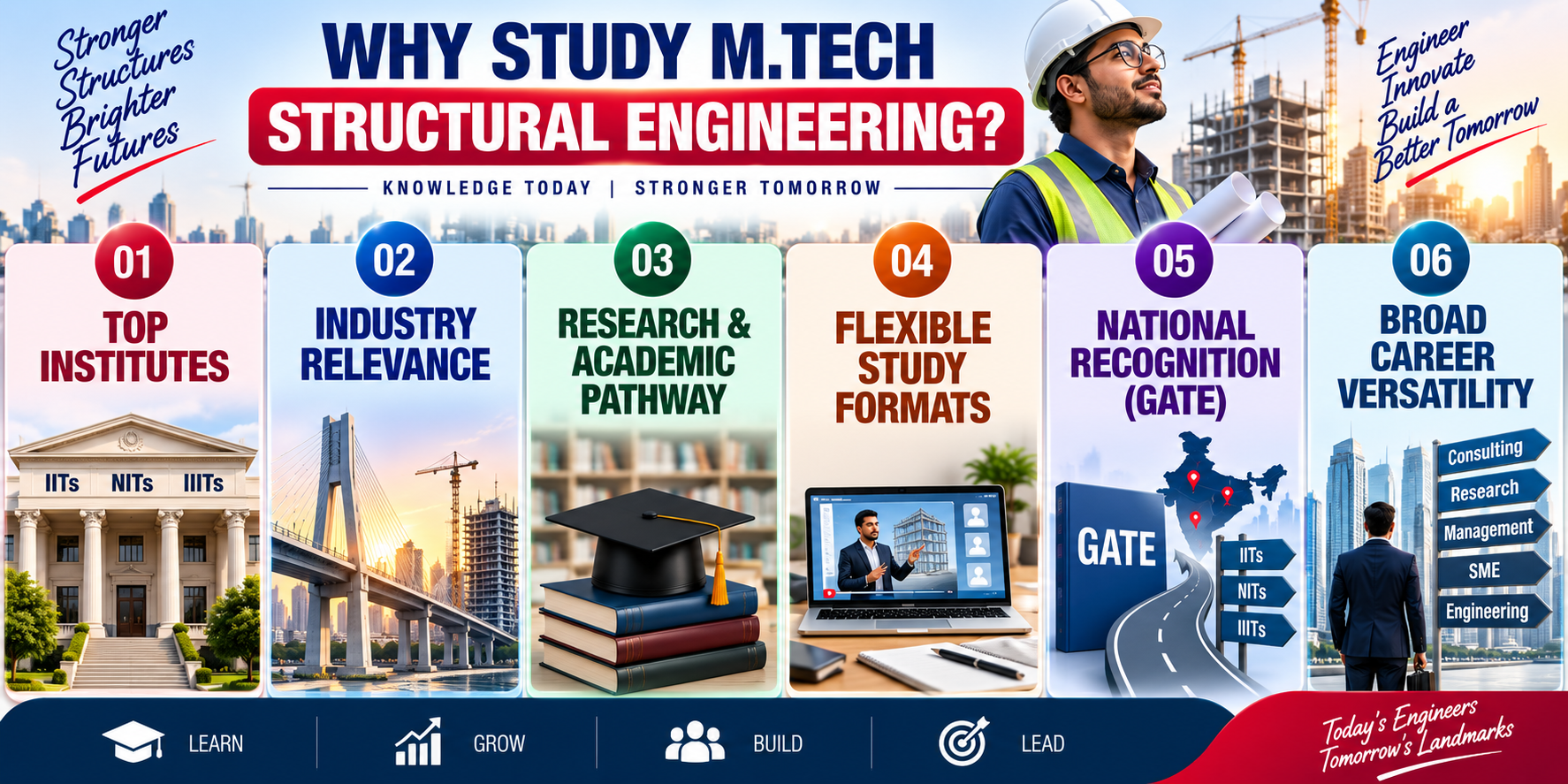
Strong institutional presence — Offered at India's most reputed engineering institutes, including all major IITs, NITs, and IIITs, giving students access to top-tier faculty and research infrastructure.e
Direct industry relevance — Core skills in structural design and analysis are essential across the entire construction industry, both commercial and public sector. or
Research and academic pathway — Strong foundation for those interested in further research, PhD programs, or academic careers in structural/civil engineering
Flexible study formats — Availability of part-time and distance education options makes it accessible even for working professionals unable to commit to full-time study
National recognition of GATE — Since GATE is the predominant national-level entrance exam, a strong GATE score opens doors to IITs, NITs, and IIITs nationwide rather than being limited to one region or state.
Broad career versatility — Beyond traditional engineering roles, M.Tech graduates can also move into consulting, subject-matter expert (SME), research, and managerial positions across nearly every sector
Eligibility Criteria for M.Tech Structural Engineering
Academic qualification — A Bachelor's degree in Civil Engineering or a closely related field from a recognised university is generally required
Minimum aggregate marks — Most institutes require a minimum of 50-60% aggregate marks in the undergraduate degree, with some sources citing 60% as the standard for top-tier colleges
Category-based relaxation — Reserved category candidates typically receive relaxation (e.g., 45% instead of 50%) as per applicable norms
GATE score requirement — A valid GATE score is generally required for admission to IITs, NITs, and IIITs, with institute-specific cutoffs varying significantly (as low as 250 to as high as 775 depending on the IIT)
Alternative pathway (no GATE) — Some universities accept their own entrance tests (RUAS AT, MET) or CUET-PG scores instead of, or alongside, GATE
Document requirements — HSC certificate and marksheet, all graduation certificates and marksheets, migration certificate (if applicable), passport-size photographs, and caste/tribe or disability certificates (where applicable) are typically required at the time of admission
Five-year integrated program eligibility — Students who completed a 5-year integrated science/engineering program with a relevant master's degree may also be eligible to
Admission Process for M.Tech Structural Engineering 2026
Admission Process for M.Tech Structural Engineering 2026
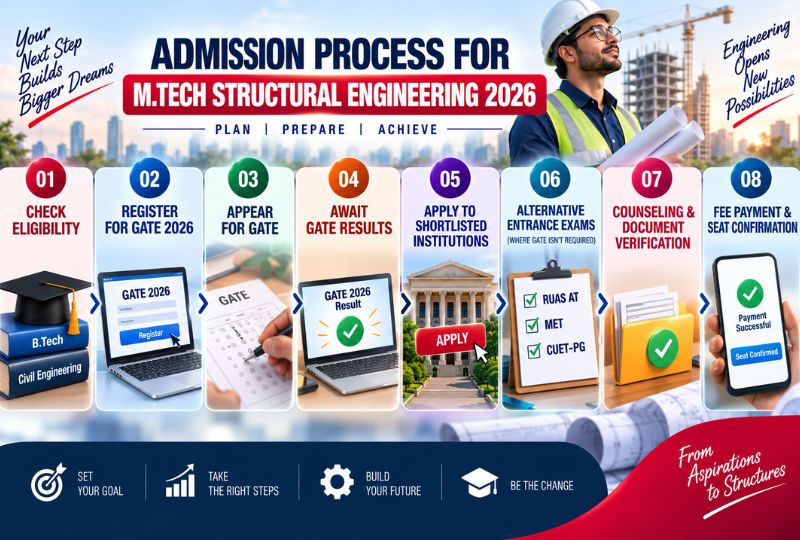
Step 1: Check eligibility — Confirm your Bachelor's degree in Civil Engineering or a related field (like architectural engineering) meets the minimum requirement — generally 60% marks or a first-class equivalent for top institutions
Step 2: Register for GATE 2026 — The application deadline was September 28, 2026, with the exam conducted across four dates: February 7, 8, 14, and 15, 2026
Step 3: Appear for GATE — Admit cards were released January 13, 2026; over 23 IITs and IISc coordinate this highly competitive national admission process
Step 4: Await GATE results — Results were released March 19, 2026, determining your score and percentile for institute-wise cutoff comparison
Step 5: Apply to shortlisted institutions — After qualifying GATE, candidates must apply separately to each desired institute, since GATE qualification alone doesn't guarantee a seat
Step 6: Alternative entrance exams (where GATE isn't required) — Register for institute-specific tests like RUAS AT, Manipal Entrance Test (MET), or submit CUET-PG scores
Step 8: Fee payment and seat confirmation — Complete fee payment to confirm your seat within the specified deadlin
Entrance Exams for M.Tech Structural Engineering
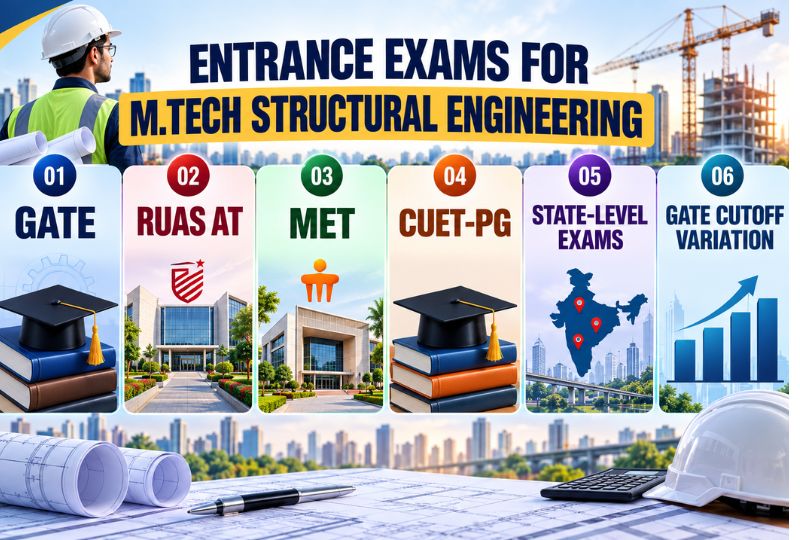
Entrance Exams for M.Tech Structural Engineering
GATE (Graduate Aptitude Test in Engineering) — The primary and most widely accepted entrance exam for IITs, NITs, IIITs, and most GFTIs across India
RUAS AT — Accepted alongside GATE and CUET-PG at M.S. Ramaiah University of Applied Sciences
MET (Manipal Entrance Test) — Used specifically by Manipal Institute of Technology for its M.Tech Structural Engineering admissions
CUET-PG — Accepted at select universities as an alternative or supplementary route to GATE
State-level PG entrance exams — Options like TS PGECET, TANCET, and Gujarat PGCET serve as state-level alternatives to the national GATE exam
GATE cutoff variation — IIT Mandi requires a GATE score of 300-400; IIT Bhubaneswar's cutoff is 514-623 across categories; IIT Kharagpur's is 250-621; IIT Roorkee's is 501-775
Exam difficulty note — GATE is considered moderate to challenging, while most institute-specific and state-level tests are considered comparatively moderate
M.Tech Structural Engineering Syllabus
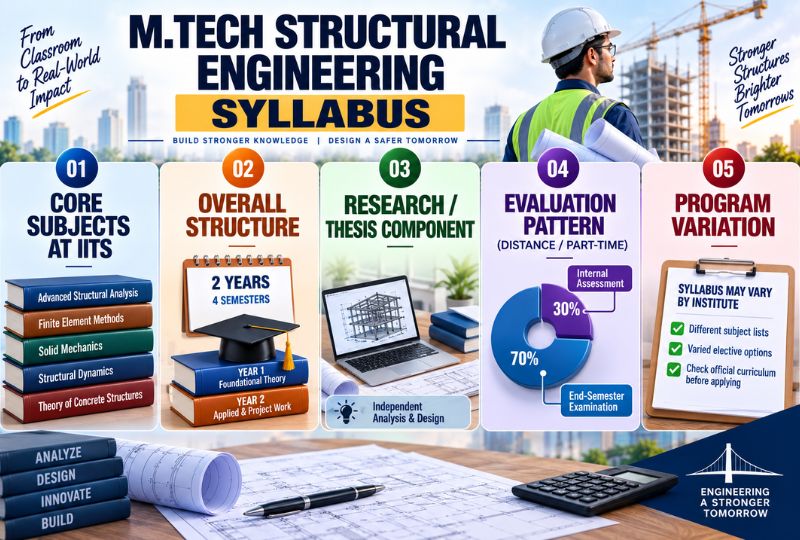
Core subjects at IITs — Advanced Structural Analysis, Finite Element Methods in Structural Engineering, Solid Mechanics in Structural Engineering, Structural Dynamics, and Theory of Concrete Structures
Overall structure — A 2-year program split across four semesters, combining foundational structural theory in the first year with applied, project-based coursework in the second
Research/thesis component — Later semesters typically include a significant research project or thesis, especially at IITs and NITs, building toward independent structural analysis or design work.
Evaluation pattern (distance/part-time programs) — Roughly 30% internal assessment and 70% end-semester examination, mirroring the structure used in regular full-time programs
Program variation notice — Since the syllabus isn't standardised nationally, exact subject lists and elective options can differ meaningfully between institutes — always check the specific college's official curriculum before applying
Top M.Tech Structural Engineering Colleges in India
Top M.Tech Structural Engineering Colleges in India
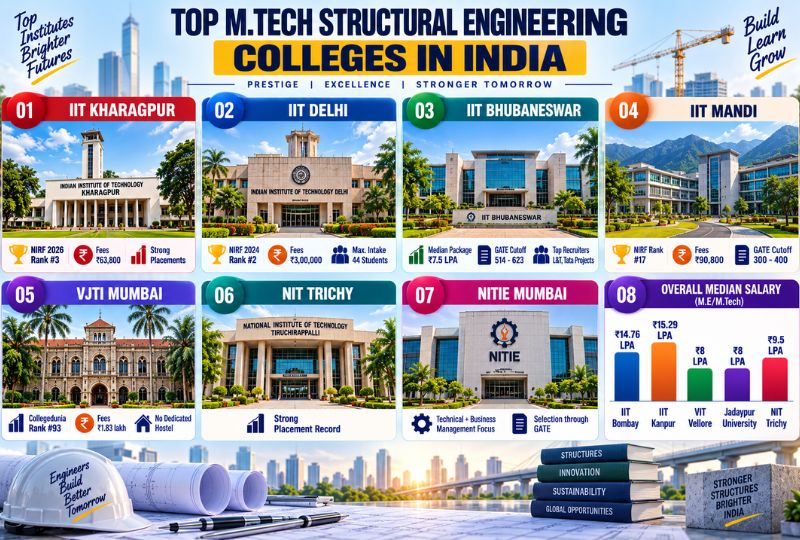
IIT Kharagpur — NIRF 2026 Rank #3 (engineering); Fees: ₹63,800 for the full course; strong placement record
IIT Delhi — Course ranked #2 per NIRF 2024; Fees: ₹3,00,000 for the entire duration; maximum enrollment of 44 students
IIT Bhubaneswar — Median package of ₹7.5 lakh in 2026; GATE cutoff 514-623; hostel facilities available; top recruiters include L&T and Tata Projects
VJTI Mumbai — Collegedunia Rank #93; Fees: ₹1.83 lakh; no dedicated hostel (PG/flat options available nearby)
NIT Trichy — Strong placement record specifically for M.Tech Structural Engineering, per multiple student/alumni sources
NITIE Mumbai — An alternative to core IIT programs, blending technical and business/industrial management coursework, with selection also through GATE scores
Overall median salary benchmark (M.E/M.Tech broadly) — IIT Bombay ₹14.76 LPA, IIT Kanpur ₹15.29 LPA, VIT Vellore and Jadavpur University ₹8 LPA, NIT Trichy ₹9.5 LPA — useful as a general M.Tech benchmark, though structural-specific packages tend to run somewhat lower (e.g., IIT Bhubaneswar's ₹7.5 LPA median for this specific specialisation)
Best Government M.Tech Structural Engineering Colleges
Best Government M.Tech Structural Engineering Colleges
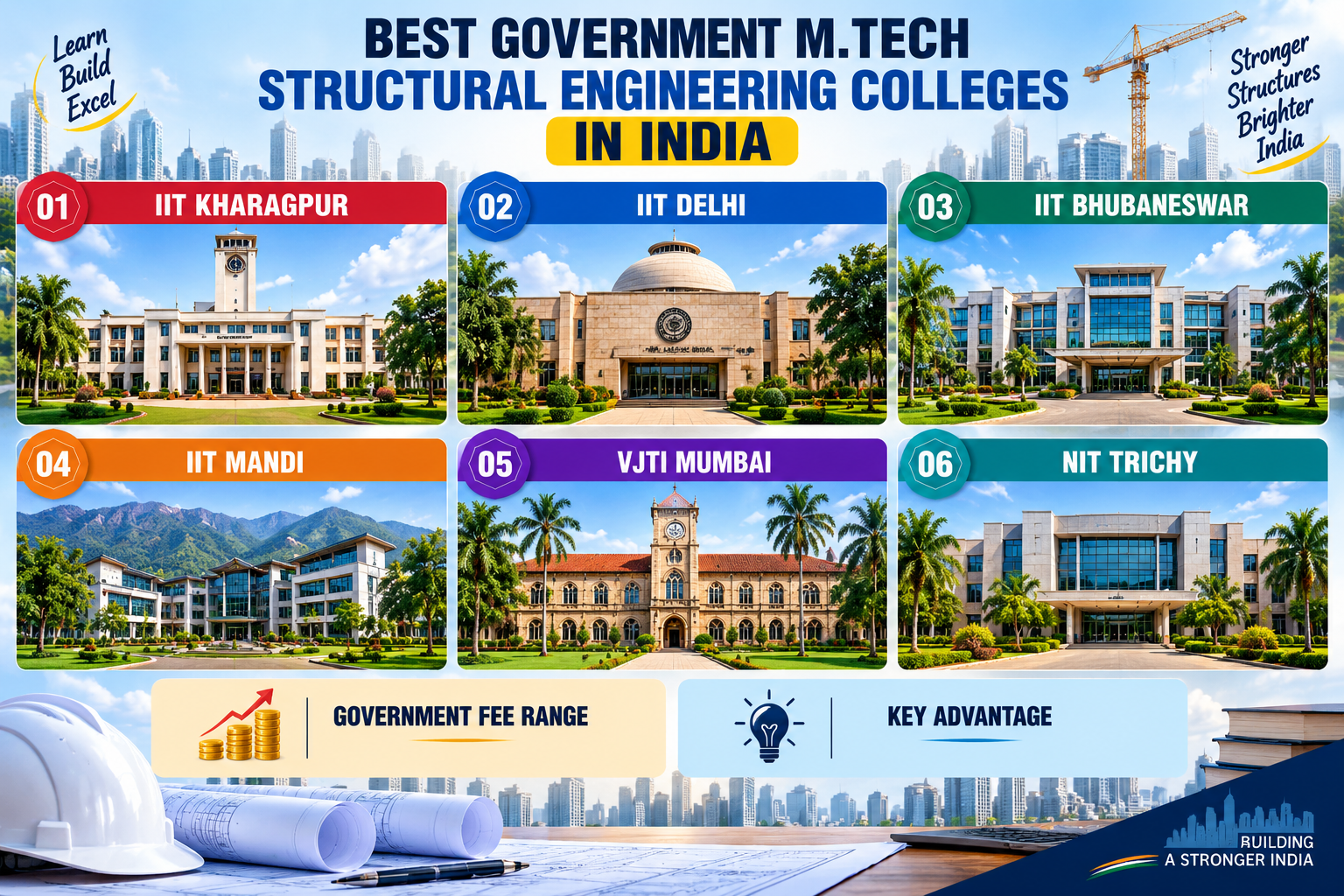
IIT Kharagpur — Fees: ₹63,800 (full course), among the most affordable IIT options for this specialisation
IIT Delhi — Fees: ₹3,00,000 (full course); ranked #2 per NIRF 2024 for this specific program
IIT Bhubaneswar — Fees: government-subsidized rate; median package ₹7.5 lakh; strong recruiter base (L&T, Tata Projects)
IIT Mandi — Fees: ₹90,800; comparatively lower GATE cutoff (300-400) among top IITs, making it a relatively more accessible government option
VJTI Mumbai — Fees: ₹1.83 lakh; state government-affiliated institute with solid regional reputation
NIT Trichy — Strong government NIT option with a well-regarded placement record specifically for this specialisation
Overall government fee range — ₹80,000 to ₹3,00,000 per annum across government institutions nationally, varying significantly by institute ranking and location
General advantage — Government institutes (IITs, NITs) typically offer the strongest fee-to-placement ROI, given heavily subsidised tuition combined with strong recruiter access.
Best Private M.Tech Structural Engineering Colleges
Best Private M.Tech Structural Engineering Colleges
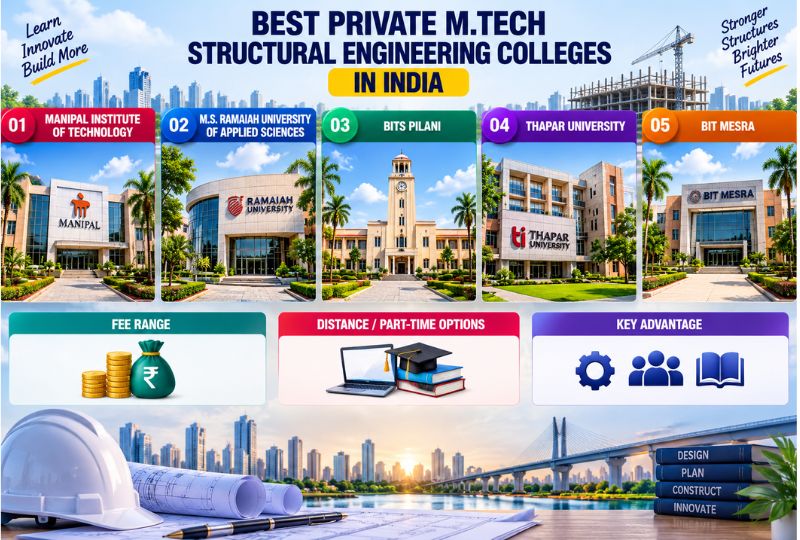
Manipal Institute of Technology (MIT Manipal) — Uses its own Manipal Entrance Test (MET) for admission, offering an alternative to the GATE-only route.e
M.S. Ramaiah University of Applied Sciences (RUAS) — Accepts RUAS AT, GATE, or CUET-PG scores, offering flexible admission routes
BITS Pilani, Thapar University, BIT Mesra —Recognised private institutes offering strong private-sector alternatives with solid industry connections
Overall private fee range — ₹1,50,000 to ₹5,00,000 per annum, varying meaningfully by institution and its national ranking
Distance/part-time private options — Institutes like Thapar University and BIT Mesra offer part-time or distance M.Tech Structural Engineering programs specifically suited for working professionals
General private-sector advantage — Private institutes often provide more flexible admission routes (without mandatory GATE), broader specialisation electives, and additional intake cycles compared to the GATE-only government route
M.Tech Structural Engineering Fees
Overall national fee range — ₹20,000 to ₹3,50,000 total, varying significantly by college type, ranking, and location
Government institutions (IITs/NITs) — ₹80,000 to ₹3,00,000 per annum on average, though several specific IITs charge far less for the full program.
Specific IIT fee examples — IIT Kharagpur: ₹63,800 (full course); IIT Delhi: ₹3,00,000 (full course); IIT Mandi: ₹90,800 (reduced from earlier figures); IIT Madras: among the lowest at ₹62,000 per annum
Private universities — ₹1,50,000 to ₹5,00,000 per annum, with VJTI Mumbai charging ₹1.83 lakh for the full program as a public-affiliated example on the more affordable end.
Broader M.Tech benchmark (also specialisations) — ₹50,000 PA to ₹4 LPA on average nationally, with premium institutes ranging up to ₹4.2 LPA and select private colleges reaching ₹8.1 LPA
Scholarship support — Options like the Reliance Foundation Scholarship, TATA Steel Millennium Scholarship, and DRDO Scholarship Scheme for Girls can meaningfully offset total program cost for eligible candidates
Fee structure note — Costs typically include one-time and semester-wise/annual components (tuition, hostel, mess, etc.), so always check whether a quoted figure is per-semester or for the full program duration
M.Tech Structural Engineering Specialisations
M.Tech Structural Engineering Specialisations
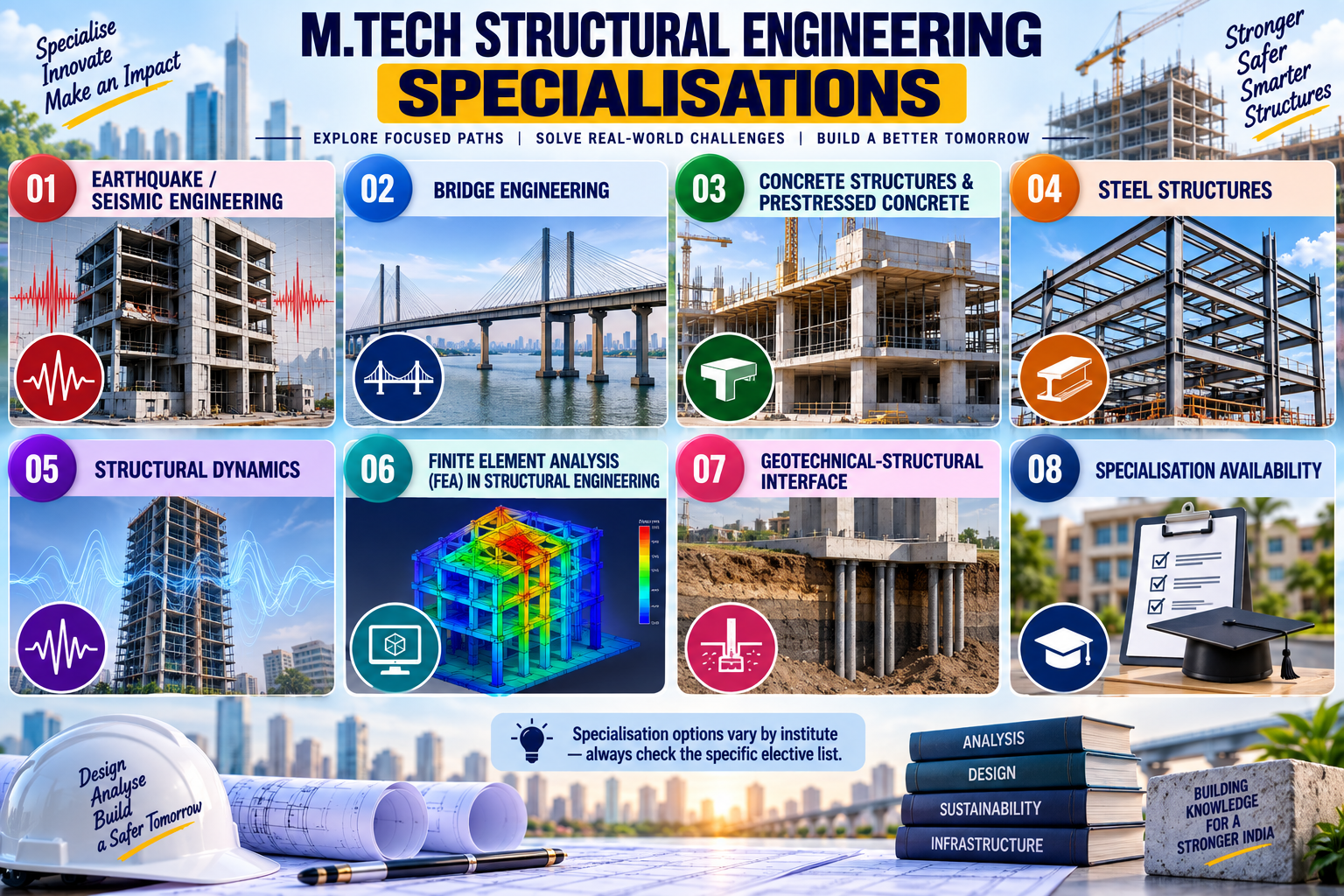
Earthquake/Seismic Engineering — Focuses on designing structures to withstand seismic activity, increasingly relevant given India's earthquake-prone zones
Bridge Engineering — Specialised track focusing on the design, analysis, and maintenance of bridge structures
Concrete Structures & Prestressed Concrete — Deep dive into concrete-specific structural theory and design, building on Theory of Concrete Structures coursework
Steel Structures — Focused specialisation on steel-based structural design and analysis
Structural Dynamics — Covers structures under dynamic loading conditions, including vibrations and time-dependent forces
Finite Element Analysis (FEA) in Structural Engineering — Computational/simulation-focused track for advanced structural modelling
Geotechnical-Structural Interface — Some programs offer combined coursework bridging structural and geotechnical engineering, useful for foundation-heavy projects.
Specialisation availability varies significantly by institute — checking the specific elective list at your shortlisted IIT/NIT/private college is essential, since not all specialisations are offered everywhere.
M.Tech Structural Engineering Course Duration
Standard full-time program — 2 years, split across four semesters, the norm at virtually all Indian institutes (IITs, NITs, IIITs, and private universities)
First-year focus — Foundational and core subjects (Advanced Structural Analysis, FEM, Solid Mechanics, Structural Dynamics) aligned with the specialisation
Second-year focus — Applied coursework, electives, and a significant research project or thesis, particularly emphasised at IITs and NITs.
Part-time/distance programs — Also generally structured around a similar overall curriculum timeline, though total completion time can extend further for working professionals studying part-time
Integrated program alternative — A 5-year Integrated M.Tech option is available at select institutes (like BHU, IIT Bombay, IIT Delhi) for students entering directly after Class 12, combining undergraduate and postgraduate structural engineering education in one continuous program
Executive M.Tech format — More flexible, industry-project-based structure for working professionals with prior work experience, though this remains a 2-year framework overall
M.Tech Structural Engineering Placements
IIT Bhubaneswar — Median package of ₹7.5 lakh in 2026, with top recruiters including L&T and Tata Projects
NIT Trichy — Strong, consistently well-regarded placement record specifically for this specialisation, per multiple student and alumni sources
Broader M.E/M.Tech benchmark (all specialisations, top colleges) — IIT Bombay ₹14.76 LPA, IIT Kanpur ₹15.29 LPA, VIT Vellore and Jadavpur University ₹8 LPA, NIT Trichy ₹9.5 LPA — useful as a general reference, though structural-specific packages (like IIT Bhubaneswar's ₹7.5 LPA) tend to run somewhat lower than flagship CSE/general M.Tech averages
Top recruiters across the specialisation — L&T, Tata Projects, and other major construction and infrastructure firms are consistently active recruiters for structural engineering graduates.
PSU recruitment pathway — MTech graduates broadly (including structural specialisation) are in high demand at PSUs, alongside private-sector construction and infrastructure companies
International offers — Available from top colleges, though these remain a smaller share of overall placements compared to domestic infrastructure and construction sector roles.
Placement variance by institute tier — IITs and top NITs report significantly stronger and more consistent placement outcomes than newer or lower-tier private colleges, making institute reputation a meaningful factor in expected placement strength.
M.Tech Structural Engineering Salary in India
IIT Bhubaneswar median package — ₹7.5 lakh per annum (2026 data), specific to this specialisation
Broader M.Tech average at top IITs/NITs (all specialisations) — ₹12-22 LPA average CTC, with highest packages reaching ₹30-45 lakh+ at premier institutes — though structural engineering-specific figures tend to sit below this broader average, closer to the ₹7-10 LPA range at most institutes
Mid-tier college range — Average packages around ₹8-9.5 LPA at strong institutes like VIT Vellore, Jadavpur University, and NIT Trichy (based on broader M.Tech data)
Entry-level private-sector roles — Structural design engineers, site engineers, and consulting roles typically start in a more modest range compared to CSE-heavy M.Tech specialisations, given the construction/infrastructure sector's different pay scale.
Career growth factors — Salary growth depends heavily on specialisation depth (seismic/bridge engineering vs. general structural design), institute reputation, and whether the graduate moves into consulting, government/PSU roles, or private infrastructure firms
Top recruiting companies driving salary bands — L&T and Tata Projects are among the most active and higher-paying recruiters specifically for this specialisation
Career Options After M.Tech Structural Engineering
Structural Design Engineer — Core role focused on designing and analysing structures for buildings, bridges, and infrastructure projects
Site Engineer / Project Engineer — On-ground execution and supervision of construction projects, applying structural design principles in real-world settings
Structural Consultant — Independent or firm-based consulting on structural safety, design review, and code compliance for construction projects
Research & Academia — Pursuing a PhD or joining academic institutions as faculty, building on the research foundation developed during M.Tech
PSU Roles — Structural engineering positions within public sector undertakings, offering stable, government-linked career paths
Government Sector Roles — Positions in bodies like PWD (Public Works Department), municipal corporations, and infrastructure development authorities
Bridge & Infrastructure Specialist — Specialised roles focused specifically on bridge design, maintenance, and large-scale infrastructure projects
Seismic/Earthquake Engineering Specialist — Niche career path focused on designing earthquake-resistant structures, particularly relevant in India's seismic zones
Higher studies/further specialisation — Graduates can pursue additional certifications or a PhD to move into more senior technical leadership or research-focused roles
Top Recruiters for M.Tech Structural Engineering Graduates
L&T (Larsen & Toubro) — One of the most active and consistent recruiters for structural engineering graduates, particularly at institutes like IIT Bhubaneswar
Tata Projects — Major infrastructure and construction recruiter, alongside L&T, for structural design and site engineering roles
PSUs (Public Sector Undertakings) — Broadly recruit M.Tech graduates, including structural specialisation, into stable, government-linked engineering roles
Construction and Infrastructure Firms — Beyond L&T and Tata Projects, various private construction companies actively hire for structural design and project execution roles
Tech companies (broader M.Tech context) — Google, Microsoft, TCS, Infosys, ISRO, and DRDO are noted as major recruiters across M.Tech specialisations broadly, though structural-specific hiring concentrates more heavily in infrastructure and construction sectors
Consulting firms — Structural design consultancies actively recruit for specialised design review and safety-compliance roles
Government departments — PWD and municipal/infrastructure authorities recruit structural engineering graduates for public infrastructure projects.
Seismic safety focus — Increasing regulatory and industry emphasis on earthquake-resistant design creates growing demand for seismic/earthquakeengineering specialistst.s
Sustainable and green building design — Rising focus on sustainable construction practices is creating specialised roles at the intersection of structural engineering and environmental design
Digital transformation in design — Growing use of Finite Element Analysis (FEA), Building Information Modelling (BIM), and simulation-based design tools is reshaping how structural engineers work, rewarding those with strong computational skills
PSU and government infrastructure push — Continued government investment in public infrastructure supports steady, long-term demand for structural engineers in PSU and government roles
International opportunities — Skilled structural engineers, particularly those with strong FEA/BIM and seismic design expertise, can find opportunities with international infrastructure and consulting firms
Research and academic growth — As structural engineering research areas (like advanced materials and smart structures) expand, academic and R&D career paths continue to grow alongside traditional industry roles
Steady long-term demand — Given the essential nature of safe structural design across virtually every construction project, this remains a durable, recession-resistant career field over the long term
Skills Required for Structural Engineering Careers
Strong foundation in structural analysis — Core competency built through subjects like Advanced Structural Analysis and Structural Dynamics
Finite Element Analysis (FEA) proficiency — Increasingly essential for modern structural design and simulation work
Software proficiency — Familiarity with structural design and analysis software (commonly used tools in the industry for modelling, analysis, and BIM integration)
Understanding of building codes and standards — Critical for ensuring designs comply with national and international safety codes
Problem-solving and analytical thinking — Needed to assess structural integrity, identify potential failure points, and design safe, efficient solutions
Attention to detail — Essential given the safety-critical nature of structural design work
Project management skills — Valuable for site engineering and project execution roles, where coordinating timelines, budgets, and teams is central
Communication skills — Important for consulting roles and cross-functional collaboration with architects, contractors, and project stakeholders
Continuous learning mindset — Given evolving building codes, materials science, and digital design tools, staying updated is important for long-term career growth in this field
Compare M.Tech Structural Engineering Colleges
College
Type
Fees (Total)
GATE Cutoff
Placement/Salary
IIT Delhi
Government
₹3,00,000
Competitive
NIRF Rank #2 for this course
IIT Kharagpur
Government
₹63,800
Moderate
NIRF Rank #3 (engineering)
IIT Bhubaneswar
Government
Subsidized
514-623
Median ₹7.5 LPA; L&T, Tata Projects
IIT Mandi
Government
₹90,800
300-400
NIRF Rank #17
VJTI Mumbai
Government-affiliated
₹1.83 lakh
Moderate
Collegedunia Rank #93
NIT Trichy
Government
Moderate
Competitive
Strong placement reputation
MIT Manipal
Private
₹1.5-5 lakh
MET-based
Solid private-sector placements
RUAS
Private
₹1.5-5 lakh
RUAS AT/GATE/CUET-PG
Flexible admission routes
Best for brand + lowest fees: IIT Kharagpur
Best for ROI: IIT Mandi, IIT Kharagpur
Best for placement strength: IIT Bhubaneswar, NIT Trichy
Best for flexible admission (non-GATE): MIT Manipal, RUAS
Frequently Asked Questions (FAQs)
Q1. Which is the best M.Tech Structural Engineering college in India?
IIT Delhi (ranked #2 per NIRF 2024 for this specific course) and IIT Kharagpur (NIRF Rank #3 overall) are among the top choices, alongside IIT Bhubaneswar and NIT Trichy for strong placement records.
Q2. What is the average fee for M.Tech Structural Engineering?
Fees range from ₹63,800 (IIT Kharagpur) to ₹3,00,000 (IIT Delhi) at government institutes, and ₹1.5-5 lakh at private universities, depending on the specific college.
Q3. Is GATE mandatory for M.Tech Structural Engineering admission?
Not always — while GATE is the primary route for IITs, NITs, and IIITs, some universities like Manipal Institute of Technology and RUAS accept their own entrance tests or CUET-PG scores instead.
Q4. What is the average salary after M.Tech Structural Engineering?
Salaries vary by institute — IIT Bhubaneswar reports a median package of ₹7.5 lakh, while broader M.Tech averages at top IITs range from ₹12-22 LPA, though structural-specific figures tend to sit somewhat lower than flagship CSE averages.
Q5. Which are the top recruiters for structural engineering graduates?
L&T (Larsen & Toubro) and Tata Projects are among the most active recruiters, alongside various PSUs, government infrastructure departments, and private construction firms.
Q6. What is the duration of an M.Tech in Structural Engineering?
It's a standard 2-year full-time postgraduate program, though integrated 5-year options and part-time/distance formats are also available at select institutes.
Q7. What career options are available after this degree?
Graduates can pursue roles as structural design engineers, site engineers, consultants, PSU/government engineers, or move into research, academia, or specialised fields like seismic and bridge engineering.
Conclusion
M.Tech Structural Engineering remains a foundational and consistently in-demand postgraduate specialisation for civil engineering graduates in India, offering a clear pathway into infrastructure, construction, and government engineering roles. With fees ranging from an accessible ₹63,800 at IIT Kharagpur to ₹3,00,000 at IIT Delhi, and additional flexible private-sector and non-GATE admission routes through institutes like Manipal and RUAS, this program remains genuinely accessible across different budgets and admission profiles. While placement packages for this specialisation (typically ₹7-10 LPA at most institutes) run somewhat lower than flagship CSE-focused M.
Enter Your Details to Unlock Eligibility
Get personalized college recommendations and scholarship opportunities