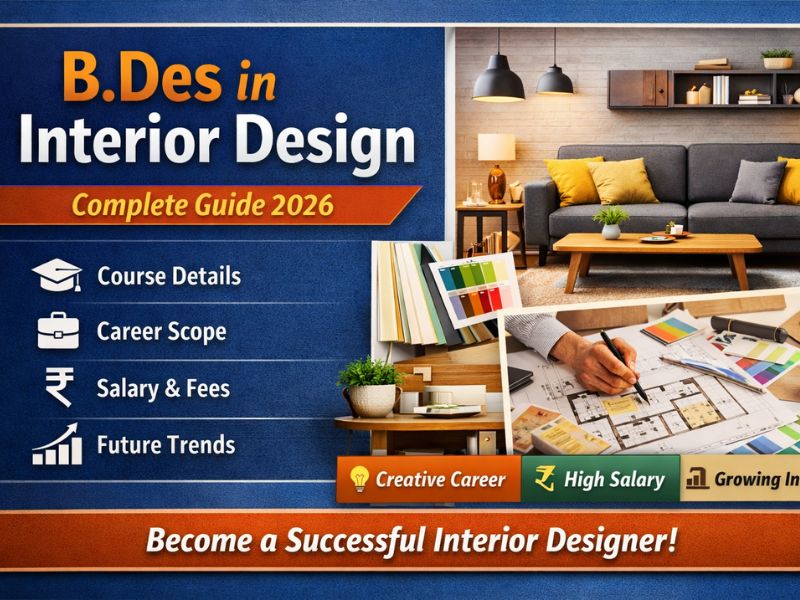
Imagine walking into a beautifully designed home, a stylish office, or a luxury hotel—everything feels perfectly placed, balanced, and visually stunning. Ever wondered who creates these spaces? That’s the work of an interior designer.
In today’s fast-growing world, interior design is no longer just about decoration—it’s about functionality, sustainability, and lifestyle transformation. If you are creative, detail-oriented, and passionate about designing spaces, then a Bachelor of Design (B.Des) in Interior Design can be your perfect career path.
This guide will give you complete clarity—from course details to career opportunities—so you can confidently decide your future.
What is B.Des in Interior Design?
A B.Des in Interior Design is a 4-year undergraduate degree that focuses on designing functional and aesthetically pleasing interior spaces.
What You Will Learn:
-
Space planning and layout design
-
Furniture and lighting design
-
Colour theory and materials
-
2D & 3D design software (AutoCAD, SketchUp, etc.)
-
Sustainable and eco-friendly design
-
Client handling and project management
H2: Why Choose B.Des in Interior Design?
Key Highlights:
-
High demand in the real estate and construction industries
-
Opportunity to work independently (freelancing/business)
-
Creative and non-traditional career
-
High earning potential with experience
-
Global career opportunities
Eligibility Criteria
Basic Requirements:
-
Must have completed 12th (any stream: Arts, Commerce, Science)
-
Minimum 50% marks (varies by college)
Entrance Exams (Some Colleges):
-
NIFT
-
NID
-
UCEED
-
University-specific exams
Skills Required for Interior Design
Important Skills:
-
Creativity and imagination
-
Drawing and visualisation skills
-
Attention to detail
-
Communication and client handling
-
Technical knowledge of design tools
-
Problem-solving ability
Course Structure
Year-wise Learning:
Year 1–2 (Basics)
-
Design fundamentals
-
Drawing and sketching
-
Material studies
-
Color theory
Year 3–4 (Advanced)
-
Residential & commercial design
-
Furniture design
-
Lighting design
-
Internship & final project
Fees Structure (India)
Average Fees:
-
Government Colleges: ₹50,000 – ₹1,50,000 per year
-
Private Colleges: ₹2,00,000 – ₹5,00,000 per year
Total Investment:
-
₹2 Lakhs – ₹20 Lakhs (depending on college)
- Career Scope After B.Des Interior Design
Interior design is booming due to urbanisation and lifestyle changes.
Job Roles:
-
Interior Designer
-
Space Planner
-
Furniture Designer
-
Set Designer
-
Exhibition Designer
-
Visual Merchandiser
Salary in Interior Design (India)
Average Salary:
-
Freshers: ₹2.5 LPA – ₹5 LPA
-
Mid-Level: ₹5 LPA – ₹10 LPA
-
Experienced: ₹10 LPA+
Freelancers and business owners can earn even more depending on projects.
Benefits of Studying Interior Design
Why It Matters:
-
Turns creativity into a profession
-
Improves lifestyle and living standards
-
High demand in modern society
-
Opportunity to work globally
-
Flexibility in career (job + freelance)
Latest Trends in Interior Design (2026)
Top Trends:
-
Sustainable and eco-friendly design
-
Smart homes (AI & automation integration)
-
Minimalist and functional spaces
-
Biophilic design (nature-inspired interiors)
-
Multi-functional furniture
Future Scope of Interior Design
The future is very promising due to:
-
Rapid urban development
-
Increasing demand for personalised spaces
-
Growth in the real estate and commercial sectors
By 2026 and beyond, interior designers will play a major role in smart city development.
Pros and Cons
Pros:
-
Creative and exciting career
-
High income potential
-
Freelancing opportunities
-
Global exposure
Cons:
-
Competitive field
-
Requires continuous learning
-
Client expectations can be challenging
-
Initial growth may be slow
Salary After B.Des Interior Design in India
The salary after completing a B.Des in Interior Design in India varies based on factors like skills, experience, location, portfolio, and the type of employer. While fresh graduates may start with moderate salaries, the growth potential in this field is quite strong, especially for those who continuously upgrade their skills and build a strong client base.
At the entry level, freshers can expect an average salary ranging between ₹2.5 LPA and ₹5 LPA. Beginners usually work under senior designers or in design firms to gain practical exposure. During this phase, learning software tools, understanding client requirements, and building a portfolio are more important than just salary.
With 2–5 years of experience, interior designers can earn between ₹5 LPA and ₹10 LPA. At this stage, professionals start handling projects independently, dealing with clients directly, and managing complete design executions. Their earning potential increases significantly based on the quality of work and reputation.
For experienced designers (5+ years), salaries can go beyond ₹10 LPA to ₹20 LPA or more. Senior designers, design consultants, or those running their own firms often earn much higher salaries depending on the scale and number of projects they handle.
Freelancing is another highly profitable option in interior design. Freelance designers can charge ₹50,000 to ₹5 Lakhs per project or even more for luxury projects. Income in freelancing depends largely on creativity, client network, and branding.
Latest Trends in Interior Design (2026)
Interior design in 2026 is driven by a clear shift in user behaviour—people want spaces that are not just visually appealing but also functional, sustainable, and personalised. From an SEO and market perspective, search demand is increasing for terms like “sustainable interior design,” “smart homes,” and “space-saving furniture.” This indicates where the industry is heading.
Below are the most important interior design trends in 2026, explained in a clear, data-driven style:
1. Sustainable Interior Design (High Search Growth)
Sustainability is no longer optional—it’s a priority. Users are actively searching for eco-friendly solutions.
What’s trending:
-
Recycled and upcycled materials
-
Bamboo, reclaimed wood, natural stone
-
Energy-efficient lighting
Why it matters:
Consumers are becoming environmentally conscious, and designers who offer sustainable solutions have a competitive advantage.
2. Smart Homes & Integrated Technology
Search interest in “smart home design” has significantly increased.
Key features:
-
Smart lighting and voice-controlled systems
-
Automated curtains and climate control
-
Hidden or minimal-tech design integration
Insight:
Technology is blending into interiors rather than standing out.
3. Multi-Functional Spaces (Post-Work-from-Home Demand)
With a hybrid work culture, demand for multi-use spaces is growing.
Examples:
-
Living room + workspace
-
Foldable furniture
-
Modular layouts
SEO Angle:
Keywords like “small space interior design” and “space-saving ideas” are trending.
4. Warm Minimalism (Replacing Cold Minimalism)
Traditional minimalism is evolving into something more comfortable.
Features:
-
Neutral and warm tones (beige, cream, brown)
-
Soft lighting
-
Simple but cosy layouts
Why it works:
Users want clean spaces without sacrificing comfort.
5. Biophilic Design (Nature Integration)
Search demand for “indoor plants decor” and “natural interiors” is rising.
Elements:
-
Indoor plants
-
Natural ventilation and sunlight
-
Organic textures
Benefit:
Improves mental well-being and productivity.
6. Personalised & Custom Interiors
Mass-produced designs are losing popularity.
What’s changing:
-
Customized furniture
-
Personal storytelling through decor
-
Unique design themes
Insight:
People want homes that reflect their identity, not trends.
7. Texture-Driven Design
Flat designs are being replaced with layered textures.
Popular materials:
-
Linen, velvet, wood, stone
-
Matte finishes over glossy
Impact:
Adds depth and richness to interiors.
8. Curved & Organic Shapes
Sharp edges are being replaced by soft forms.
Seen in:
-
Sofas and chairs
-
Arches and walls
-
Decorative elements
Reason:
Creates a more relaxed and inviting environment.
9. Bold Accent Elements
Minimal spaces are now combined with bold highlights.
Examples:
-
Statement walls
-
Unique lighting fixtures
-
Artistic furniture
Trend Insight:
Users want a balance between simplicity and creativity.
10. Luxury Meets Functionality
Luxury is no longer just about expensive materials—it’s about usability.
Focus areas:
-
Smart storage
-
Comfortable layouts
-
Premium yet practical design
Key Takeaways (Ahrefs Style Summary)
Common Mistakes to Avoid
-
Ignoring practical functionality
-
Over-designing spaces
-
Not understanding the client's needs
-
Poor budget planning
-
Lack of software skills
Expert Tips for Success
-
Build a strong portfolio from an early stage
-
Learn design software like AutoCAD & SketchUp
-
Do internships for real-world experience
-
Stay updated with trends
-
Network with professionals
Job Roles in the Interior Design Field
The interior design industry offers a wide range of career opportunities for graduates of B.Des in Interior Design. With the growing demand for well-designed residential, commercial, and corporate spaces, professionals in this field can choose from a range of specialised roles based on their skills and interests.
One of the most common roles is that of an Interior Designer, who plans, designs, and executes interior spaces according to client requirements. They focus on layout, colour schemes, furniture, lighting, and overall aesthetics while ensuring functionality and safety standards.
Another important role is a Space Planner, who specialises in optimising the use of available space. This role is crucial in offices, retail stores, and small apartments where efficient space utilisation is essential. Space planners work closely with architects and clients to create practical and visually appealing layouts.
A Furniture Designer focuses on designing custom furniture pieces that match the theme and functionality of a space. This role requires creativity along with knowledge of materials, ergonomics, and production techniques. With the rise of personalised interiors, this career path is gaining popularity.
For those interested in visual presentation, a career as a Visual Merchandiser is a great option. These professionals design retail spaces and storefront displays to attract customers and enhance the shopping experience. This role is highly in demand in malls, showrooms, and retail brands.
Another exciting role is a Set Designer, who works in the entertainment industry, including films, television, and events. They create visually engaging sets that match the theme and story requirements, making this a creative and dynamic career option.
Additionally, many interior design graduates choose to become Freelance Designers or start their own design studios. This path offers flexibility, independence, and high earning potential, especially with a strong portfolio and client network.
Key Highlights of Interior Design Careers:
-
Diverse job roles across industries
-
Opportunity for creative expression
-
High demand in the urban and commercial sectors
-
Scope for freelancing and entrepreneurship
Overall, the interior design field provides a perfect blend of creativity, technical skills, and business opportunities, making it a highly rewarding career choice in 2026 and beyond.
Examples & Career Options Comparison
| Option | Description | Growth |
|---|
| Job | Work in design firms | Stable |
| Freelance | Independent projects | High earning |
| Business | Start your own firm | Very high growth |
FAQs (SEO Optimised)
Q1: Is B.Des Interior Design a good career?
Yes, it offers strong career growth and creative satisfaction.
Q2: What is the duration of B.Des Interior Design?
It is a 4-year undergraduate program.
Q3: Can I do interior design after 12th?
Yes, from any stream.
Q4: What is the salary after interior design?
Freshers earn around ₹2.5–5 LPA.
Q5: Do I need drawing skills?
Basic drawing helps, but software skills are also important.
Q6: Which is better, B.Des or Diploma?
B.Des offers better career opportunities and depth.
Q7: Can I start my own business after B.Des?
Yes, many designers start their own firms.
Q8: Is interior design in demand in India?
Yes, demand is rapidly increasing.
Q9: What software should I learn?
AutoCAD, SketchUp,3D Max.
Q10: Is interior design expensive to study?
It depends on the college, but ROI is high.
Conclusion
A B.Des in Interior Design is not just a degree—it’s a gateway to a creative, flexible, and high-growth career. With the rise of modern living, smart homes, and personalised spaces, the demand for skilled interior designers is only going to increase in 2026 and beyond.
If you have a creative mindset and a passion for transforming spaces, this field can offer both financial success and personal satisfaction.
👉 Start building your future today—choose the right college, develop your skills, and take your first step toward becoming a successful interior designer.