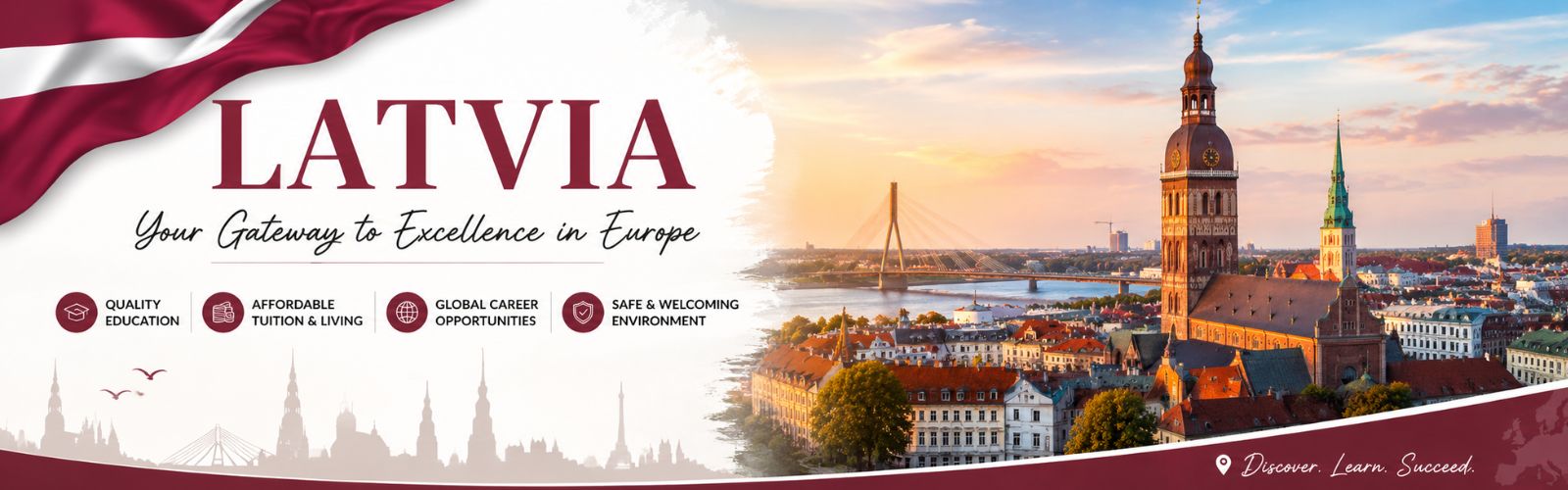
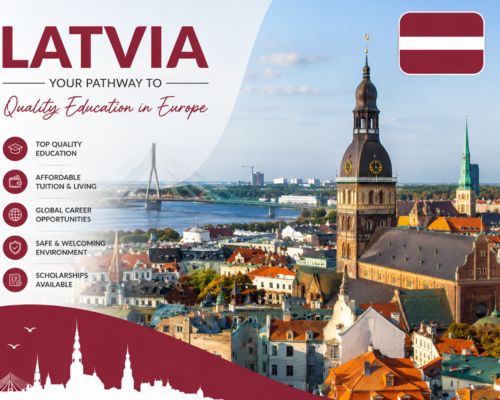
Latvia is quietly becoming one of Europe's most exciting and strategically smart study destinations. Situated in the heart of the Baltic region and a proud member of the European Union, Latvia offers international students a rare combination of high-quality education, genuinely affordable living costs, and the prestige of an EU-recognised degree, all in a safe, welcoming, and culturally rich environment. Each year, thousands of students from across Asia, Africa, and the Middle East choose to study in Latvia, attracted by its English-taught programmes, competitive tuition fees, and the growing reputation of its universities on the world stage. For Indian students looking to pursue a European education without the financial burden of studying in Western Europe, Latvia is an opportunity that deserves serious attention.
Academic Excellence
Latvian universities have a rich and distinguished academic heritage. The University of Latvia, founded in 1919, is the country's largest and most prominent institution, offering programmes across natural sciences, social sciences, humanities, law, and medicine. Riga Technical University (RTU) is internationally recognised for its engineering, IT, and applied sciences programmes. Rīga Stradiņš University (RSU) holds a particularly strong reputation for medicine and health sciences, with its medical degrees recognised by the National Medical Commission (NMC) of India, a critical factor for Indian students pursuing careers in healthcare. BA School of Business and Finance rounds out Latvia's top-tier academic offering with internationally accredited business and finance programmes. The Latvian education system is fully compliant with the Bologna Process, ensuring that academic standards are benchmarked against the best in Europe. Faculty members across Latvian universities bring a combination of research expertise, industry experience, and international academic credentials, delivering programmes that are both intellectually rigorous and professionally relevant. Students who study in Latvia benefit from small class sizes, personalised academic support, and access to modern research infrastructure, creating an environment that genuinely nurtures talent and ambition.
Affordable Tuition Fees
The cost of studying in Latvia is one of the most compelling reasons why international students choose it over other European destinations. Annual tuition fees at Latvian universities range from €2,000 to €8,000 per year for most undergraduate and postgraduate programmes, with medicine and specialist postgraduate courses typically costing €8,000 to €14,000 annually. Even at the higher end of the spectrum, these fees represent exceptional value compared to universities in Germany, the Netherlands, Sweden, or the United Kingdom, where similar programmes can cost two to three times as much. For Indian students accustomed to evaluating the return on investment of their education spend, affordable education in Latvia offers a truly compelling proposition: European-standard teaching, an EU-recognised qualification, and a cost structure that is genuinely accessible without requiring excessive student debt or family financial strain.
International Student Environment
Latvia has cultivated a warm and inclusive environment for international students. The country's universities collectively host students from over 100 nationalities, and Riga. Latvia's vibrant capital is one of Northern Europe's most cosmopolitan and culturally dynamic cities. Dedicated international student offices at all major universities provide orientation support, accommodation guidance, visa assistance, and ongoing academic and personal counselling. Student unions organise cultural festivals, international food events, networking evenings, and sports competitions that help new arrivals integrate quickly and comfortably. For Indian students specifically, active Indian student associations on major campuses provide community, cultural connection, and peer support from the moment of arrival, making the transition to life in Latvia smooth and enjoyable.
Recognition of Degrees Worldwide
A degree earned when you study in Latvia carries strong international credibility. All degrees awarded by accredited Latvian institutions are fully recognised across the 27 EU member states and respected by employers and academic institutions in the United States, United Kingdom, Canada, Australia, and India. Latvia's participation in the Bologna Process and the European Higher Education Area (EHEA) ensures that academic qualifications follow a standardised framework, facilitating credit transfers, further study, and professional recognition across borders. RSU's medical degrees carry the additional distinction of NMC recognition in India, a decisive advantage for Indian students pursuing medicine abroad.
Thinking about studying in Latvia? Contact Your Global Mentors today for a free personalised consultation and expert guidance on the best universities and programmes for your profile.
Facts About Latvia
1. Location & Size Latvia is a small Baltic nation in Northern Europe, bordered by Estonia, Lithuania, Russia, and Belarus. It covers an area of 64,589 sq km with a population of approximately 1.8 million people.
2. Capital & Language Riga is the capital and largest city, home to nearly one-third of the entire population. The official language is Latvian, but English is widely spoken, especially among younger generations and in universities.
3. EU & NATO Member Latvia joined both the European Union and NATO in 2004, giving it full access to European markets, academic frameworks, and collective security. It adopted the Euro (€) as its currency in 2014.
4. Education System Latvia follows the Bologna Process, meaning all university degrees, Bachelor's, Master's, and PhD, are fully recognised across all 27 EU member states and internationally, including in India and the UK.
5. Top Universities Latvia's leading institutions include the University of Latvia (founded 1919), Riga Technical University, Rīga Stradiņš University (RSU), and BA School of Business and Finance, all offering English-taught programmes for international students.
6. Affordable Cost of Living: Latvia is one of the most affordable countries in the EU. A student can live comfortably on €550 to €1,100 per month, covering accommodation, food, transport, insurance, and personal expenses, far cheaper than Western Europe.
7. Safe and Stable Country: Latvia ranks consistently well on European safety and governance indices. It has low violent crime rates, a strong rule of law, and a stable political environment, making it a reassuring destination for international students and their families.
8. Schengen Area Member: As a Schengen Area country, students studying in Latvia enjoy passport-free travel across 26 European countries. Riga's international airport connects directly to major European cities through multiple budget and full-service airlines.
9. Indian-Friendly Destination: RSU's medical degrees are recognised by India's National Medical Commission (NMC), making Latvia especially popular among Indian medical students. Active Indian student associations exist at major universities, and English is the medium of instruction across most international programmes.
10. Growing Economy & Work Opportunities Latvia has one of the fastest-growing economies in the EU, with strong demand for professionals in IT, engineering, finance, healthcare, and logistics. International students can work up to 20 hours per week during the semester and full-time during vacations without a separate work permit.
LIVING COST
Understanding the actual cost of living is one of the first and most important steps before you decide to study in Latvia. The good news is that Latvia consistently ranks as one of the most affordable countries in the European Union for students. Whether you are comparing accommodation costs, food prices, or daily transport expenses, Latvia offers a standard of living that is comfortable, safe, and well-served at a price point that is significantly lower than most Western European countries. Here is a realistic and detailed breakdown of what international students can expect to spend on a monthly basis.
|
Expense Category |
Estimated Monthly Cost (EUR) |
Estimated Monthly Cost (INR) |
|
University Dormitory |
€80 – €180 |
8,808.72 – 19,819.98 |
|
Private Rented Room (Shared) |
€200 – €450 |
22,022.40 – 49,546.80 |
|
Food & Groceries |
€150 – €250 |
16,514.55 – 27,524.25 |
|
Public Transportation |
€15 – €30 |
1,651.26 – 3,302.52 |
|
Health Insurance |
€30 – €60
|
3,302.52 – 6,605.04 |
|
Utilities & Internet |
€30 – €70 |
3,302.52 – 7,705.88 |
|
Personal & Entertainment |
€50 – €120 |
5,504.20 – 13,209.36 |
|
Total Estimated Monthly Cost |
€550 – €1,100 |
60,542.90 – 1,21,085.80 |
Monthly Accommodation Costs
Student accommodation in Latvia is both widely available and remarkably affordable. University dormitories remain the most cost-effective choice, with monthly rates typically falling between €80 and €180, often including utilities such as heating, electricity, and internet. For students who prefer greater independence, private shared apartments in Riga range from €200 to €450 per person per month, depending on proximity to the city centre and the quality of the property. Neighbourhoods slightly further from the old town, such as Āgenskalns, Purvciems, or Imanta, offer excellent value without sacrificing safety or public transport connectivity. In smaller Latvian university cities such as Jelgava and Daugavpils, rental costs are even lower, making it possible to live very comfortably on a modest monthly budget.
Food Expenses
Food costs in Latvia are among the most student-friendly in the EU. A hot meal at a university canteen typically costs between €2.50 and €5, while a sit-down meal at a local café or restaurant ranges from €5 to €10. Students who cook at home, a popular and practical choice, can expect to spend between €100 and €180 per month on groceries from local supermarkets such as Rimi, Maxima, and Lidl, all of which are well-stocked and competitively priced. Riga's Central Market, one of the largest and most celebrated markets in all of Europe, is a favourite destination for students seeking fresh vegetables, dairy, meat, fish, and local produce at very low prices. Overall, monthly food costs for a student eating a healthy and varied diet typically fall between €150 and €250.
Transportation Costs
Getting around Latvia is easy, affordable, and reliable. Riga's public transportation network, comprising trams, buses, and trolleybuses, covers the entire city comprehensively. A monthly student transport pass costs approximately €15 to €25, offering unlimited travel across all city transport modes. Intercity travel by coach or train is also very reasonably priced; a journey between Riga and Jelgava, for example, costs just €2 to €4. Many students choose to cycle, benefiting from Riga's steadily expanding network of dedicated cycling lanes. Compared to transportation costs in Western European capitals, where monthly passes alone can exceed €80 to €100, Latvia's public transport is extraordinarily economical.
Health Insurance
Non-EU international students are required to hold valid health insurance throughout their period of study in Latvia. Private student health insurance plans are available from approximately €30 to €60 per month, providing coverage for inpatient hospital care, outpatient consultations, emergency treatment, and prescription medications. EU students may use their European Health Insurance Card (EHIC) for necessary medical treatment during their stay. Most Latvian universities partner with local insurance providers to offer students convenient, affordable group health insurance packages that can be arranged as part of the enrolment process.
Student Discounts
Students in Latvia enjoy a generous range of discounts that make daily life and leisure more affordable. A valid student ID card grants access to reduced fares on public transport across Riga and other Latvian cities, discounted or free entry to national museums, galleries, and cultural institutions, and reduced ticket prices at cinemas, theatres, and live events. Many cafés, restaurants, and shops near university campuses also offer student loyalty programmes and meal deals. The National Youth Council of Latvia coordinates additional discount schemes available to all registered students, making it straightforward to stretch a student budget further without compromising on quality of life.
*Note: All the costs mentioned are estimates and are subject to change.
Want a personalised breakdown of your monthly budget for studying in Latvia? Speak to a Your Global Mentors advisor today and plan your finances with confidence.
Benefits of Studying in Latvia
Choosing to study in Latvia is a decision that delivers benefits well beyond the degree itself. From EU-recognised qualifications and cutting-edge research opportunities to a vibrant cultural life and seamless access to the rest of Europe, Latvia offers a comprehensive and genuinely enriching study abroad experience, one that shapes not just careers but character.
Quality Education
Latvia's universities deliver education that is academically rigorous, professionally relevant, and internationally oriented. The University of Latvia and Riga Technical University feature in global rankings and maintain active research partnerships with European universities and industry bodies. Programme content is regularly updated in collaboration with employers and professional associations, ensuring graduates are equipped with skills that are immediately applicable in the modern workplace. Class sizes are generally smaller than in Western European mass universities, enabling more personalised interaction between students and faculty. When you study in Latvia, you are not simply qualifying; you are developing genuine competence, critical thinking, and professional readiness in an environment that takes academic quality seriously.
EU-Recognised Degrees
One of the most strategically important benefits of choosing to study in Latvia is the full EU recognition of your degree. Latvia's membership in the European Union and its full adherence to the Bologna Process mean that degrees from accredited Latvian institutions are automatically recognised across all 27 EU member states. This recognition facilitates postgraduate study, professional licensing, and employment across the entirety of Europe, giving Latvian graduates a labour market reach that extends from Lisbon to Helsinki. For Indian students who plan to build careers in Europe or return to India with a European credential, an EU-recognised degree from a Latvian university is a powerful and versatile qualification.
Cultural Diversity
Life as a student in Latvia is culturally rich, stimulating, and genuinely international. Riga, Latvia's magnificent capital city and a UNESCO World Heritage Site, is celebrated for its extraordinary Art Nouveau architecture, medieval old town, thriving arts and music scene, and diverse culinary landscape. On campus, students encounter peers from across Europe, Asia, Africa, and the Americas, creating a cross-cultural learning environment that broadens perspectives and builds the kind of global mindset that modern employers prize. For Indian students, the presence of a growing and well-established South Asian student community across Latvian campuses ensures that cultural familiarity is always within reach, even as students explore an exciting and unfamiliar European environment.
Safety and Student-Friendly Environment
Latvia is a safe, politically stable, and welcoming country for international students. Crime rates, particularly violent crime, are low, and Riga's compact, walkable city centre allows students to move freely and confidently at all hours. Latvia consistently performs well on European safety and governance indices, and its strict rule of law creates an environment of security and predictability that is deeply reassuring for students and their families. Universities maintain robust international student support networks, offering dedicated advisors, mental health services, housing assistance, and career guidance, all specifically designed to ensure that international students in Latvia feel genuinely supported and included from their very first day.
Travel Opportunities Across Europe
As a full member of the Schengen Area, Latvia grants students passport-free access to 26 European countries, turning the entire continent into an accessible extension of the study experience. Riga International Airport connects directly to major European hubs, including London, Amsterdam, Berlin, Frankfurt, Vienna, and Stockholm, with budget airlines making travel extremely affordable. Weekend trips to Tallinn, Vilnius, Warsaw, Helsinki, and beyond are entirely practical and remarkably inexpensive from Riga. The Baltic region itself, with its dramatic coastlines, ancient forests, medieval cities, and vibrant contemporary culture, offers extraordinary travel experiences right on the doorstep.
Research and Innovation Opportunities
Higher education in Latvia is increasingly shaped by a commitment to research, innovation, and knowledge transfer. The Latvian government and EU structural funds have invested significantly in upgrading university research infrastructure, establishing technology transfer centres, and funding projects under the Horizon Europe framework. Students at RTU and the University of Latvia can engage with research in areas including information technology, smart energy, materials science, biotechnology, and environmental sustainability. Latvia's Digital Latvia strategy and its growing startup ecosystem in Riga provide students with exposure to real-world innovation challenges and entrepreneurial opportunities that enrich the academic experience considerably.
Discover why thousands of international students choose Latvia every year. Connect with Your Global Mentors for expert advice on programmes, scholarships, and applications.
No universities listed for Latvia yet.
No scholarships available right now.
Program Duration in Latvia
Understanding the structure and duration of programmes is essential when planning your decision to study in Latvia. The Latvian higher education system follows the three-cycle Bologna Process framework: Bachelor's, Master's, and Doctoral, ensuring full compatibility with academic systems across Europe and facilitating seamless degree recognition worldwide.
|
Programme |
Duration |
Intakes |
|
Bachelor's Degree |
3 – 4 years |
September & February |
|
Master's Degree |
1.5 – 2 years |
September & February |
|
MBA Programme |
1 – 2 years |
September & January |
|
PhD / Doctoral |
3 – 4 years |
September (primary) |
|
Medical Programme (MBBS equiv.) |
6 years |
September (primary) |
Bachelor's Programmes
A Bachelor's degree in Latvia typically spans three to four years, depending on the discipline and institution. Most programmes in business, social sciences, computer science, and humanities run three years, requiring 180 ECTS credits for completion. Engineering, architecture, and medicine-adjacent programmes generally extend to four years, requiring 240 ECTS credits. A substantial and growing number of English-taught programs in Latvia are available at the undergraduate level, particularly in business administration, computer science, international relations, and tourism management. These English-medium programmes are specifically designed to attract and accommodate international students, with admissions processes, orientation materials, and academic support delivered entirely in English. Admission typically requires completion of secondary school (10+2 or equivalent), academic transcripts, a personal statement, and proof of English proficiency through IELTS (minimum 5.5–6.0) or an equivalent qualification.
Master's Programmes
A Master's in Latvia generally takes one and a half to two years to complete, requiring between 60 and 120 ECTS credits depending on the programme. Postgraduate programmes taught in English are widely available across disciplines, including business administration, information technology, engineering management, public health, international law, and finance. Research-oriented master's programmes provide a strong foundation for doctoral study, while coursework-based programmes are ideal for students seeking to accelerate their professional careers. Admission to master's programmes typically requires a relevant bachelor's degree with strong academic results, two letters of recommendation, a statement of purpose, and English language proficiency at IELTS 6.0 or above. Latvian universities consistently attract high-quality postgraduate cohorts from across Asia, the Middle East, and Africa.
MBA Programmes
Latvia has developed a credible and internationally oriented MBA offering, particularly through the BA School of Business and Finance and the Riga Business School. Full-time MBA programmes run between one and two years and are delivered entirely in English, with cohorts typically comprising students from fifteen to twenty nationalities. These programmes combine rigorous business theory with applied learning, case studies, industry guest lectures, and international study components. For Indian professionals and graduates seeking a high-quality European MBA at a fraction of the cost of programmes in the UK, France, or the Netherlands, Latvia's MBA landscape offers genuine value and strong career development prospects across Baltic, Nordic, and broader European business markets.
PhD Programmes
Doctoral programmes at Latvian universities typically run three to four years and are primarily research-based, culminating in the submission and defence of an original doctoral thesis. Many PhD positions at the University of Latvia and Riga Technical University are funded through EU Horizon Europe grants or national research programmes, providing tuition waivers and monthly stipends for successful applicants. PhD students benefit from access to modern laboratories, international research networks, and collaborative partnerships with European academic institutions and industry partners. The primary doctoral intake is in September, with some faculties accepting applications on a rolling or annual basis. For research-oriented students, higher education in Latvia at the doctoral level offers a well-resourced and internationally connected environment for serious academic and scientific development.
Academic Intake Periods
The primary and most widely available academic intake at Latvian universities commences in September, marking the beginning of the autumn semester and serving as the main entry point for bachelor's, master's, and doctoral programmes alike. A secondary intake in February is available for select undergraduate and postgraduate programmes, offering flexibility for students who miss the September deadline or prefer to begin their studies mid-year. Medical programmes at RSU operate on a single September intake. Students are strongly advised to begin the application process six to nine months before their intended start date to ensure adequate time for university admissions, scholarship applications, and Latvia student visa or residence permit processing.
Unsure which programme level or intake timing suits your situation? Your Global Mentors provides personalised programme matching and application support for students planning to study in Latvia - contact us for a free assessment.
Work Opportunities in Latvia
Latvia's economy has grown consistently, making it one of the most dynamic in the Baltic region and the broader EU, and work opportunities in Latvia for international students and graduates are both meaningful and varied. Riga's expanding technology and startup ecosystem, combined with Latvia's strategic role as a Baltic trade and logistics hub, creates strong employment demand across multiple high-value sectors. Students holding a valid Latvian student residence permit may work up to 20 hours per week during the academic semester and full-time during official university vacation periods with no requirement for a separate work permit. This makes part-time employment during studies a practical and financially beneficial reality for most international students.
A. Most Demanded Careers in Latvia
IT and Software Development Latvia has firmly positioned itself as one of the Baltic region's leading technology centres. Riga hosts a thriving ecosystem of tech startups, scale-ups, and international development centres, including operations for Accenture, Tietoevry, Evolution Gaming, and dozens of homegrown software firms. Software developers, backend and frontend engineers, mobile application specialists, DevOps professionals, and cybersecurity analysts are among the most actively recruited roles in the Latvian job market. Graduate salaries in IT range from €1,500 to €3,500 per month, highly attractive relative to Latvia's low cost of living and competitive even by broader European standards.
Engineering: Civil, electrical, mechanical, and environmental engineers are in consistent and growing demand as Latvia accelerates investment in infrastructure modernisation, renewable energy development, and smart city initiatives supported by EU structural funds. Latvia's commitment to achieving carbon neutrality by 2050, combined with significant ongoing construction and urban development projects, creates sustained and long-term employment opportunities for engineering graduates. Students who study in Latvia in technical and engineering disciplines are well-placed to enter a local job market that actively needs their skills.
Business and Finance Riga functions as the financial and corporate hub of the Baltic states, hosting regional headquarters of major international banks, accounting firms, and management consultancies. Finance professionals, business analysts, risk managers, and accountants with EU-accredited qualifications are consistently sought after by employers, including SEB, Swedbank, Luminor, Deloitte, KPMG, and PwC. The BA School of Business and Finance's strong employer relationships give its graduates particularly direct pathways into Baltic and European business careers.
Healthcare Latvia faces a structural and growing shortage of qualified healthcare professionals, creating immediate and sustained employment opportunities for doctors, dentists, nurses, pharmacists, and allied health specialists trained at Latvian institutions. Medical graduates from Rīga Stradiņš University benefit from NMC recognition in India and EU recognition across Europe, giving them exceptional flexibility in terms of where they choose to practise. For Indian medical students, RSU represents one of the most strategically valuable institutions to consider when planning a career in medicine.
Logistics, Supply Chain, Data Science, and AI - Latvia's geographic position, bridging the EU's eastern and western economic zones, makes it a natural and important logistics and supply chain hub. Operations managers, freight coordinators, customs specialists, and supply chain analysts are consistently in demand. Simultaneously, Data Science and Artificial Intelligence are the fastest-growing and highest-compensated fields in Latvia's digital economy, driven by the government's Digital Latvia strategy and the rapid adoption of data-driven business practices across all major sectors.
B. Popular Courses in Latvia
The following programmes attract the highest numbers of international students in Latvia and consistently deliver strong graduate employment outcomes:
Post-study work opportunities in Latvia are accessible through the EU Blue Card for highly qualified professionals and standard Latvian work permit routes for other positions. Graduates with qualifications in IT, engineering, medicine, and finance are actively recruited by Latvian and international employers. Latvia's full EU membership means that career opportunities extend seamlessly across the entire European labour market — a significant and enduring advantage for ambitious graduates who choose to study in Latvia.
Planning your career from Latvia? Your Global Mentors will connect you with the most employment-aligned programmes at Latvia's top universities. Talk to our study abroad experts today.
Frequently Asked Questions
Q1. What are the requirements for a Latvian student visa?
Non-EU international students from India must apply for a Long-Stay Visa (Type D) or a Latvian Student Residence Permit to legally study in Latvia. Key documents required include a letter of acceptance from a recognised Latvian university, a valid passport with at least 12 months remaining validity, proof of sufficient financial means (approximately €300–€500 per month of planned study), valid health insurance, proof of accommodation in Latvia, and a completed visa application form. Applications are submitted at the Latvian Embassy or Consulate in India. Your Global Mentors provides comprehensive Latvia student visa guidance and document preparation support from start to finish.
Q2. What are the average monthly living expenses for a student in Latvia?
Living costs in Latvia for an international student typically range from €550 to €1,100 per month. This includes accommodation (€80–€450 depending on dormitory or private rental), food (€150–€250), public transportation (€15–€30 with a student pass), health insurance (€30–€60), and personal expenses. Latvia's affordable cost structure means students can maintain a comfortable, active, and culturally enriching lifestyle at a total monthly outlay that is among the lowest in the European Union, making it genuinely one of the most financially accessible EU study destinations available.
Q3. Can international students work part-time in Latvia?
Yes. Non-EU international students holding a valid Latvian student residence permit are entitled to work up to 20 hours per week during the academic semester and full-time during official university vacation periods, without requiring a separate work permit. Part-time jobs in Latvia for students are available in sectors including hospitality, retail, customer service, IT support, campus administration, and tutoring. Hourly wages typically range from €6 to €12, in line with Latvia's statutory minimum wage, providing a meaningful supplement to student finances during the course of study.
Q4. What are the post-study work opportunities in Latvia?
Post-study work opportunities in Latvia are accessible through several official pathways. Graduates with high-value qualifications may apply for the EU Blue Card, which provides a streamlined route to skilled employment across the EU. Standard Latvian work permits are available for other professional roles. Latvia's acute skills shortages in IT, engineering, healthcare, and finance mean that qualified international graduates are actively sought by employers. Full EU membership further extends the career horizon to all 27 member states, a powerful and enduring advantage for those who choose to study in Latvia.
Q5. What are the employment prospects after studying in Latvia?
Employment prospects for graduates who study in Latvia are strong and improving year on year. Latvia's unemployment rate has fallen steadily and remains below the EU average. Riga's growing technology startup ecosystem, the presence of major Baltic and international employers, and Latvia's role as a regional trade and logistics hub create a dynamic and diverse job market for skilled graduates. Most importantly, EU degree recognition and the freedom to work across all 27 EU member states mean that career opportunities for Latvian graduates extend far beyond the country's borders, giving ambitious international students a truly European career platform.
Have more questions about how to study in Latvia? Your Global Mentors' experienced counsellors are ready to support you every step of the way — from your first enquiry through to graduation and beyond. Get in touch today.
© Your Global Mentors | www.yourglobalmentors.com | Trusted Study Abroad Consultants for Indian Students. Contact us today to begin your Study in Latvia journey.