MBA in Malta Fees, Eligibility, Admission, Colleges, Scholarships & Career Opportunities
August 18, 2026
21 min read
Table of Contents
MBA in Malta 2026: Highlights
University landscape — Malta has 1 public university and 8 private universities, offering a genuinely broad choice for international MBA applicants
Fee range — University of Malta MBA programs cost approximately €12,000-16,000 for the entire program, while Global College Malta ranges from €10,000-14,000, and MFMAC's Master in Business Administration costs €10,000, with an AI-specialization track at €12,500
English proficiency of the population — Around 80% of Malta's population speaks English, easing daily life and communication for international students well beyond the classroom.
Indian student presence — Around 500 Indian students go to Malta every year, making it a smaller but steadily growing destination compared to larger European hubs.
Growing demand for business courses — Malta is currently showing high demand for business management courses specifically.
Cost of living advantage — Malta has an affordable cost of living compared to major European countries like Germany
Degree recognition nuance for Indian returnees — For corporate jobs, entrepreneurship, international careers, or European employment, a Malta MBA is completely valid and respected; however, for government jobs or Indian university teaching positions, the degree should be assessed by the Association of Indian Universities (AIU) upon return
Why Study MBA in Malta
Why Study MBA in Malta?
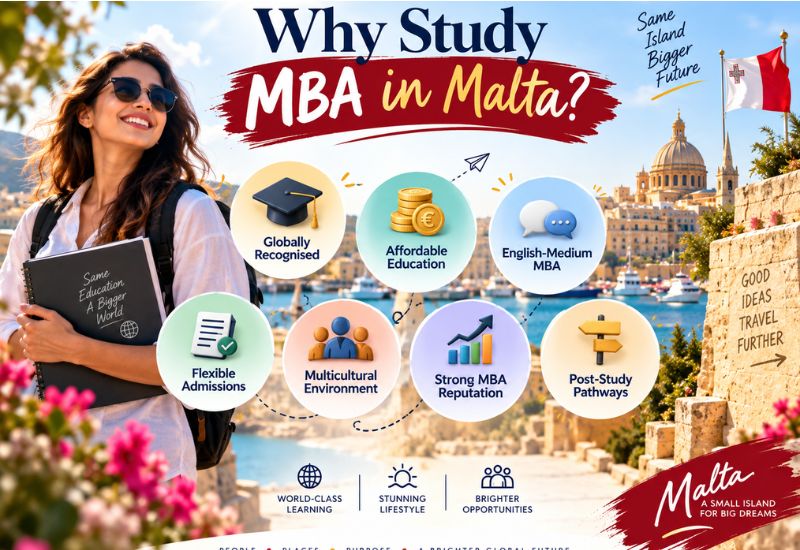
Globally recognised universities — Universities in Malta are recognised internationally, giving graduates credible, portable qualifications
Affordable education relative to Western Europe — The cost of pursuing an MBA in Malta is notably more affordable than many other European destinations.
English-medium instruction throughout — Since Malta's population is majority English-speaking and MBA programs are taught in English, the language transition is minimal for Indian applicants
Smooth, flexible admission process — If a single document isn't ready during the admission process, universities generally allow time to submit it later, letting applicants focus more on academics than paperwork logistics
Multicultural, career-focused environment — Malta offers a multicultural environment alongside career-focused MBA specialisations.
Strong reputation specifically for MBA education — Malta has built a well-established reputation globally for MBA programs specifically, supported by experienced faculty across its top institutions.
Clear post-study work pathways — Malta offers clear post-study work pathways alongside its affordable, English-taught programs
Eligibility Criteria for MBA in Malta
Eligibility Criteria for MBA in Malta
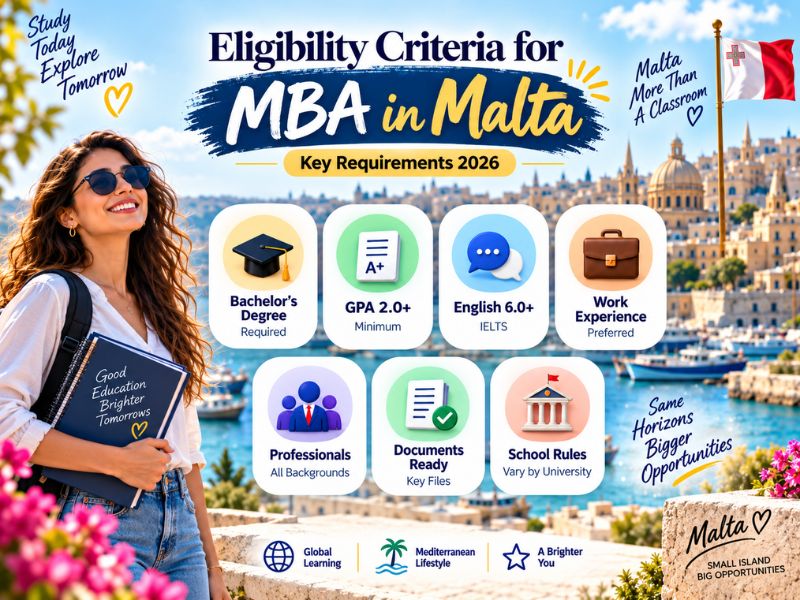
Bachelor's degree requirement — A bachelor's degree or an equivalent qualification in a related field is typically required for MBA/management program admission.n
US-system GPA requirement — Candidates studying under the US education system should submit transcripts with an average GPA of 2.0 for admission
English proficiency — IELTS 6.0 or equivalent is required, or applicants can qualify via prior English-medium undergraduate education instead.
Work experience — Not strictly mandatory for MBA admission, but preferred; 1-2 years of relevant experience meaningfully strengthens the application
Working professionals advantage — Working professionals applying for MBA programs in Malta should provide proof of work experience for better chances of success in the admission process. ess
Documentation readiness — All necessary documents should be prepared in advance, since they're essential for both the MBA admission process and the subsequent student visa application.
Program-specific variation — Since exact GPA, English test, and work-experience thresholds differ between the University of Malta, Global College Malta, MFMAC, and other private institutions, confirming the specific requirement on each shortlisted school's official page is essential.
Admission Process for MBA in Malta 2026
Admission Process for MBA in Malta 2026
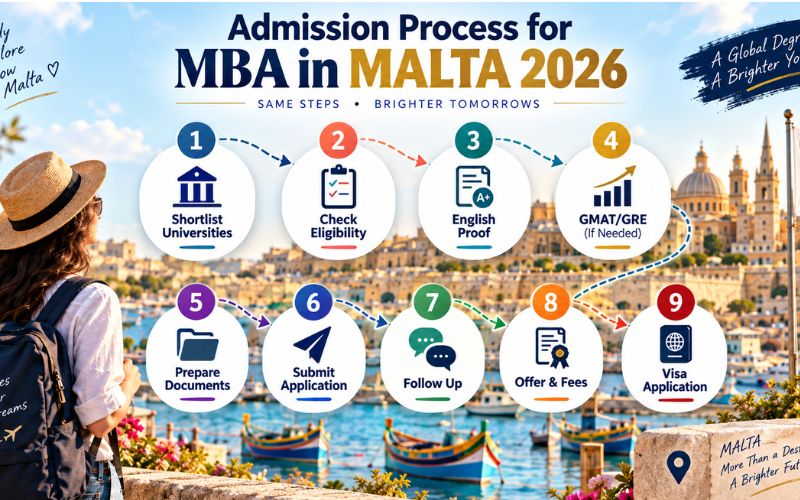
Step 1: Shortlist universities — Compare based on fees (€10,000-16,000 range), specialisation availability, and public vs. private status
Step 2: Confirm eligibility — Check each university's specific bachelor's degree, GPA, and work-experience preference
Step 3: English proficiency proof — Take IELTS (6.0+) or confirm eligibility via prior English-medium education
Step 4: Standardised test (if required) — Some institutions may require GMAT or GRE scores as part of the admission evaluation process, though this isn't universal across all Malta business schools
Step 5: Compile application documents — Complete and submit the application form, along with academic transcripts and supporting documents, prepared well in advance
Step 6: Submit application — Apply directly through the university's admissions portal or via an authorised study-abroad consultancy
Step 7: Document follow-up (if needed) — Since universities generally allow time to submit any missing document after initial submission, follow up promptly if requested
Step 8: Offer and fee confirmation — Confirm your admission offer and complete tuition payment or deposit as required
Step 9: Visa application — Apply for the Malta student visa well in advance, since visa processing carries a documented rejection risk if documentation isn't complete and accurate
GMAT, GRE & English Language Requirements
Not universally mandatory — Some institutions may require applicants to take the GMAT or GRE, using these exams to assess readiness for advanced management studies as part of the admission evaluation — but this requirement varies by university rather than being a blanket national standard.
GMAT-free pathways common at private institutions — Several private Maltese business schools (like MFMAC) do not list GMAT as a strict requirement, focusing instead on academic background and work experience
English proficiency benchmark — IELTS 6.0 or equivalent is the commonly cited standard, a comparatively accessible threshold relative to many other European MBA destinations
Alternative English proof — Applicants with prior English-medium undergraduate education can often use this as proof of proficiency instead of a separate test score
US-system applicants' specific requirement — A minimum GPA of 2.0 is expected from candidates coming from a US-pattern education system
Confirm exact thresholds per school — Since GMAT/GRE and English requirements differ meaningfully between University of Malta, American University of Malta, Global College Malta, GBS Malta, and MFMAC, checking each shortlisted institute's specific admissions page is essential before applying.ng
Note: Fees, GMAT policy, aur degree-recognition rules (especially the AIU equivalency point for government-sector roles in India) university-wise aur regularly update hote hain — publish se pehle official university websites aur Association of Indian Universities (AIU) se latest 2026 figures confirm kar lena strongly recommend karta h
Top MBA Universities in Malta
Top MBA Universities in Malta
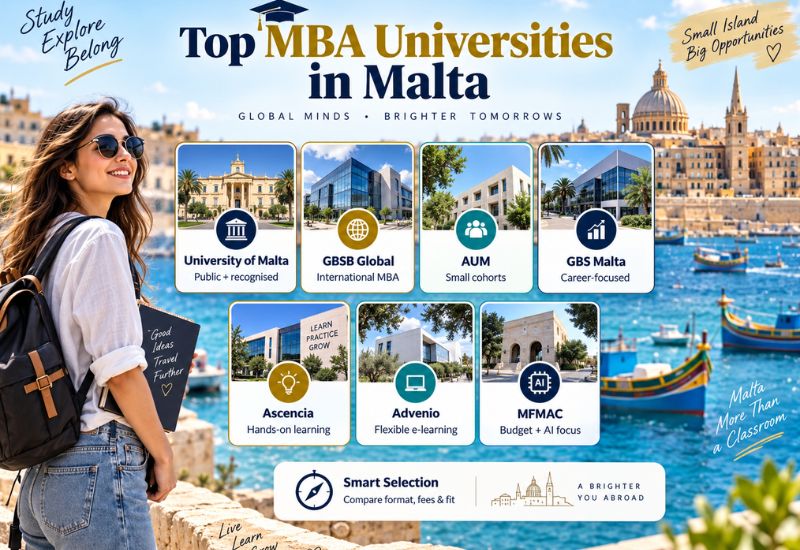
University of Malta — The country's leading public university, offering a wide range of specialisations, including healthcare management, logistics and supply chain management, and more
GBSB Global Business School — Globally recognised private institution, popular among international MBA applicants
American University of Malta (AUM) — A globally recognised university, known for small class sizes, a diverse international student body, and modern facilities offering a personalised learning experience
GBS Malta — Popular for business and management programmes, with a student-friendly application process
Ascencia Business School — Part of the French educational conglomerate Collège de Paris, offering global MBA and executive programmes with a strong focus on innovation and entrepreneurship near Valletta
Global College Malta & MFMAC — Recognised private options offering more budget-friendly MBA tracks, including specialised AI-focused MBA options
MCAST (Malta College of Arts, Science and Technology) — Excellent for vocational and technical education, with prestigious specialities in Business Administration, Hospitality and Tourism Management, and Engineering
Best MBA Colleges in Malta for International Students
Best MBA Colleges in Malta for International Students
University of Malta — Best choice for globally recognised, publicly-backed education with the widest specialisation range
American University of Malta — Best for a highly personalised, small-cohort learning experience with modern facilities
GBS Malta — Strong choice for career-oriented, employability-focused business education
Ascencia Business School — Best for practical, case-study and live-project-driven learning, ideal for students wanting hands-on exposure to European business practices
Advenio eAcademy — A flexible e-learning option offering MBA, Master's in Finance, and Master's in Marketing, partnered with universities across Europe and part of the Erasmus+ program — useful for students wanting a remote-friendly format
MFMAC — Strong budget-conscious option with a distinctive AI-specialization MBA track
Selection consideration — Since Malta doesn't have one single dominant MBA brand the way some countries do, comparing specialisation strength, learning format (on-campus vs. e-learning), and fee bracket across these institutions is more useful than relying on a single overall ranking
MBA Specialisations in Malta
Healthcare Management — Offered at the University of Malta, reflecting growing global demand for healthcare-sector business leadership.
Logistics and Supply Chain Management — Also a University of Malta specialisation, relevant given Malta's Mediterranean trade and shipping positioning
Finance — Offered at institutions like Advenio eAcademy (Masters in Finance) and several other Maltese business schools.
Marketing — Available at Advenio eAcademy and Ascencia Business School, among others
Digital Marketing — A specific offering at Ascencia Business School, reflecting current industry demand
International Management — Also offered at Ascencia, suited for students targeting cross-border corporate careers
Artificial Intelligence (MBA specialisation) — A distinctive track at MFMAC, blending traditional MBA coursework with AI-focused modules
Business Administration (general) — The broadest and most commonly available specialisation across nearly every Maltese business school
MBA in Malta: Fees Comparison
University of Malta — €12,000-16,000 for the entire program
Global College Malta — €10,000-14,000 for the entire program
MFMAC — €10,000 for the standard MBA; €12,500 for the MBA with AI Specialization
Overall annual fee range (broader sources) — ₹5.5-22 lakh per year depending on university, or ₹7-24 lakh for a 1-year program at institutions like GBS Malta and the London School of Commerce
Cheaper vocational/business-focused institutions — Global College Malta, MCAST, GBS Malta, and the European Institute of Education (EIE) generally start from €6,000 and go up to €10,000 for UG and PG courses, making business/management/IT programs comparatively more affordable than other disciplines
EU/EEA vs non-EU/EEA fee gap — Specialised programmes (including MBA) generally range €9,000-27,000/year for EU/EEA students, but can range more widely, €2,000-31,000/year, for non-EU/EEA students depending on the specific university and program
Business-related programs pricing note — Science-based and business-related programmes are generally the most expensive category, and private universities typically charge even higher fees than public one
Cost of Living in Malta for MBA Students
Cost of Living in Malta for MBA Students
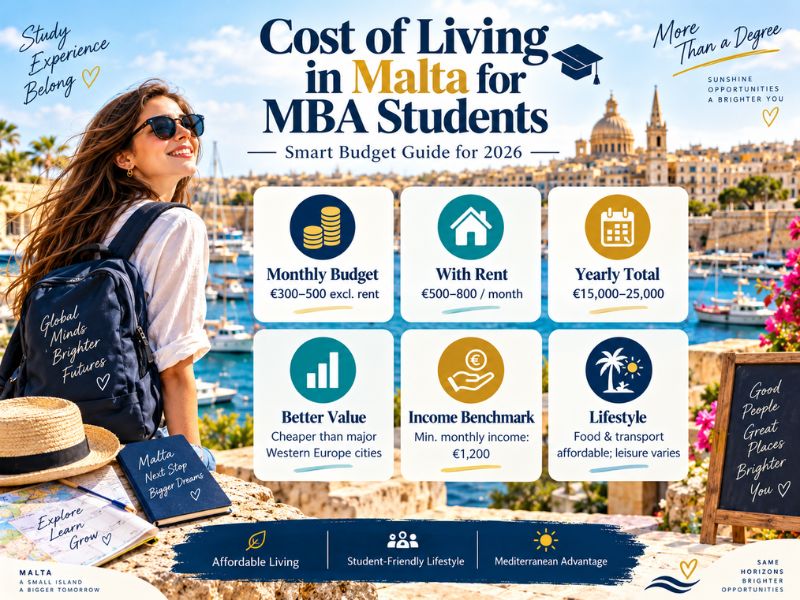
Monthly living cost range — €300-500 per month excluding rent, or €500-800/month depending on lifestyle and accommodation type when rent is included
City-based variation — Monthly expenses in cities like St. Julian's, Msida, and Birkirkara generally run ₹70,000-1,50,000 lower than equivalent Western European cities
Overall combined cost (tuition + living) — Total cost of studying in Malta, including living expenses, typically comes to around €15,000-25,000 per year (~₹16-27 lakh at recent exchange rates)
Cost comparison note — Malta is considered relatively expensive by British/Indian currency standards compared to living in India, but remains notably cheaper than London, Paris, or major German citi.es
Minimum wage benchmark — Malta's minimum monthly average income is €1,200, a useful reference point for post-study budget planning
Lifestyle factor — Food and transport costs are not particularly expensive, though leisure and entertainment spending can vary significantly based on individual lifestyle choices
Scholarships for MBA in Malta
University of Malta scholarships — Offers scholarships for international students specifically to help reduce the cost of studying, available across undergraduate, postgraduate, MBA, diploma, and research programs
GBS Malta and Global College Malta — Provide merit-based and excellence scholarships that can cover up to 50-100% of tuition fees for deserving candidates
Erasmus+ and external opportunities — Some external funding sources like Erasmus+ or private Indian foundations may support students depending on eligibility
Limited government-funded scholarships — Malta's government-funded scholarships are generally geared toward EU students, so Indian applicants should focus primarily on institutional awards designed to attract global talent.
Scholarship types — Offered in two main forms: need-based and merit-based, with some covering full tuition, others partial tuition, and some extending to accommodation or day-to-day living expenses
Application requirements — Academic certificates, a Statement of Purpose (SOP), recommendation letters, English language proficiency proof, and a university admission letter are generally required. ired
Apply early — Since scholarship seats are limited and competition is high, applying as early as possible meaningfully improves selection chances
MBA in Malta for Indian Students
British-influenced education system — Malta's education system is similar to the British education system, and degrees from institutions like the University of Malta are highly regarded and globally acknowledged
Multicultural, inclusive policy environment — The Maltese government has permitted applicants from diverse backgrounds to participate in higher study programs, with inclusive representation of minority groups, languages, and cultures
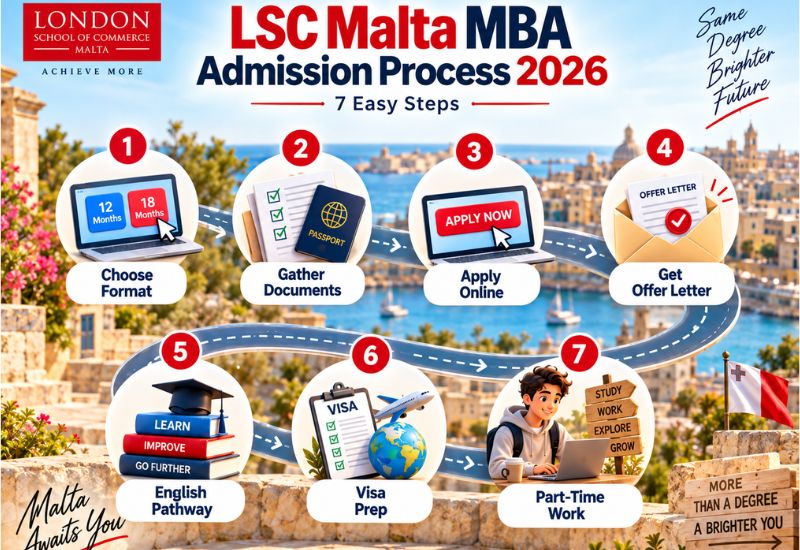
Part-time work rights during study — Indian students can work up to 20 hours per week during the academic term and full-time during holidays
Type D student visa requirement — Required for courses longer than 90 days, covering most MBA programs lasting 1-2 years; requires an admission letter from an accredited Maltese university, valid passport, proof of funds, health insurance, academic transcripts, and English proficiency .proof
Distinctive curriculum style at some schools — Programs often incorporate sector visits, consultancy projects (e.g., 12-week briefs for Maltese SMEs), and boardroom simulations with panels from institutions like HSBC Mediterranean bankers
Practical caution for Indian students — Malta's Western/European social environment includes distractions like late-night parties and nightlife culture — staying focused on academics over the 1-2 year program is important for both academic and scholarship success.
MBA in Malta: Course Duration & Curriculum
Standard duration — Most MBA programs run 1-2 years, aligning with the Type D student visa's coverage window
Core subjects — Strategic Management, Corporate Finance, and Behavioural Economics form common core coursework at several Maltese business schools
Elective options — ESG Reporting, Blockchain Governance, and Digital Health Ventures are among specialised electives available at some institutions.
Applied consultancy component — Programs often include a real-world consultancy project, such as a 12-week brief for a Maltese SME (small-medium enterprise), giving students direct practical exposure
Fast-track/block delivery format — Some programs offer modules like Managerial Accounting completed in eight weeks or Supply-Chain Leadership in six weeks, alongside five-day intensive workshops every six weeks — a format designed to enable continued employment during study
Capstone/exit options — Students can typically choose between a dissertation or live start-up incubation (with seed funding up to €5,000 at some schools) as their final program component
Industry engagement built into design — Universities purposely load the curriculum with sector visits and boardroom simulations, reflecting Malta's practical, industry-embedded approach to MBA education.n
MBA in Malta: Placements
Post-study work visa pathway — Graduates can apply for a post-study work visa valid for up to nine months, allowing them to stay in Malta while seeking employment related to their MBMBA specialisation in sectors like finance, consulting, and technology
Qualification requirements for post-study visa — Graduates must submit proof of degree completion, a valid residence permit, and evidence of sufficient funds
Conversion to work permit — During the post-study period, graduates can accept job offers and later switch to a work permit tied to their employment, bridging the gap between academic life and professional careers
Long-term work permit threshold — Employers only need to show the job pays at or above Malta's national median wage (~€21,000 per year) to convert the post-study permit into a longer-term work visa
iGaming sector accessibility — Given that entry-level managerial salaries in Malta's iGaming industry touch €28,000, most MBA holders comfortably satisfy the salary threshold for work permit conversion in this sector
Career support caveat — It's worth distinguishing between "career support" services (workshops, resume help) and "guaranteed campus placements" — insist on clarity from your shortlisted university on which one they actually offer
Strategic career fit — Malta's compressed cost, risk, and time-to-ROI make it particularly suited to mid-level managers who are priced out of London or wary of longer visa queues in destinations like Germany
Average MBA Salary in Malta
National median wage benchmark — Around €21,000 per year, used as the key threshold for converting a post-study permit into a longer-term work visa
iGaming sector entry-level salaries — Entry-level managerial salaries in Malta's iGaming industry reach around €28,000 per year, notably above the national median and a strong fit for MBA graduates targeting this sector
Minimum monthly income reference — Malta's lowest average monthly income is €1,200, relevant both for cost-of-living planning and work-permit salary requirements
Sector variation — Salaries vary meaningfully by industry, with digital/tech-adjacent sectors like iGaming and fintech generally offering higher starting compensation than more traditional local business roles
Time-to-ROI positioning — Malta is specifically positioned as compressing cost, risk, and time-to-ROI into roughly an 18-month horizon, making it attractive for mid-career professionals seeking a faster payback period than larger, higher-cost MBA destinations
India-comparison value — Even at more modest Maltese salary levels compared to larger economies like the UK or Germany, the combination of lower tuition, lower cost of living, and Schengen-adjacent mobility can still represent a meaningful overall value proposition for Indian MBA aspirants
Note: Scholarship structures, salary thresholds, aur post-study visa/work-permit rules multiple sources ke beech thoda vary kar rahe hain aur regularly update hote hain — publish se pehle official university websites aur Malta's immigration authorities se latest 2026 figures cross-verify kar lena strongly recommend karta hoon.
Student Visa & Residence Permit for Malta
For Indian and other non-EU students planning to pursue an MBA in Malta, obtaining the correct student visa and residence permit is an important part of the admission process.
Student D-Visa — Students planning to study a course of more than 105 days generally need to apply for a Malta National D-Visa before travelling. Identità recommends submitting the application well in advance of the course start date.
Study Residence Permit — Students enrolled in eligible full-time higher-education programmes at MQF Level 5 or above can apply for a study residence permit in Malta.
Part-Time Work Permission — International students may be permitted to work up to 20 hours per week, subject to the required employment licence and applicable conditions.
Financial & Accommodation Documents — Students should be prepared to provide documents related to finances, accommodation, insurance, passport and admission/enrolment as required by the authorities.
Residence Permit Renewal — Students continuing their studies may need to renew or extend their residence status before the existing permit expires.
Post-Study Residence Option — Eligible graduates may apply for a 9-month post-study residence permit to look for employment or establish a qualifying business after completing their studies.
Important: Visa and residence requirements can change, so students should verify the latest requirements with Identità Malta before submitting an application.
Career Opportunities After MBA in Malta
An MBA in Malta can provide international students with exposure to European business practices and opportunities across several growing industries. The country's international business environment makes an MBA relevant for students interested in management and business careers.
Management & Business Consulting — MBA graduates can explore roles in business strategy, management consulting and organisational development.
Finance & Banking — Opportunities are available in areas such as financial management, corporate finance, investment services and risk management.
Marketing & Sales — Graduates can pursue careers in digital marketing, brand management, sales management and business development.
International Business — Malta's international business environment can be suitable for graduates interested in multinational companies and cross-border operations.
Operations & Supply Chain — MBA graduates may work in operations management, logistics, procurement and supply-chain-related roles.
Entrepreneurship — Students with a business idea can explore entrepreneurship and startup opportunities after completing their MBA.
Management Roles — With relevant experience, graduates can progress toward positions such as Business Manager, Operations Manager, Marketing Manager or Business Development Manager.
Post-Study Work Opportunities in Malta
Malta offers eligible international graduates a pathway to remain in the country temporarily after completing their studies and search for suitable employment.
9-Month Job Search Period — Eligible non-EU graduatsfully complete an MQF Level 5 or higher course can apply for a 9-month post-study residence permit.
Find Relevant Employment — Graduates can use this period to search for jobs related to their qualifications and career goals.
Transition to a Work Permit — The post-study permit itself does not automatically provide full-time work rights. After receiving a suitable job offer, the employer generally needs to apply for the appropriate work authorisation, such as a Single Permit.
Business Opportunities — The post-study route can also provide eligible graduates with time to explore setting up a qualifying business in Malta.
Long-Term Career Planning — Students who secure suitable employment can explore longer-term residence and employment options according to Malta's immigration rules.
Build European Experience — Working in Malta after an MBA can help graduates gain practical international business experience and strengthen their professional profile.
Note: The 9-month post-study permit is a temporary job-search route and is not itself a full-time work permit. Graduates need to meet the applicable requirements for employment authorisation.
ROI of MBA in Malta (Fees vs Salary)
The Return on Investment (ROI) of an MBA in Malta depends on tuition fees, living expenses, previous work experience, job role, salary level and how quickly a graduate secures suitable employment.
Tuition Fees — MBA costs vary considerably by university and programme. For example, the University of Malta lists a €14,000 total fee for non-EU students for its International MBA for the 2026/27 intake, before any applicable discount.
Living Expenses — Students should separately budget for accommodation, food, transport, insurance and other personal expenses.
Part-Time Work — Eligible students may be able to work up to 20 hours per week under the applicable rules, helping them gain experience and partially manage living expenses.
Salary Potential — MBA salaries vary based on industry, experience, job title and employer. Management, finance, business development and consulting roles can offer stronger earning potential than entry-level positions.
Career Growth — Students with prior professional experience may have better opportunities to move into managerial and specialist positions.
Long-Term ROI — The strongest ROI generally comes when graduates secure relevant employment and use their MBA to progress into higher-responsibility roles.
Compare the Best MBA Universities in Malta
Choosing the right MBA university in Malta depends on your budget, preferred learning style, career goals and the type of business specialisation you want to pursue.
University / Business School
Best For
Key Advantage
University of Malta
International MBA & academic quality
Public university with a broad range of academic and professional opportunities
American University of Malta
Small-cohort learning
Personalised learning environment and modern business education
GBS Malta
Career-focused business education
Practical approach with emphasis on employability and business skills
Ascencia Business School
Practical MBA learning
Case studies, projects and hands-on business exposure
Advenio eAcademy
Flexible learning
Flexible, technology-supported study options
MFMAC
Budget-conscious students
Business education with specialised programme options
When comparing MBA colleges in Malta, students should check programme accreditation, tuition fees, entry requirements, course duration, specialisations, learning format, career support and international recognition.
For example, the University of Malta's International MBA offers an international business curriculum and lists career possibilities including management consulting, investment banking, entrepreneurship, corporate finance and international business.
Best choice: There is no single MBA university that is ideal for every student. The best option depends on your academic profile, budget, career objective and preferred specialisation.
Frequently Asked Questions (FAQs)
1. Is Malta a good destination for an MBA?
Yes. Malta can be a suitable option for students looking for an international business education in a European environment. MBA programmes can help students develop skills in management, finance, marketing, strategy, leadership and entrepreneurship.
2. How much does an MBA in Malta cost for international students?
MBA tuition fees vary depending on the university and programme. For example, the University of Malta lists total tuition fees of €14,000 for non-EU students for its 2026/27 International MBA.
3. Can Indian students study MBA in Malta?
Yes. Indian students can apply for eligible MBA programmes in Malta if they meet the university's academic, English-language and other admission requirements.
4. Do Indian students need a visa to study MBA in Malta?
Yes. Indian students generally need the appropriate National Long-Stay Type D visa before travelling to Malta for studies exceeding the relevant short-stay period. Students studying eligible higher-education programmes may also need a study residence permit.
5. Can international students work while studying in Malta?
Eligible international students can work part-time under Malta's applicable student employment rules. Students should obtain the required authorisation before starting employment.
6. Can I stay in Malta after completing my MBA?
Eligible non-EU graduates may apply for a 9-month post-study residence permit after completing an eligible course. This period can be used to search for employment or explore a qualifying business opportunity.
7. Can I work full-time after my MBA in Malta?
The post-study residence permit is primarily a job-search route and does not automatically give graduates full-time work rights. After receiving a suitable job offer, the appropriate employment authorisation, such as a Single Permit, is required.
8. What career opportunities are available after an MBA in Malta?
MBA graduates can explore careers in management consulting, finance, investment services, marketing, business development, operations, entrepreneurship and international business. The University of Malta also lists management consulting, investment banking, corporate finance and international business among potential career areas.
9. Is an MBA in Malta worth the investment?
It can be worthwhile for students who choose an appropriate programme and successfully transition into relevant employment. Students should compare tuition fees, living costs, university reputation, programme quality, career support and potential salary growth before making a decision.
10. Which is the best MBA university in Malta?
There is no single best university for every student. The right choice depends on your budget, academic profile, preferred specialisation, learning format and career goals. The University of Malta is one important option for students considering an established public university and an International MBA.