







London School of Commerce Malta MBA Fees, Eligibility, Admission & Career Opportunities

Table of Contents
London School of Commerce Malta MBA: Highlights 2026
London School of Commerce Malta (LSC Malta) has emerged as a genuinely popular choice for Indian students specifically, combining British-affiliated degree credibility with Mediterranean affordability. Located in Floriana, Malta, the campus offers students the opportunity to study English and obtain an internationally recognised MBA degree awarded by the University of Bedfordshire, giving graduates a UK degree qualification without UK-level tuition costs.
LSC Malta forms part of the global London School of Commerce Group of Colleges, with all programmes fully accredited by the National Commission for Further and Higher Education in Malta and approved at the appropriate level of the European Qualifications Framework — ensuring global portability and recognition of your degree. The MBA is specifically accredited at Level 7 in the Maltese Qualifications Framework, which is internationally recognised as equivalent to both UK Master's Level 7 and European Qualifications Framework Level
Why Choose London School of Commerce Malta MBA?
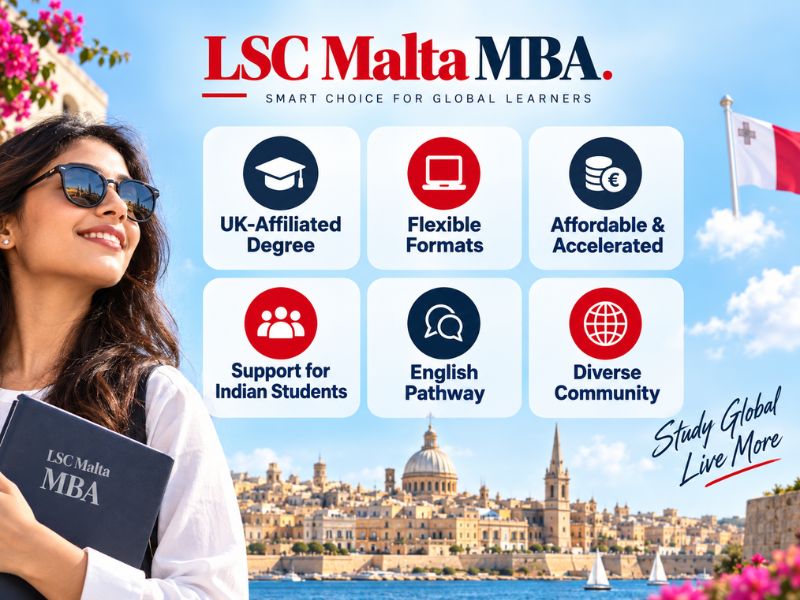
Considering LSC Malta specifically for your MBA? Here's why it makes strategic sense in 2026.
1. A UK-affiliated degree at a genuinely accessible cost
This course leads to an MBA degree awarded by the London School of Commerce Malta, accredited at Level 7 in the Maltese Qualifications Framework — internationally recognised as equivalent to UK Master's Level 7, giving you UK-level degree recognition without London's price tag.
2. Genuinely flexible program formats
MBA courses are taken part-time, and you can choose between full-time (12 months) or part-time (18 months) formats, genuinely accommodating both career-focused fast-trackers and working professionals.
3. Cost-effective and accelerated structure
LSC Malta's programmes are cost-effective and accelerated, allowing students to achieve qualifications more efficiently, with flexible programme entry and exit points throughout the year enabling smooth progression. The fees charged are extremely competitive and include all costs associated with recruitment, admission, and tuition.
4. Strong support specifically for Indian students
LSC Malta stands out due to its flexible programs, multicultural community, and strong career support, helping Indian students transition seamlessly from Indian academia to international success.
5. Discounted pathway for English preparation
Students who complete programs in Academic English can proceed to study for an MBA for a discounted fee — a genuinely useful bridge if your current English proficiency doesn't yet meet direct MBA entry requirements.
6. Balanced, diverse student community
The student population at LSCM comprises a very balanced percentage of local and international delegates, reflecting genuine multicultural integration rather than an isolated international-student bubble.
London School of Commerce Malta MBA: Eligibility Criteria
Before applying to LSC Malta's MBA program, make sure you meet the following eligibility requirements for 2026 admissions.
Academic qualification
- Postgraduate programs require a relevant bachelor's degree with satisfactory academic records.
Curriculum background flexibility
- The MBA attracts people from a wide range of academic disciplines — you don't need a specific undergraduate business background to qualify, genuinely widening eligibility for career-changers.
English proficiency
- Non-native English speakers must provide proof of English language proficiency.y
Required documents
- Academic transcripts, proof of English proficiency, a personal statement, and a passport copy are all required as part of your application package.
Our advice: Since the MBA genuinely welcomes candidates from diverse academic disciplines rather than requiring a specific undergraduate business background, don't rule out LSC Malta if your degree is in an unrelated field — this program is specifically designed to be accessible to a broad range of professional backgrounds, including recent graduates alongside experienced managers.
London School of Commerce Malta MBA Admission Process 2026
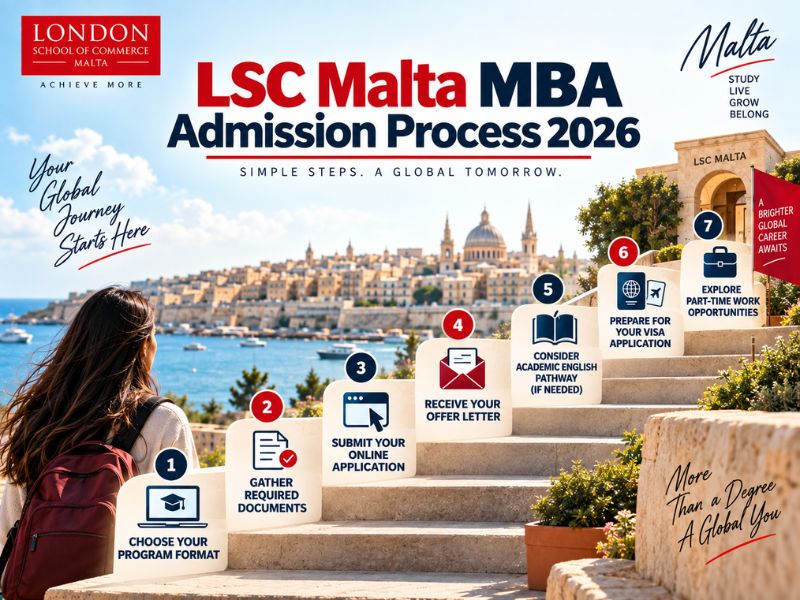
Here's a step-by-step breakdown of what the admission process looks like for 2026.
Step 1: Choose your program format
Decide bet
ween full-time (12 months, €6,950) or part-time (18 months, €5,950) based on your career situation and timeline preferences.
Step 2: Gather required documents
Prepare your academic transcripts, proof of English proficiency, a personal statement, and a passport copy.
Step 3: Submit your online application
Submit the application form and required documents through the LSC Malta website, or download the LSC application form and send the completed form by post or email.
Step 4: Receive your offer letter
Successful applicants will receive an offer letter detailing the next steps in your admission journey.
Step 5: Consider the Academic English pathway if needed
If your English proficiency needs strengthening, you can enrol in Academic English programs (available in 4-,8-8, or 12-month durations, priced from €1,950 to €3,950) before proceeding to the MBA — and completing this pathway qualifies you for a discounted MBA fee.
Step 6: Prepare for your visa application
International students willing to apply must fulfil required documentation at least 60 days before their intended arrival date in Malta — build this timeline into your overall application planning.
Step 7: Explore part-time work opportunities
International students in Malta can seek external funding or employment while studying at LSCM, with a broad range of work availability spanning hospitality and other professional and industrial outlets — work permits are given to viable candidates as long as they retain good academic standing.
Our advice: Since visa documentation needs to be finalised at least 60 days before your intended arrival, and the Academic English pathway (if needed) adds several additional months before you can even begin your MBA, start your entire application process well in advance — particularly if you anticipate needing the English preparation route to unlock your discounted MBA fee.
London School of Commerce Malta MBA: English Language Requirements
Here's what you need to know about English proficiency for LSC Malta's MBA program in 2026.
Standard proficiency requirement
Non-native English speakers must provide proof of English language proficiency as part of their standard application documentation.
Academic English as a genuine bridge pathway
If your current proficiency falls short, LSC Malta offers dedicated Academic English programs in three durations — 12 months (€3,950), 8 months (€2,950), and 4 months (€1,950) — designed to prepare you for the MBA specifically.
The discount incentive for using this pathway
Students who complete programs in Academic English can proceed to study for an MBA for a discounted fee — meaning taking this route isn't just a proficiency safety net, but can genuinely reduce your total program investment.
What this means practically for Indian applicants
Since Indian undergraduate education is frequently English-medium, many applicants may already meet proficiency requirements directly — but for those from regional-language-medium backgrounds or with weaker formal English test scores, LSC Malta's structured Academic English pathway offers a genuinely accessible, cost-effective route rather than requiring you to separately prepare for and pass IELTS/TOEFL before applying at all.
Our advice: If you're uncertain whether your English proficiency meets direct MBA entry requirements, don't assume you're ineligible — reach out to LSC Malta admissions directly to assess your specific documentation, since the Academic English pathway genuinely functions as both a proficiency bridge and a cost-saving route into your eventual MBA.
London School of Commerce Malta MBA: English Language Requirements
Here's what you need to know about English proficiency for LSC Malta's MBA program in 2026.
Standard proficiency requirement
Non-native English speakers must provide proof of English language proficiency as part of their standard application documentation.
Academic English as a genuine bridge pathway
If your current proficiency falls short, LSC Malta offers dedicated Academic English programs in three durations — 12 months (€3,950), 8 months (€2,950), and 4 months (€1,950) — designed to prepare you for the MBA specifically.
The discount incentive for using this pathway
Students who complete programs in Academic English can proceed to study for an MBA for a discounted fee — meaning taking this route isn't just a proficiency safety net, but can genuinely reduce your total program investment.
What this means practically for Indian applicants
Since Indian undergraduate education is frequently English-medium, many applicants may already meet proficiency requirements directly — but for those from regional-language-medium backgrounds or with weaker formal English test scores, LSC Malta's structured Academic English pathway offers a genuinely accessible, cost-effective route rather than requiring you to separately prepare for and pass IELTS/TOEFL before applying at all.
Our advice: If you're uncertain whether your English proficiency meets direct MBA entry requirements, don't assume you're ineligible — reach out to LSC Malta admissions directly to assess your specific documentation, since the Academic English pathway genuinely functions as both a proficiency bridge and a cost-saving route into your eventual MBA.
London School of Commerce Malta MBA Fees 2026
Here's a realistic breakdown of LSC Malta's MBA costs for 2026.
Core MBA tuition
The Master in Business Administration costs €6,950 for full-time study (12 months) or €5,950 for part-time study (18 months).
Discounted fee via the Academic English pathway
Students who complete the Academic English course pathway at LSC Malta can proceed to study the full-time 12-month MBA at a discounted price of €5,950 — meaningfully lower than the standard direct-entry fee.
Academic English course fees (if needed as a bridge)
If your proficiency needs strengthening before the MBA, Academic English courses are available at €1,950, €2,950, and €3,950 depending on duration (4, 8, or 12 months respectively).
What's included in your tuition
Fees are extremely competitive and include all costs associated with recruitment, admission, and tuition — genuinely comprehensive pricing without hidden add-ons for core program costs.
Payment flexibility
Tuition fees are payable in flexible instalments, easing the cash-flow burden across your program duration rather than requiring a single lump-sum payment.
Our advice: Since completing the Academic English pathway genuinely unlocks a lower MBA fee (€5,950 vs. potentially higher direct rates), it's worth evaluating this route even if your English proficiency is borderline-sufficient — the combined cost of English preparation plus discounted MBA tuition may work out comparably to, or even below, standard direct MBA entry at other institutions.
London School of Commerce Malta MBA Course Duration
Here's what the actual program timeline looks like for 2026.
Standard duration options
The MBA program spans 12 months for full-time study or 18 months for part-time study — genuine flexibility depending on whether you're studying exclusively or balancing work alongside your degree.
Combined English-plus-MBA pathway duration
If you require the Academic English bridge course, factor in an additional 4-12 months (depending on your starting proficiency level) before beginning your MBA coursework itself.
Semester structure
The program is structured across semesters — for instance, Semester 2 comprises two core modules plus two electives, reflecting a genuinely structured, modular progression through the degree.
Flexible entry and exit points
Flexible programme entry and exit points throughout the year enable students to proceed to the next level of their education smoothly — a genuine advantage if your personal timeline doesn't align with traditional September/January-only intakes.
Our advice: If you're weighing full-time versus part-time, remember that the 18-month part-time format isn't necessarily "slower" in a negative sense — it's specifically designed for working professionals who want to continue earning and building experience alongside their MBA, which can itself be valuable for your eventual major project and career narrative.
London School of Commerce Malta MBA Curriculum & Syllabus
Here's what you'll actually study during your LSC Malta MBA in 2026.
Core modules
The core modules of the MBA programme are designed to introduce students to various areas of business, including Accounting, Finance, Marketing, Human Resource Management, and Strategic Management — the standard, comprehensive general management foundation.
Broader subject coverage
The program covers a wide range of topics including marketing, accounting, finance, human resource management, operations management, and strategic management, giving you rounded exposure across nearly every core business function.
Teaching and delivery format
The program is delivered through a combination of lectures, seminars, workshops, and case studies, which provide students with the opportunity to apply theoretical concepts to practical situations — genuinely blending theory with applied learning.
Skill-building focus
The program is designed to develop students' critical thinking, problem-solving, and decision-making skills, which are essential for success in the business world — core competencies employers genuinely value beyond just subject knowledge.
Progression structure
Students complete the first five core modules and required electives before being given the option to progress to their Major Project for final degree completion.
Our advice: Since the curriculum genuinely spans the full breadth of core MBA subjects (Accounting, Finance, Marketing, HR, Strategic Management, Operations) rather than narrowing early into a single specialisation, use your first several modules to identify which functional area genuinely interests you most — this will meaningfully shape your elective choices and Major Project direction later in the program.
London School of Commerce Malta MBA Specialisations & Electives
Here's what specialisation options are genuinely available within LSC Malta's MBA structure for 2026.
Elective choice built into the program
Students on the MBA programme also have a choice of specialist electives before proceeding to the Major Project — genuine flexibility to tailor your studies toward specific interests within the broader MBA framework.
International Business specialisation option
Specific electives exist for students enrolled on the MBA course who wish to specialise in International Business — a distinctly available track for those wanting deeper focus in this area.
Tailoring to career goals
The elective structure allows students to tailor their studies to their specific interests and career goals — rather than a rigid, single-track program, you genuinely shape part of your degree around your professional direction.
Semester-based elective structure
Electives are integrated within the semester structure — for example, Semester 2 specifically comprises two core modules plus two electives, showing how specialisation choices are woven throughout the program rather than concentrated only at the end.
Global perspective option
A "Master in Business Administration Global" variant is also available, focusing on innovative strategies, leadership skills, and international market dynamics — worth checking whether this specific global-focused track differs from the standard MBA in your admissions conversations.
Our advice: If international career mobility is a priority for you, specifically ask your admissions counsellor about the International Business elective track and the Global MBA variant — these appear to be genuinely distinct options worth clarifying before you finalise your enrollment, since programme naming and structure can vary slightly across LSC's different prospectus materials.
London School of Commerce Malta MBA: Major Project
Here's what the culminating Major Project component genuinely involves for 2026.
What the Major Project is
The Major Project is an intellectually rigorous, capstone component required to complete your MBA — positioned as the final stage after you've completed your core modules and chosen electives.
Genuine employer-recognized value
The programme, together with the Major Project module, adds value that will be recognised by employers in an increasingly competitive environment — it's specifically designed to demonstrate your applied capability, not just theoretical knowledge.
What it prepares you for professionally
It offers a dimension of experience that enables graduates to fit into work culture, do the job, develop ideas, take initiative and responsibility, and ultimately help organisations manage change — genuinely practical, workplace-relevant skill demonstration.
Degree-awarding partner university — an important variation to verify
This is genuinely worth clarifying directly with LSC Malta before enrolling, since different sources describe different partner-university pathways for the Major Project and final degree award — some describe progression to the University of Suffolk (resulting in an MBA from University of Suffolk), others describe the University of Bedfordshire (resulting in an MBA Global degree), and still others describe an option to transfer credits to Anglia Ruskin University for your final semester. This may reflect different intake cohorts, programme variants, or updates over time — confirm the current, specific partner university and degree-awarding body for your intended intake directly with LSC Malta admissions before committing.
Assessment structure
Each module, including work leading into your Major Project, consists of scheduled classes, guided learning, and self-directed learning — a genuinely blended structure balancing structured teaching with independent research capability.
Our advice: Given the genuine inconsistency across sources regarding which UK partner university (Suffolk, Bedfordshire, or Anglia Ruskin) awards your final MBA degree, treat this as your single most important verification question before enrolling — get written confirmation of the exact degree-awarding institution for your specific intake, since this detail directly affects how your qualification will be recognised by employers and other universities later.
London School of Commerce Malta MBA: Awarding University
- Degree awarded by University of Bedfordshire, UK — The MBA at LSC Malta leads to a degree officially conferred by a British university, not by LSC Malta itself.
- UK Level 7 / EQF Level 7 standard — The programme is delivered at UK Level 7, which equates to European Qualifications Framework Level 7, an internationally recognised academic standard
- NCFHE accreditation — LSCM is licensed as a higher education institution by Malta's National Commission for Further and Higher Education (NCFHE), with all programmes approved at the appropriate EQF level for global visibility and recognition
- Part of a global education group — LSC Malta forms part of the wider London School of Commerce Global Group, one of the UK's leading private education providers, offering one of the largest MBA programmes in Europe across its network.
- Founded in 2014 — LSCM was established in June 2014 as a global higher education provider in Malta, operating in parallel with the main LSC campus in London.n
- Multi-campus flexibility — Students have the opportunity to spend a semester at one of LSC's many overseas campuses, since the group operates across seven total locations including Malta and London
- Dual qualification value — Because the degree is UK-awarded but delivered in Malta, students effectively gain both UK and Malta higher education standing on their qualification
London School of Commerce Malta MBA: Placements & Career Opportunities
- Core curriculum design — Covers Accounting, Finance, Marketing, Human Resource Management, and Strategic Management, with a choice of specialist electives before progressing to a Major Project
- Internship placement support — Dedicated assistance in securing internships that provide practical experience directly in students' fields of study
- Industry partnerships — Collaborations with local and international companies offer a wide range of internship opportunities beyond just classroom learning
- Skill development workshops — Regular workshops on business communication, leadership skills, and project management supplement the core academic curriculum
- Industry-specific seminars — Led by industry experts focusing on current trends and developments across various business fields
- Mentorship programme — Current students are paired with alumni mentors who provide guidance and support based on real professional experience
- Alumni networking access — Students gain access to a network of successful alumni working across various industries, plus reunions and gatherings to stay connected post-graduation
- Reported placement outcomes — LSC aims to maintain a high placement rate for its graduates, with many securing jobs within a few months of graduation
Average Salary After MBA in Malta
- National median wage benchmark — Around €21,000 per year, which also serves as the key threshold for converting a post-study permit into a longer-term Maltese work visa
- iGaming sector entry-level salaries — Entry-level managerial roles in Malta's strong iGaming industry reach approximately €28,000 per year, notably above the national median
- Sector-based variation — Salaries vary meaningfully depending on industry, with digital, gaming, and fintech-adjacent sectors generally paying above traditional local business roles
- LSC-specific outcome data limitation — LSC Malta doesn't appear to publish detailed program-specific salary statistics publicly, so broader Malta-wide MBA salary benchmarks (median wage and iGaming figures) are the more reliable reference points currently available
- Broader European mobility value — Since the MBA is UK-awarded (University of Bedfordshire), graduates can also leverage this credential for salary negotiations or job opportunities beyond Malta itself, across both the UK and wider EU/EEA job markets
Scholarships & Financial Assistance for LSC Malta MBA
- No internal scholarships currently — LSC Malta explicitly states there are currently no internal funding opportunities for students at this institution
- External funding encouraged — External funding avenues are available to students independently, and many LSCM students receive funding or sponsorship from external agencies before beginning their studies
- Academic English discount pathway — Students who first complete a program in Academic English (€3,950 for 12 months, €2,950 for 8 months, or €1,950 for 4 months) can proceed to the MBA at a discounted fee
- Cost-effective fee structure by design — LSC Malta's overall fee positioning is built around affordability rather than merit-based scholarship reduction, with fees described as extremely competitive and inclusive of recruitment, admission, and tuition costs
- Part-time work as a funding supplement — International students can seek external funding or employment while studying, with a broad range of job availability in hospitality and other professional/industrial sectors in Malta, subject to maintaining good academic standing
- Budgeting takeaway — Since scholarships aren't built into LSC Malta's own funding model, prospective students should plan around either self-funding, external sponsorship, or education loans from their home country rather than expecting an in-house scholarship award
Student Visa Requirements for LSC Malta MBA
- Student visa application required — International students must apply for a Maltese student visa to study at LSC Malta, with the institute guiding the application process
- Core documentation — Submission of the offer letter, proof of financial means, and other required documents as part of the visa application
- Eligibility baseline — Applicants must have completed secondary education equivalent to UK A-levels or International Baccalaureate (IB) as a foundational admission requirement (relevant context for the broader LSC Malta application process)
- Academic transcripts and English proficiency — Overseas applicants must submit academic transcripts, meet GPA requirements, and provide IELTS scores as part of the standardised admission and visa-supporting documentation
- Accommodation arrangement — The institute assists with arranging accommodation, either on-campus or off-campus, as part of pre-arrival planning.
- Travel and orientation planning — Students are guided to plan travel in time for program start, followed by a formal orientation programme covering campus facilities and available resources
- Multiple intakes available — LSC Malta offers multiple intakes throughout the year, providing flexibility for when students choose to begin their program and, correspondingly, when to time their visa application.n
- Work permit access during study — Work permits are available to students maintaining good academic standing, alongside a broad range of job opportunities in hospitality and other professional/industrial sectors in Malta
Note: Fees, scholarship availability, aur admission requirements LSC Malta ke liye directly source se confirm hue hain, lekin placement statistics aur salary figures broader Malta-market estimates hain, LSC-specific published data nahi — publish se pehle official LSC Malta admissions office (lscmalta.edu.mt) se latest 2026-27 intake details aur fee structure verify kar lena strongly recommend karta hoon.
London School of Commerce Malta MBA: Awarding University
- Degree awarded by University of Bedfordshire, UK — The MBA at LSC Malta leads to a degree officially conferred by a British university, not by LSC Malta itself.lf
- UK Level 7 / EQF Level 7 standard — The programme is delivered at UK Level 7, which equates to European Qualifications Framework Level 7, an internationally recognised academic standard
- NCFHE accreditation — LSCM is licensed as a higher education institution by Malta's National Commission for Further and Higher Education (NCFHE), with all programmes approved at the appropriate EQF level for global visibility and recognition
- Part of a global education group — LSC Malta forms part of the wider London School of Commerce Global Group, one of the UK's leading private education providers, offering one of the largest MBA programmes in Europe across its network.
- Founded in 2014 — LSCM was established in June 2014 as a global higher education provider in Malta, operating in parallel with the main LSC campus in London.n
- Multi-campus flexibility — Students have the opportunity to spend a semester at one of LSC's many overseas campuses, since the group operates across seven total locations including Malta and London
- Dual qualification value — Because the degree is UK-awarded but delivered in Malta, students effectively gain both UK and Malta higher education standing on their qualification
London School of Commerce Malta MBA: Placements & Career Opportunities
- Core curriculum design — Covers Accounting, Finance, Marketing, Human Resource Management, and Strategic Management, with a choice of specialist electives before progressing to a Major Project
- Internship placement support — Dedicated assistance in securing internships that provide practical experience directly in students' fields of study
- Industry partnerships — Collaborations with local and international companies offer a wide range of internship opportunities beyond just classroom learning
- Skill development workshops — Regular workshops on business communication, leadership skills, and project management supplement the core academic curriculum
- Industry-specific seminars — Led by industry experts focusing on current trends and developments across various business fields
- Mentorship programme — Current students are paired with alumni mentors who provide guidance and support based on real professional experience
- Alumni networking access — Students gain access to a network of successful alumni working across various industries, plus reunions and gatherings to stay connected post-graduation
- Reported placement outcomes — LSC aims to maintain a high placement rate for its graduates, with many securing jobs within a few months of graduation
Average Salary After MBA in Malta
- National median wage benchmark — Around €21,000 per year, which also serves as the key threshold for converting a post-study permit into a longer-term Maltese work visa
- iGaming sector entry-level salaries — Entry-level managerial roles in Malta's strong iGaming industry reach approximately €28,000 per year, notably above the national median
- Sector-based variation — Salaries vary meaningfully depending on industry, with digital, gaming, and fintech-adjacent sectors generally paying above traditional local business roles
- LSC-specific outcome data limitation — LSC Malta doesn't appear to publish detailed program-specific salary statistics publicly, so broader Malta-wide MBA salary benchmarks (median wage and iGaming figures) are the more reliable reference points currently available
- Broader European mobility value — Since the MBA is UK-awarded (University of Bedfordshire), graduates can also leverage this credential for salary negotiations or job opportunities beyond Malta itself, across both the UK and wider EU/EEA job markets
Scholarships & Financial Assistance for LSC Malta MBA
- No internal scholarships currently — LSC Malta explicitly states there are currently no internal funding opportunities for students at this institution
- External funding encouraged — External funding avenues are available to students independently, and many LSCM students receive funding or sponsorship from external agencies before beginning their studies
- Academic English discount pathway — Students who first complete a program in Academic English (€3,950 for 12 months, €2,950 for 8 months, or €1,950 for 4 months) can proceed to the MBA at a discounted fee
- Cost-effective fee structure by design — LSC Malta's overall fee positioning is built around affordability rather than merit-based scholarship reduction, with fees described as extremely competitive and inclusive of recruitment, admission, and tuition costs
- Part-time work as a funding supplement — International students can seek external funding or employment while studying, with a broad range of job availability in hospitality and other professional/industrial sectors in Malta, subject to maintaining good academic standing
- Budgeting takeaway — Since scholarships aren't built into LSC Malta's own funding model, prospective students should plan around either self-funding, external sponsorship, or education loans from their home country rather than expecting an in-house scholarship award
Student Visa Requirements for LSC Malta MBA
- Student visa application required — International students must apply for a Maltese student visa to study at LSC Malta, with the institute guiding the application process
- Core documentation — Submission of the offer letter, proof of financial means, and other required documents as part of the visa application
- Eligibility baseline — Applicants must have completed secondary education equivalent to UK A-levels or International Baccalaureate (IB) as a foundational admission requirement
- Academic transcripts and English proficiency — Overseas applicants must submit academic transcripts, meet GPA requirements, and provide IELTS scores as part of the standardised admission and visa-supporting documentation
- Accommodation arrangement — The institute assists with arranging accommodation, either on-campus or off-campus, as part of pre-arrival planning.
- Travel and orientation planning — Students are guided to plan travel in time for program start, followed by a formal orientation programme covering campus facilities and available resources
- Multiple intakes available — LSC Malta offers multiple intakes throughout the year, providing flexibility for when students choose to begin their program and time their visa application accordingly.y
- Work permit access during study — Work permits are available to students maintaining good academic standing, alongside job opportunities in hospitality and other professional/industrial sectors in Malta
Student Life at London School of Commerce Malta
- Location — The campus is located in Floriana, in the vicinity of the historic city of Valletta, a UNESCO World Heritage Site, within easy reach of the island's main transport hub, shopping centres, leisure zones, and entertainment locations
- Multicultural student population — Students are immersed in a truly diverse environment made up of a melting pot of nationalities and cultures, making the experience formative well beyond core academic achievement
- Modern facilities — State-of-the-art classrooms equipped with interactive whiteboards, projectors, and audio-visual equipment; a well-stocked library with books, journals, and online resources; and a computer lab for internet access and academic software use
- Online learning integration — Students also get access to online learning platforms for course materials, assignment submission, and communication with instructors
- Close faculty-student interaction — The institution emphasises close faculty-student interaction, high academic standards, and a supportive living-learning environment, with a stated focus on student employability and entrepreneurial/innovative skill-building
- Government-aligned positioning — LSC Malta's presence aligns with the Government of Malta's broader objective of promoting the country as a Higher Education Hub to attract global talent and engage with regional business
- Government scholarship access — The Scholarships Unit within Malta's Ministry of Education periodically announces scholarship schemes open to current and prospective LSC Malta students, separate from any internal LSC funding
London School of Commerce Malta MBA: Pros and Cons
Pros:
- UK-awarded degree (delivered in association with a recognised UK university) at a meaningfully lower cost than studying directly in the UK
- Multiple intakes throughout the year, offering flexible enrollment timing
- Full-time (12 months) and part-time (18 months) format options, suited to both traditional students and working professionals
- Located in a UNESCO World Heritage city (Valletta) with strong transport, leisure, and cultural access
- Rated 3 Palms (Excellent Business School) by Eduniversal 2023, positioning it among the top 50 in Southern Europe for business education
- Modern facilities, close faculty-student interaction, and structured internship, mentorship, and alumni networking support
Cons:
- No internal scholarships currently offered directly by LSC Malta — students must rely on external funding, sponsorship, or government schemes
- Smaller, more niche brand recognition globally compared to larger, more established European or UK business schools
- Reported awarding-partner information varies across sources (University of Bedfordshire is most commonly cited, though at least one source references University of Wales Trinity Saint David) — confirm the current partner university directly with LSC Malta before applying, since accreditation partnerships can change over time
- Detailed, program-specific placement percentage and salary data isn't publicly available in the same depth as larger, more established business schools.
London School of Commerce Malta MBA vs Other MBA Colleges in Malta
| Institution | Degree Type | Fees (Full-time) | Duration | Notable Strength |
|---|---|---|---|---|
| LSC Malta | UK-awarded degree (via partner university) | €6,950 (Full-time) | 12 months | Eduniversal 3 Palms rating; UK degree at lower cost |
| University of Malta | Maltese public degree | €12,000-16,000 | Standard | Widest specialisation range (Healthcare, Logistics) |
| American University of Malta (AUM) | US-affiliated | Moderate-high | Standard | Small class sizes, personalised learning |
| GBS Malta | Private Maltese | Moderate | Standard | Career-oriented, employability-focused |
| MFMAC | Private Maltese | €10,000 (€12,500 AI track) | Standard | Most affordable, distinctive AI-MBA specialisation |
- Best for UK-branded degree at lower cost: LSC Malta
- Best for widest specialisation variety: University of Malta
- Best for lowest overall fees: MFMAC, LSC Malta (part-time option at €5,950)
- Best for personalised, small-cohort learning: American University of Malta
Is London School of Commerce Malta MBA Worth It?
- Strong value for UK-degree seekers on a budget — At €6,950 (full-time) or €5,950 (part-time), LSC Malta offers meaningfully lower-cost access to a UK-awarded MBA than studying directly in the UK, where equivalent programs often cost several times more
- Recognised business school rating — The Eduniversal 2023 rating of 3 Palms (Excellent Business School), placing it among the top 50 in Southern Europe, offers third-party validation beyond LSC's own marketing claims.
- Best fit for cost-conscious, career-continuity-focused students — Particularly worth considering for students who want a UK-affiliated credential without UK-level costs, and who value flexibility (multiple intakes, full-time/part-time options)
- Less ideal for students prioritising brand prestige alone — If global brand recognition on par with top-50 worldwide MBA rankings is the primary goal, LSC Malta is not positioned to compete with elite global business schools — it serves a different, more accessible segment of the market.
- Confirm current accreditation partner before committing — Given some inconsistency across sources regarding the exact UK awarding partner, verifying this directly with LSC Malta's admissions office is an essential step before enrolling, since this detail affects the ultimate value and recognition of your degree.e
- Reasonable choice for regional/EU career goals — Particularly worth it for students targeting careers within Malta's growing sectors (iGaming, fintech) or broader EU mobility, rather than expecting elite global placement outcomes
How to Apply for London School of Commerce Malta MBA
- Step 1: Confirm eligibility — Ensure you meet the baseline requirement of completed secondary/undergraduate education plus any specific GPA and standardised test expectations
- Step 2: Prepare English proficiency proof — Arrange IELTS scores, or consider LSC Malta's own Academic English pathway if you need additional preparation before the MBA
- Step 3: Gather documentation — Academic transcripts, GPA records, IELTS results, and other application materials required by LSC Malta's admissions process
- Step 4: Submit your application — Apply through LSC Malta's official application channels; the institution notes it can fast-track applications in as little as a week for eligible candidates
- Step 5: Choose your program format — Decide between full-time (12 months, €6,950) or part-time (18 months, €5,950) based on your personal and professional circumstances
- Step 6: Arrange financing — Since no internal scholarships are currently offered, explore external funding, sponsorship, or education loan options early, alongside checking Malta Ministry of Education scholarship schemes if eligible
- Step 7: Apply for your student visa — Submit your offer letter, proof of financial means, and other required documents as part of the Maltese student visa application, with guidance provided by the institute
- Step 8: Arrange accommodation and travel — Work with the institute to arrange on-campus or off-campus housing, then plan travel to arrive in time for orientation and program start
- Step 9: Attend orientation and enrol — Complete the enrolment process, including registering for classes and obtaining your student ID, after attending the orientation programme
Note: LSC Malta ke awarding-partner university ke baare mein sources thoda conflict kar rahe hain (University of Bedfordshire vs University of Wales Trinity Saint David) — publish se pehle official LSC Malta admissions office (lscmalta.edu.mt) se current accreditation partner, fees, aur 2026-27 intake details directly confirm kar lena strongly recommend karta hoon.
Frequently Asked Questions (FAQs)
Q1. Which university awards the MBA degree at LSC Malta?
Most sources cite the University of Bedfordshire, UK, as the awarding partner, though at least one source references the University of Wales Trinity Saint David — confirming the current, exact accreditation partner directly with LSC Malta before applying is essential, since this affects the degree's ultimate value and recognition.
Q2. How much does the MBA at LSC Malta cost?
The full-time MBA costs €6,950 (12 months), while the part-time option costs €5,950 (18 months), making it considerably more affordable than studying an equivalent UK-awarded degree directly in the UK.
Q3. Are scholarships available at LSC Malta?
LSC Malta doesn't currently offer internal scholarships, though students can access external funding, sponsorship, or periodic scholarship schemes announced by Malta's Ministry of Education.
Q4. Is the LSC Malta MBA internationally recognised?
Yes — it's rated 3 Palms (Excellent Business School) by Eduniversal 2023, placing it among the top 50 business schools in Southern Europe, and is delivered at UK Level 7/EQF Level 7 standard.
Q5. What is student life like at LSC Malta?
Students study in Floriana near UNESCO World Heritage city Valletta, in a multicultural, diverse cohort, with modern facilities, close faculty-student interaction, and structured mentorship and alumni networking support.
Q6. Can I work while studying the MBA at LSC Malta?
Yes, work permits are available to students maintaining good academic standing, with job opportunities available in hospitality and other professional/industrial sectors in Malta.
Q7. How does LSC Malta compare to other Malta MBA options?
LSC Malta is among the most affordable options with a UK-awarded degree advantage, while the University of Malta offers wider specialisation variety and stronger overall public-university brand recognition — the right choice depends on whether you prioritise a UK-branded credential or broader specialisation depth.
Q8. Is the LSC Malta MBA worth it?
It offers strong value specifically for cost-conscious students seeking a UK-affiliated degree without UK-level costs, particularly those targeting careers in Malta's growing iGaming/fintech sectors or broader EU mobility — though it isn't positioned to compete with globally elite, top-ranked business schools.
Conclusion
The London School of Commerce Malta MBA offers a genuinely accessible pathway to a UK-affiliated postgraduate business qualification, combining a comparatively low fee structure (€5,950-6,950), flexible full-time or part-time formats, and an Eduniversal-recognised "Excellent Business School" rating, all delivered from a campus near the UNESCO-listed city of Valletta. Its core appeal lies in bridging affordability with UK academic standards — a combination that particularly suits students who want international credential value without the far higher cost of studying in the UK directly. That said, prospective students should approach the decision with a few important caveats: there's no internal scholarship program, so financing needs to be planned independently, and there's some inconsistency across sources regarding the exact UK awarding partner university, making direct verification with LSC Malta's admissions office a non-negotiable step before enrolling.