







MBA Colleges in Australia for Indian Students Fees, Scholarships, and Career Scope

Table of Contents
MBA Colleges in Australia for Indian Students: Highlights 2026
Australia has cemented itself as a genuinely strong MBA destination specifically for Indian students, combining world-class business schools with a straightforward path to post-study work rights and a culturally welcoming environment backed by a large existing Indian community. Top-ranked Australian universities for MBA include the University of Melbourne, University of Sydney, UNSW, Macquarie University, University of Queensland, and RMIT University, with rankings drawn from sources like QS Global MBA Rankings 2026 and Shiksha Popularity Rankings.
The total cost of pursuing an MBA in Australia ranges from AUD 75,000 to AUD 1,65,000 (₹51 Lakhs-1.12 Crore), including tuition, living expenses, health insurance, and visa costs, with tuition fees alone spanning AUD 30,000-1,25,000 (₹20-85 Lakhs). Australia recorded over 64,000 student visa applications from Indian students in 2023 alone, reflecting genuinely strong and growing demand from this specific applicant pool.
Why Study MBA in Australia as an Indian Student?
Considering Australia for your MBA specifically as an Indian applicant? Here's why it makes strategic sense in 2026.
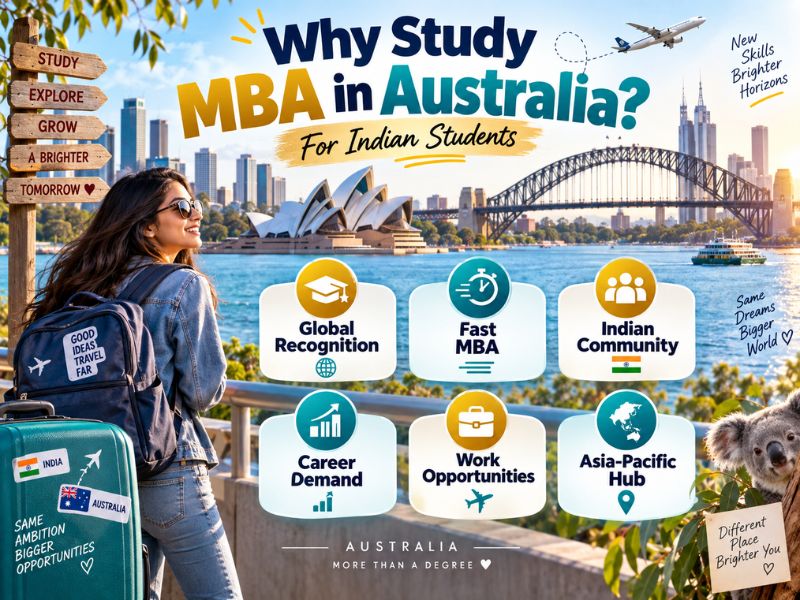
1. Globally recognised business schools with strong rankings
Australian universities featured in the QS Global MBA Rankings 2026 provide some of the best MBA programs acknowledged worldwide, giving your degree genuine international credibility.
2. Fast, efficient program formats
One-year full-time MBA options are available at institutions such as Melbourne Business School and UNSW's AGSM, meaningfully reducing your total opportunity cost compared to longer two-year formats.
3. Genuinely large, established Indian community
With a substantial Indian diaspora concentrated in Toronto-equivalent hubs like Sydney and Melbourne, Indian students find familiar food, cultural events, and readily available peer support throughout their program.
4. Strong sector-specific demand aligned with Indian applicant backgrounds
High demand for MBA graduates exists in sectors like finance, consulting, and technology — genuinely aligning well with common Indian applicant career backgrounds and goals.
5. Genuine post-study work opportunities
Post-study work experience becomes possible given Australia's strong economy, offering graduates a real runway to build local career experience after completing their MBA.
6. Strong Asia-Pacific business connectivity
Good transport links to the Asia-Pacific region ensure strong relations with most industries, a genuine advantage for Indian students eyeing careers spanning both Asian and Western markets.
The bottom line: If you want a globally respected MBA, a fast program format, and a genuine pathway to work experience in a stable, high-quality-of-life country with a strong existing Indian community, Australia offers a strategically compelling choice for Indian students in 2026.
Eligibility Criteria for MBA in Australia
Before applying to MBA programs in Australia, make sure you meet the following eligibility requirements for 2026 admissions.
Academic qualification
- A bachelor's degree from a recognised university, with a minimum GPA of 2.5 or higher — specifically, a 10+2+3 degree from an accredited Indian institution with a minimum score of 60% for many programs
Work experience
- Students must generally have at least 3 years of work experience to study an MBA in Australia, though the broader range cited is 2-5 years of work experience for international students. Work experience is not always mandatory but is preferred by many universities.
Standardised test scores
- A GMAT or GRE score is required at many institutions, though GMAT or GRE scores may be required, but not always. GMAT scores ranging from 550-600 are often cited as optional but recommended, while some programs specify a GMAT score of 600-680 as optional.
English proficiency
- International students must have a minimum IELTS Academic score of 6.5 bands at several top institutions, though some programs accept a minimum IELTS score of 6.0
Application essentials
- Academic transcripts, GMAT/GRE scores (where required), Statement of Purpose, Letters of Recommendation, and a professional CV are standard requirements across Australian MBA programs.
Admission Process for MBA Colleges in Australia
Here's a step-by-step breakdown of what the admission process looks like for Indian applicants in 2026.
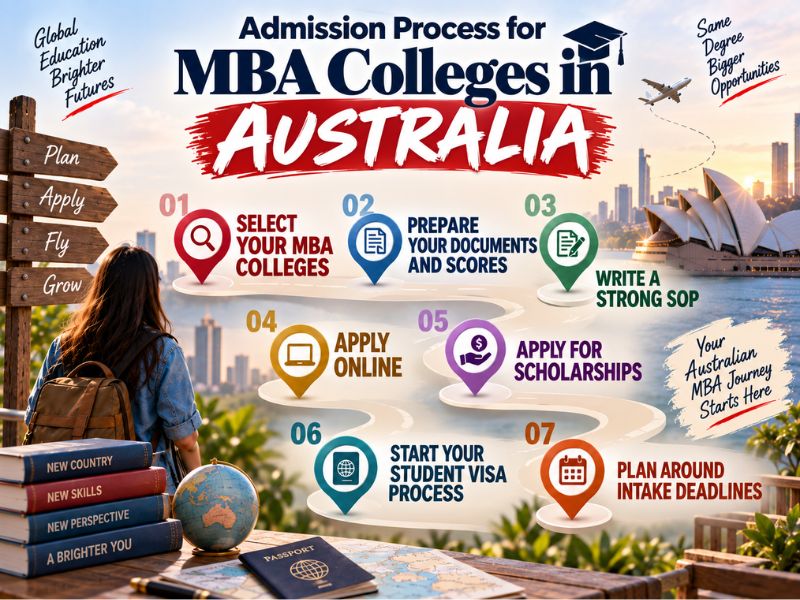
Step 1: Select your preferred MBA colleges
Choose your preferred MBA colleges in Australia based on course curriculum, location, and affordability.
Step 2: Prepare your academic documents and scores
Gather your academic documents and GMAT/GRE scores if required by your target institutions.
Step 3:Write a strong Statement of Purpose
Draft an SOP highlighting your career goals and specifically why you chose Australia for your MBA as an Indian applicant.
Step 4: Apply online before respective deadlines
Submit your application online to your chosen universities before their specific deadlines — note that Australian universities either have rolling admissions or fixed admission deadlines, so verify each institution's specific format.
Step 5: Apply for scholarships to reduce costs
Consider applying for scholarships available specifically for Indian students to help reduce your overall tuition burden.
Step 6: Start your student visa process after receiving your offer
Once you receive your Letter of Offer, begin your Subclass 500 student visa process promptly.
Step 7: Plan around intake-specific deadlines
Application deadlines for the February 2027 intake close as early as October 2026 for offshore international students, allowing sufficient visa processing time — a useful benchmark for planning your 2026 application timeline for subsequent intakes.
GMAT, GRE & Other Entrance Exams for MBA in Australia
Here's what Indian applicants specifically need to know about standardised testing for MBA programs in Australia in 2026.
GMAT/GRE requirements genuinely vary by school
Most Australian universities and colleges accept GMAT scores for admission, though GMAT or GRE scores may be required, but not always — this remains genuinely institution-dependent rather than a fixed nationwide rule.
Typical competitive score ranges
GMAT scores ranging from 550-600 are commonly cited as optional but recommended, while some programs specify a GMAT score of 600-680, also treated as optional.
GMAT-waiver institutions worth knowing
University of Adelaide and RMIT University specifically waive GMAT scores for MBA admission, making them genuinely accessible options for strong Indian candidates without competitive standardised test scores.
No other national entrance exams accepted
Unlike some destinations accepting Indian exams like CAT or NMAT, Australian MBA programs generally rely on GMAT/GRE specifically (where required) rather than Indian national-level management entrance exams — plan your test-prep strategy around GMAT/GRE rather than assuming CAT scores will transfer.
Our advice: Even if your target school doesn't strictly require GMAT, consider taking it anyway if you're aiming for a top program like Melbourne Business School or AGSM — a strong score can unlock significant scholarship value at institutions like ANU, sometimes covering your entire tuition fee.
English Language Requirements for MBA in Australia
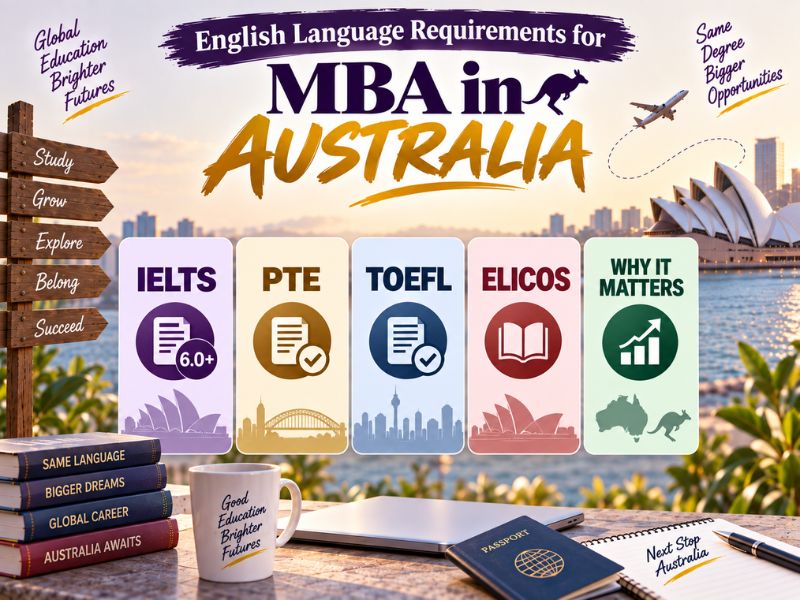
Here's what Indian applicants need to know about English proficiency requirements for MBA programs in Australia in 2026.
IELTS as the primary benchmark
Students must secure a good IELTS score to get an Australian visa, since students from non-native English-speaking countries must demonstrate English language proficiency for university admission. A minimum IELTS Academic score of 6.5 bands is required at several top institutions, though some programs accept a slightly lower 6.0 minimum.
PTE as a genuine alternative
PTE Academic is increasingly accepted across Australian universities as a faster-turnaround alternative to IELTS, with equivalent score bands generally mapped against IELTS requirements by each specific institution.
TOEFL acceptance
TOEFL is accepted as a valid alternative to IELTS across many Australian MBA programs.
ELICOS as a genuine bridge pathway
Students who need to prove English language proficiency to study at a university or vocational college, or who want to work, can pursue any course under ELICOS (English Language Intensive Courses for Overseas Students) — a useful bridge option if your current English test scores fall short of your target program's requirement.
Why your English score matters beyond just admission
Since IELTS/PTE requirements genuinely affect both your university application AND your visa eligibility (not just admission), Indian applicants should aim for the higher benchmark (6.5+) where possible to keep both applications comfortably covered rather than risking a borderline score that satisfies one requirement but not the other.
Top MBA Colleges in Australia for Indian Students 2026
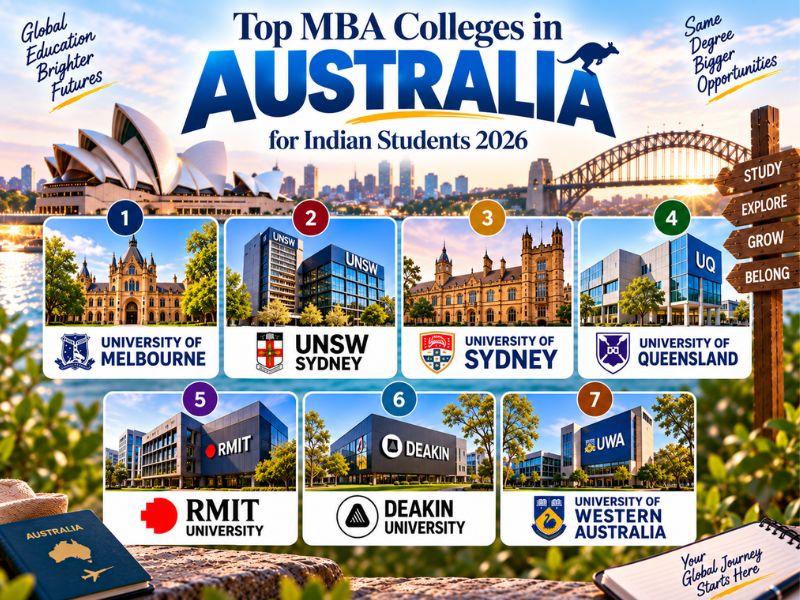
- Melbourne Business School (University of Melbourne) — QS #1 Australia/Oceania Global MBA ranking; Fees: ~AUD 89,000 (~₹48.76 lakh), among the highest but most prestigious in the country
- AGSM at UNSW Sydney — Fees: ~AUD 70,000-90,000; strong brand recognition and Global Reach Scholarship access
- University of Sydney Business School — Fees: ~AUD 70,000-90,000, positioned alongside AGSM as a top-tier choice
- University of Queensland (UQ) — Fees: ~₹35 lakh annually, strong reputation with solid industry connections
- RMIT University and Deakin University — Among the more accessible options starting from ~AUD 48,600 (~₹27 lakh) annually, combining affordable tuition with quality education
- University of Western Australia (UWA) x IIM Kozhikode — A distinctive dual-credential online Executive MBA offering both a UWA MBA and a Payroll Compliance Professional certification from IIM-Kozhikode, priced at ₹5,60,000 (GST excluded) — a genuinely unique, India-linked option
- GMAT-optional universities — Monash University, Macquarie University, Deakin University, Griffith University, and RMIT University all offer MBA programs without requiring GMAT scores
Best Universities in Australia for MBA
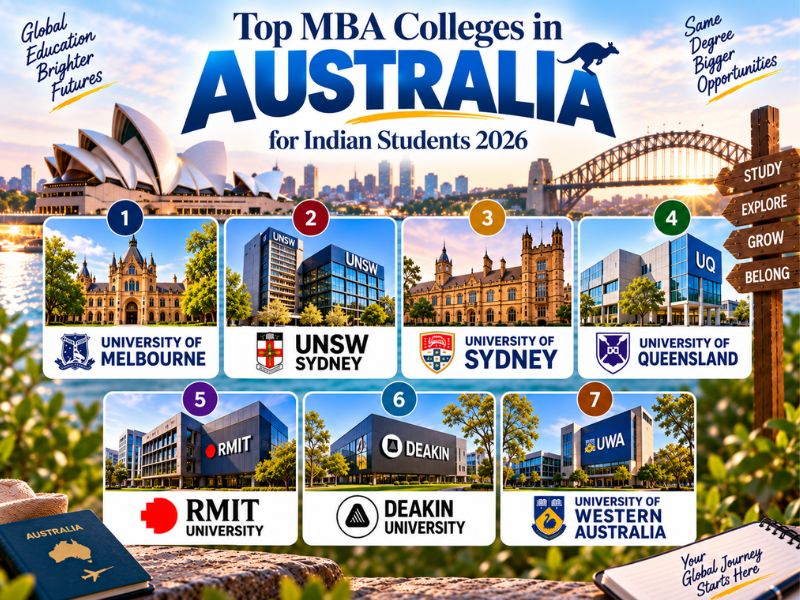
- Melbourne Business School — The clear top pick for brand prestige and QS Australia/Oceania ranking, though carrying the highest fee bracket
- AGSM (UNSW) and University of Sydney Business School — Best for candidates prioritising Sydney's dense corporate and finance ecosystem alongside strong global rankings
- University of Queensland — Solid mid-premium choice balancing reputation with somewhat more moderate fees than Melbourne or Sydney
- RMIT University and Deakin University — Best for cost-conscious students wanting quality education without the premium price tag, while still delivering industry-focused curricula that enhance employability
- Federation University, Victoria University, Charles Sturt University, Central Queensland University — Best for students prioritising maximum affordability (fees starting AUD 30,000-40,000) over brand prestige
- UniSA Business School — Another genuinely affordable option, with fees starting around AUD 30,000-39,000
- Selection consideration — Since fee ranges vary so dramatically (AUD 30,000 at Federation to AUD 89,000+ at Melbourne), matching your budget priority (ROI-maximizing affordable college vs. brand-maximising premium school) to the right tier matters more than chasing a single "best" ranking
Popular MBA Specialisations in Australia

- Business Analytics — One of the highest-paying specialisations, reflecting growing industry-wide demand for data-driven decision-making skills
- Finance — A consistently strong, well-compensated specialisation track across most Australian MBA programs
- Healthcare Management — A distinctive, well-paying specialisation also cited among Australia's popular MBA tracks.
- Technology Management — Increasingly in-demand given Australia's growing tech sector
- Supply Chain Management — A strong, well-compensated specialisation aligned with Australia's trade and logistics economy
- Broader specialisation range — Banking, Agriculture, and Interior Designing are also cited among Australia's genuinely diverse MBA specialisation offerings — a reflection of the country's wide-ranging economic sectors.
- Program-specific additional fees — MBA programs offeringspecialisedd tracks (finance, marketing, international business) may carry additional fees due to the nature of the curriculum and resources required, so confirm whether your target specialisation affects the base tuition quoted
MBA Fees in Australia for Indian Students
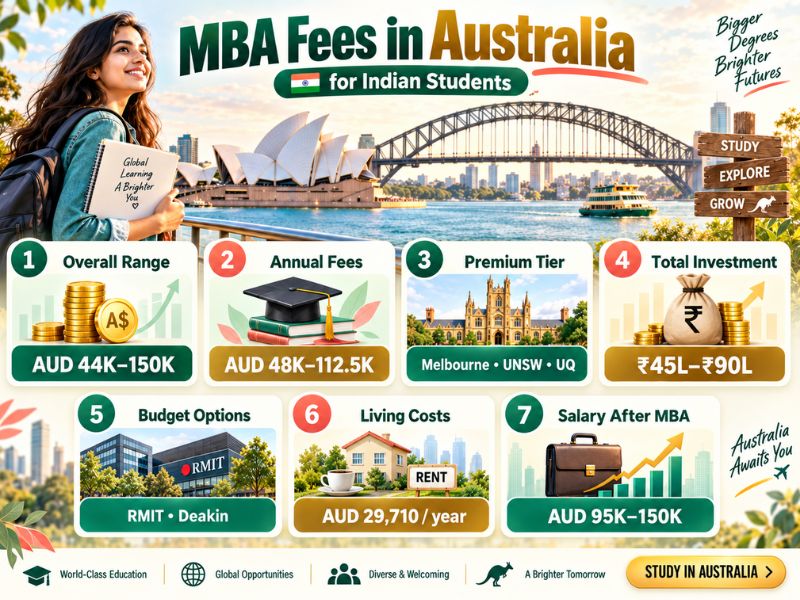
- Overall national fee range (varies by source) — AUD 44,000-150,000 for the full program, with 2026 intake figures most commonly cited between AUD 60,000-150,000
- Annual fee range (2026 specific) — AUD 48,000-112,500 (₹28.07-65.76 lakh) per year at a projected exchange rate of 1 AUD = ₹63
- Premium-tier examples — Melbourne Business School (~₹29 lakh annually per one source, though total program cost is considerably higher at ~AUD 89,000); UNSW Sydney (~₹45 lakh annually); UQ (~₹35 lakh annually)
- Total investment for Indian students — Typically ranges ₹45-90 lakh overall, depending on university and city, once tuition and living costs are combined.
- Budget-tier examples — RMIT and Deakin starting from ~₹27 lakh (AUD 48.6K) annually
- Government benchmark for living costs — The Australian government has set a benchmark of AUD 29,710 (~₹17.18 lakh) per year for urban living expenses, a figure worth using for visa financial-proof planning
- Post-MBA salary context — Average salaries of AUD 95,000-150,000 (₹65 lakh-1 crore+) mean many students recover their MBA investment within 2-4 years
Affordable MBA Colleges in Australia

- Federation University and Victoria University — Among the cheapest, with fees startingat AUD 30,000-38,000 (~₹20-26 lakh) for the complete program
- Charles Sturt University and Central Queensland University — Also start from AUD 30,000-40,000, positioned alongside Federation and Victoria as the most budget-friendly recognised options.
- UniSA Business School — Fees starting from AUD 30,000-39,000 (~₹20-27 lakh)
- RMIT University and Deakin University — Slightly higher but still accessible, starting from AUD 48,600 (~₹27 lakh) annually
- Overall budget approach — Students choosing regional cities combined with scholarships may be able to complete their entire MBA within a total budget of around ₹35-40 lakh, a dramatically lower investment than the premium ₹45-90 lakh range at top-tier universities
- GMAT-free affordability bonus — Since several of these accessible universities (Monash, Macquarie, Deakin, Griffith, RMIT) also waive GMAT requirements, students save both money and preparation time by choosing this affordable tier.
Cost of Living in Australia for Indian Students
- Government-set living cost benchmark — AUD 29,710 (~₹17.18 lakh) per year, the official figure used for visa financial-proof purposes
- Broader estimated range — AUD 21,000-30,000 per year for accommodation, food, transport, health insurance, and personal expenses
- City-based variation — Sydney and Melbourne carry notably higher living costs than regional cities, directly affecting overall program affordability even at the same tuition tier
- Combined budgeting approach — Since tuition (AUD 30,000-150,000) and living costs (AUD 21,000-30,000/year) both vary significantly, total program cost planning should factor in both city choice and university tier together rather than tuition alone.e
- Regional city cost advantage — Choosing a regional Australian city over Sydney or Melbourne can meaningfully reduce the living-cost portion of your budget, complementing savings from choosing an affordable-tier universi.ty.
- Pre-arrival budget additions — Visa fees, health insurance, airfare, and accommodation deposits should all be budgeted as separate line items on top of the core tuition and living cost estimates
Scholarships for MBA in Australia
- ANU MBA Scholarship — Can cover up to 100% of tuition fees, available for both full-time and part-time students
- Melbourne Business School Scholarships — A range of merit-based scholarships specifically designed to ease the financial burden of MBA study
- Macquarie University Scholarship for Indian Students — Covers approximately 25% of annual tuition fees, one of the more generous nationality-specific awards.
- University of Sydney's Indigenous Australians Leading in Business MBA Scholarship — Valued at over $70,000, covering up to 4 years of tuition (though this specific award targets Indigenous Australian candidates rather than international students broadly)
- University of Adelaide — Offers scholarships specifically for its Executive MBA program for international students.
- Curtin University — Offers AUD $10,000-12,500 or full tuition fee coverage based on academic excellence.
- RMIT University-funded scholarships — Open across all fields of study, including MBA
- India-specific external scholarships — Higher Education Scholarship Test (HEST) and Nehru Study Abroad Scholarship (NSAS) are both open to Indian nationals across most disciplines (excluding Medicine/MBBS)
- Automatic consideration for merit-based awards — Many scholarships are automatically considered upon course application submission, while major awards (like AAS) require a separate, detailed application well ahead of the admission deadline.
Documents Required for MBA Admission in Australia
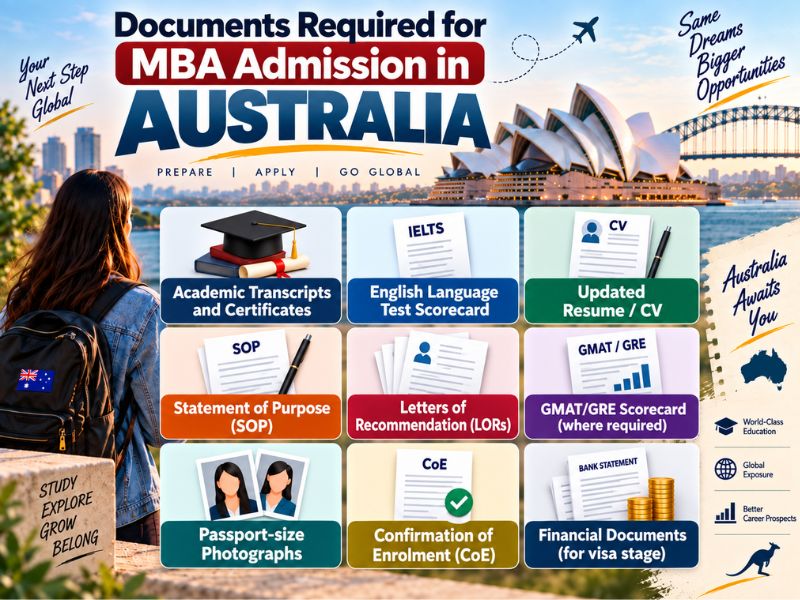
- Academic transcripts and certificates — Class 10, Class 12, and all prior degree transcripts
- English language test scorecard — IELTS, PTE Academic, TOEFL iBT, or equivalent
- Updated resume/CV — Highlighting work experience, academic achievements, and leadership roles
- Statement of Purpose (SOP) — Explaining career goals, program fit, and reasons for choosing Australia
- Letters of Recommendation (LORs) — Typically 2, from academic or professional references
- GMAT/GRE scorecard (where required) — Not universal, since several universities (Monash, Macquarie, Deakin, Griffith, RMIT) waive this requirement
- Passport-size photographs — As per Department of Home Affairs specifications
- Confirmation of Enrolment (CoE) — Required specifically for the subsequent visa application stage, issued once university admission is confirmed
- Financial documents (for visa stage) — Bank statements, education loan sanction letter, or scholarship documentation to demonstrate sufficient funds
Student Visa Requirements for Indian MBA Students
- Visa type — Subclass 500 Student Visa, applicable for both undergraduate and postgraduate applicants, including MB.
- Base Application Charge — AU $2,000
- Financial proof requirement (2026) — A single applicant must demonstrate access to at least AUD 29,710 (~₹20 lakh) per year for living costs, in addition to a full year's tuition fees and a return airfare
- Recommended evidence types — Combining more than one type of evidence (bank statements from the last 3-6 months, education loan sanction letter, scholarship/sponsorship letter, fixed deposits) makes your financial capacity look clearly documented rather than borderline
- Red flag to avoid — A sudden, large, unexplained deposit shortly before applying is one of the more common triggers for additional document requests or visa refusal, even when the funds are genuine
- Overseas Student Health Cover (OSHC) — Mandatory health insurance confirmation for your full course duration
- Additional required documents — Health examination results from an approved panel physician (if requested) and a Police Clearance Certificate (if requested for character assessment)
- 2026-specific changes — Significant updates this year include admission caps, a student visa fee increase, and a new "Level 3 scrutiny category" — a notably more rigorous review process than in 2024, so understanding these changes before applying is essential
- Processing prerequisite — The visa is processed only once you have your Confirmation of Enrolment (CoE) or offer letter in hand, whether applying from within Australia or outside
MBA Placements and Job Opportunities in Australia
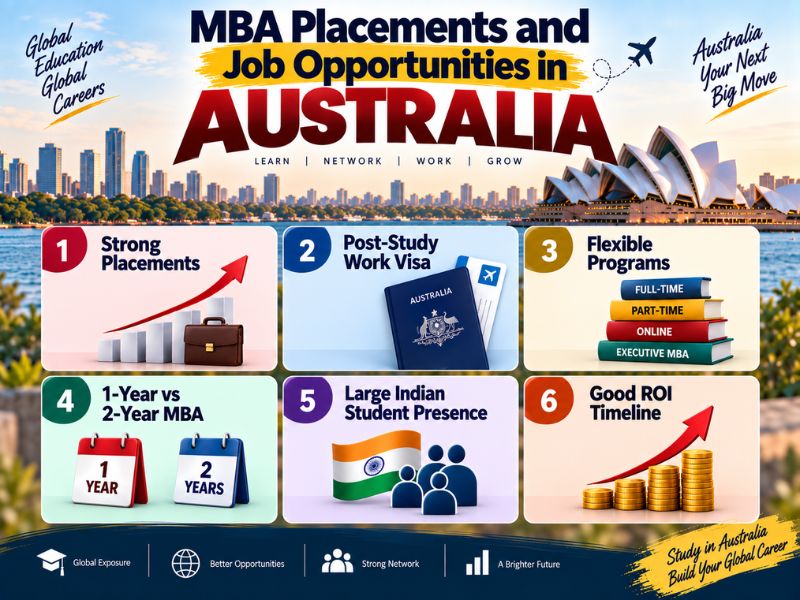
- Full-time employment outcomes — With globally recognised universities, strong employment opportunities, and post-study work rights, an MBA in Australia offers genuinely solid long-term value and career growth
- Post-study work visa pathways — The Graduate Work Stream visa and the Post-Study Work Stream visa are the two popular options allowing MBA graduates to stay and work in Australia for several years after completing their studies
- Program flexibility supporting career transitions — Many Australian universities offer flexible study options (full-time, part-time, online, executive MBA), letting students tailor their studies to either advance in their current role or pivot to a new field
- 1-year vs 2-year format trade-off — A 1-year MBA reduces overall living expenses and helps students return to the workforce faster, while a 2-year MBA provides longer internship opportunities, deeper networking exposure, and more flexibility for career transitions
- Strong Indian student presence supporting networking — Australia saw over 64,000 Indian student visa applications in a recent year, reflecting a well-established Indian student community that supports peer networking and job referrals
- ROI timeline — Many students recover their MBA investment within 2-4 years, given the combination of solid starting salaries favourablealia's favorable post-study work policies
Average MBA Salary in Australia
- Overall commonly-cited range — AUD 95,000-150,000 (~₹65 lakh-1 crore+) annually, varying by job role and industry
- Alternate tighter range — AUD 100,000-130,000 (~₹55-71 lakh) per year depending on job roles and industries, per another source
- 2026-specific benchmark — Graduates can earn an average salary ranging from AUD 95,000-120,000 annually
- Specialisation impact — Business Analytics, Finance, Healthcare Management, Technology Management, and Supply Chain Management specialisations pay particularly well, reflecting current industry demand
- ROI timeline based on salary — Given the AUD 95,000-150,000 salary range against total program costs of AUD 44,000-150,000, most graduates recover their MBA investment within 2-4 years
- Currency/reporting variance note — Since salary figures across sources range fairly widely (AUD 95,000 to AUD 150,000), treating this as an approximate band rather than a fixed number is the more realistic planning approach
Top Recruiters for MBA Graduates in Australia

- Consulting and Professional Services — A strong recruiting sector across Australia's top MBA programs, drawing on the country's globally recognised business education standards
- Finance and Banking — Actively recruiting Business Analytics and Finance specialisation graduates specifically, given these tracks' strong salary outcomes
- Healthcare — A growing recruiting sector aligned with the popular Healthcare Management specialisation
- Technology — Recruiting Technology Management specialisation graduates, reflecting Australia's expanding tech sector
- Supply Chain and Logistics — Active recruiters given Australia's trade-dependent economy and the popularity of Supply Chain Management as an MBA specialisation
- Industry-connected curriculum support — Australian MBA programs are known for their practical, industry-focused approach to management education, with most programs requiring a capstone project or internship that directly connects students to potential employers before graduation.
- Sector concentration overall — Consulting, Finance, Healthcare, Technology, and Supply Chain collectively form the strongest recruiting pillars, directly aligned with the specialisations Australian MBA programs are best known for delivering strong salary outcomes
Career Opportunities After MBA in Australia

- Consulting and Strategy — A strong pathway given Australia's globally recognised business education standards and dense professional services ecosystem
- Finance and Banking — Business Analytics and Finance specialisation graduates find particularly strong opportunities, given these tracks' consistently high salary outcomes.
- Healthcare Management — A growing career pathway aligned with Australia's expanding healthcare sector and its popularity as an MBA specialisation
- Technology Management — Reflects Australia's growing tech sector, offering roles in product, digital strategy, and tech-adjacent business leadership.
- Supply Chain and Logistics — Strong opportunities given Australia's trade-dependent economy and international shipping/logistics ecosystem
- Entrepreneurship — Flexible study formats (full-time, part-time, online, executive MBA) support professionals who want to build their own venture while studying or shortly after graduation
- Career transition support — The 2-year MBA format specifically provides longer internship opportunities, deeper networking exposure, and more flexibility for career transitions compared to the faster 1-year route.e
- Cross-industry breadth — With specialisations spanning Banking, Agriculture, Interior Designing, Healthcare, and more, Australia's MBA ecosystem genuinely supports a wide range of career pivots, not just traditional corporate management tracks
Post-Study Work Options for Indian MBA Graduates
- Graduate Work Stream visa — One of the two popular post-study visa options, allowing MBA graduates to remain in Australia and gain work experience after completing their degree
- Post-Study Work Stream visa — The second key pathway, offering several years of work rights post-graduation, specifically designed for higher education graduates including MBA holders
- Favourable overall policy environment — Australia has consistently favourable post-study work visa policies, allowing international MBA graduates genuine, multi-year opportunities to build local work experience before needing longer-term sponsorship
- No job offer required to begin the process — These post-study work visas allow graduates to search for employment while working, rather than requiring a confirmed job offer before the visa is granted
- Strong local networking support — Given the large Indian student community in Australia (60,000+ visa applications in a recent year), post-study job searching benefits from an established peer and alumni network
- Path to longer-term settlement — Successfully building Australian work experience during the post-study work visa period is commonly used as a stepping stone toward longer-term skilled visa or permanent residency pathways
- 2026 policy environment caveat — Given that 2026 has already brought admission caps, visa fee increases, and a new Level 3 scrutiny category for the Subclass 500 student visa, confirming the latest post-study work visa terms directly with the Australian Department of Home Affairs before finalising your plans is especially important this year
FAQs About MBA Colleges in Australia for Indian Students
Q1. What is the average cost of an MBA in Australia for Indian students?
Total investment typically ranges from ₹ 45- 90 lakh, with tuition fees alone ranging from AUD 48,000-150,000 depending on the university, program duration, and specialisation.
Q2. Which are the most affordable MBA universities in Australia?
Federation University, Victoria University, Charles Sturt University, Central Queensland University, and UniSA Business School offer fees starting around AUD 30,000-40,000 for the complete program.
Q3. Is GMAT mandatory for MBA admission in Australia?
Not always — Monash University, Macquarie University, Deakin University, Griffith University, and RMIT University all offer MBA programs without requiring GMAT scores.
Q4. What is the average salary after an MBA in Australia?
Reported figures vary by source, but average salaries commonly range from AUD 95,000-150,000 (₹65 lakh-1 crore+) annually, with Business Analytics, Finance, and Healthcare Management specialisations paying particularly well.
Q5. Can I stay and work in Australia after my MBA?
Yes, through the Graduate Work Stream visa or Post-Study Work Stream visa, both offering several years of work rights without requiring a confirmed job offer beforehand.
Q6. What is the visa financial proof requirement for Australia in 2026?
A single applicant must demonstrate access to at least AUD 29,710 (~₹20 lakh) per year for living costs, plus a full year's tuition fees and return airfare.
Q7. Are scholarships available for Indian MBA students in Australia?
Yes — options include the ANU MBA Scholarship (up to 100% tuition), Macquarie University's India-specific award (25% tuition), Melbourne Business School scholarships, and India-specific external awards like HEST and Nehru Study Abroad Scholarship.
Q8. What changed for the Australia student visa in 2026?
Several significant updates this year include admission caps, a student visa fee increase, and a new Level 3 scrutiny category — making the review process notably more rigorous than in 2024, so confirming current requirements before applying is essential.
Conclusion
An MBA in Australia continues to offer Indian students a compelling combination of globally recognised business education, genuinely diverse specialisation options (from Business Analytics and Finance to Healthcare Management and even Agriculture), and one of the more favourable post-study work visa environments among major English-speaking study destinations. With total investment ranging from ₹45-90 lakh depending on university choice — anywhere from budget-friendly options like Federation University and RMIT (AUD 30,000-48,000) to premium institutions like Melbourne Business School (AUD 89,000+) — and average salaries of AUD 95,000-150,000, most graduates can expect to recover their investment within 2-4 years, particularly those entering high-demand specialisations like Business Analytics or Finance. That said, 2026 has introduced meaningful new complexity to the visa process, with admission caps, fee increases, and a new Level 3 scrutiny category making careful documentation and early planning more important than ever. Prospective students should weigh their choice between a faster 1-year program (lower cost, quicker workforce re-entry) and a more networking-rich 2-year format, actively pursue the substantial scholarship ecosystem available (from ANU's up-to-100% tuition coverage to India-specific awards), and confirm every fee, GMAT policy, and visa requirement directly with their shortlisted university and the Australian Department of Home Affairs before finalising their 2026-27 application.