




University of Nottingham
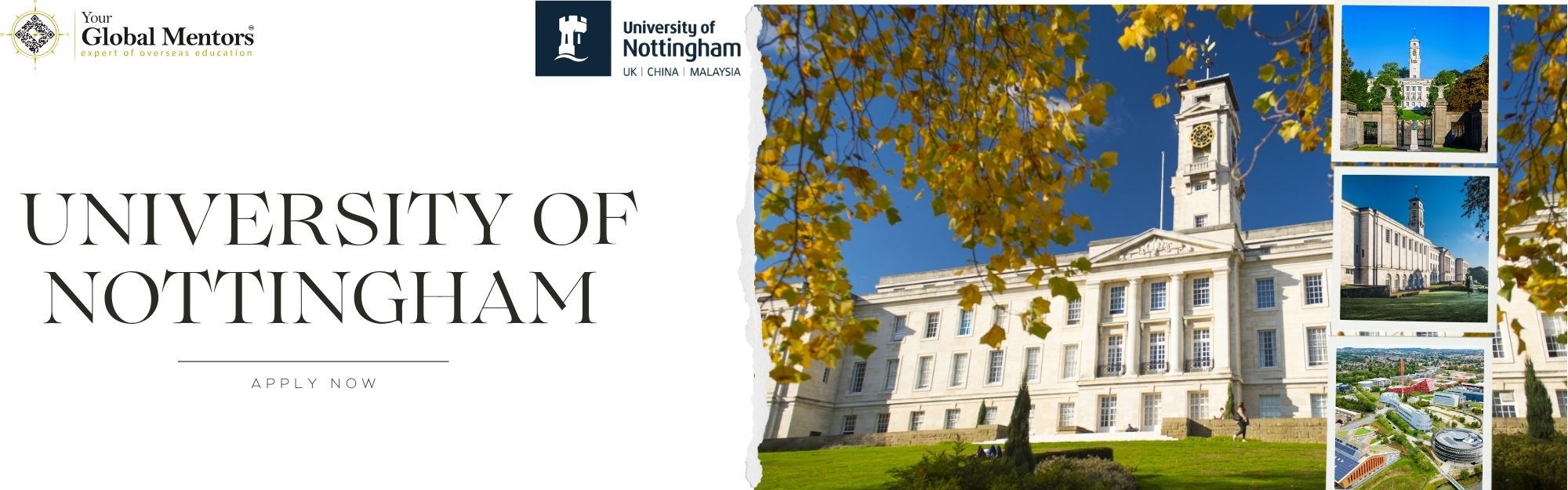
The University of Nottingham is a globally respected, research-led institution that blends historic campus charm with modern teaching, research infrastructure, and strong graduate employability. Founded to serve a global student community, Nottingham offers a broad suite of undergraduate, postgraduate, and doctoral programmes across Arts & Humanities, Engineering, Medicine & Health Sciences, Science, Social Sciences, Business, Law, and Computer Science.
Your Global Mentors (YGM) positions the University of Nottingham at the centre of its UK admissions portfolio because Nottingham combines strong QS ranking credentials, impactful research, industry-aligned courses, and robust student support. Our consultants evaluate your academic profile against Nottingham’s entry requirements, highlight scholarship opportunities, and design an application strategy tailored to your academic and career goals. From SOP, LOR, and resume crafting to visa preparation and pre-departure guidance, YGM provides full lifecycle support so you can transition smoothly to life and study at Nottingham.
Key elements we emphasise for Nottingham applicants include research alignment where applicable, clarity of career intent, demonstration of academic readiness, and evidence of financial preparedness for visa purposes. We also prioritise employer-relevant outcomes and placement options because Nottingham’s strong industry connections can significantly influence your postgraduate prospects.
The University of Nottingham appears regularly in global higher education rankings and maintains a competitive position among UK universities. Ranking metrics reflect research output, employer reputation, internationalisation, and student outcomes. Nottingham attracts strong research funding and industry partnerships in fields such as biomedical sciences, energy and materials, sustainable engineering, business analytics, and data science—all areas that boost the university’s global profile and career outcomes for graduates.
YGM monitors ranking trends, including QS World University Rankings, to understand how Nottingham’s standing affects scholarship availability, employer perception, and international student desirability. We map ranking signals to practical guidance: for high-ranked subject areas, we advise stronger research statements and evidence of related experience; for interdisciplinary or emerging programmes, we highlight how candidate stories can demonstrate fit and innovation.
Why rankings matter for applicants:
Rankings strengthen scholarship narratives and lend weight to claims of program quality.
Employer perceptions influenced by rankings can affect internship and placement outcomes.
Applicants targeting research degrees should align proposals with departments that drive Nottingham’s ranking metrics.
We recommend that applicants reference Nottingham’s up-to-date ranking and subject position when drafting SOPs and scholarship essays to demonstrate awareness and alignment with a programme’s reputation.
The University Park campus is Nottingham’s flagship and is celebrated for its parkland setting, modern learning spaces, libraries, laboratories, sports facilities, and cultural venues such as Lakeside Arts. Campus life blends academic intensity with extracurricular richness: more than 200 student societies, active volunteering networks, employer engagement events, and dedicated support for international students.
Nottingham’s global presence includes campuses in Malaysia and China (Ningbo), which extend student exchange and international research collaborations. This global footprint enhances mobility options and cross-cultural learning experiences for Nottingham students. YGM advises international applicants on how to leverage these global campuses—choosing programmes with international study or exchange options can enhance employability and global exposure.
Campus services aimed at international students include orientation weeks, visa and immigration support, academic tutoring, wellbeing services, and targeted career guidance. Student accommodation ranges from catered halls to self-catered flats and vetted private rentals. YGM helps students compare living options, prioritise proximity to faculties or transport hubs, and secure rooms in popular halls by advising on application windows and deposit management.
Campus highlights applicants should mention in their SOP:
Research facilities and labs relevant to your field.
Industry partnerships and placement year opportunities.
Specific faculty, professor, or research group you wish to work with.
Campus resources like career services support the transition to employment.
The University of Nottingham provides a wide range of programmes across levels and modalities, including three-year bachelor's degrees, integrated masters (MEng, MSci), one-year taught master's, part-time and distance learning, and doctoral research degree pathways. Courses vary across faculties but share a commitment to research-led teaching and employability-focused curricula.
Key programme features:
Many undergraduate degrees offer placement or sandwich years, which extend the duration by one year to include a professional placement. Placement experience often leads to enhanced graduate job prospects.
Taught Master’s programmes typically last one year full-time and may include professional practice modules, industry projects, or dissertation work, enabling rapid upskilling.
Research degrees (PhD) include close supervision, laboratory access, and potential for funded research assistantships or collaborative industry projects.
Course selection advice from YGM:
Choose programs that match both your academic background and long-term career ambitions.
Identify modules and placement opportunities that map to targeted employers.
For research applicants, prepare focused proposals that connect to supervisors and ongoing departmental research themes.
If you require pre-sessional English or conversion pathways, plan these into the timeline early.
International Researcher
Musician
Artist
Sociologist
Historian
Journalists and media personnel
International Busines
Innovation and Entrepreneurship
Marketing
Finance Human Resources
Business Information Systems
Business Economics
Business Analytics
Accounting
Property and estate management
Threats from cyberspace
MS in Microbiology or Clinical Pathology
MS in Hospital Administration
MBA in Healthcare Management
M.Tech in Biomedical Engineering and Biological Sciences
The law of the family.
Environmental legislation
Computer systems and networks
Construction
Cyber security
Computer ethics and law
Principles of security design
Cryptography
Software and security administration
Intelligence on cyber-threats and incident response
Management in the Retail Industry
B.Sc Nutrition & Dietetics
Bachelor of Optometry
B.Sc Microbiology
Petroleum Engineering
Industrial Instrumentation
Engineering Science
Marine Engineering
Process engineering
B.Sc Radio-Imaging Technology
Systems Engineering
Manufacturing Engineering
Industrial Engineering
Mechanical Engineering
Aerospace Engineering
Biomedical Engineering
Electrical Engineering
BBA
M.Sc Operation Theater Technology
Production design
Structural engineering
Civil engineering
Interior design
Building technology and management
Building conservation
M.Sc Microbiology
M.Sc Medical Laboratory Technology
M.Sc Radio-Imaging Technology
M.Sc Nutrition & Dietetic
Master of Optometry
B.Sc Renal Dialysis
B.Sc Cardiac Care Technology
B.Sc Medical Laboratory Technology
B.Sc Operation Theater Technology
B.Sc Neuro-physiology Technology
Tuition at the University of Nottingham varies widely by programme, subject area, and level of study. Health and clinical programmes, engineering, and specialist professional courses often have higher fees than humanities or social sciences. International student fees are distinct from home/EU rates and are published annually on Nottingham’s official pages.
YGM’s tuition guidance includes:
Detailed fee band mapping by faculty, showing likely fee ranges for international students per programme.
Calculation of total annual cost: tuition + accommodation + living expenses + mandatory insurance + travel.
Comparative scenarios showing how different accommodation choices influence total cost.
Assistance in assembling proof of funds for visa applications and bank statements required for CAS issuance.
Typical fee band examples (generalised ranges for planning only):
Arts, Humanities, Social Sciences: moderate international tuition band.
Engineering, Computer Science, Business: higher fee band.
Medicine, Dentistry, Veterinary, Clinical Programmes: highest fee band reflecting resource intensity.
For accurate, current tuition figures, check Nottingham’s official fee pages and confirm before submitting your application.
The University of Nottingham does not publish an institutional acceptance rate for all programmes. Admission competitiveness varies by subject: medicine, dentistry, certain engineering streams, and some business degrees are highly competitive. Acceptance is influenced by academic transcripts, test scores, the quality of the personal statement, reference letters, and evidence of relevant experience.
How YGM improves acceptance chances:
Profile gap analysis with a realistic assessment of strengths and weaknesses.
Strategic course selection to target programmes with a higher likelihood of matching your profile.
Document excellence: SOPs, LORs, and resumes tailored to Nottingham’s expectations.
Timing and deadline management to submit strong applications early, where rolling decisions apply.
Scholarship and funding applications that showcase merit and need.
Our consultants prepare applicants to present a cohesive narrative across application elements. For example, if your academic GPA is slightly below the typical cut-off, we help you emphasise compensating strengths such as research experience, industry projects, or a high IELTS score.
Your Global Mentors offers end-to-end consultancy focused on measurable results and personalised service. We provide a dedicated consultant for each applicant who coordinates the entire application, from initial profile evaluation to visa and pre-departure support. Our core competencies include targeted SOP drafting, referee coaching for LORs, CV optimisation, mock interviews, scholarship strategy, and document finalisation.
What sets YGM apart:
Expert writers with admissions experience at UK universities.
Data-driven course shortlisting aligned with QS ranking insights and employer trends.
Scholarship-first approach: we prioritise high-impact scholarships and track deadlines.
Post-offer and post-visa assistance, including accommodation, arrival, and local orientation support.
Transparent timelines and milestone tracking so applicants always know the next steps.
Client outcomes: high offer conversion rates to Russell Group universities, above-average scholarship success, and smooth visa approvals supported by robust documentation.
University of Nottingham scholarships for international students include merit-based awards, programme-specific bursaries, country-linked funding, and faculty-level scholarships. Scholarships vary by amount and eligibility and can be competitive.
YGM scholarship services:
Mapping of candidate eligibility to available internal and external scholarships.
Drafting high-impact scholarship essays and supporting statements.
Evidence collation: academic records, leadership certificates, publications, and project summaries.
Strategic prioritisation so applicants invest effort in scholarships with the highest expected return.
External funding advice, including government and NGO scholarships in your home country.
Scholarship strategy:
Early research to identify deadlines and documentation.
Strong narrative in essays linking personal achievements to the scholarship mission.
Supporting evidence and referee letters that corroborate the scholarship story.
Follow-up and appeals where applicable.
We recommend that applicants apply for multiple scholarships and maintain a calendar of deadlines and document requirements.
Applying to the University of Nottingham requires the accurate and timely submission of documents tailored to the programme. Common requirements include:
An online application form with accurate personal and academic details.
Official academic transcripts with certified translations where necessary.
Degree certificate or provisional certificate.
Statement of Purpose (SOP) clearly showing motivation, research interest, and career goals.
Two or more Letters of Recommendation from academic or professional referees.
CV/Resume with clear academic and work chronology.
English language test results (IELTS, TOEFL) meeting the programme’s threshold.
Portfolio (creative subjects) or additional test scores (GMAT/GRE) if requested.
Passport copy and identity proof.
Evidence of funds or scholarship award letters for a visa.
Medical certificates or DBS check for regulated professions if required.
YGM provides checklists, document templates, and verification to reduce application errors and avoid delays. We also provide timeline checkpoints to ensure each conditional requirement is addressed promptly.
Graduates from the University of Nottingham have strong employability outcomes thanks to the university's career services, employer fairs, and placement opportunities. Sectors that commonly recruit Nottingham graduates include finance, consulting, engineering, healthcare, technology, research and development, and public policy.
YGM supports placement success by:
Aligning CVs to employer expectations and job descriptions.
Coaching for technical and HR-style interviews used by UK and international employers.
Advising on networking strategies and employer engagement during placement years.
Preparing students for graduate recruitment cycles and professional accreditation requirements.
We recommend that applicants choose programmes with placement or industry-year options where possible because placements often lead to full-time job offers.
Score cut-offs at Nottingham vary by programme. Typical expectations include:
Undergraduate: strong secondary school qualifications or international equivalents; certain programmes demand specific subject grades or A-level scores.
Postgraduate taught: a 2:1 honours degree or equivalent is commonly required; some programs accept a 2:2 with significant professional experience.
Research degrees: strong academic record with clear research potential and, for many disciplines, proposal alignment with faculty research interests.
English language: Many programmes require IELTS 6.5 overall with no band lower than 6.0; some professional courses require higher bands.
YGM helps applicants interpret international grading systems and prepare remediation plans, including test retakes, bridging courses, or additional certifications to meet cut-offs.