








University of Milan
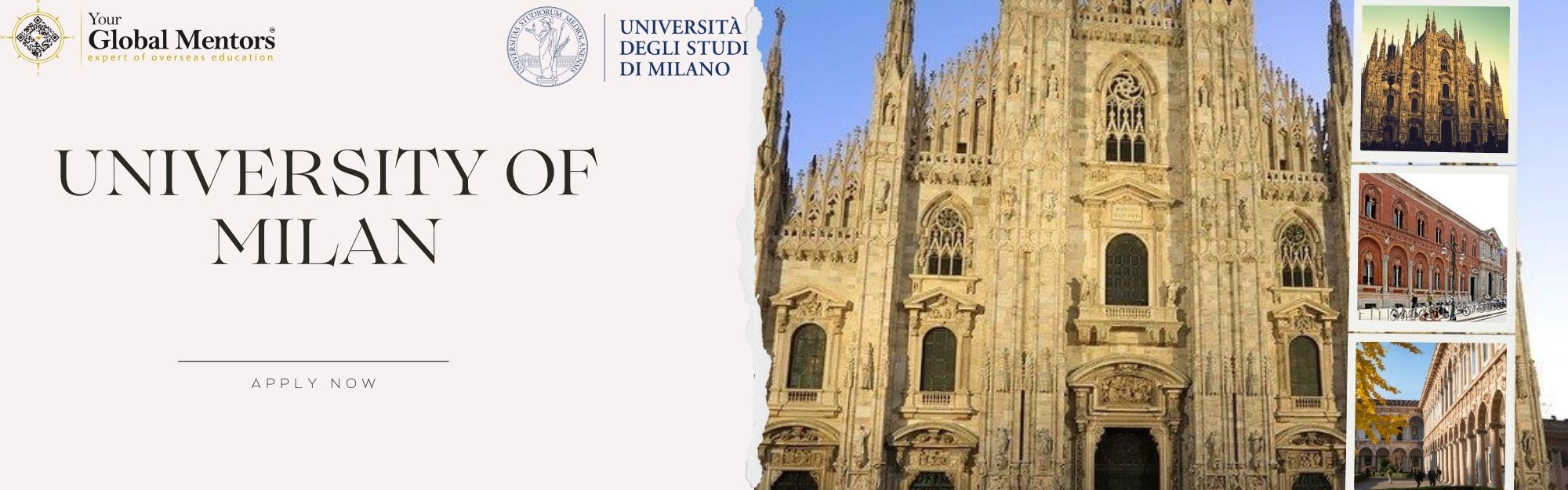
Your Global Mentors foreign education consultancy begins every university profile with a comprehensive overview that places the institution in context for international applicants. The overview for the University of Milan emphasises its status as a research-intensive public university with a long academic tradition, a broad portfolio of undergraduate and postgraduate programs, and strong ties to industry and research networks. The overview is written to speak directly to prospective students, using the focus keyword early and naturally: foreign education consultancy.
Start with a compelling opening paragraph that highlights the university’s unique selling points: multidisciplinary research centres, international collaborations, English-taught programs, and a strategic location in Milan, Italy’s financial and fashion capital. Follow with a paragraph that explains how Your Global Mentors supports applicants: personalised programme matching, document preparation (SOP, LOR, resume), scholarship identification, and visa assistance. This section also outlines the typical student journey from initial consultation to pre-departure briefing, emphasising transparency, timelines, and measurable outcomes.
Include a paragraph about the university’s international student services: language support, orientation programs, and career services. Explain how the university’s research output and industry partnerships translate into internships and placement opportunities for graduates. Conclude the overview with a clear call to action: invite students to book a free consultation via /contact or to explore program-specific pages under /universities/unimi. Use internal links to the services page and scholarship resources to guide users to the next steps.
Benefits at a glance:
Personalised program matching tailored to your academic profile and career goals.
End-to-end application support, including SOP, LOR, and resume optimisation.
Visa and pre-departure assistance to ensure a smooth transition.
Scholarship and loan guidance to make studying abroad affordable.
SEO and readability: Use the focus keyword at the beginning of the overview and in at least one subheading. Keep paragraphs long enough to be informative but broken into digestible sections with bold labels for quick scanning. Add a short bulleted list of immediate benefits for international students to improve scannability and conversion.
Ranking context is an important decision factor for many students and parents. The University of Milan is recognised in international ranking systems for its research output, academic reputation, and subject-specific strengths. When presenting ranking information, Your Global Mentors balances global ranking metrics with program-level strengths and employability outcomes. Rankings such as QS World University Rankings, Times Higher Education, and subject-specific lists provide a snapshot of institutional reputation, but they should be interpreted alongside program fit, faculty expertise, and placement statistics.
Explain what rankings mean and how they should influence a student’s choice. While overall rankings are useful, program-specific rankings and faculty research impact often matter more for specialised fields like medicine, engineering, or economics. Provide a clear note that ranking positions change annually and link to the official ranking pages for verification (for example, link to QS at https://www.topuniversities.com). Use the focus keyword foreign education consultancy in this section to reinforce topical relevance.
Offer practical advice: how to use rankings in application strategy, scholarship targeting, and visa justification. For example, higher-ranked programs may have stricter cut-offs and more competitive scholarship pools; a foreign education consultancy like Your Global Mentors helps students craft stronger SOPs and LORs to improve admission chances. Include a short table summarising ranking sources and what they measure (research, teaching, citations, international outlook) to help students interpret the data.
Campus life and facilities are central to the student experience and influence both academic success and personal well-being. The University of Milan’s campus network blends historic buildings with modern laboratories, libraries, and student centres. Describe the campus layout, highlighting key facilities such as research labs, medical centres, libraries, sports complexes, and student unions. Emphasise accessibility features, international student offices, and language centres that support non-native speakers.
Discuss accommodation options in detail: university halls of residence, private student apartments, homestays, and short-term stays for initial arrival. Explain how Your Global Mentors assists with university accommodation help, including application timelines for on-campus housing, tips for securing private rentals, and guidance on lease agreements and local tenant laws. Provide practical advice on neighbourhood selection in Milan, proximity to public transport, and estimated monthly living costs.
Include a paragraph on student life: clubs and societies, cultural events, internships and industry networking opportunities in Milan, and student support services such as counselling and career guidance. Add a short checklist for campus arrival: registration steps, health insurance enrollment, local ID registration, and bank account setup. This checklist should be part of the pre-departure briefing and reinforced during the arrival orientation.
Course descriptions must be precise, program-specific, and aligned with admission requirements. For each program at the University of Milan, provide a clear summary that includes program objectives, core modules, elective options, research opportunities, internship components, and typical career paths. Use the focus keyword foreign education consultancy in the introductory paragraph to maintain SEO relevance.
For undergraduate programs, explain the structure (three-year bachelor's, credit requirements, language of instruction) and highlight foundational courses and capstone projects. For master’s programs, detailed specialisation tracks, thesis or project requirements, industry collaborations, and research supervisor availability. For doctoral programs, outline research expectations, funding opportunities, and publication expectations.
Include a sample curriculum table for a representative program (for example, MSc in Data Science) that lists core modules, elective modules, credit distribution, and assessment methods. Guide prerequisites, recommended undergraduate majors, and typical applicant profiles. Explain how Your Global Mentors helps applicants choose the right specialisation, prepare targeted SOPs, and secure strong LORs from relevant referees.
Student outcomes: Add a paragraph on employability and alumni networks, describing how program content maps to industry needs and how students can leverage university career services and YGM’s placement guidance. Link to program pages on the university site and to yourglobalmentors.in/program-advice for tailored counselling.
Philosopher
Research and doctoral collaborations in engineering disciplines
MSc Aerospace Engineering
MSc Rail, Transport and Logistics
Fashion Communication
Fashion Business
MS in Microbiology or Clinical Pathology
Master of Optometry
Historian
Building technology and management
Tuition transparency is essential for planning and scholarship strategy. Provide a clear breakdown of average tuition fees for different program levels at the University of Milan: undergraduate, master’s, doctoral, and professional programs. Explain the difference between EU and non-EU fee structures, and note that fees vary by program and may change annually. Use the focus keyword foreign education consultancy in the opening paragraph to reinforce SEO.
Offer a sample fee table that shows typical ranges for common disciplines (Arts and Humanities, Social Sciences, Engineering, Medicine, Business). Include notes about additional mandatory fees such as student union fees, registration fees, and lab or materials fees. Guide living cost estimates for Milan, including rent, food, transport, and personal expenses, and show a combined annual budget estimate (tuition + living costs) for planning purposes.
Explain how Your Global Mentors helps students manage finances: identifying scholarships, preparing education loan documentation, and advising on part-time work regulations for international students. Provide links to external resources for official fee schedules (university site) and to yourglobalmentors.in/education-loans for loan assistance. Encourage students to request a personalised cost estimate during their consultation.
Acceptance rate is a key indicator of competitiveness, but must be interpreted carefully. Provide a clear explanation of what acceptance rate means and why it varies by program, intake, and applicant pool. For the University of Milan, acceptance rates differ significantly between high-demand programs (medicine, selective engineering tracks, top business programs) and broader programs (arts, humanities). Use the focus keyword foreign education consultancy early in the section to maintain SEO relevance.
Offer practical advice on how to interpret acceptance rates: consider program capacity, applicant quality, and international demand. Explain that a lower acceptance rate does not necessarily mean a program is better for every student; fit and alignment with career goals matter more. Describe how Your Global Mentors helps applicants improve their chances: targeted SOPs, strong LORs, tailored resumes, and strategic application timing.
Provide a short list of strategies to improve admission odds: apply to a balanced mix of reach, match, and safety programs; strengthen academic transcripts and test scores; highlight relevant internships and research; and craft a compelling narrative in the SOP. Link to yourglobalmentors.in/application-strategy for detailed guidance and to the university’s admissions pages for program-specific statistics.
YGM Review is an evidence-based snapshot of student experiences and outcomes for applicants who used Your Global Mentors' services. This section presents anonymised success metrics, testimonials, and case studies that demonstrate the consultancy’s impact on admission rates, scholarship awards, visa approvals, and placement outcomes. Use the focus keyword foreign education consultancy in the opening paragraph to reinforce topical relevance.
Include a mix of quantitative and qualitative data: percentage of clients who received offers from target universities, average scholarship amounts secured, visa approval rate for clients, and average time saved in the application process. Complement these metrics with short student testimonials that highlight specific services (SOP drafting, interview coaching, IELTS preparation) and their outcomes. Provide links to full case studies and video testimonials hosted on yourglobalmentors.in/testimonials and yourglobalmentors.in/success-stories.
Explain the methodology behind YGM Review: how data is collected, anonymised, and verified. This builds trust and transparency. Conclude with a call to action inviting prospective students to read detailed case studies or to schedule a free consultation to receive a personalised success forecast.
Scholarships can dramatically reduce the cost of studying abroad and are a central part of financial planning. This section explains the types of scholarships available at the University of Milan and how Your Global Mentors supports scholarship applications. Start with a clear definition of scholarship categories: merit-based, need-based, departmental, government-funded, and external scholarships.
Provide practical steps for scholarship success: identify eligible scholarships early, tailor essays to scholarship criteria, gather strong LORs, and prepare supporting documents such as financial statements and academic transcripts. Explain how YGM assists with scholarship essay drafting, deadline tracking, and submission management. Include a short table listing common scholarship types, typical award amounts, eligibility criteria, and application deadlines.
Offer tips for maximising scholarship chances: apply to multiple scholarships, highlight leadership and community impact, and demonstrate clear alignment between academic goals and scholarship objectives. Link to external scholarship resources and to yourglobalmentors.in/scholarship-assistance for personalised support. Emphasise that scholarship applications often require a different narrative than university applications and that YGM’s expertise increases the likelihood of success.
Scholarship Type | Typical Award | Eligibility | Application Deadline |
|---|---|---|---|
Merit-based University Scholarships | Partial to full tuition | High academic achievement | Varies by program |
Government Scholarships | Stipend + tuition | Country-specific eligibility | Annual cycles |
Departmental Grants | Partial tuition or stipend | Research proposals or faculty nomination | Program-specific |
External Foundations | Varies | Field-specific or nationality-based | Rolling or fixed |
Application requirements vary by program and intake, but a complete, well-organised application is non-negotiable. This section lists typical documents and steps required by the University of Milan and explains how Your Global Mentors ensures each element meets institutional standards. Use the focus keyword foreign education consultancy in the opening paragraph.
Provide a comprehensive checklist: academic transcripts, degree certificates, SOP, LORs, CV/resume, language test scores (IELTS/TOEFL), GRE/GMAT where applicable, passport copy, portfolio for creative programs, and any program-specific tests or prerequisites. Explain the importance of document translation and notarization for non-Italian documents and how YGM assists with certified translations and attestation.
Detail the role of SOP and LOR: what admissions committees look for, how to structure a compelling SOP, and how to select referees who can write impactful LORs. Offer examples of strong SOP themes and LOR prompts. Provide a timeline for document preparation and submission, and link to yourglobalmentors.in/documentation for document review services.
Document checklist (summary):
Academic transcripts and degree certificates (translated and notarised if required)
Statement of Purpose (SOP) tailored to program and research interests
Letters of Recommendation (LORs) from academic or professional referees
CV / Resume optimised for academic or professional admissions
Language test scores (IELTS/TOEFL) and other standardised tests (GRE/GMAT) if required
Passport copy and identity documents
Portfolio for creative programs (if applicable)
Financial documents for visa and scholarship applications
Score cut-offs are program-specific thresholds used by admissions committees to shortlist candidates. This section explains typical cut-offs for the University of Milan and how applicants can interpret them. Use the focus keyword foreign education consultancy early in the section.
Clarify that cut-offs may include GPA, standardized test scores (GRE/GMAT), and language proficiency scores (IELTS/TOEFL). Provide sample cut-off ranges for competitive programs and explain that meeting the cut-off does not guarantee admission — holistic review factors such as SOP, LORs, and relevant experience also matter. Offer strategies for applicants who fall slightly below cut-offs: strengthen SOP and LORs, highlight relevant work or research experience, consider alternative intakes, or apply to related programs with lower thresholds.
Explain how Your Global Mentors helps applicants assess their competitiveness and create a remediation plan, including targeted test preparation (IELTS, GRE, GMAT), transcript evaluation, and application timing. Link to yourglobalmentors.in/test-prep for coaching services.