

Trinity College Dublin
Studying at Trinity College Dublin is a compelling and high-impact choice for international students seeking a world-class education in the heart of Dublin. Your Global Mentors provides a full-service, personalised consultancy that removes the complexity and uncertainty from the admissions journey so you can focus on building a powerful academic narrative. The process to study at Trinity College Dublin often includes strategic program selection, academic profile optimisation, custom SOP (Statement of Purpose) and LOR (Letters of Recommendation) support, resume and portfolio refinement, scholarship targeting, visa application support, IELTS preparation, pre-departure briefing, and in-country logistics such as university accommodation help, forex, and tickets.
We begin with a deep profile assessment to position you strongly for Trinity’s admissions criteria. Our approach is tailored, data-driven, and outcome-focused—every recommendation, from the opening sentence of your SOP to the format of your academic transcripts, is designed to raise your admission probability and scholarship potential. If your goal is to study at Trinity College Dublin, partnering with Your Global Mentors means you gain structured timelines, documentation checklists, proofreading and compliance verification, mock interviews, and targeted scholarship essays that align with Trinity’s expectations.
Study at Trinity College Dublin benefits from the university’s strong international rankings, which are commonly cited by admissions teams, employers, and scholarship committees. Trinity consistently appears in global ranking lists such as QS World University Rankings, Times Higher Education, and others, reflecting its research excellence, high academic standards, and strong graduate employability. When you study at Trinity College Dublin, referencing Trinity’s QS and THE rankings in your application and scholarship essays can strengthen your positioning by demonstrating awareness of institutional reputation and the value of the degree in a global context.
At Your Global Mentors, we incorporate ranking data into your narrative—showing how the academic environment at Trinity aligns with your research ambitions or career aims. We help you cite discipline-specific department rankings and faculty research strengths (for example: engineering, computer science, business, or life sciences) to make your SOP and scholarship essays more persuasive. This is particularly useful for postgraduate research and taught programs where faculty fit and departmental research output are scrutinised.
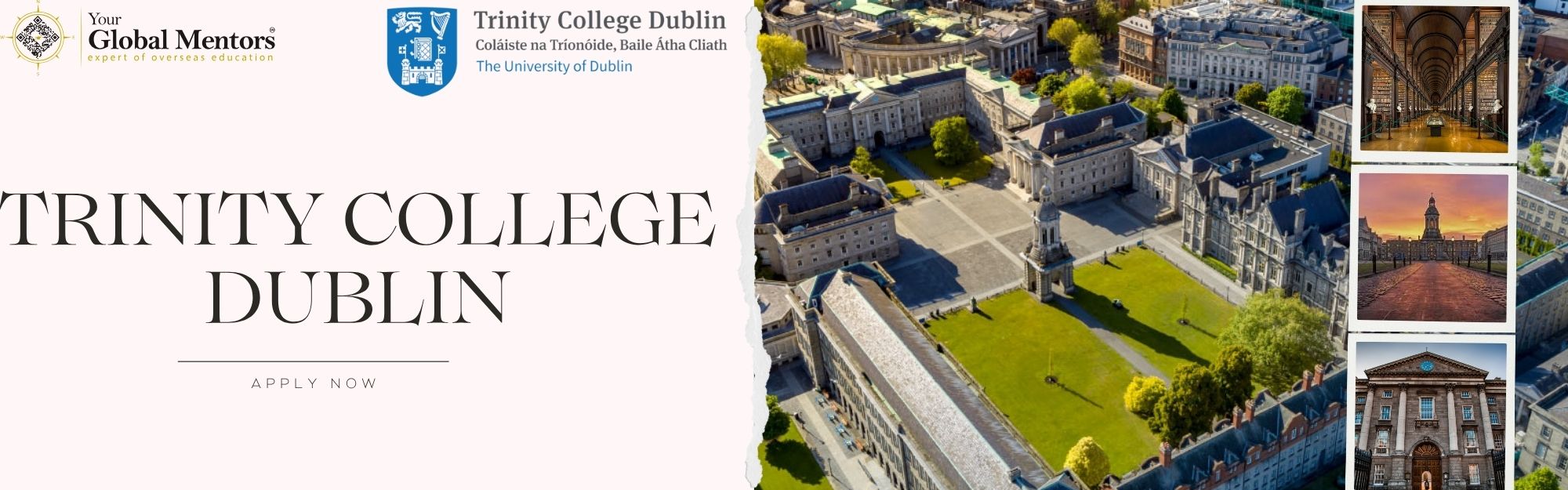
Choosing to study at Trinity College Dublin places you on a compact, historic campus at the centre of Dublin—an environment that combines heritage buildings such as the Long Room with modern research labs, lecture theatres, student societies, and entrepreneur-friendly industry links. Trinity’s campus is walkable and deeply social: societies, sports clubs, startups, and cultural events create an intense student ecosystem. For international students planning to study at Trinity College Dublin, living close to campus reduces commute times and increases participation in campus life, which is essential for building networks and gaining access to internships and placement opportunities.
Your Global Mentors offers campus orientation as part of our pre-departure services: virtual campus tours, accommodation orientation, neighbourhood safety and cost guides, and introductions to student services such as career centres, counselling, and disability services. We also guide students on how to leverage campus resources—library access, research centre memberships, and society leadership—as evidence of campus engagement in applications and future scholarship renewals.
Study at Trinity College Dublin across diverse programs: undergraduate degrees (BA, BSc), professional and honours tracks, postgraduate taught degrees (MSc, MA), and research degrees (MPhil, PhD). Trinity’s curricula combine rigorous theory, research-led teaching, and practical components—laboratories, industry placements, and group project work—designed to develop transferable skills sought by global employers. Course selection is decisive: aligning your academic background, research interests, and career goals to the specific module, faculty, and supervisor (for research degrees) substantially increases admission likelihood.
Your Global Mentors help you choose the right course by mapping competencies, prior coursework, and professional experience to Trinity’s course learning outcomes. We draft targeted SOPs and research proposals (for MPhil/PhD), assist with portfolios (for architecture, fine arts, and design programs), and prepare you for any program-specific auditions or interviews. For candidates who aim to study at Trinity College Dublin, our course-mapping includes a program suitability matrix, expected career trajectories, and scholarship fit analysis.
Musician
Artist
Sociologist
International Researcher
International Busines
Innovation and Entrepreneurship
Marketing
Finance Human Resources
Business Information Systems
Business Economics
Business Analytics
Accounting
Computer systems and networks
Testing
Systems Engineering
Manufacturing Engineering
Industrial Engineering
Mechanical Engineering
Aerospace Engineering
Biomedical Engineering
Electrical Engineering
BBA
M.Sc Medical Laboratory Technology
Construction
Production design
Structural engineering
Civil engineering
Interior design
Town planning
Building technology and management
Building conservation
MBBS
Cost is a critical variable when you plan to study at Trinity College Dublin. Tuition varies by level and discipline; international (non-EU) fees are generally higher than EU fees. For example, humanities and social sciences might have different fee bands compared with engineering, medicine, or business. In addition to tuition, living costs in Dublin (accommodation, food, transport, insurance, and personal expenses) form a significant part of your budget.
Your Global Mentors produces detailed, program-level fee breakdowns and financial planning tools for candidates who want to study at Trinity College Dublin. Our financial planning includes scholarship offsets, education loan strategies, and monthly living budgets to forecast realistic cash flow requirements. We also advise on cost-saving measures—student discounts, subsidised housing options, and part-time work restrictions under Ireland’s student visa policies.
Admission to Trinity College Dublin is competitive and varies by program. Acceptance rates depend on applicant pool strength, program capacity, and subject demand. Some professional and research programs are more selective. Your application quality—academic transcripts, SOP, LORs, and relevant experience—often matters more than raw grades.
At Your Global Mentors, we analyse program-specific historical acceptance patterns and advise applicants planning to study at Trinity College Dublin on realistic target programs. We recommend a balanced application strategy: reach programs (higher competition), target programs (good fit), and safety options (better chance of admission), plus a timeline to meet Trinity’s rolling or fixed deadlines. Our counsel reduces guesswork and improves application allocation.
This YGM Review of Trinity summarises why students should study at Trinity College Dublin and how Your Global Mentors improves admission outcomes. Trinity’s strengths include research output, global alumni, an interdisciplinary academic culture, a central Dublin location, and strong career services. Challenges include competitive entry criteria, the need for robust documentation for non-EU applicants, and early financial planning. Our review also includes evidence-based suggestions: early SOP drafting, targeted scholarship applications, and interview preparation for shortlist stages.
We provide a 12-week action plan for applicants who want to study at Trinity College Dublin: Week 1–2 profile assessment; Week 3–5 SOP and LOR drafting; Week 6–8 application submission and document compliance; Week 9–10 scholarship submissions; Week 11–12 interview prep and visa readiness. This modular plan positions candidates competitively and reduces last-minute errors.
Scholarships significantly lower the financial barrier to studying at Trinity College Dublin. Trinity provides merit-based scholarships, research funding, and departmental awards. External scholarships from governments, international foundations, and industry partners are also relevant. Scholarship selection requires precise alignment between your achievements and the award criteria.
Your Global Mentors help you identify relevant Trinity and external scholarships, draft persuasive scholarship essays, collate supporting documents, and meet strict deadlines. We create a scholarship calendar and provide essay templates tailored to awards such as merit funding, research grants, and diversity scholarships. Our strategy aims to build a combined funding package—part scholarship, part loan, part personal savings—so you can realistically plan to study at Trinity College Dublin.
To study at Trinity College Dublin, typical requirements include certified transcripts, degree certificates or predicted grades, English language test scores (IELTS/TOEFL), SOP, a minimum of 2–3 LORs, an updated resume/CV for postgraduate programs, and program-specific materials like portfolios or research proposals. Non-EU applicants may need translations and equivalence statements.
Your Global Mentors creates a customised, program-specific checklist for each applicant, verifies document formats, and performs pre-submission compliance checks to ensure nothing is missed. We also advise on how to present non-standard qualifications or gap years, and how referees should structure LORs to increase impact.
Graduates who study at Trinity College Dublin benefit from strong employer connections, a proactive career services centre, and Dublin’s dynamic job market. Placement outcomes vary by discipline—STEM and business graduates often access internships and graduate schemes with high employability, while the arts and humanities develop transferable skills that open diverse paths.
Your Global Mentors enhances placement readiness by optimising CVs for local recruiter expectations, running interview simulations for the Irish job market, and facilitating alumni outreach tactics. We also provide guidance on Ireland’s post-study work permission and employer sponsorship pathways to help international students convert academic credentials into employment.
Some Trinity programs enforce minimum scores or grade cut-offs, either in national matriculation exams or GPA scales. International applicants must map their grades to Trinity’s standards. For competitive programs, meeting the minimum score is necessary but not always sufficient—supplementary evidence via research experience or strong LORs often matters.
Your Global Mentors help interpret cut-offs, suggest remedial steps for borderline applicants (additional modules, certifications, short courses), and prepare persuasive explanations where necessary.