







Simon Fraser University
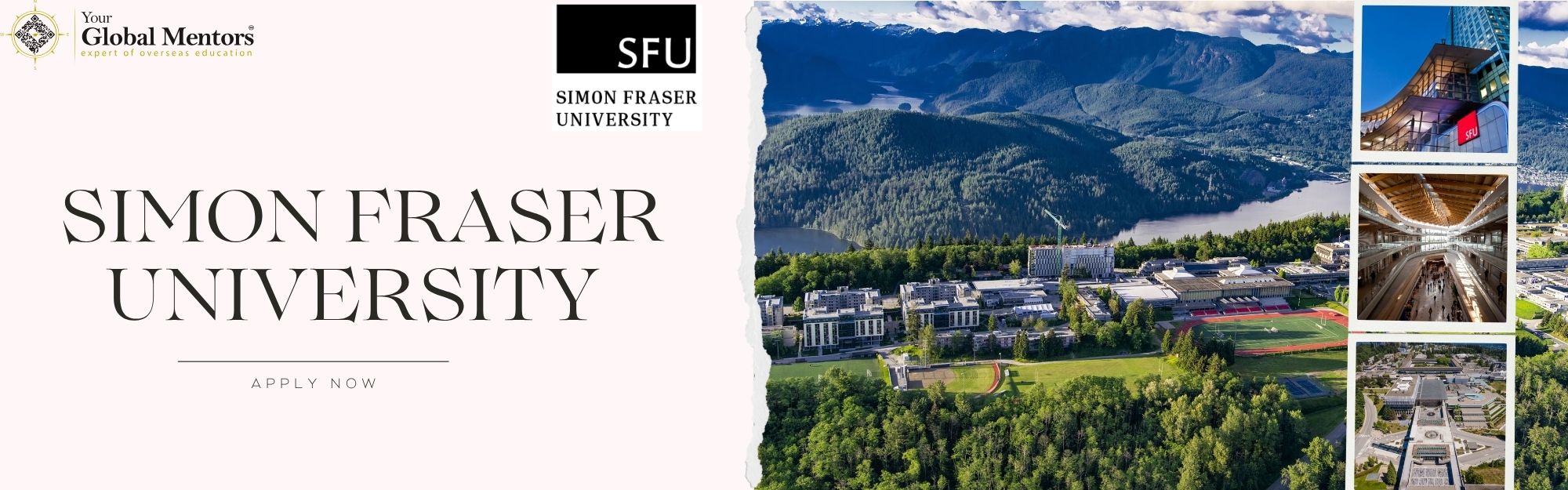
Simon Fraser University is a premier public research university in Canada, known for a strong emphasis on innovation, interdisciplinary research, and applied learning. Founded with a vision to bridge academic excellence and community impact, Simon Fraser University has grown into a multi-campus institution (Burnaby, Surrey, Vancouver) that offers a broad range of undergraduate, graduate, and professional programs. International students are attracted to Simon Fraser University for its robust co-op and internship programs, excellent student-support services, strong career outcomes, and an inclusive campus life that supports global perspectives.
At Your Global Mentors, we position Simon Fraser University as a top-choice destination for Indian and international applicants who want a balance between research intensity and practical career pathways. Our team helps applicants understand SFU’s admissions nuances, program-specific expectations and campus culture so they can present compelling applications tailored to the university’s strengths. We focus on optimizing every stage of the application — from academic credential evaluation and SOP drafting to LOR guidance, visa documentation and pre-departure orientation.
Choosing Simon Fraser University means choosing a university that values experiential learning, cross-disciplinary collaboration, and an ecosystem where students quickly connect with industry, incubators and community partners. For graduate applicants, the opportunity to work with active research supervisors and funded labs at Simon Fraser University is a major draw. For undergraduates, the blend of strong academic foundations with co-op placements and community-engaged learning makes SFU an attractive pathway toward global careers.
Key highlights that make Simon Fraser University stand out include: strong ties to the Vancouver tech and startup ecosystem, dedicated career services for international students, extensive research centers focused on sustainability and digital innovation, and an active alumni network that supports job placements and mentorship. Your Global Mentors leverages its in-depth knowledge of Simon Fraser University to build application strategies that highlight a candidate’s fit with the program, research groups and the larger SFU community.
Simon Fraser University frequently appears among Canada’s well-regarded and research-active universities in global ranking tables. While ranking numbers change each year, the university’s consistent performance in areas such as innovation, research impact, and employability is notable. In QS subject rankings and general global ranking platforms, Simon Fraser University is recognised for strong subject-area performance, especially in Computer Science, Engineering, Environmental Sciences, and select social sciences.
When evaluating Simon Fraser University from an admissions and career perspective, rankings provide useful signals about global reputation, research funding and employer perception. However, rankings do not tell the whole story: Simon Fraser University offers program-level strengths and unique research centres where specific departments may outperform broader institutional ranking positions. Prospective students should look at subject-level QS rankings for a more nuanced understanding of where Simon Fraser University excels.
At Your Global Mentors, we help applicants interpret these rankings strategically: we map an applicant’s profile to the SFU departments and supervisors that are influential within their niche. We emphasise how Simon Fraser University’s strong reputation in targeted subjects can amplify scholarship chances, graduate assistantship opportunities, and long-term employability. Rather than chasing broad rank numbers, we advise students to align with departmental strengths and research groups at Simon Fraser University that match their academic interests and career objectives.
Useful external reference: the official Simon Fraser University site (admissions and department pages) and the QS subject pages for more detailed subject-specific rankings and methodology.
Simon Fraser University operates three active campuses — Burnaby, Surrey, and Vancouver — each offering a distinct student experience and specialised academic focus. The Burnaby campus is the main campus, perched on Burnaby Mountain, featuring scenic views, large research facilities, extensive student residences, vibrant student clubs and the iconic Academic Quadrangle. The Burnaby campus is often the primary site for many of the university’s research centres and large undergraduate cohorts.
The Surrey campus is tailored toward health sciences, business, and industry‑linked applied research. Surrey’s campus is strategically placed to serve growing suburban communities and regional employers and houses specialised labs focused on public health, applied social research and entrepreneurship programs. Vancouver campus serves as the urban node, with convenient industry linkages, internships and collaborations in tech, media and the creative sectors. Vancouver campus students often benefit from proximity to Vancouver’s corporate, cultural and startup ecosystems.
On-campus life at Simon Fraser University is student-centric: there are dedicated international student services, counselling and wellness support, career centres, co‑op offices and mentoring programs crucial for international applicants. Student clubs and societies foster a campus culture where cross-disciplinary collaboration is encouraged and students can advance leadership skills. Residence life includes catered and self-catered halls, roommate matching, meal plans and community-building events.
Your Global Mentors offers campus-fit guidance — helping applicants choose the campus and program that best aligns with academic preferences and career prospects. We provide virtual campus tour recommendations, apartment-hunting support for off-campus students, residence application assistance and orientation planning for the first weeks on campus. We also guide clients on campus resources unique to SFU, such as the co-op office, research incubator programs, and experiential learning hubs that offer customizable student engagement paths.
Simon Fraser University delivers a comprehensive suite of programs across faculties including Applied Sciences, Business, Arts & Social Sciences, Communication, Art & Technology, Health Sciences, and Science. The course structure commonly includes degree types such as Bachelor of Arts (BA), Bachelor of Science (BSc), Bachelor of Applied Science (BASc), Master of Arts (MA), Master of Science (MSc), Master of Engineering (MEng), MBA, and PhD. Many programs offer specialized streams, minors and interdisciplinary options that enable students to tailor their academic trajectory.
Programs at Simon Fraser University are designed to combine theoretical foundations with hands-on experiential learning: co-op placements, industry projects, research assistantships, laboratory work and fieldwork form important components of the curriculum. Popular and highly competitive programs include Computer Science, Engineering, Business Analytics, Environmental Science, Public Health, and Interactive Arts and Technology. Course descriptions typically outline core coursework, elective options, practicum requirements and possible industry certifications. Graduate degrees emphasize research alignment with supervisors, lab availability and funding possibilities.
Your Global Mentors assists applicants in interpreting course descriptions, selecting the most appropriate specialization or stream, and aligning previous coursework or work experience with SFU’s program prerequisites. We also help frame academic goals in SOPs that map directly to SFU courses and research themes, ensuring admissions assessors see a clear fit between the applicant’s background and the program’s learning outcomes. For professional and creative programs that require portfolios or supplemental materials, we provide critique and coaching to polish submissions and highlight the unique elements sought by SFU admissions committees.
Management of a Hotel
Musician
Artist
Sociologist
International Researcher
International Busines
Innovation and Entrepreneurship
Marketing
Finance Human Resources
MBA in Healthcare Management
M.Tech in Biomedical Engineering and Biological Sciences
Engineering Science
B.Sc Neuro-physiology Technology
Manufacturing Engineering
Industrial Engineering
Mechanical Engineering
BBA
Construction
Structural engineering
Civil engineering
Interior design
International tuition at Simon Fraser University varies significantly by program, faculty and degree level. For undergraduate international students, tuition differs across faculties — programs like Engineering and Computer Science typically have higher tuition bands than arts and social science majors. Graduate tuition also fluctuates by research vs coursework-based programs: research-based master's and PhD programs often include funding packages or assistantships that offset tuition costs, while course-based master’s programs have per-term tuition rates.
Beyond tuition, international students should factor in ancillary fees (student services, campus levies), mandatory health insurance (extended health coverage for international students), textbooks, residence fees or rent, food and personal expenses. Living costs in the Metro Vancouver region (which includes Burnaby and Vancouver) are generally higher than in smaller Canadian cities; off-campus housing costs differ by neighbourhood and proximity to campus. Prospective students should budget for first-term deposits, arrival costs, temporary accommodation and local mobility expenses.
Your Global Mentors provides accurate, program-specific tuition breakdowns, typical living-cost estimates, and guidance on financial aid pathways such as scholarships and education loans. We prepare cost sheets showing tuition per term/year, estimated total cost for program duration, and recommended budgets for living expenses to present to lenders or for visa documentation. We also assist with scholarship applications and departmental funding inquiries that can substantially reduce net costs for eligible international students.
Acceptance rates at Simon Fraser University are program-dependent and fluctuate by intake, applicant quality and competition level. High-demand programs such as Computer Science, Engineering, certain Business specializations and professional health programs generally have lower acceptance rates due to volume of applicants and higher academic thresholds. Conversely, other programs with larger intake capacities may be relatively less competitive. For graduate admissions, the availability of supervisors, the alignment of research interests, and funding opportunities play a pivotal role in acceptance decisions.
International applicants to Simon Fraser University are assessed holistically: admissions committees review academic transcripts, English language proficiency (IELTS/TOEFL), SOPs, LORs, CV and any program-specific materials (portfolios, GRE/GMAT if required). For research degrees, a potential supervisor’s endorsement often strongly influences the outcome. Applicants from India and other countries should ensure that their academic credentials are presented with clear grade conversions and that any gaps or course differences are explained in application materials.
Your Global Mentors offers a candid eligibility assessment that approximates competitive chances of acceptance at SFU programs and provides an action plan to strengthen weak areas. Whether it is improving English scores, augmenting research experience, or refining SOPs and LORs, we focus on actionable steps to raise an applicant’s competitiveness for Simon Fraser University admissions.
Your Global Mentors evaluates Simon Fraser University as a destination of choice for students seeking a blend of academic excellence and career-oriented training. SFU’s strengths lie in its pragmatic approach to higher education — embedding co-op, internships and applied research into degree programs — which creates strong employer linkages for graduates. The university’s multiple-campus model broadens access and niche specialisations, enabling applicants to select a campus that best fits their career goals.
From the perspective of an admissions consultancy, Simon Fraser University is attractive because it often rewards candidates who demonstrate clear alignment between their prior experience, research interests and the host program’s unique strengths. SFU values applicants who show evidence of practical engagement, leadership in projects or relevant professional experience in combination with academic potential. Your Global Mentors position students to present such evidence persuasively in SOPs, LORs and interviews.
We also recognise SFU’s supportive environment for international students — from orientation programs and health coverage to career counselling and community integration efforts. Our internal review typically flags SFU as particularly suitable for students aspiring to work in technology, public policy, environmental sectors or health-related professions. For creative and interdisciplinary applicants, programs under Communication, Art & Technology often provide dynamic labs and studio spaces that enhance experiential learning and market readiness.
Simon Fraser University provides a range of scholarships, awards, bursaries and assistantships for both incoming and continuing students. Scholarships include automated entrance awards, merit-based departmental scholarships, external scholarships, and graduate funding through research supervisor grants or teaching assistantships. Many entrance scholarships are evaluated at the time of application; some require separate applications or letters of recommendation. Graduate research positions frequently come with funding stipends that vary by department and supervisor grant allocations.
Applying strategically for scholarships at Simon Fraser University increases the probability of funding success. Your Global Mentors help applicants identify which awards they are eligible for, complete scholarship applications, and draft targeted essays that tailor an applicant’s narrative to the scholarship’s stated objectives. We also map timelines — many awards have early internal deadlines or require nominations from departments — and coordinate with applicants to secure the strongest possible portfolio for scholarship review.
External scholarships from governments, private foundations or international organisations can also be layered with SFU funding. We advise applicants on combining scholarship offers, understanding the conditions tied to awards, and navigating the paperwork needed to accept funding as an international student at Simon Fraser University.
Applying to Simon Fraser University requires careful preparation of several core documents and fulfilment of program-specific criteria. Standard documents for international applicants include: official academic transcripts (with certified translations), academic records evaluation where necessary, proof of English language proficiency (IELTS Academic preferred by many programs), a well-crafted Statement of Purpose (SOP), strong Letters of Recommendation (LOR), an updated resume/CV highlighting research or work experience, and any required supplemental materials (e.g., portfolios for art/design applicants).
Graduate applicants often need to demonstrate research alignment by contacting potential supervisors; this can be a decisive factor in research-based admissions. Some programs may require standardised tests (GRE/GMAT) or additional certifications. International applicants should also prepare passport copies, financial proof for visa processing, and medical records if required. Deadlines differ between faculties and intakes, so early application and thorough document review increase admission probability.
Your Global Mentors provides application checklists, document templates and step-by-step upload guides to ensure every requirement for Simon Fraser University is completed accurately. We also coordinate translations, notarization and credential evaluation services, ensuring that transcripts and certificates meet SFU’s formatting expectations and official submission procedures.
Simon Fraser University emphasises employability through co-op, experiential learning, employer networking events and strong career services. Placement outcomes vary by discipline and market conditions; however, many SFU graduates find roles in technology companies, consulting firms, environmental agencies, healthcare, and the public sector. Co-op programs help students gain industry experience during their studies, often leading to post-graduation job offers. Employer partnerships and career fairs hosted by SFU connect students with recruiters from major multinational firms and local startups.
Placement success hinges on student proactivity, relevant experience, resume quality, interview preparedness and networking skills — areas where Your Global Mentors provides dedicated coaching. We help students tailor Canadian-style resumes, prepare for behavioural and technical interviews, and build online professional profiles that attract employers. For international students, we provide guidance on work permits, co-op authorisation, and post-graduation work pathways, ensuring a clearer transition from campus to the workforce.
Score cut-offs at Simon Fraser University are program and intake-specific. Undergraduate programs use high school or equivalent grades, and competitive programs often demand higher percentage thresholds. For graduate programs, a strong undergraduate GPA (often equivalent to a Canadian 3.0/4.33 or higher) is commonly expected, though well-aligned research experience and supervisor support can offset marginal GPA gaps in some cases.
English language cut-offs are explicit for many SFU programs: IELTS Academic and TOEFL scores are the usual benchmarks; some programs require higher bands for speaking or writing than for overall score minima. Your Global Mentors offers targeted preparation for meeting SFU’s English requirements (IELTS coaching), and for applicants just below cut-offs, we propose conditional pathways, preparatory language programs or alternative test strategies to maximise admission chances.