







Newcastle University
Newcastle University admissions is the focused gateway for ambitious international students seeking world-class education at a research-led Russell Group university. Newcastle University combines strong academic traditions with cutting-edge research, a student-centred campus experience, and deep industry links across STEM, health, social sciences, arts, and business. For students who choose Newcastle University, the opportunity is more than a degree: it is a launchpad into global careers, research networks, and professional development. Our consultancy, Your Global Mentors, specialises in tailoring every step of the Newcastle University admissions journey — from assessing eligibility and selecting the right course, to crafting application documents, applying for scholarships, preparing for visa interviews, and coordinating logistics such as accommodation, forex, and domestic travel.
Why work with a consultancy for Newcastle University admissions? The UK application system and Newcastle’s high academic standards mean competitive entry requirements, careful documentation, and strategic positioning in personal statements and interviews. Your Global Mentors streamlines these steps, increasing application success rates while minimising administrative stress for students and families. We work closely with applicants to highlight academic strengths, professional experiences, and unique motivations that match Newcastle’s values: research excellence, civic engagement, and employability-focused learning.
Newcastle University is situated in one of the UK’s most vibrant student cities, offering a balanced cost of living relative to London, a lively cultural scene, and very good student support services. International students receive support across visa guidance, language pathways, and career services. Our Newcastle University admissions pathway includes personalised course selection based on employability outcomes, tuition alignment to budgets, and scholarship optimisation to reduce net costs. For students targeting Newcastle University, our services ensure that every application is not only compliant but compelling.
Newcastle University is recognised globally for research and teaching excellence, consistently placed among the top UK universities and internationally competitive in subject-level rankings. As a founding member of the Russell Group, the university benefits from deep research funding, industry partnerships, and interdisciplinary collaborations that directly translate into enriched course content and work placement opportunities. In global rankings, Newcastle University features prominently in lists evaluating research output, student satisfaction, and international outlook.
Prospective applicants often ask about QS rankings for Newcastle University. While subject rankings vary year by year, Newcastle holds strong positions across engineering, medicine, life sciences, architecture, and social sciences in major ranking tables. These positions reflect sustained research impact, high-quality faculty, and a strong pipeline of postgraduate research and taught programmes. For students weighing universities, ranking should be considered alongside course content, placement opportunities, and scholarship availability — all of which Your Global Mentors helps evaluate comprehensively.
Key ranking highlights (indicative and updated periodically): Newcastle University is widely recognised among the UK’s leading research universities and regularly appears within the global top 200 in comprehensive university rankings, with many subject-specific standings stronger than the overall rank. We advise applicants to check the latest QS and subject-specific rankings for the most current comparison and to prioritise programmes that align with career goals and practical training elements, such as industry placements, lab access, and employability modules.
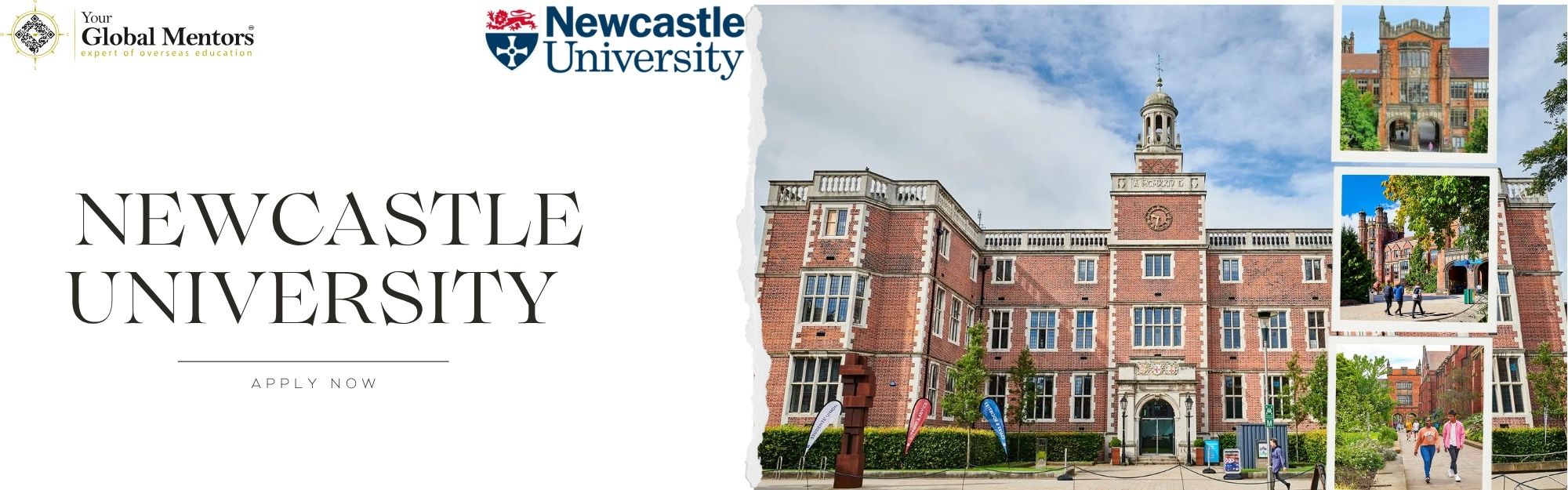
Newcastle University offers an accessible, integrated campus experience located in the heart of Newcastle upon Tyne. The campus blends historic and modern architecture, dedicated research facilities, specialist laboratories, libraries, and creative spaces that support interdisciplinary study and student life. Key campus features include contemporary lecture theatres, innovation hubs, sports and wellbeing centres, and specialist facilities for health sciences and engineering. The Student Union forms the social core with clubs, societies, and student-led initiatives that promote cultural engagement, volunteering, and leadership opportunities.
For international students, campus services include orientation programmes, international student societies, language support, disability services, and dedicated career development centres that host employer events and placement fairs. The proximity to the city’s transport links, major hospitals, and industry clusters means students often secure internships and part-time roles that complement their studies. Newcastle’s campus safety, active student support networks, and accessible accommodation options make it a comfortable and secure setting for study.
Our Newcastle University admissions guidance includes campus exploration as a decision criterion: we help applicants collect virtual tour links, arrange campus visits where feasible, and align accommodation preferences (on-campus halls vs private rentals) with budgets and study commitments. We also provide a campus checklist covering document submissions for accommodation, health registration processes, and local banking and mobile connectivity steps.
Newcastle University offers a wide spectrum of undergraduate, postgraduate taught, and postgraduate research programmes across faculties such as Medical Sciences, Science, Engineering, Humanities, and Social Sciences. Degree pathways emphasise research-led teaching, critical thinking, practical experience, and employability. Popular fields include Biomedical Sciences, Mechanical and Civil Engineering, Computer Science and AI, Architecture, Business and Management, Law, and Public Health.
Each course has a clearly defined structure: core modules that build disciplinary foundations, elective modules for specialisation, and project or dissertation components that demonstrate independent research capability. Many postgraduate programmes include industry placements, professional accreditation pathways (where relevant), and collaborative research projects that give students hands-on experience.
Your Global Mentors provides course-matching services to align your academic background, career goals, and financial constraints with Newcastle University courses. We evaluate module content, credit structures, research supervision availability, and placement options. For example, prospective engineering applicants will receive guidance on accredited routes that align with UK professional standards, while health-related applicants will be briefed on clinical placement expectations and regulated profession requirements.
International Researcher
Management of a Hotel
Musician
Artist
Sociologist
Historian
Language translator
Journalists and media personnel
International Busines
Innovation and Entrepreneurship
Marketing
Finance Human Resources
Business Information Systems
Business Economics
Business Analytics
Accounting
Property and estate management
Threats from cyberspace
MS in Microbiology or Clinical Pathology
MS in Hospital Administration
MBA in Healthcare Management
M.Tech in Biomedical Engineering and Biological Sciences
The law of the family.
The criminal code
Commercial law
Environmental legislation
Computer systems and networks
Construction
Cyber security
Computer ethics and law
Principles of security design
Cryptography
Software and security administration
Intelligence on cyber-threats and incident response
Management in the Retail Industry
Commercial Cookery or Chef
Avionics and Aeronautical Engineering
B.Sc Nutrition & Dietetics
Bachelor of Optometry
B.Sc Microbiology
Petroleum Engineering
Industrial Instrumentation
Materials and Mineral Engineering
Engineering Science
Marine Engineering
Process engineering
B.Sc Radio-Imaging Technology
Systems Engineering
Manufacturing Engineering
Industrial Engineering
Mechanical Engineering
Aerospace Engineering
Biomedical Engineering
Electrical Engineering
M.Sc Operation Theater Technology
Production design
Structural engineering
Civil engineering
Interior design
Town planning
Building technology and management
Building conservation
M.Sc Microbiology
M.Sc Medical Laboratory Technology
M.Sc Radio-Imaging Technology
M.Sc Nutrition & Dietetic
Master of Optometry
B.Sc Renal Dialysis
B.Sc Cardiac Care Technology
B.Sc Medical Laboratory Technology
B.Sc Operation Theater Technology
B.Sc Neuro-physiology Technology
Understanding tuition is essential for planning Newcastle University admissions. Tuition for international students varies by level and subject — typically higher for laboratory-based and professional programmes. As a rule of thumb, undergraduate international fees for many programmes range from moderate to high depending on course intensity and required resources; postgraduate taught fees often differ by discipline, with clinical and lab-heavy subjects attracting higher fees.
Your Global Mentors provides a tailored fee breakdown for each applicant, including tuition, mandatory course fees, living cost estimates, health surcharge (where applicable), and projected incidental expenses. We analyse scholarship opportunities and external funding sources to reduce net costs and provide guidance on education loan documentation and bank guarantees often required for visa applications.
Table: Indicative tuition bands for international students at Newcastle University
Programme Type | Typical Annual Tuition Range (GBP) |
|---|---|
Undergraduate (Arts, Social Sciences) | £18,000 — £22,000 |
Undergraduate (Engineering, Science) | £20,000 — £26,000 |
Postgraduate Taught (Humanities) | £19,000 — £24,000 |
Postgraduate Taught (STEM, Clinical) | £21,000 — £30,000 |
Postgraduate Research (PhD) | £20,000 — £28,000 |
Sources: University published fees and international student guidance.
Acceptance rates for Newcastle University admissions vary by course, level, and year. Competitive programmes — particularly in medicine, dentistry, certain engineering disciplines, and highly ranked research masters — have lower acceptance rates due to higher application volumes and stringent entry standards. Conversely, niche or interdisciplinary programmes may have more flexible intake criteria.
Admission decisions consider academic records, relevant work or research experience, personal statement quality, references, and, when applicable, performance in interviews or tests. International applicants with non-UK qualifications often require credential evaluations and sometimes pathway or pre-sessional English courses. Your Global Mentors help applicants present their strongest academic profile through targeted SOPs, LORs, and CVs to improve acceptance probability.
We counsel applicants on managing realistic expectations, applying to a balanced mix of reach, match, and safety courses at Newcastle University, and leveraging scholarships and conditional offers strategically.
Your Global Mentors (YGM) brings a consultative, evidence-based approach to Newcastle University admissions. Our track record reflects high success rates across competitive UK universities, with expert teams in academic advising, SOP/LOR writing, visa documentation, and pre-departure orientation. We tailor strategies to each applicant’s background: academic strength, extracurricular achievements, work experience, research interests, and long-term career goals.
YGM’s Newcastle University admissions package includes:
Detailed course and faculty alignment research
Application drafting and submission with compliance checks
Professionally written SOP and tailored LOR coaching
CV/resume optimisation for academic and professional applications
Scholarship search and application management
Education loan assistance and paperwork guidance
Student visa application & document checklist management
Interview coaching and mock interviews for competitive programmes
Pre-departure guidance, accommodation assistance, forex, and ticket coordination
Scholarships can significantly reduce the net cost of studying at Newcastle University for international students. The university and external organisations provide merit-based awards, departmental scholarships, and targeted funding for specific regions or research topics. Scholarship criteria vary widely: some are based on academic excellence, others target social mobility, leadership, or subject-specific research proposals.
Your Global Mentors identify scholarships relevant to each applicant’s profile and manage application timelines, supporting documents, and persuasive scholarship statements. We also advise on funding packages that combine university awards, external scholarships, and education loans to create a sustainable finance plan. Applicants should apply early and ensure their SOP aligns with scholarship priorities such as research impact, leadership potential, or community contribution.
High-value scholarship opportunities often require additional documentation such as research proposals, evidence of impact, or academic endorsements — areas where YGM provides significant support.
Newcastle University admissions require specific documentation depending on the level of study and applicant origin. Typical application requirements include:
Completed online application or UCAS form for undergraduate programmes
Academic transcripts and certified translations
Degree certificates (or provisional certificates)
Proof of English proficiency (IELTS, TOEFL, PTE or equivalent) or completion of an approved pathway
Personal Statement / Statement of Purpose (SOP)
Letters of Recommendation (LORs) — usually two for postgraduate research and one to three for taught programmes
Curriculum Vitae / Resume for postgraduate and professional programmes
Portfolio (for architecture, design, and arts applicants)
Test scores for specific courses (e.g., GMAT/GRE for some programmes)
Passport scan and passport-style photo
Financial evidence for visa purposes (bank statements, loan sanction letters)
Health or police certificates, where applicable
Your Global Mentors prepare a personalised checklist for each applicant and manage document collection, verification, and timely submission. We also coordinate LORs with referees and draft compelling SOPs that follow Newcastle University admissions expectations. For documentary translations and notarisation, YGM offers vendor recommendations to ensure compliance with UK visa documentary standards.
Newcastle University’s focus on employability results in strong graduate outcomes. The university’s career services, employer engagement, and placement modules increase graduates’ chances of securing internships and full-time roles in the UK and internationally. Popular destinations for Newcastle graduates include healthcare providers, engineering consultancies, software and AI firms, finance and consulting firms, and creative industries.
Placement rates vary by discipline and market conditions. Many STEM programmes offer industrial placements, sandwich years, and project partnerships with industry that translate directly into higher employability. Career support includes CV workshops, interview preparation, employer fairs, and alumni networking events — services Your Global Mentors supplements with targeted interview coaching and employer-relevant CV tailoring for Newcastle University admissions.
Metrics that applicants should consider: graduate employment within six months of graduation, median starting salary by subject area, and proportion of graduates entering professional or managerial roles. YGM provides subject-specific placement insights and uses that data to advise on course and module selection that maximise employability outcomes.
Entry score cut-offs for Newcastle University admissions depend on programme level and applicant origin. Undergraduate students may be assessed on A-levels, IB scores, or equivalent national examinations with programme-specific minimums. Postgraduate taught programmes typically require a UK upper second-class honours degree (2:1) or equivalent; some specialised MSc or taught programmes may accept lower classifications with relevant experience.
For international qualifications, Newcastle provides equivalency guidance; applicants should verify exact grade requirements on the course pages. English language cut-offs also vary; typical IELTS requirements for postgraduate taught courses are in the range of 6.5 overall with minimum component scores, while some competitive programmes ask for 7.0 or subject-specific IELTS thresholds.
Your Global Mentors help applicants interpret academic equivalencies, build conditional offer responses, and, where necessary, prepare for English language pre-sessional courses or alternative credential pathways.