




Embry‑Riddle Asia
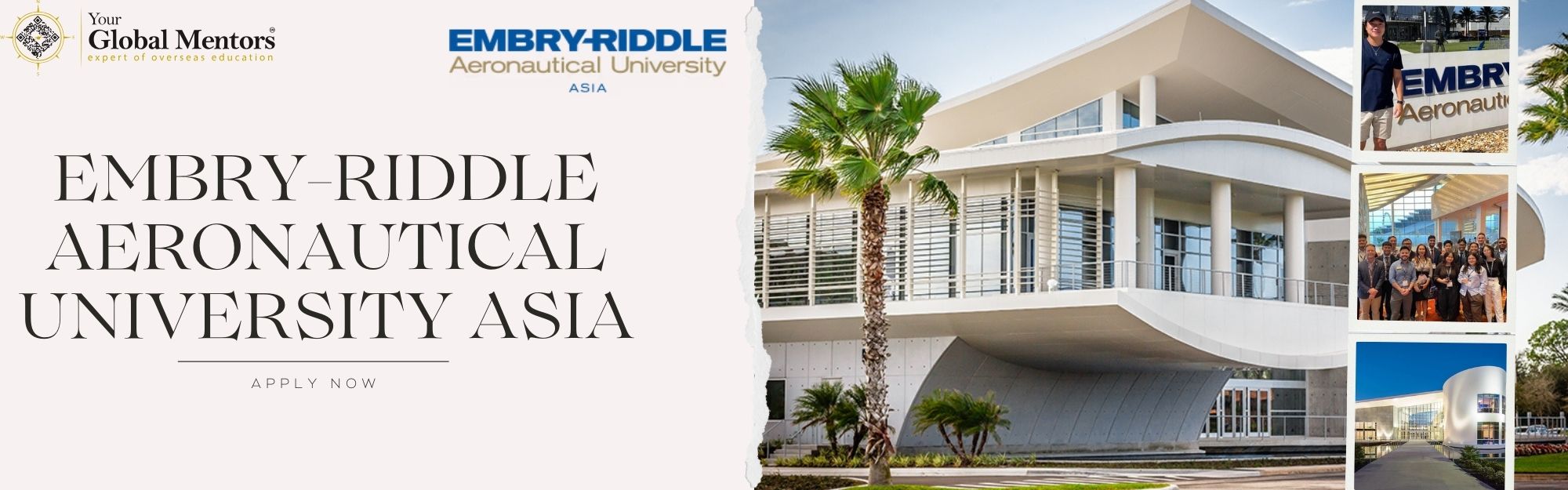
Your Global Mentors foreign education consultancy introduces each university profile with a clear, student‑centric overview that highlights academic strengths, campus culture, career pathways, and the practical benefits of choosing the institution. Embry‑Riddle Aeronautical University Asia is a specialised campus that extends the global reputation of Embry‑Riddle into the Asia Pacific region. The campus focuses on aviation, aerospace engineering, aeronautics, and related business and technology programs designed to prepare graduates for high‑impact careers in airlines, aerospace manufacturers, defence, research, and aviation services.
Embry‑Riddle Asia blends rigorous academic curricula with hands‑on training, industry partnerships, and experiential learning opportunities. Students benefit from small class sizes, faculty with industry experience, and access to specialised labs and simulation facilities. The campus is strategically located to serve students from across Asia while maintaining close ties to Embry‑Riddle’s global network of alumni and industry collaborators. This combination of local accessibility and global reach makes Embry‑Riddle Asia an attractive option for students seeking specialised training in the aerospace and aviation fields.
At Your Global Mentors foreign education consultancy, we begin every application journey by assessing academic background, career goals, and financial needs. Our advisors map each student to the most suitable programs, clarify admission requirements, and create a step‑by‑step plan that includes application timelines, documentation checklists, scholarship strategies, and visa preparation. We emphasise transparency, measurable milestones, and continuous communication so students and families feel confident at every stage. For students targeting Embry‑Riddle Asia, we provide tailored guidance on program selection, SOP and LOR crafting, resume optimization, and interview preparation to maximize admission and scholarship outcomes.
Why Embry‑Riddle Asia matters for aspiring aerospace professionals: the campus offers a focused curriculum that aligns with industry standards, practical training that employers value, and a network that opens doors to internships and placements. Choosing Embry‑Riddle Asia through Your Global Mentors foreign education consultancy means receiving personalised support that turns ambition into acceptance and acceptance into a successful global career.
Embry‑Riddle Aeronautical University is globally recognised for its leadership in aviation and aerospace education. While global ranking systems such as QS World University Rankings and Times Higher Education focus on broad multidisciplinary metrics, Embry‑Riddle’s reputation is particularly strong in subject areas like aerospace engineering, aeronautics, and aviation management. Prospective students should consult the latest QS subject rankings and specialised industry reports for the most current subject‑level placements and comparative metrics.
At Your Global Mentors foreign education consultancy, we track subject rankings, employer reputation indicators, and industry partnerships to help students understand how a program’s standing translates into career opportunities. Rankings are one of several factors we consider; we also evaluate program curriculum, faculty expertise, lab and simulation resources, internship pipelines, and alumni outcomes. For students seeking the best return on investment, we combine ranking data with practical indicators such as graduate employability, internship availability, and industry collaborations.
How we use rankings in counselling: we interpret ranking data in context. A high subject ranking in aerospace engineering signals strong research output and academic reputation, but students also need to assess program fit, hands‑on training, and local industry connections. Our advisors present ranking information alongside program specifics and career outcomes so students can make informed decisions. We also guide students on how to highlight ranking‑relevant achievements in their applications, such as research experience, technical projects, and industry internships.
Where to verify rankings: Students can check QS World University Rankings by Subject and other reputable ranking platforms for the latest data. We recommend cross‑referencing multiple sources and reviewing the university’s official pages for program‑level details. Your Global Mentors foreign education consultancy will provide direct links and up‑to‑date ranking snapshots during counselling to ensure applicants have accurate and actionable information.
Embry‑Riddle Asia’s campus environment is designed to support focused learning, technical training, and professional development. The campus typically features specialised facilities such as flight simulators, avionics and avionics testing labs, wind tunnels, engineering workshops, and collaborative project spaces. These facilities enable students to apply theoretical knowledge in realistic settings, complete capstone projects, and gain practical skills that employers in aerospace and aviation value highly.
Student life on campus balances academic rigour with community engagement. Clubs and societies often include aviation clubs, engineering teams, robotics groups, and entrepreneurship cells that foster leadership and teamwork. Guest lectures, industry seminars, and networking events connect students with professionals from airlines, aerospace manufacturers, and research organisations. Career services and internship offices actively support students in securing placements, co‑ops, and industry projects that enhance employability.
Accessibility and student support: Embry‑Riddle Asia typically offers robust student support services, including academic advising, counselling, career guidance, and international student services. These services help students adapt to campus life, manage academic workloads, and navigate visa and accommodation logistics. For international students, orientation programs and pre‑departure briefings are essential to ensure a smooth transition to life abroad.
Sustainability and campus innovation. Many modern campuses emphasise sustainability, research in green aviation technologies, and partnerships with industry leaders to pilot new technologies. Students interested in research can often collaborate with faculty on funded projects or industry‑sponsored initiatives, gaining exposure to cutting‑edge developments in aerospace and aviation.
How Your Global Mentors support campus transition: we assist students with accommodation search, campus orientation planning, and connecting with student groups before arrival. Our pre‑departure briefings cover campus culture, academic expectations, housing options, local transport, and safety protocols so students arrive prepared and confident.
Embry‑Riddle Asia offers a range of undergraduate and graduate programs focused on aerospace, aviation, engineering, and related business disciplines. Course structures emphasise a blend of theoretical foundations, laboratory work, simulation training, and industry internships. Core courses typically cover aerodynamics, aircraft systems, propulsion, avionics, flight operations, aviation safety, aerospace materials, and systems engineering. Electives and specialisation tracks allow students to tailor their studies toward areas such as unmanned aerial systems, aerospace systems design, aviation management, or aerospace data analytics.
Graduate programs often include advanced coursework, research components, and capstone projects that address real‑world industry challenges. Many programs encourage interdisciplinary collaboration, combining engineering fundamentals with data science, business analytics, and systems thinking to prepare graduates for complex roles in aerospace organisations. Course delivery may include lectures, lab sessions, simulation exercises, project work, and industry placements.
Program highlights:
Hands‑on labs and simulators: flight simulators and avionics labs provide practical training that complements classroom learning.
Capstone projects: final year projects often partner with industry sponsors to solve practical engineering or operational problems.
Internships and co‑ops: structured internship programs connect students with airlines, aerospace manufacturers, and research labs.
Industry‑aligned curriculum: courses are regularly updated to reflect technological advances and regulatory changes in aviation and aerospace.
How Your Global Mentors help with course selection: our advisors analyse each student’s academic background, career goals, and technical interests to recommend the most suitable programs and specialisation tracks. We provide detailed course maps, explain credit structures, and outline how elective choices influence career pathways. For students aiming at research or PhD progression, we advise on research experience, faculty contacts, and publication strategies.
International Researcher
International Busines
Innovation and Entrepreneurship
Marketing
Fashion Design
Research and doctoral collaborations in engineering disciplines
MSc Integrated Circuit Design
Fashion Business
Finance Human Resources
BBA
Business Information Systems
Business Economics
Business Analytics
Accounting
Property and estate management
Construction
Building conservation
Tuition fees vary by program, level of study, and residency status. For specialised campuses like Embry‑Riddle Asia, tuition for undergraduate and graduate programs reflects the cost of specialised labs, simulation facilities, and industry partnerships. Fees may also differ for international students due to additional services and regulatory requirements.
Typical cost components:
Tuition per semester or year: program dependent and varies by course load.
Lab and equipment fees: specialised courses may include additional charges for simulator access or lab consumables.
Student services and insurance: international students often pay health insurance and student services fees.
Living expenses: accommodation, food, transport, and personal expenses vary by city and lifestyle.
How Your Global Mentors supports financial planning: we provide transparent cost breakdowns and help students estimate the total cost of study, including tuition, living expenses, travel, and contingencies. Our services include education loan assistance, scholarship application support, and guidance on part‑time work regulations to help students manage finances responsibly. We also prepare students for scholarship interviews and help craft compelling funding applications to maximise chances of receiving financial aid.
Example fee planning table
Cost Component | Estimated Range |
|---|---|
Tuition per year | Varies by program; estimate provided during counselling |
Lab and equipment fees | Program dependent |
Accommodation per month | City dependent |
Living expenses per month | City dependent |
Insurance and student services | Mandatory for international students |
This table is illustrative. For precise fee schedules, students should consult the university’s official fee pages and request program‑specific estimates through Your Global Mentors foreign education consultancy.
Acceptance rates for specialised programs can vary widely depending on program demand, applicant qualifications, and intake capacity. Embry‑Riddle’s selective programs in aerospace and aviation attract applicants with strong STEM backgrounds, relevant experience, and clear career objectives. Acceptance rates may be influenced by the number of seats available, the competitiveness of the applicant pool, and program prerequisites.
How Your Global Mentors improve acceptance chances: we focus on strengthening every element of the application package. This includes crafting a compelling Statement of Purpose (SOP) that articulates career goals and program fit, securing strong Letters of Recommendation (LORs) that highlight technical and professional strengths, optimising resumes to showcase relevant projects and internships, and ensuring documentation is complete and error‑free. We also advise on strategic program choices and backup options to maximise overall admission success.
Application strategy:
Targeted program selection: apply to programs that match academic profile and career goals.
Compelling SOP and LORs: emphasise unique experiences, technical skills, and motivation.
Early application: Submit applications early to avoid capacity constraints and to be considered for scholarships.
Test score optimisation: where required, aim for competitive GRE, TOEFL, or IELTS scores and use our IELTS preparation services to improve outcomes.
Your Global Mentors foreign education consultancy provides an in‑depth YGM Review for each university and program we recommend. Our review synthesises academic quality, industry relevance, campus facilities, student support, scholarship opportunities, and career outcomes. The YGM Review is designed to help students and families evaluate program fit and return on investment.
What the YGM Review covers:
Academic rigour and curriculum relevance: analysis of course content, lab access, and research opportunities.
Industry connections and internships: assessment of employer partnerships and internship pipelines.
Student support and campus life: evaluation, counselling, accommodation, and international student services.
Scholarship and funding landscape: overview of available scholarships, eligibility criteria, and application strategies.
Placement outcomes: typical employer sectors, average starting salaries, and alumni success stories.
How the YGM Review helps applicants: the review provides actionable recommendations on application strategy, scholarship targeting, and career planning. It identifies program strengths and potential gaps so students can make informed choices. For Embry‑Riddle Asia, the YGM Review highlights the campus’s specialised focus on aerospace and aviation, the practical training advantages, and the career pathways into airlines, aerospace manufacturers, and defence sectors.
Scholarships can significantly reduce the cost of study and are offered by universities, governments, and private organisations. Embry‑Riddle and similar institutions may provide merit‑based scholarships, need‑based aid, and program‑specific awards for outstanding applicants. Scholarship availability, eligibility criteria, and application deadlines vary by program and intake.
How Your Global Mentors assist with scholarships:
Scholarship search: We identify scholarships aligned with the student’s profile and program.
Application support: We help prepare scholarship essays, recommendation letters, and supporting documents.
Deadline management: We track scholarship deadlines and ensure timely submission.
Interview coaching: for scholarships requiring interviews, we provide mock interviews and feedback.
Scholarship strategy:
Highlight academic excellence and leadership: craft narratives that demonstrate impact and potential.
Showcase technical projects and internships: emphasise hands‑on experience relevant to aerospace and aviation.
Leverage unique backgrounds: use personal stories and community contributions to stand out.
Apply broadly: combine university scholarships with external funding sources to maximise support.
Scholarship application checklist
Item | Required |
|---|---|
Scholarship essay | Yes |
Recommendation letters | Yes |
Academic transcripts | Yes |
Proof of achievements | Yes |
Interview (if applicable) | Prepare with YGM |
Applying to Embry‑Riddle Asia or similar institutions requires careful preparation of academic and supporting documents. Requirements typically include academic transcripts, degree certificates, standardised test scores (if required), English proficiency proof (IELTS/TOEFL), Statement of Purpose (SOP), Letters of Recommendation (LORs), resume or CV, passport copy, and any program‑specific documents such as portfolios or technical project summaries.
How Your Global Mentors Manage Documentation:
Document checklist: We will provide a tailored checklist for each program and intake.
SOP and LOR drafting: our experts draft and refine SOPs and LORs to align with program expectations.
Resume optimisation: we format and highlight technical projects, internships, and leadership roles.
Verification and submission: We ensure documents meet university formatting and authentication requirements and assist with online submission portals.
Application timeline guidance:
6–12 months before intake: begin program research, test preparation, and document collection.
3–6 months before intake: finalise SOP, LORs, and resume; submit applications early.
After submission: track application status, prepare for interviews, and apply for scholarships and loans.
Application requirement table
Document | Notes |
|---|---|
Academic transcripts | Official and translated if required |
SOP | Tailored to program and career goals |
LORs | From academic or professional referees |
Resume | Highlight technical and leadership experience |
English test | IELTS/TOEFL as required |
Passport | Valid for the duration of the study |
Graduates from specialised aerospace and aviation programs often find roles in airlines, aerospace manufacturers, defence contractors, research labs, and aviation services. Placement outcomes depend on program strength, internship experience, and networking. Average placement metrics include job offer rates within six months of graduation, typical employer sectors, and median starting salaries.
How Your Global Mentors enhances placement prospects:
Internship alignment: We help students secure internships that lead to full‑time offers.
Career readiness: resume workshops, interview simulations, and employer networking events.
Alumni connections: introductions to alumni working in target companies and sectors.
Job search strategy: targeted applications, LinkedIn optimisation, and employer outreach.
Placement support services:
Mock interviews: technical and HR interview practice with feedback.
Employer mapping: identify companies hiring graduates in aerospace and aviation.
Offer negotiation: guidance on salary, benefits, and relocation packages.
Placement outcomes table
Metric | Typical Range |
|---|---|
Job offer rate | Program dependent |
Top employer sectors | Airlines; aerospace manufacturers; defense; research |
Median starting salary | Varies by country and role |
Score cut‑offs for standardised tests and academic thresholds vary by program and intake. Competitive programs may expect strong undergraduate GPAs, solid math and physics foundations, and competitive GRE or equivalent scores for graduate applicants. English proficiency requirements, such as IELTS or TOEFL scores, are commonly required for international applicants.
How Your Global Mentors Prepare Applicants:
Test preparation: focused IELTS coaching and guidance on GRE or other required tests.
Academic strengthening: advice on prerequisite courses, project portfolios, and research experience.
Application positioning: strategies to offset lower scores with strong SOPs, LORs, and relevant experience.
Typical score guidance:
IELTS: target scores depend on program; many technical programs expect a band of 6.5–7.0 or higher.
GRE: where required, competitive scores vary by program; we provide target ranges during counselling.
Undergraduate GPA: Competitive applicants typically have strong STEM GPAs; we advise on how to present academic context and improvements.