
Dublin City University
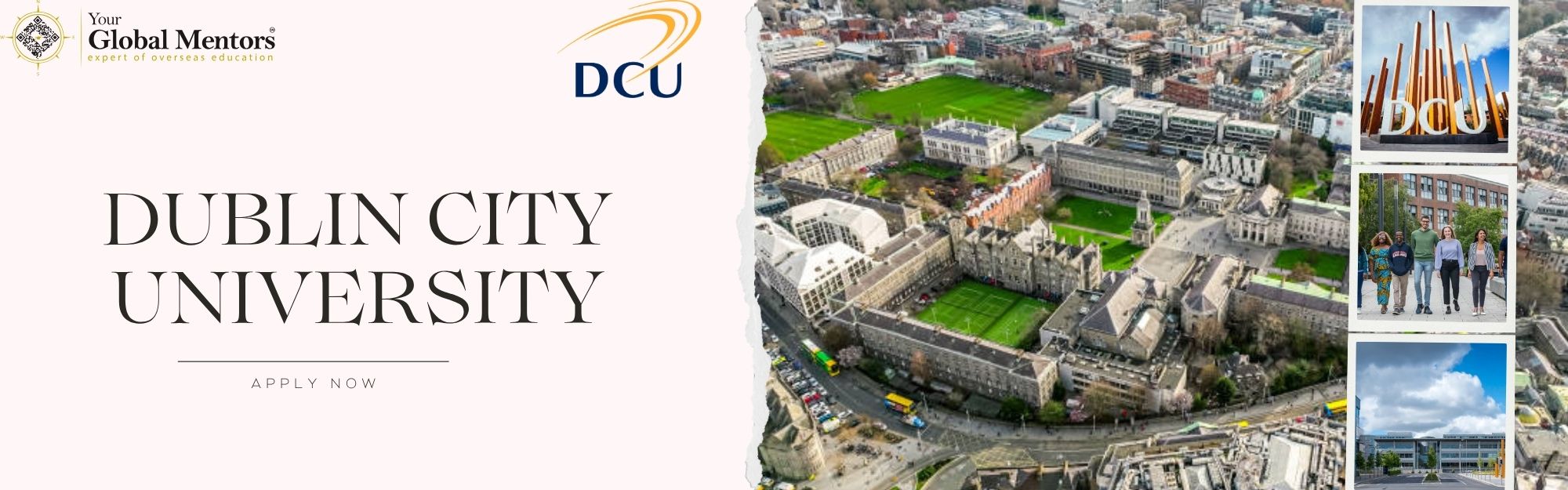
Dublin City University is a globally respected Irish university combining modern, student-centred learning with strong industry links, high graduate employability, and a dynamic research culture. Founded with a mission to transform lives and societies, DCU brings together interdisciplinary teaching, robust campus services, and a strategic focus on innovation, entrepreneurship, and community engagement. Many DCU courses include structured work placements through the INTRA programme — a major advantage for international students who want practical experience alongside academic study. DCU positions itself among the top young universities globally and invests heavily in student support, inclusive campus life, and career readiness. For applicants from India and other international markets, Dublin City University offers a wide range of undergraduate and postgraduate programmes across faculties such as Business, Engineering & Computing, Humanities & Social Sciences, and Science & Health. DCU’s international student community is large and diverse, reflecting over a hundred nationalities on campus, and the university provides tailored services for new students, including orientation, accommodation support, and career services to ensure a smooth transition and strong graduate outcomes.
Dublin City University has achieved notable recognition among young universities and across global league tables. In recent Times Higher Education Young University rankings, DCU has been placed among the top young universities in Ireland and internationally, reflecting its research quality, teaching standards, and graduate outcomes. While QS-specific rankings vary year to year, DCU’s consistent improvements in global rankings reflect investment in research, teaching innovation, and student support. DCU also ranks highly in measures such as research quality and graduate employability: the university reports strong graduate outcomes and high participation in structured work placements, which are decisive for prospective students evaluating return on investment and career pathways. Prospective students should consult official ranking releases and program-specific rankings to make the best fit-based decision; Your Global Mentors can help interpret rankings and translate them into an admission strategy and scholarship targeting for applicants to DCU.
Dublin City University’s campuses are modern, accessible, and carefully designed to support academic life, research, and student wellbeing. DCU’s main campus sits within an expansive urban campus environment with green spaces, contemporary teaching buildings, research institutes, student residences and sports facilities. The campus includes high-quality facilities such as libraries, laboratories, performance spaces, the Helix cultural centre, student clubs and societies hubs, and dedicated areas for entrepreneurship and innovation via DCU: Innovate hubs. Student support services — counselling, health services, disability and learning support, and academic guidance — are integrated into campus life to help international students adapt to studying in Ireland. Transport connectivity and on-campus student accommodation options are available to meet diverse needs, and DCU’s emphasis on accessibility and inclusive campus initiatives ensures the campus environment is welcoming for students from different backgrounds. The campus culture at DCU is active: clubs, societies, sports teams and cultural events create a vibrant social calendar that complements academic life and aids networking and professional development. For Indian students and international applicants, campus visits (virtual or in-person), accommodation consultations, and orientation planning are essential steps; Your Global Mentors provides bespoke support to help students choose the right campus housing, prepare for arrival, and access student services on-site.
Dublin City University offers a broad portfolio of undergraduate, postgraduate taught, and research programmes across multiple faculties. Popular subject areas include Business and Management, Engineering and Computing, Education, Health Sciences, Humanities & Social Sciences, and Natural Sciences. Many courses are designed with practical, industry-focused elements such as paid internships (INTRA), live project work, and collaboration with industry partners that boost employability and real-world skills. Program structures typically include modular learning, research-led teaching, and a balance of theory with applied practice. At the postgraduate level, DCU hosts specialised MSc and MA programmes that target industry demand — from data analytics and cyber security to digital marketing and applied social research. Doctoral and research opportunities are available through the university’s research institutes and centres, which focus on impactful interdisciplinary themes such as digital technologies, health innovation, sustainability, and creative industries. Entry requirements vary by programme and level: undergraduate applicants normally apply through CAO or direct application routes with specified subject prerequisites, while postgraduate candidates submit academic transcripts, references, and program-specific documentation. Your Global Mentors provides end-to-end support on selecting the right DCU course, mapping eligibility, preparing SOPs and LORs, and matching applicants with scholarships and finance options.
Journalists and media personnel
Catering
Artist
Sociologist
Politician
International Researcher
International Busines
Innovation and Entrepreneurship
Marketing
Finance Human Resources
Business Information Systems
Business Economics
Business Analytics
Accounting
Computer systems and networks
Testing
The criminal code
Cyber security
Computer ethics and law
Principles of security design
Industrial Instrumentation
B.Sc Neuro-physiology Technology
Avionics and Aeronautical Engineering
Systems Engineering
Manufacturing Engineering
Industrial Engineering
Mechanical Engineering
Aerospace Engineering
Biomedical Engineering
Electrical Engineering
BBA
Structural engineering
Interior design
Town planning
Understanding tuition fees is crucial for planning your study budget at Dublin City University. Tuition costs at DCU vary significantly by study level, nationality (EU vs non-EU), and programme. Typically, non-EU international students pay higher fees than EU students, with undergraduate and postgraduate taught programmes reflecting market-based fee levels that account for specialised resources and industry-aligned learning. For example, postgraduate taught master’s courses in STEM areas or business disciplines tend to have higher fees than some humanities or education programmes. In addition to base tuition, prospective students should budget for ancillary costs, including student levies, health insurance, accommodation, living expenses, travel, and course-specific materials or field trips. Scholarships, research assistantships, and part-time work options (within visa regulations) can offset costs and improve affordability. Your Global Mentors help candidates identify scholarship opportunities at DCU and external funding, prepare robust scholarship applications, and structure education loan applications where required. For current, program-specific fee figures, we recommend checking the official DCU programme pages and fee schedules and consulting Your Global Mentors for personalised financial planning and education loan assistance tailored to Indian students’ needs.
Dublin City University attracts a competitive and diverse pool of applicants each year. Acceptance rates at DCU vary by programme, level of study, and applicant profile. Highly specialised or career-oriented programmes (such as certain engineering, business, or health science master's) may have lower acceptance rates due to limited intake and high demand, while broader programmes may have more flexible entry windows. International applicants are assessed on academic credentials, English language proficiency, relevant experience, and programme-specific criteria such as portfolios or interviews where applicable. DCU emphasises a holistic approach in admissions for many programmes: grades matter, but predictive potential, relevant work/internship experience, quality of SOP (Statement of Purpose), LORs, and the alignment of applicant goals with programme outcomes play a substantial role in selection decisions. Applicants from India can enhance admission probability by following a targeted application strategy — choosing programs aligned with their background, securing strong LORs, crafting a persuasive SOP, and ensuring timely, complete documentation. Your Global Mentors provides data-driven admissions counselling that benchmarks applicant profiles against DCU programme expectations, helping to improve selection chances through document refinement, eligibility checks, and strategic application timing.
Your Global Mentors’ review of Dublin City University is based on detailed evaluation criteria: academic excellence, industry linkages and employability, campus facilities, international student support, scholarship opportunities, and overall return on investment. DCU stands out for its applied learning approach, high graduate employment outcomes, and strong integration with industry through INTRA placements and research partnerships. For Indian students, DCU’s student services, multicultural campus environment, and career readiness initiatives make it a compelling destination. YGM assesses programme fit according to students’ career goals and academic background and recommends targeted pathways where DCU has demonstrable strengths — for example, MSc programmes with strong industry ties, professional master’s degrees in education and health, and computer science or engineering streams that lead to clear employability advantages. YGM also evaluates scholarship availability, visa success metrics, and accommodation support to provide a holistic decision-making framework for prospective applicants considering DCU. Our recommendations are personalised: we map candidate profiles to DCU programmes with the best probability of success, curate scholarship applications, and provide interview and visa preparation to maximise conversion from offer to enrollment.
Dublin City University offers a range of scholarships, bursaries and awards aimed at supporting academic excellence, research potential, and student diversity. Scholarships may be merit-based, need-based, programme-specific, or focused on research excellence and postgraduate study. International students are eligible for certain awards, and DCU also provides targeted scholarships for doctoral researchers and high-achieving master’s candidates. In addition to DCU-funded scholarships, external funding — from governments, foundations, and industry partners — can supplement study budgets. The scholarship application process typically requires a compelling academic record, a strong personal statement, and sometimes evidence of project proposals or references. Your Global Mentors help applicants identify appropriate DCU scholarships and external funding, prepare persuasive scholarship essays and supporting documents, and time applications to align with scholarship windows. We also advise on alternative funding mechanisms such as education loans, part-time work options (within visa limits), and cost-reduction strategies for living expenses. For accurate, up-to-date scholarship listings, applicants should consult DCU’s official scholarships pages and leverage YGM’s scouting and application services to increase the likelihood of receiving financial awards.
Applying to Dublin City University requires careful document preparation and compliance with application timelines and programme-specific criteria. Typical application requirements include certified academic transcripts, degree certificates, a detailed curriculum vitae or resume, a well-crafted Statement of Purpose (SOP) outlining academic interests and career goals, Letters of Recommendation (LORs), and proof of English language proficiency such as IELTS or equivalent (when applicable). Some programmes may require additional items: portfolios, research proposals for doctoral applicants, GRE/GMAT scores for select business programmes, or evidence of professional experience for certain applied master’s programmes. Non-EU applicants must also provide certified translations where documents are not in English. Visa-related requirements (financial proof, passport copies, biometric information) must be prepared in parallel for timely submission. Your Global Mentors specialises in assembling complete, compelling application packages: we draft and refine SOPs, coach referees on LOR content, format academic transcripts, and ensure all documents satisfy DCU’s verification standards. We also handle tailored checks for each DCU course to ensure applicants meet prerequisites and recommend preparatory measures where necessary. Applicants should begin the process early to secure interviews, scholarship deadlines, and visa timelines without last-minute pressure.
Graduate employability is a key strength at Dublin City University, reflected in strong graduate outcome statistics and the wide integration of industry placements into many courses. DCU reports a high percentage of graduates entering employment or further study within months of completing their programmes, boosted by career services, employer networks, and INTRA work placement schemes. Placement outcomes vary by faculty and programme: career paths for business, computing, engineering, and health graduates are often buoyed by employer demand for skilled professionals, while humanities and social science graduates benefit from transferable skills, postgraduate study routes, and expanding public/private sector opportunities. DCU’s Careers Service provides CV and interview coaching, recruitment fairs, employer networking events, and placement matching services that substantially increase students’ hiring potential. For international students, placements are valuable not just for work experience but for potential routes to post-study work visas and international career trajectories. Your Global Mentors provides targeted interview preparation, employer-specific coaching, and CV/resume fine-tuning to enhance placement outcomes for DCU applicants and graduates aiming to convert internships into long-term employment.
Score cut-offs for programmes at Dublin City University differ across undergraduate and postgraduate offerings, and between EU and non-EU applicants. Undergraduate entry via CAO or direct admission typically uses academic results (e.g., grades, subject prerequisites) as a baseline. Postgraduate programmes may require a minimum undergraduate GPA, relevant subject background, or professional experience. English language cut-offs (IELTS, TOEFL or equivalent) are strictly enforced for applicants whose prior education was not in English — each programme has its own accepted thresholds which are published on DCU’s admissions pages. Some competitive programmes also consider additional assessments such as portfolios, interviews, or entrance tests. Your Global Mentors advises candidates on realistic target scores and recommend preparation plans if applicants are below thresholds (e.g., additional coursework, bridging modules, or English language programmes). We also provide mock interviews and document improvement strategies that can compensate when academic scores sit near cut-off levels. For precise programme-specific cut-offs, consult the DCU course pages and let YGM tailor a plan to meet or exceed those requirements.