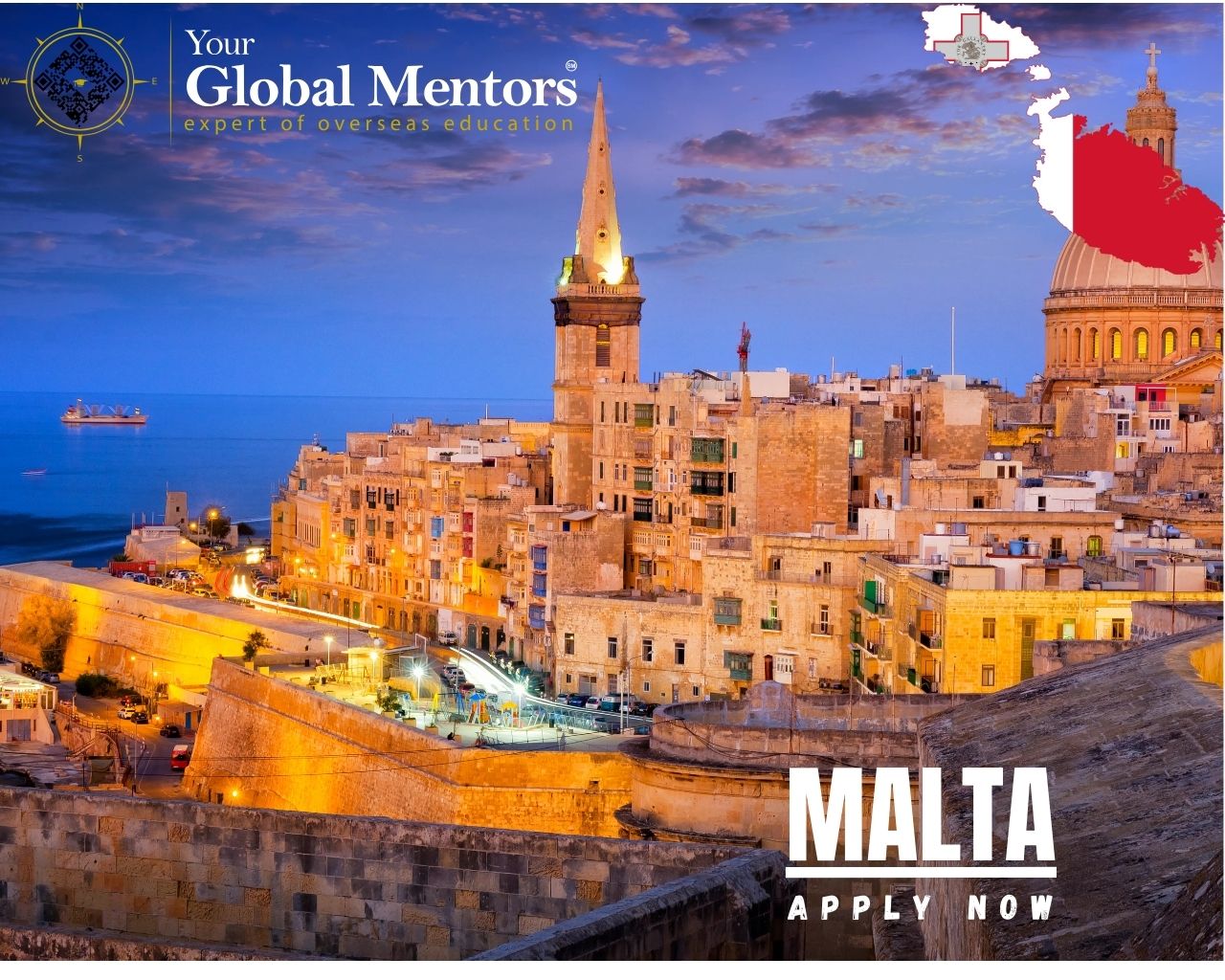
Why Study in Malta
Malta is one of Europe's best-kept secrets when it comes to higher education, and for international students who discover it, the experience is transformative. This small but extraordinarily dynamic island nation, situated at the heart of the Mediterranean Sea, offers a unique combination of world-class English-medium education, an affordable cost of living, a warm and welcoming culture, and the full prestige of a European Union member state degree. Each year, thousands of students from across Asia, Africa, and the Middle East choose to study in Malta, drawn by its high academic standards, stunning quality of life, and the remarkable advantage of studying in a country where English is an official language. For Indian students in particular, Malta represents a genuinely compelling, strategic, and often overlooked pathway into European higher education, one that delivers outstanding academic and personal value without the financial burden associated with studying in the UK, Germany, or the Netherlands.
Academic Excellence
Malta's higher education system, though compact, punches well above its weight academically. The University of Malta, founded in 1592, is one of the oldest universities in the world and the country's flagship institution, offering a comprehensive range of undergraduate, postgraduate, and doctoral programmes across sciences, arts, engineering, medicine, law, and business. The Malta College of Arts, Science and Technology (MCAST) provides industry-aligned vocational and technical programmes, while the American University of Malta (AUM) delivers US-style liberal arts and professional education with an international faculty and student body. Faculty members at Malta universities are internationally trained, research-active, and deeply connected to industry, ensuring that students receive an education that is both academically rigorous and practically relevant. The Malta education system adheres fully to the Bologna Process, guaranteeing that academic standards meet the highest European benchmarks and that qualifications are structured for global recognition and transferability.
Affordable Tuition Fees
The cost of studying in Malta is one of the most attractive aspects of this destination for international students. Annual tuition fees at the University of Malta for international students typically range from €5,000 to €15,000 per year, depending on the programme and level of study. Medicine, law, and specialist postgraduate programmes are priced at the higher end of this range, while business, arts, and science programmes offer excellent value at the lower end. Private institutions such as AUM have their own fee structures, generally ranging from €10,000 to €18,000 annually. When compared to equivalent programmes in the United Kingdom (£15,000-£38,000), Ireland (€10,000-€25,000), or the Netherlands (€8,000-€20,000), affordable education in Europe through Malta represents exceptional value, particularly when the lower living costs, English-language instruction, and EU-recognised qualification are factored into the overall calculation.
International Student Environment
Malta's universities are genuinely international environments. The University of Malta alone hosts students from over 90 countries, and the island's small size creates an unusually close-knit, supportive, and immersive international community that larger university cities cannot replicate. International students in Malta benefit from dedicated support services, English-language orientation programmes, active student unions, and a social and cultural life that is vibrant, accessible, and welcoming. For Indian students, the combination of English as an official language, a large and established expat community, Indian cuisine options in Valletta and Sliema, and a warm Mediterranean climate creates an environment that feels simultaneously adventurous and reassuringly familiar. Malta's student community is friendly, diverse, and remarkably easy to integrate into, making the transition to life abroad smooth and enjoyable from the very first week.
Recognition of Degrees Worldwide
A degree earned when you study in Malta carries strong and widely recognised international credibility. The University of Malta is a full member of the European University Association (EUA) and the Association of Commonwealth Universities (ACU), and its degrees are recognised across all 27 EU member states, the United Kingdom, Commonwealth nations, and in India. Malta's full compliance with the Bologna Process ensures that qualifications are structured to international standards, facilitating credit transfers, further postgraduate study, and professional recognition across borders. For Indian students, the dual recognition within both EU and Commonwealth frameworks is a particularly valuable advantage, opening doors to careers and further study in Europe, the UK, Australia, Canada, and beyond.
Interested in exploring your study options in Malta? Contact Your Global Mentors today for a free personalised consultation and expert guidance on universities, programmes, and applications.
Facts About Malta
1. Malta is a small island country located in the Mediterranean Sea between Europe and North Africa.
2. The capital city of Malta is Valletta.
3. Malta has three main inhabited islands: Malta, Gozo, and Comino.
4. The official languages are Maltese and English.
5. Malta uses the Euro (€) as its official currency.
6. It is one of the smallest countries in Europe by area.
7. Malta is known for its rich history, with over 7,000 years of civilization.
8. The country enjoys more than 300 days of sunshine each year.
9. Malta became independent from the United Kingdom in 1964.
10. Malta is a popular destination for international students due to its English-speaking environment and quality education system.
One of the most important considerations for any prospective student is understanding the true, day-to-day cost of living before committing to a destination. Malta, as a Mediterranean EU island nation, offers a lifestyle that is genuinely comfortable, safe, and culturally rich, and at a cost that, while not the cheapest in Europe, remains very manageable compared to Western European destinations. Here is a comprehensive and realistic breakdown of what international students can expect to spend monthly when they study in Malta.
|
Expense Category |
Estimated Monthly Cost (EUR) |
Estimated Monthly Cost (INR) |
|
University Residence / Dormitory |
€300 – €600 |
32,997.00 – 65,994.00 |
|
Private Rented Room (Shared) |
€400 – €700 |
43,999.60 – 76,976.90 |
|
Food & Groceries |
€200 – €350 |
21,993.40 – 38,480.75 |
|
Public Transportation |
€20 – €40 |
2,198.90 – 4,397.80 |
|
Health Insurance |
€40 – €80 |
4,397.80 – 8,795.60 |
|
Utilities & Internet |
€40 – €80 |
4,397.80 – 8,795.60 |
|
Personal & Entertainment |
€100 – €200 |
10,994.50 – 21,993.40 |
|
Total Estimated Monthly Cost |
€700 – €1,500 |
76,971.30 –1,64,938.50 |
Understanding the cost of studying in Malta is essential for effective financial planning. Compared to other European countries, Malta offers a remarkably affordable standard of living without compromising on quality of life. Here is a detailed breakdown of monthly expenses for international students in Malta.
Monthly
Accommodation Costs
Student accommodation in Malta ranges from €700 to €1500 per month, depending on
the type of housing. Shared apartments are the most popular and budget-friendly
option, typically costing €250-€400 per month. University-managed residences
and private studio apartments range from €400 to €700 per month. Most students
prefer areas like Msida, Gzira, and Sliema for their proximity to the
University of Malta campus.
Food
Expenses
Monthly food expenses average between €200 and €250. Students who cook at home
spend closer to €200, while those who eat out regularly may spend up to €300.
Malta has numerous affordable supermarkets, local markets, and student canteens
with subsidized meal options.
Transportation
Costs
Public transport in Malta is highly affordable. A monthly bus pass for students
costs approximately €20–€40. Malta's compact size means most destinations are
accessible within 30–60 minutes by bus.
Health
Insurance
EU students benefit from the European Health Insurance Card (EHIC). Non-EU
international students, including those from India, are required to have
private health insurance, which typically costs €40–€80 per month depending on
the plan.
Student
Discounts
International students in Malta enjoy discounts on public transport, museums,
cultural events, and select restaurants. The Student Card is widely accepted
across the island.
*Note: All the costs mentioned are estimates and are subject to change.
Benefits of Studying in Malta
Choosing to study in Malta goes far beyond academic achievement. The island offers a holistic educational experience enriched with cultural diversity, career prospects, personal growth, and unmatched travel opportunities. Here are the key benefits that make Malta a compelling choice for international students.
Quality
Education
Malta universities maintain rigorous academic standards aligned with the
European Higher Education Area (EHEA). Programs are designed to meet global
industry requirements, and faculty members often bring international research
and professional experience to the classroom. Malta's education system ensures
students receive both theoretical knowledge and practical skill development.
EU-Recognized
Degrees
Degrees awarded by accredited Maltese universities are fully recognized across
all 27 European Union member states. This opens access to employment, further
education, and professional licensing throughout Europe, a massive advantage
for Indian students seeking a global career pathway.
Cultural
Diversity
With students from over 80 countries, Malta's campuses are genuinely
multicultural. International students benefit from cross-cultural
collaboration, diverse perspectives, and a truly global academic environment.
For Indian students, this diversity creates a familiar yet internationally
enriching experience.
Safety and
Student-Friendly Environment
Malta consistently ranks as one of the safest countries in the world. Its low
crime rate, friendly locals, and strong sense of community make it an ideal
environment for international students. The Maltese population's familiarity
with English further eases integration for newcomers.
Travel
Opportunities Across Europe
Situated at the crossroads of Europe and Africa, Malta's strategic location
allows students to explore the rest of Europe affordably. With budget airlines
operating from Malta International Airport, cities like Rome, Barcelona, Paris,
and Amsterdam are just a short flight away, perfect for weekend travel.
Research
and Innovation Opportunities
Malta is increasingly investing in research and innovation, particularly in
areas such as blockchain technology, artificial intelligence, and maritime
studies. International students have access to funded research programs,
innovation hubs, and industry partnerships that enhance their academic and
professional profiles.
Studying in Malta means investing in a future that is globally relevant and locally enriching. Contact Your Global Mentors today to explore programs that match your academic goals and career aspirations.
No universities listed for Malta yet.
No scholarships available right now.
Program Duration in Malta
Understanding program structures is critical when planning to study in Malta. Whether you are considering an undergraduate degree, postgraduate qualification, MBA, or doctoral research, Malta universities offer flexible timelines designed for international students.
Bachelor's
Programs (3-4 Years)
Bachelor's degree programs in Malta typically span 3 to 4 years, depending on
the subject area. Programs in arts, business, and social sciences are generally
3 years, while engineering, architecture, and health sciences may extend to 4
years. Most Bachelor's programs are conducted in English, making them highly
accessible for Indian students.
Master's
Programs (1-2 Years)
A Master's in Malta is typically completed in 1 to 2 years. One-year programs
are common in business, IT, and social sciences, while research-intensive
disciplines may require 18 to 24 months. Master's programs often include
industry placements, dissertations, and collaborative research components.
MBA
Programs (1-2 Years)
MBA programs in Malta are designed for working professionals and recent
graduates seeking leadership roles. Full-time MBAs typically last 12 to 18
months, while part-time and executive options allow working students to
complete the program over 2 years. Several institutions offer internationally
accredited MBA qualifications.
PhD
Programs (3-5 Years)
Doctoral research at Maltese universities generally spans 3 to 5 years. PhD
candidates work closely with academic supervisors, engage in original research,
and contribute to their fields through publications and presentations.
Scholarships and research funding are available for eligible international PhD
applicants.
Academic
Intake Periods
Malta universities typically offer two main intake periods:
Planning your academic journey requires careful timing and preparation. Let Your Global Mentors help you identify the right program, intake, and university — reach out to our advisors for a personalized roadmap.
Work Opportunities in Malta
One of the most important considerations for international students is the ability to work during and after their studies. Malta offers promising work opportunities for international students, both as part-time workers during their degree and as full-time professionals post-graduation.
International students from non-EU countries, including India, are permitted to work up to 20 hours per week during term time and full-time during official academic holidays, subject to work authorization under their Malta student visa. This allows students to offset living costs and gain valuable European work experience simultaneously.
A. Most Demanded Careers in Malta
IT and
Software Development
Malta has a thriving tech sector, with numerous multinational companies and
startups headquartered on the island. Software developers, cybersecurity
analysts, and cloud engineers are in particularly high demand.
Engineering
Civil, mechanical, and electrical engineers are consistently sought after in
Malta's construction and infrastructure sectors. Engineering graduates who study
in Malta have strong local and European employment prospects.
Business
and Finance
Malta's status as a financial services hub within the EU creates robust demand
for finance professionals, accountants, compliance officers, and business
analysts. The iGaming industry, one of Malta's largest sectors, also employs
thousands of business professionals.
Healthcare
With an ageing population and growing healthcare infrastructure, Malta faces a
sustained demand for medical professionals, nurses, pharmacists, and allied
health workers. Medical graduates from Maltese universities are eligible to
practice across the EU.
Logistics
and Supply Chain
Malta's strategic Mediterranean location makes it a critical logistics and
shipping hub. Supply chain managers, freight specialists, and port operations
professionals are in consistent demand.
Data
Science and Artificial Intelligence
Malta is actively positioning itself as a blockchain and AI innovation hub.
Data scientists, machine learning engineers, and AI researchers are
increasingly sought after by both local companies and international firms
operating from Malta.
B. Popular Courses in Malta
Below are the most popular and career-aligned courses that international students pursue when they study in Malta:
Computer
Science
Programs covering programming, software engineering, data structures, and
systems design. Highly employable graduates across all industries.
Engineering
Covering civil, mechanical, electrical, and systems engineering. Accredited
programs with EU-wide professional recognition.
Business
Management
One of the most popular courses for Indian students in Malta, covering
strategy, marketing, operations, and leadership.
Finance
and Accounting
Aligned with global standards such as ACCA and CFA, making graduates
competitive in European and international financial markets.
Medicine
Malta offers internationally recognized medical degrees attracting students
from across Asia, Africa, and the Middle East.
Hospitality
and Tourism
Given Malta's thriving tourism industry, hospitality management programs offer
direct industry exposure and excellent employment pathways.
Artificial
Intelligence
Emerging AI and machine learning programs are attracting tech-savvy students
looking to be at the forefront of technological innovation.
Frequently Asked Questions (FAQs)
Q1. What
are the requirements for a Malta student visa for Indian students?
Indian students who wish to study in Malta must apply for a Type D
National Visa or a residence permit if their program exceeds 90 days. Required
documents typically include a confirmed university offer letter, proof of
financial means (approximately €7,300 per year), valid health insurance, accommodation
proof, and a clean criminal background check. Your Global Mentors provides
end-to-end Malta student visa guidance to ensure a smooth application process.
Q2. How
much does it cost to study in Malta?
The cost of studying in Malta varies by institution and program. Tuition fees
for international students generally range from €8,000 to €15,000 per year.
When combined with living costs of approximately €700–€1,000 per month, Malta
remains one of the most affordable study destinations in Europe compared to the
UK, Germany, or France.
Q3. What
are the monthly living expenses for students in Malta?
On average, international students spend between €700 and €1,000 per month in
Malta. This includes accommodation (€300-€600), food (€150-€250), transport
(€15-€26), and miscellaneous expenses. Malta's living costs are considerably
lower than those of most Western European capitals.
Q4. What
are the post-study work opportunities in Malta?
After completing their degree, international graduates can apply for a
job-seeker permit, allowing them to remain in Malta and seek employment.
Graduates with in-demand skills in IT, healthcare, finance, and engineering
have strong employment prospects. Post-study work opportunities in Malta are
supported by the government's active skilled migration policies.
Q5. What
are the employment prospects after studying in Malta?
Employment prospects for graduates who study in Malta are strong, particularly
in sectors such as IT and software development, financial services, iGaming,
healthcare, engineering, and tourism. Malta's EU membership means graduates
with recognized degrees can also seek employment across Europe. The country's
growing economy and international business environment create consistent demand
for skilled graduates.
Post-study work opportunities in Malta are expanding, with the Maltese government actively encouraging skilled international graduates to remain and contribute to the local economy. Your Global Mentors can help you identify the right course aligned with Malta's top employment sectors. Get in touch with our team today.