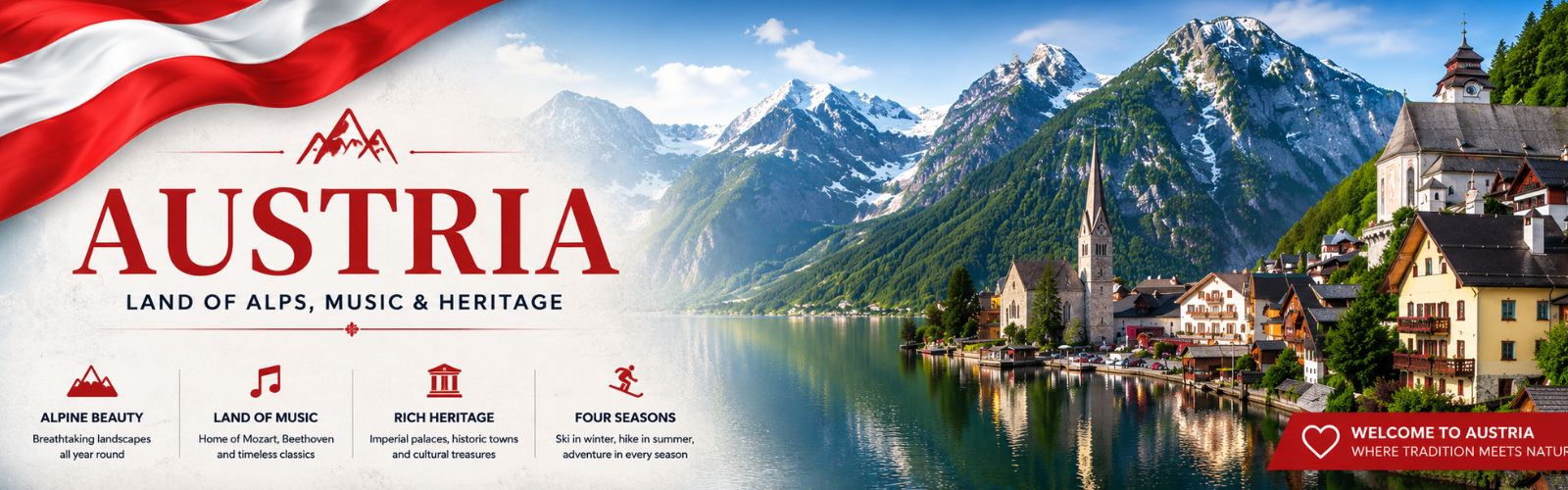
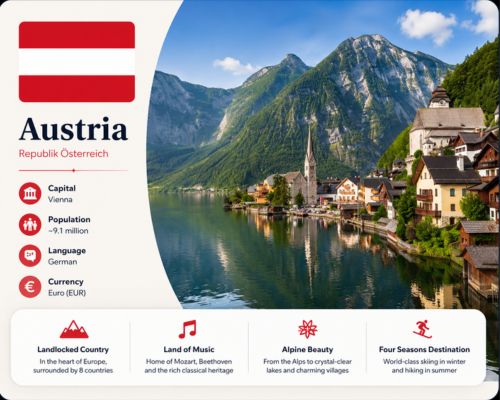
Why Study in Austria?
Austria is one of Europe's most distinguished and culturally rich study destinations, offering international students a rare combination of world-class academic institutions, an affordable European lifestyle, and an unmatched quality of life. For Indian students exploring high-quality education within the European Union, the opportunity to study in Austria presents a compelling proposition, with prestigious universities, low tuition fees, EU-recognized degrees, and a safe, welcoming environment nestled at the heart of Europe.
Overview
of Austria as a Study Destination
Austria is a landlocked EU member state bordered by Germany, Switzerland,
Italy, Hungary, the Czech Republic, and Slovakia, giving students extraordinary
access to the best of European culture, travel, and professional networks. The
country's higher education system comprises over 60 accredited universities,
universities of applied sciences (Fachhochschulen), and private institutions,
all regulated by the Austrian Agency for Quality Assurance and Accreditation
(AQ Austria). Vienna, Graz, Salzburg, Innsbruck, and Linz are vibrant academic
cities that consistently rank among Europe's most liveable urban environments.
Austria currently hosts over 90,000 international students, representing more
than 20% of total enrolment, one of the highest international student ratios in
the EU.
Academic
Excellence
Austria's universities carry centuries of academic tradition and global
recognition. The University of Vienna, founded in 1365, is one of the oldest
and largest universities in the German-speaking world, consistently ranking in
the global top 150. The Vienna University of Technology (TU Wien), the
University of Graz, and the Medical University of Vienna are internationally
respected for their research output, faculty expertise, and industry
partnerships. Austria has produced numerous Nobel Prize laureates and continues
to be a significant contributor to global research in science, medicine, music,
philosophy, and economics. The country invests heavily in higher education and
research, with R&D expenditure exceeding 3.2% of GDP, one of the highest
rates in the EU.
Affordable
Tuition Fees
One of the most attractive aspects of choosing to study in Austria is
its highly affordable tuition structure. EU and EEA students pay no tuition
fees at Austrian public universities, while non-EU international students,
including those from India, pay a standard tuition fee of just €726.72 per
semester (approximately €1,453 per year). This remarkably low fee applies
across virtually all programs at public universities, regardless of discipline,
making higher education in Austria among the most affordable in Western Europe
for international students. Universities of applied sciences charge slightly
higher fees, typically ranging from €1,800 to €3,600 per year for international
students.
International
Student Environment
Austria is deeply committed to international academic exchange and has
cultivated a genuinely diverse and multicultural campus environment. Vienna -
Austria's capital and largest city- is consistently ranked as the world's most
liveable city by the Economist Intelligence Unit, attracting students from
across Asia, Africa, the Americas, and Europe. Austrian universities maintain
active partnerships with institutions across the globe, and English-taught
programs have expanded significantly in recent years, with over 300 programs
now fully delivered in English. Indian student communities are well-established
in Vienna and Graz, with cultural associations, restaurants, and
familiar social networks making the transition to life in Austria smooth and
welcoming.
Recognition
of Degrees Worldwide
Degrees from accredited Austrian universities carry full recognition across all
27 EU member states under the Bologna Process framework. Austrian
qualifications are respected globally by employers, professional licensing
bodies, and academic institutions in Europe, North America, Asia, and beyond.
For Indian students, a degree from an Austrian university signals academic
excellence, European quality standards, and international credibility, all of
which are highly valued by multinational employers operating across global
markets.
Ready to explore your options to study in Austria? Contact Your Global Mentors today for a free consultation with our Austria education specialists.
Facts About Austria
1. World's
Most Liveable City - Vienna
Vienna has been ranked the world's most liveable city multiple times by the
Economist Intelligence Unit, offering students an unmatched quality of life
with outstanding public transport, healthcare, safety, and cultural richness.
2. Over 60
Accredited Higher Education Institutions
Austria hosts more than 60 universities, universities of applied sciences, and
private institutions regulated by AQ Austria, offering thousands of programs
across all disciplines in one of Europe's most respected higher education
systems.
3. Over
90,000 International Students Enrolled
Austria welcomes more
than 90,000 international students annually, representing over 20% of total
university enrolment, one of the highest international student ratios in the
entire European Union.
4. 300+
English-Taught Programs Available
Over 300 fully English-medium programs are available across Austrian
universities at bachelor's, master's, and MBA levels, making Austria highly
accessible for Indian students without German language proficiency.
5. Vienna
Annual Transport Pass Costs Just €1 Per Day
Students in Vienna
can access unlimited metro, tram, and bus travel across the entire city for
just €365 per year, exactly €1 per day, making it one of the best-value
public transport systems in Europe.
6. R&D
Investment Exceeds 3.2% of GDP
Austria invests over 3.2% of its GDP in research and development, one of the
highest rates in the EU, providing international students with access to
world-class research facilities, funded research positions, and cutting-edge
innovation ecosystems.
7.
Part-Time Work Up to 20 Hours Per Week Permitted
International
students holding a valid Austrian residence permit for study purposes can
legally work up to 20 hours per week during term time and full-time during
official holidays; no separate work permit is required.
8.
EU-Recognized Degrees with Pan-European Validity
All degrees from
accredited Austrian universities are fully recognized across all 27 EU member
states under the Bologna Process, giving graduates the right to work, study
further, or seek professional licensing anywhere in Europe.
9.
Pathway to Permanent Residency After 5 Years
International
students who study and work in Austria can apply for EU long-term permanent
residency after 5 years of continuous legal residence, with Austrian
citizenship available after 10 years, one
of Europe's most structured and accessible long-term immigration pathways.
Living cost
|
Expense Category |
Average Monthly Cost (EUR) |
Average Monthly Cost (INR) |
|
Accommodation |
€250 - €650 |
27,421.50 - 71,295.90 |
|
Food & Groceries |
€150 - €300 |
16,452.90 – 32,905.80 |
|
Transportation |
€20 - €50 |
2,193.72 – 5,484.30 |
|
Health Insurance |
€50 - €75 |
5484.30 – 8,226.45 |
|
Mobile & Internet |
€15 - €30 |
1,645.29 – 3,290.58 |
|
Study Materials |
€20 - €50 |
2,193.72 – 5,484.30 |
|
Personal & Lifestyle |
€80 - €150 |
8774.88 – 16,452.90 |
|
Tuition (monthly equiv.) |
€121 |
13,272.01 |
|
Total Monthly Cost |
€900 - €1,300 |
98,717.40 – 1,42,591.80 |
1.
Accommodation - €250 to €650/month
Accommodation is the single largest monthly expense for international students
in Austria, but it remains considerably more affordable than in cities like
London, Paris, or Amsterdam. Students who opt for university-managed
dormitories (Studentenheime), the most budget-friendly option, can find
well-maintained rooms for €250 to €450 per month, often with utilities
included. Shared private apartments in Vienna, Austria's most expensive city,
typically cost €350 to €650 per month, depending on location and room size. In
smaller but equally prestigious university cities such as Graz, Innsbruck, and
Salzburg, shared rooms are available for €250 to €500 per month. Students
seeking independent living in a private studio apartment should budget €600 to
€950 per month in Vienna. Applying early for university dormitory places is
strongly recommended, as demand consistently exceeds availability, particularly
in Vienna.
2. Food
& Groceries - €150 to €300/month
Austria offers good value for food when students shop and eat smartly. Students
who cook regularly at home spend approximately €120 to €200 per month on
groceries from affordable supermarket chains, including Hofer (the Austrian
branch of Aldi), Billa, Lidl, and Spar, all of which offer quality produce at
competitive prices. University canteens (Mensa) across Austrian campuses serve
freshly prepared, nutritious hot meals for just €3 to €6 per meal, making them
one of the most popular and economical daily dining options for students.
Students following a mixed pattern of home cooking combined with occasional
dining out at local restaurants or cafés typically spend between €150 and €300
per month on food, well within a manageable student budget for a Western
European capital city.
3.
Transportation - €20 to €50/month
Austria's public transport system is among the finest and most affordable in
Europe, and students benefit enormously from this. In Vienna, the annual public
transport pass (Wiener Linien Jahreskarte) costs just €365 per year, exactly €1
per day, providing unlimited access to all metro (U-Bahn), tram (Straßenbahn),
and bus services across the entire city at any time. This translates to a
monthly equivalent of approximately €30, making it one of the best transport
value deals available to students anywhere in Europe. In Graz, Innsbruck, Linz,
and Salzburg, monthly student-discounted transport passes cost between €20 and
€50. Austria's national rail network (ÖBB) also offers significant student
discounts on intercity travel, making weekend trips to other Austrian cities
and neighboring countries very affordable.
4. Health
Insurance - €50 to €75/month
Health insurance is legally mandatory for all students enrolled at Austrian
universities and is a key requirement for obtaining and maintaining a student
residence permit. Non-EU international students, including those from India,
can access Austria's public healthcare system through voluntary enrollment in
the Austrian Health Insurance Fund (Österreichische Gesundheitskasse, ÖGK) at a
monthly premium of approximately €65 to €75. Students under 27 may qualify for
reduced-rate student health insurance packages starting from around €50 per
month. Many Austrian universities also offer group health insurance
arrangements through student unions (ÖH) at preferential rates. Private health
insurance options providing broader coverage, including dental and specialist
care, are available from approximately €30 to €60 per month as a supplementary
option.
5. Mobile
& Internet - €15 to €30/month
Staying connected in Austria is straightforward and affordable. Austria's
leading mobile network operators, A1, Magenta (T-Mobile), and Drei (3), offer
prepaid and monthly SIM plans with generous data packages, unlimited domestic
calls, and SMS starting from just €10 to €15 per month for basic plans and €20
to €30 per month for premium unlimited data packages. Austria has excellent 4G
and rapidly expanding 5G network coverage across all major cities and
university campuses. Most university dormitories and student accommodations
include Wi-Fi in the monthly rent, significantly reducing additional
connectivity costs. In shared apartments where broadband is not included, the
monthly cost is typically split among flatmates, bringing individual
contributions down to €10 to €20 per person.
6. Study
Materials - €20 to €50/month
Monthly spending on study in Austria is relatively modest and
manageable. Books, stationery, and printing costs average approximately €20 to
€50 per month when spread across the academic semester. Austrian university
libraries are exceptionally well-resourced, providing students with access to
extensive digital databases, e-books, academic journals, and online learning
platforms, significantly reducing the need to purchase physical textbooks. Many
faculty members at Austrian universities provide digital course packs and
reading materials directly through university online portals, further reducing
study material expenses. Students are also encouraged to use second-hand
textbook markets and student exchange platforms available on most campuses to
keep costs at the lower end of this range.
7.
Personal & Lifestyle - €80 to €150/month
Personal and lifestyle expenses in Austria cover a broad range of day-to-day
spending, including toiletries and personal care products (€20–€50), clothing
and seasonal shopping (€20–€60), and entertainment, including social outings,
cinema, and cultural events (€30–€80 per month). Austria, and Vienna in
particular, offers an extraordinary cultural scene that is largely accessible
to students at heavily discounted or free rates through the university student
ID (Studienausweis). World-famous institutions, including the Kunsthistorisches
Museum, the Albertina Gallery, the Vienna State Opera, and numerous concert
halls, offer significant student concessions, making Vienna's rich cultural life
genuinely affordable. Students who explore Austria's stunning natural environment,
including hiking, skiing, and cycling, find that outdoor activities add
tremendous lifestyle value at very low cost.
8. Tuition - €121/month (Monthly Equivalent)
One of Austria's most remarkable advantages for international students is its
extraordinarily low tuition fee. Austrian public universities charge non-EU
international students, including those from India, a standard semester
contribution fee of just €726.72 per semester (as of 2024–25). Spread across a
standard 6-month semester, this equates to a monthly equivalent of
approximately €121, a figure that is almost unbelievably low for a public
university system in a Western European capital city. This flat fee applies
across virtually all programs at public universities, regardless of discipline,
including engineering, medicine, business, and arts. Universities of applied
sciences (Fachhochschulen) charge slightly higher fees of €1,800 to €3,600 per
year for international students, while private institutions range from €5,000
to €20,000 annually.
Total
Monthly Cost - €900 to €1,300/month
When all expense categories are combined, accommodation, food, transport,
health insurance, mobile, study materials, personal expenses, and tuition,
international students in Austria can comfortably plan for a total monthly
budget of €900 to €1,300. Students living in university dormitories in smaller
cities like Graz or Innsbruck, cooking at home regularly, and making full use
of student discounts can manage well at the lower end of this range. Students
in Vienna's private rental market with a more active social lifestyle will
naturally lean toward the higher end. Either way, Austria's overall cost of
studying and living is significantly lower than the UK (€1,500–€2,200/month),
Switzerland (€1,800–€2,800/month), and broadly comparable with Germany
(€850–€1,200/month), making it one of the best-value Western European study
destinations available to Indian students today.
*Note: All the costs mentioned are estimates and are subject to change.
Contact Your Global Mentors to get personalized financial planning support and visa documentation guidance for your Austria student visa application.
Benefits of Studying in Austria
Choosing to study in Austria delivers a powerful combination of academic excellence, cultural richness, professional opportunity, and personal growth that few European destinations can match. Austria's unique position as a Western European EU member state with affordable tuition, a globally respected higher education system, and an unparalleled quality of life makes it an outstanding choice for Indian students.
Quality
Education
Austria's higher education system is internationally celebrated for its
rigorous academic standards, interdisciplinary research excellence, and strong
industry partnerships. Austrian universities offer programs that balance deep
theoretical foundations with applied, real-world learning, producing graduates
who are immediately competitive in European and global job markets. The
country's emphasis on academic freedom, research innovation, and intellectual
inquiry creates a stimulating learning environment that challenges and inspires
students across all disciplines.
EU-Recognized
Degrees
A degree from an accredited Austrian university carries full recognition across
all 27 EU member states under the Bologna Process. For Indian students, this
means that a qualification from Austria opens career doors not just within
Austria but across the entire European continent. Austrian degrees are also
recognized by employers, professional bodies, and academic institutions in
North America, Asia, and Australia, providing genuine global career mobility to
graduates.
Cultural
Diversity
Austria and Vienna in particular have been a crossroads of European cultures for
centuries. Today, Austrian universities reflect this multicultural heritage,
with students from over 130 countries enrolled across Vienna, Graz, Salzburg,
and Innsbruck. Indian students will find well-established Indian communities,
cultural associations, and familiar social networks in major Austrian cities.
Vienna's extraordinary cosmopolitan energy, combining historic imperial
grandeur with modern multicultural dynamism, creates an enriching and inspiring
backdrop for the study abroad experience.
Safety and
Student-Friendly Environment
Austria consistently ranks among the safest and most peaceful countries in the
world, performing exceptionally well on the Global Peace Index year after year.
Vienna has been rated the world's most liveable city multiple times by the
Economist Intelligence Unit, reflecting its outstanding public infrastructure,
healthcare quality, environmental standards, and overall quality of life.
Austrian universities provide dedicated international student support services,
including orientation programs, counselling, housing assistance, and legal
advice, ensuring that students from India and other countries feel supported
throughout their studies.
Travel
Opportunities Across Europe
Austria's central European location makes it one of the best bases on the
continent for student travel. Bordered by eight countries and well-connected by
rail, road, and air, Austria places students within easy reach of destinations
including Germany, Italy, Switzerland, Hungary, the Czech Republic, and
Slovenia. Vienna's international airport and the excellent ÖBB rail network
make weekend trips to cities like Prague, Budapest, Munich, Venice, and Zurich
genuinely accessible and affordable for students.
Research
and Innovation Opportunities
Austria is a significant European contributor to research and innovation, with
R&D investment exceeding 3.2% of GDP. International students have access to
world-class research facilities, funded research assistant positions, and
collaboration opportunities with Austria's renowned research institutions, including the Institute of Science and Technology Austria (ISTA), the Austrian
Academy of Sciences, and numerous industry-linked research centers. Austria's
growing technology and startup ecosystem — particularly in Vienna and Graz —
creates expanding opportunities for students in STEM, business, and digital
innovation fields.
Studying in Austria means investing in a future anchored in European academic excellence and an extraordinary quality of life. Reach out to Your Global Mentors today to explore programs and universities that match your academic and career ambitions.
No universities listed for Austria yet.
No scholarships available right now.
Program Duration in Austria
Before committing to study in Austria, understanding how academic programs are structured will help you plan your timeline, finances, and career trajectory with confidence. Austrian universities follow the European Bologna framework, offering three-cycle qualifications, bachelor's, master's, and doctoral degrees that are standardized, internationally recognized, and fully compatible with European academic norms.
Bachelor's
Programs (3–4 Years)
Bachelor's degree programs in Austria typically span 3 years (6 semesters) for
most disciplines, including business, social sciences, humanities, and natural
sciences. Engineering, architecture, and technical programs may extend to 4
years (8 semesters). Programs are predominantly taught in German at public
universities, though an increasing number of bachelor's programs are now
offered in English, particularly at universities of applied sciences and
private institutions in Vienna and Graz. Students intending to enroll in
German-taught programs are typically required to demonstrate German language
proficiency at the B2 level or above.
Master's
Programs (1–2 Years)
Master's degree programs in Austria require 1 to 2 years of full-time study (2
to 4 semesters). Austria has seen significant growth in English-taught master's
programs, particularly in fields including business administration,
international relations, data science, computer science, and environmental
studies.
MBA
Programs (1–2 Years)
Austria hosts several highly regarded business schools and management programs
offering internationally accredited MBA qualifications. The Vienna University
of Economics and Business (WU Vienna), ranked among Europe's top business
schools, offers full-time and part-time MBA programs lasting 12 to 24 months.
WU Vienna's Executive MBA and other programs attract students and professionals
from across the globe, providing a prestigious and internationally connected
business education in the heart of Europe.
PhD
Programs (3–5 Years)
Doctoral programs in Austria typically span 3 to 5 years and are structured
around independent research conducted under the supervision of experienced
academic mentors. Austrian PhD programs are available across all major
disciplines, with particularly strong offerings in natural sciences,
engineering, medicine, economics, and the arts. Many PhD positions at Austrian
research universities are funded through research grants or employment
contracts, providing doctoral candidates with a monthly stipend while
completing their research.
Academic
Intake Periods
Austrian universities generally operate on two primary intake periods:
Some specialized programs and private institutions may offer rolling or flexible admissions. Let Your Global Mentors guide you through Austria's application timelines, program selection, and intake planning. Contact our advisors today for a personalized academic roadmap.
Work Opportunities in Austria
Work opportunities in Austria are an important consideration for international students planning to study in Austria and build a professional career in Europe. Austria's stable, high-income economy, the 12th largest in the EU, and its position as a major hub for international organizations, multinational corporations, and growing technology companies create diverse and rewarding employment pathways for skilled graduates.
International students in Austria are permitted to work up to 20 hours per week during the academic term without a separate work permit, provided their studies remain the primary purpose of their residence. With Austria's strong minimum wage and competitive salary levels, part-time work can meaningfully supplement student budgets while providing valuable European professional experience.
A. Most Demanded Careers in Austria
IT and
Software Development
Austria's technology
sector is expanding rapidly, with Vienna emerging as a significant Central
European tech hub. Software engineers, web developers, cybersecurity
specialists, cloud architects, and mobile application developers are in strong
and growing demand across Austria's technology ecosystem. Global technology
companies, including Microsoft, IBM, Kapsch, and numerous high-growth startups, maintain significant operations in Vienna, creating excellent employment
opportunities for IT graduates.
Engineering
Austria has a strong
and diversified industrial base spanning automotive, mechanical, electrical,
and environmental engineering sectors. Companies including AVL List, Magna
International, Anton Paar, and voestalpine actively recruit qualified
engineering graduates. Austria's growing renewable energy sector, particularly
in hydropower, wind, and solar energy, creates additional sustained demand for
environmental and energy engineers.
Business
and Finance
Vienna's status as a
regional headquarters hub for Central and Eastern European operations of major
multinational corporations creates strong demand for business analysts,
management consultants, financial controllers, and marketing professionals.
Austria's well-developed banking and insurance sector, anchored by institutions
including Erste Group, Raiffeisen Bank International, and Vienna Insurance
Group, provides consistent employment opportunities for finance and business
graduates.
Healthcare
Austria's well-funded
public healthcare system and growing private healthcare sector create sustained
demand for doctors, dentists, pharmacists, nurses, and allied health
professionals. Medical degrees from Austrian universities carry EU-wide
recognition, and Austria's healthcare institutions actively recruit
internationally trained professionals to address sector-wide staffing needs.
The Medical University of Vienna is one of Europe's leading medical research
institutions, providing exceptional clinical training opportunities.
Logistics
and Supply Chain
Austria's central
European geography makes it a strategically important logistics and
distribution hub for the broader Central and Eastern European market. Supply
chain managers, logistics coordinators, freight specialists, and operations
professionals are in consistent demand across Austria's well-developed
transport and logistics sector. Vienna's role as a gateway between Western and
Eastern Europe creates particular demand for multilingual logistics
professionals.
Data
Science and Artificial Intelligence
Austria is investing
increasingly in AI and digital transformation, with several universities and
research institutions leading significant AI research initiatives. Data
scientists, machine learning engineers, AI researchers, and business
intelligence professionals are in growing demand across Austria's financial
services, manufacturing, healthcare, and technology sectors. The Austrian
Research Promotion Agency (FFG) funds numerous AI and data science research
projects that provide opportunities for student involvement and post-graduation
employment.
B. Popular Courses in Austria
Students who choose to study in Austria have access to a wide range of internationally respected programs aligned with the country's strongest employment sectors:
Computer
Science
Austria's computer
science programs, particularly at TU Wien and the University of Vienna, combine
rigorous theoretical foundations with strong practical application and direct
links to Austria's growing technology industry. Graduates are in high demand
across all sectors of Austria's digital economy.
Engineering
Mechanical,
electrical, civil, environmental, and industrial engineering programs at TU
Wien and Graz University of Technology are globally respected. Strong industry
partnerships with Austria's leading manufacturing and engineering companies
provide outstanding internship and employment pathways for graduates.
Business
Management
One of the most
popular disciplines for Indian students studying in Austria is WU
Vienna, ranking among Europe's top business schools. Programs covering
international management, marketing, strategy, and entrepreneurship provide
direct access to Vienna's vibrant multinational business community.
Finance
and Accounting
Programs aligned with
international professional standards, with direct access to Vienna's
significant financial services sector. WU Vienna's finance programs maintain
strong connections with Austria's banking, insurance, and investment management
industries — providing exceptional graduate employment prospects.
Medicine
The Medical
University of Vienna and the Medical University of Graz offer rigorous,
EU-accredited medical programs of international standing. Admission is highly
competitive, and programs are primarily taught in German, making strong German
language proficiency essential for medical applicants.
Hospitality
and Tourism
Austria's
world-famous tourism industry, anchored by Vienna's cultural heritage, the Alps,
and historic spa towns, supports outstanding demand for hospitality and tourism
management graduates. Programs offer direct industry exposure through
partnerships with Austria's leading hotels, resorts, and tourism authorities.
Artificial
Intelligence
Austria's leading
technical universities are rapidly expanding their AI and machine learning
program offerings. The country's growing AI research ecosystem and government
investment in digital innovation ensure strong industry demand for AI graduates
across multiple sectors.
Contact Your Global Mentors to identify the right program and career pathway tailored to your professional ambitions in Austria.
Frequently Asked Questions (FAQs)
Q1. What
are the requirements for an Austrian student visa for Indian students?
Indian students planning to study in Austria for more than 90 days must
apply for an Austrian Student Visa (Type D) or a Residence Permit for Study
Purposes from the Austrian embassy or consulate in India. Required documents
typically include a confirmed university admission letter, proof of sufficient
financial means (approximately €11,000 per year or €920 per month), valid
health insurance, proof of accommodation in Austria, a valid passport, academic
transcripts, language proficiency certificates (German B2 or English, depending
on the program), and a completed application form.
Q2. Are
scholarships available for international students in Austria?
Yes. Scholarships in Austria are available through the Austrian Federal
Ministry of Education, Science and Research, the Austria Scholarship Program
(OeAD), university-specific merit scholarships, and EU-funded Erasmus+ grants.
The Ernst Mach Grant, administered by OeAD, specifically supports
international students and researchers coming to Austria for study and research
purposes.
Q3. Are
programs in Austria taught in English?
Yes. Austria has significantly expanded its English-taught program offerings in
recent years, with over 300 fully English-medium programs now available across
Austrian universities. English-taught programs are particularly prevalent at the master's level in fields including business administration, international
relations, data science, computer science, environmental studies, and tourism
management. WU Vienna, TU Wien, the University of Vienna, and several private
institutions offer widely respected English-medium qualifications that are
fully accessible for Indian students.
Q4. Can
international students work part-time while studying in Austria?
Yes. International students in Austria are permitted to work up to 20 hours per
week during the academic term without requiring a separate work permit.
Part-time jobs in Austria are available across hospitality, retail, IT support,
research assistance, tutoring, and customer service sectors. Austria's minimum
wage and competitive hourly rates for part-time work allow students to earn
€350 to €600 per month, providing meaningful financial support toward living
costs.
Q5. What
are the post-study work opportunities in Austria?
After completing their degree, international graduates can apply for a 12-month
job-seeking residence permit extension, allowing them to remain in Austria and
search for employment related to their field of study. Graduates who secure
qualifying employment can transition to a standard work and residence permit.
Austria's Red-White-Red Card, a points-based skilled worker immigration system, provides a particularly streamlined pathway for qualified international
graduates in shortage occupations to obtain long-term work and residence
authorization.
Your Global Mentors is a trusted study abroad consultancy dedicated to helping Indian students achieve their international education goals. From university shortlisting and application preparation to visa processing, scholarship applications, and pre-departure support, we are with you at every step of your journey. If you are ready to study in Austria and build a world-class career at the heart of Europe, contact Your Global Mentors today for a free expert consultation.