






Top MBA Colleges in UK Rankings, Fees, Admission, Scholarships & Placements
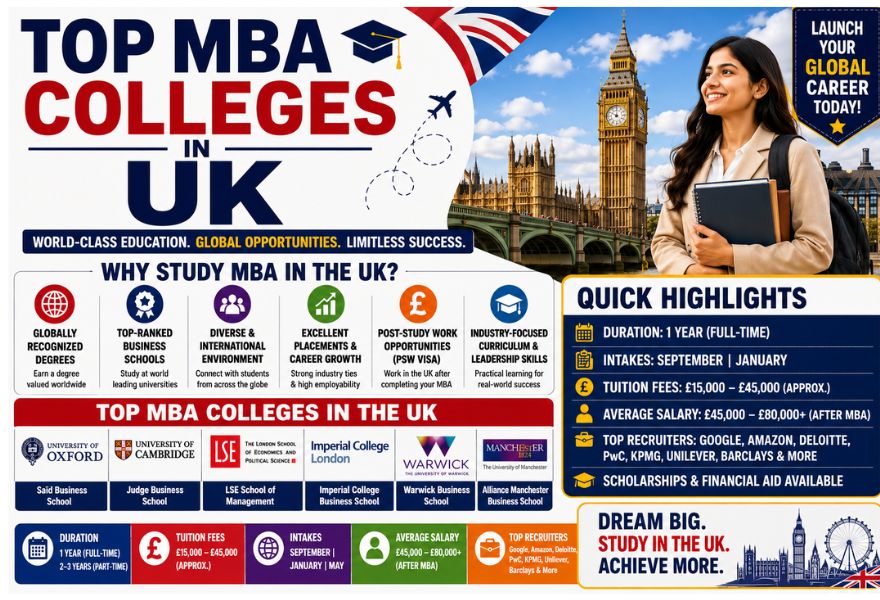
Table of Contents
MBA Colleges in the UK: Highlights 2026
- QS Global MBA Rankings 2026 — London Business School ranks #6, Cambridge Judge #7, Oxford Saïd #12, and Imperial #19 globally, with the UK placing 10 business schools in the global top 100
- Fees range — From £39,250 (~₹48.9 lakh) at Leeds to £123,950 (~₹1.58 crore) at London Business School
- Program duration — Most UK MBAs run 12 months, significantly shorter than many global programs, reducing both tuition and living cost burden
- Salary outcomes — Reported salaries range from roughly ₹76 lakh to ₹2.08 crore depending on school and source; management consultants average £64,988 (~₹81 lakh), while CEOs average £119,365 (~₹148.8 lakh)
- GMAT flexibility — GMAT is optional or waived at over 40% of UK MBA programs for strong professional profiles, though LBS applicants average 700+ GMAT scores
- Visa advantage — The Graduate Route visa offers 2 years of unrestricted UK work rights if applied by December 31, 2026, dropping to 18 months from January 2027
- Competitive applicant pool — Indian students made up roughly 8-10% of the LBS MBA Class of 2026, competing against candidates from top consulting and finance backgrounds.
Why Choose MBA Colleges in the UK?
- Global brand value — Degrees from LBS, Oxford Saïd, and Cambridge Judge carry strong recognition with Indian employers, MNCs, and European firms
- Shorter, cost-efficient format — The 1-year format reduces total tuition and living costs significantly compared to 2-year global programs, letting graduates enter the workforce faster
- London's financial ecosystem — London serves as a global financial hub, giving direct access to finance and consulting recruiters.s
- Post-study work rights — The Graduate Route visa allows 2 years of unrestricted work without needing employer sponsorship during that period
- Experience-focused admissions — UK MBAs emphasise work experience, essays, and interviews over standardised testing, unlike many US programs
- Deep recruitment infrastructure — Business and management is the single most popular subject in UK higher education, accounting for 20% of all enrollments in 2024-25, meaning stronger employer partnerships and alumni networks.
- Scholarship support — GREAT Scholarships 2026-27 offer a minimum of ₹12.95 lakh (£10,000) to eligible Indian students
Benefits of Studying MBA in the UK
- Strong starting salaries — Top graduates report average starting salaries of about £91,928 per year, with recruitment from firms like McKinsey, Amazon, and Goldman Sachs
- High job placement rates — London Business School reports 86% of its 2025 MBA class accepted job offers within three months of graduation.
- Flexible test requirements — Several top schools admit strong candidates without GMAT, provided they show solid academics and professional achievement.
- Value-for-money options — Warwick (#30) and Manchester (#39) are the most popular choices among Indian students for value-for-money MBA programs
- Post-study transition path — Graduate Route visa provides time to gain UK work experience before transitioning to a Skilled Worker visa
- Global specialisation variety — Wide range of MBA specialisations available, from finance and consulting to entrepreneurship and technology management
Eligibility Requirements for MBA Colleges in the UK
- Academic qualification — Bachelor's degree (or equivalent) from a recognised university, typically with 60-65% minimum
- Work experience — Minimum of 3 years full-time professional experience generally expected, though competitive applicants often present 3-8+ years
- GMAT/GRE — Competitive GMAT scores of 650+ required at select universities, though some schools weigh work experience and academic background more heavily instead
- English proficiency — IELTS scores of 6.0-6.5+ overall typically required, and Indian applicants specifically need UKVI IELTS, not the standard academic version, or risk visa rejection
- Alternative tests — Warwick offers its own Warwick Test as an alternative to GMAT/GRE
- Interviews — Shortlisted applicants typically go through interviews assessing teamwork, leadership, communication, and cultural fit
- GMAT waivers — Available for candidates with strong quantitative degrees, professional certifications (CFA, ACCA, CIMA), or substantial leadership experience
Admission Process for MBA Colleges in the UK
- Step 1: Shortlist schools — Based on QS ranking, fees, specialisation, and GMAT requirement (or waiver eligibility)
- Step 2: Prepare standardised tests — Take GMAT/GRE if required, and UKVI IELTS/TOEFL/PTE for English proficiency
- Step 3: Compile application documents — Bachelor's degree transcripts, updated resume, statement of purpose, and letters of recommendation
- Step 4: Submit application — Most programs run rolling or round-based admissions, so earlier submission generally improves scholarship chances
- Step 5: Interview round — Shortlisted candidates are interviewed to assess interpersonal skills, leadership acumen, and motivation
- Step 6: Offer and scholarship decision — Merit-based and need-based scholarships, including GREAT Scholarships, are typically confirmed alongside the offer
- Step 7: Visa application — Apply for a UK student visa well in advance, ensuring documents like the provisional degree certificate are ready if the final marksheet isn't out yet
- Step 8: Graduate Route visa planning — Apply before December 31, 2026 to secure the full 2-year post-study work window
Note: MBA fees, rankings, aur visa policies (especially Graduate Route deadline) frequently change — publish se pehle official university websites aur UK government visa pages se latest 2026-27 figures verify kar lena strongly recommend karta hoon.
Documents Required for MBA Admission in the UK
- Bachelor's degree transcripts and certificate — Original and attested copies from a recognised university
- Updated resume/CV — Highlighting work experience, achievements, and leadership roles
- Statement of Purpose (SOP) — Explaining career goals, choice of school, and post-MBA plans
- Letters of Recommendation (LORs) — Usually 2, from current/former employers or academic references
- GMAT/GRE scorecard — Where required by the specific school (not all schools mandate this)
- English proficiency test scorecard — UKVI IELTS specifically for Indian applicants, since standard academic IELTS can lead to visa rejection
- Passport copy — Valid for the full duration of study plus buffer period
- Financial documents — Bank statements or loan sanction letters to demonstrate funding for tuition and living costs
- Interview performance — Not a document, but most shortlisted candidates go through a mandatory interview round before final offer
GMAT, GRE & English Language Requirements
- GMAT requirement varies by school — London Business School and Imperial require a GMAT or GRE score, while some other schools weigh work experience and academics more heavily instead
- GMAT waivers available — Schools like Durham, Cranfield, Lancaster, Strathclyde, and Birmingham offer GMAT waiver routes for candidates with 3+ years of work experience, and most remain triple/AACSB/EQUIS-accredited despite the waiver
- LBS average GMAT — Around 700+, reflecting the highly competitive applicant pool
- Alternative test option — Warwick offers its own Warwick Test in place of GMAT/GRE
- GMAT optional/waived overall — At over 40% of UK MBA programs for strong professional profiles
- English proficiency — IELTS scores of 6.0-6.5+ overall are typically required.
- UKVI IELTS specifically — Indian applicants must submit UKVI IELTS (not standard academic IELTS), or risk visa rejection
- Other accepted tests — TOEFL and PTE are also accepted at many schools alongside IELTS
Top 10 MBA Colleges in the UK
- London Business School — QS Global MBA Rank #6; Fees: ~£123,950 (~₹1.58 crore); Program: 15-21 months
- Cambridge Judge Business School — QS Global MBA Rank #7
- Oxford Saïd Business School — QS Global MBA Rank #12; Fees: ~£88,800 (~₹1.09 crore) for 2026-27; Average salary: ~£85,000
- Imperial College Business School — QS Global MBA Rank #19; Fees: ~£78,000 (~₹96 lakh); Average salary: ~£98,000
- Warwick Business School — QS Global MBA Rank #30; strong value-for-money choice among Indian students
- Alliance Manchester Business School — QS Global MBA Rank #39; popular for affordability and flexible formats
- Cranfield University Business School — Known for GMAT waiver routes and strong industry links
- Durham University Business School — Triple-accredited, offers GMAT waivers for experienced professionals
- Lancaster University Management School — Strong regional recruiter network, GMAT-flexible
- University of Leeds Business School — Most affordable among top-ranked UK schools, fees starting around £39,250 (~₹48.9 lakh)
- Rankings and fees are compiled from QS Global MBA Rankings 2026 and official school fee pages current as of mid-2026
MBA Colleges in UK: Rankings 2026
- Global top tier — LBS (#6), Cambridge Judge (#7), and Oxford Saïd (#12) form the clear elite tier as per QS Global MBA Rankings 2026
- UK's global standing — The UK has 6 business schools in the global top 40 and 10 in the global top 100 per QS Global MBA Rankings 2026
- Mid-tier value picks — Warwick (#30) and Manchester (#39) are the most popular choices among Indian students seeking strong ROI without LBS/Oxford-level fees
- Alternate ranking systems — The Financial Times Global MBA Ranking is another widely respected benchmark, evaluating schools on salary outcomes and value-for-money separately from QS.
- Executive MBA rankings — Oxford's Executive MBA has held the No. 1 global spot in QS World University Rankings for three consecutive years.
- Competitive acceptance rates — Acceptance rates at top UK business schools were reported between 10-25% in 2025, reflecting high demand
- Applicant volume context — Over 98,000 Indian students received UK study visas in 2024-25, with MBA remaining among the most sought-after program choices
MBA Fees, Living Expenses, Scholarships & Global Placements
- Tuition fee range — From £39,250 (~₹48.9 lakh) at Leeds to £123,950 (~₹1.58 crore) at London Business School
- Living expenses — Typically an additional €10,000-€15,000 per year (roughly ₹9-13.5 lakh), varying by city — London costs notably more than other UK cities
- Scholarships — GREAT Scholarships 2026-27 offer a minimum of £10,000 (~₹12.95 lakh) to eligible Indian students; many schools also offer merit-based and region-specific awards
- Placement rates — London Business School reports 86% of its 2025 MBA class accepted job offers within three months of graduation
- Salary outcomes — Reported salaries range from roughly ₹76 lakh to ₹2.08 crore depending on school; top graduates average around £91,928 per year overall
- Recruiter network — Strong recruitment from firms like McKinsey, Amazon, Goldman Sachs, HSBC, PwC, and Deloitte across top UK schools
- Post-study work visa — The Graduate Route visa gives 2 years of unrestricted UK work rights (reducing to 18 months from January 2027), supporting a smoother transition into global placements
Note: Fees, rankings, aur visa policies (Graduate Route deadline) 2026 mein regularly update ho rahe hain — publish se pehle official university fee pages, QS/FT current rankings, aur UK government visa guidelines se latest figures cross-verify kar lena strongly recommend karta hoon.
MBA Specialisations Offered by UK Business Schools
- Finance & Fintech — Covers investment banking, risk management, and corporate finance; one of the most in-demand specialisations among Indian applicants
- Business Analytics & Tech Management — Focused on data-driven roles, artificial intelligence, and digital transformation
- Consulting — Strategic management focus, typically leading to high-paying roles at top consulting firms
- Entrepreneurship & Innovation — Popular at schools like Imperial, which connects students with scientists and engineers through dedicated innovation hubs
- Marketing & Brand Management — Offered widely, with strong placement links to FMCG and consumer goods companies.
- International Business & Global Strategy — Suited for students targeting multinational leadership roles across Europe and beyond
- Executive MBAspecialisationss — Available at LBS, Oxford Saïd, and Imperial for working professionals wanting to continue employment while studying
- Specialisation choice significantly affects post-MBA recruiter targeting, so aligning it with prior work experience matters more than picking the "trendiest" option.
MBA Colleges in UK: Course Duration
- Standard full-time MBA — Most UK programs run 12 months, notably shorter than the typical 2-year format common in the US
- Flexible/extended formats — LBS and Manchester offer 15-21 month flexible options, allowing students to space out coursework or include internships
- Executive MBA (part-time) — LBS and Imperial offer part-time EMBA formats that allow candidates to continue working while studying.g
- Oxford 1+1 MBA option — Combines a specialised master's degree first, followed by the MBA, extending total duration but adding a dual qualification.
- Impact on total cost — Shorter duration directly reduces both tuition outlay and living expenses compared to longer international programs.
- Faster job market entry — The 1-year format lets graduates start earning sooner, improving overall program ROI
MBA Colleges in UK: ROI (Fees vs Salary)
- London Business School — Fees: ~£123,950 vs Average salary: ~£85,000-£91,928+ → Strong long-term ROI given brand value and placement rate, though highest upfront cost
- Oxford Saïd — Fees: ~£88,800 vs Average salary: ~£85,000 → Solid ROI, slightly faster fee recovery than LBS
- Imperial College Business School — Fees: ~£78,000 vs Average salary: ~£98,000 → One of the strongest ROI profiles among top-tier schools
- Warwick Business School — Lower fees than LBS/Oxford/Imperial, strong value-for-money positioning among Indian applicants
- University of Leeds — Fees: ~£39,250, the most affordable among ranked schools, offering solid ROI for budget-conscious applicants
- General ROI trend — Mid-tier schools (Warwick, Manchester, Leeds) often deliver faster fee payback than elite-tier schools, though elite schools offer stronger long-term brand leverage and consulting/finance access
- ROI ultimately depends on specialisation chosen, prior work experience, and target recruiter sector — not fees or ranking alone
Career Opportunities After MBA in the UK
- Consulting roles — Strong recruitment pipeline into firms like McKinsey, BCG, and Deloitte, especially from LBS, Oxford, and Cambridge
- Finance & Investment Banking — London's status as a global financial hub gives direct access to firms like Goldman Sachs, HSBC, and PwC.
- Technology & Innovation roles — Strong at Imperial, given its close ties with science, engineering, and startup ecosystems
- Entrepreneurship — Many graduates launch startups using university incubation hubs and alumni investor networks
- General management & leadership tracks — Common across most schools, especially for candidates with prior managerial experience
- Post-study work via Graduate Route visa — Provides up to 2 years of unrestricted UK work rights, allowing graduates to build local experience before seeking long-term sponsorship.p
- Transition to Skilled Worker visa — Common pathway for those securing permanent roles after the Graduate Route period ends
Top Recruiters Hiring MBA Graduates in the UK
- Consulting — McKinsey, BCG, Deloitte, PwC
- Finance & Banking — Goldman Sachs, HSBC, JP Morgan
- Technology — Amazon, Google, Microsoft (especially recruiting from Imperial and LBS)
- FMCG & Consumer Goods — Unilever, P&G, recruiting largely from marketing-specialization graduates
- Placement strength indicator — London Business School alone reports 86% of its 2025 MBA class accepting job offers within three months of graduation
- Sector spread — Recruitment spans consulting, finance, technology, and entrepreneurship, reflecting the breadth of UK business school specialisations
- Alumni-driven hiring — Strong alumni networks at top schools directly influence recruiter access and referral-based hiring, particularly for consulting and finance roles
Note: Salary, ROI, aur recruiter-specific figures market averages aur recent industry reports par based hain — yeh school aur specialisation ke hisaab se significantly vary karte hain. Publish se pehle latest official school placement reports se cross-verify kar lena recommend karta hoon
Average MBA Salary in the UK
- Overall average — Top UK MBA graduates report average starting salaries of around £91,928 per year across ranked programs.
- London Business School — Reported salary outcomes at the higher end, contributing to the overall ₹76 lakh-₹2.08 crore range reported across top UKschools.s
- Oxford Saïd — Average post-MBA salary around £85,000
- Imperial College Business School — Average post-MBA salary around £98,000, among the strongest for a mid-fee program
- Management consultants — Average around £64,988 annually with a UK MBA
- CEO-level outcomes — Long-term earners average around £119,365 annually
- Mid-tier schools (Warwick, Manchester, Leeds) — Generally report lower average salaries than the elite tier, but also carry significantly lower tuition, keeping ROI competitive
- Salary outcomes vary considerably by specialisation, sector, and prior work experience — consulting and finance roles typically report the highest starting packages
Post-Study Work Visa After MBA in the UK
- Graduate Route visa — Offers 2 years of unrestricted UK work rights after graduation, with no employer sponsorship required during this period.
- Application deadline matters — Must apply by December 31, 2026 to secure the full 2-year window.w
- Reduced window from 2027 — The post-study work period drops to 18 months for those applying from January 2027 onward
- No job offer required to apply — Graduates can apply for the Graduate Route visa without first securing employment
- Transition pathway — Most graduates use this period to secure a role and then transition to the Skilled Worker visa for long-term UK employment
- Applies broadly — Available to MBA graduates across all UK universities and business schools, not just top-ranked ones
- Visa rules are set by UK immigration policy and can change with little notice, so confirming current terms before finalising your MBA plans is essential.
Student Life at MBA Colleges in the UK
- Diverse cohorts — Programs like LBS host students from 65+ nationalities, creating a highly international classroom experience
- City-based learning environments — London-based schools (LBS, Imperial) place students directly within a global financial and business hub
- Campus-based experience — Schools like Oxford, Cambridge, and Warwick offer more traditional, close-knit campus environments outside major cities
- Networking-heavy culture — Case competitions, consulting clubs, and industry treks are core to the UK MBA experience, supplementing classroom learning.g
- Strong alumni engagement — Alumni networks are actively involved in mentoring, guest lectures, and recruitment referrals.
- Balancing work and study — Part-time/EMBA students (at LBS, Imperial) often continue working while attending evening or modular classes.s
- Cultural adjustment — Indian students generally find the transition manageable given the large existing Indian student community across UK business schools.ls
How to Choose the Best MBA College in the UK
- Compare QS/FT rankings alongside specialisation fit — A lower-ranked school with a strong niche specialisation can outperform a higher-ranked generalist program for specific careers.
- Check GMAT/GRE policy — If you don't have a strong test score, prioritise schools offering waivers based on work experience or certifications like CFA/ACCA.
- Evaluate total cost, not just tuition — Factor in living expenses, which can add €10,000-€15,000+ annually depending on the city.
- Check placement rate and recruiter list — A school with strong published placement stats (like LBS's 86% within 3 months) reduces post-MBA risk.
- Confirm program duration fits your goals — 12-month programs suit those wanting fast market re-entry; 15-21 month formats suit those wanting internships or deep specialisation.n
- Check scholarship eligibility early — Programs like GREAT Scholarships have specific deadlines and eligibility criteria worth planning around.
- Talk to current students or alumni — First-hand insight into teaching quality, career services, and cohort culture is invaluable before committing.g
Why Choose Your Global Mentors?
- End-to-end application support — Guidance across school shortlisting, SOP drafting, GMAT/IELTS prep, and interview coaching
- Verified, updated data — Fees, rankings, and visa policy information cross-checked against official university and government sources
- Scholarship and funding guidance — Support in identifying and applying for scholarships like GREAT Scholarships and school-specific merit awards
- Visa application assistance — Help navigating UKVI IELTS requirements and Graduate Route visa timelines to avoid common rejection pitfalls
- Unbiased school comparisons — Focused on fit and ROI rather than pushing any single partner institution
- Post-admission support — Guidance on accommodation, pre-departure preparation, and settling into UK student life
- Reach out for a personalised MBA-in-UK roadmap tailored to your profile, budget, and career goals.
Frequently Asked Questions (FAQs)
Q1. Is GMAT mandatory for MBA in the UK?
Not always. While schools like LBS and Imperial require GMAT/GRE, over 40% of UK MBA programs offer waivers for candidates with strong work experience or professional certifications.
Q2. How long does a UK MBA take?
Most full-time UK MBA programs run 12 months, though flexible formats at schools like LBS and Manchester can extend to 15-21 months.
Q3. What is the average cost of an MBA in the UK?
Tuition ranges from around £39,250 at Leeds to £123,950 at London Business School, with additional living expenses of roughly €10,000-€15,000 per year.
Q4. Can I stay and work in the UK after my MBA?
Yes, through the Graduate Route visa, which offers 2 years of unrestricted work rights if applied for by DDecember 31 2026 (reducing to 18 months from January 2027).
Q5. What GMAT score do I need for top UK business schools?
Competitive applicants at schools like LBS often average 700+, though several schools accept lower scores or waive the GMAT entirely for experienced professionals.
Q6. Which English test do Indian students need for a UK MBA visa?
UKVI IELTS specifically — not the standard academic IELTS — since submitting the wrong version can lead to visa rejection.
Q7. What is the average salary after an MBA in the UK?
Average starting salaries across top UK MBA programs are around £91,928 per year, though this varies significantly by school, specialisation, and sector.
Conclusion
An MBA from a top UK business school remains one of the most efficient paths to a globally recognised management degree in 2026, thanks to its shorter 12-month format, strong recruiter access in London's financial hub, and a post-study work visa that gives graduates real runway to build UK career experience. That said, the decision shouldn't rest on rankings alone — GMAT policy, total cost including living expenses, specialisation fit, and placement track record all meaningfully affect the actual return on a fees investment that can cross ₹1.5 crore at the top end. Students should also stay closely attuned to visa policy deadlines, particularly the Graduate Route's December 2026 cutoff, since this materially affects post-MBA planning. With careful school selection and early preparation on tests, SOPs, and scholarships, a UK MBA can offer strong long-term career and salary outcomes across consulting, finance, technology, and entrepreneurship pathways.