





Top Job Oriented Courses in UK 2026: Best High-Paying Programs, Universities & Career Opportunities
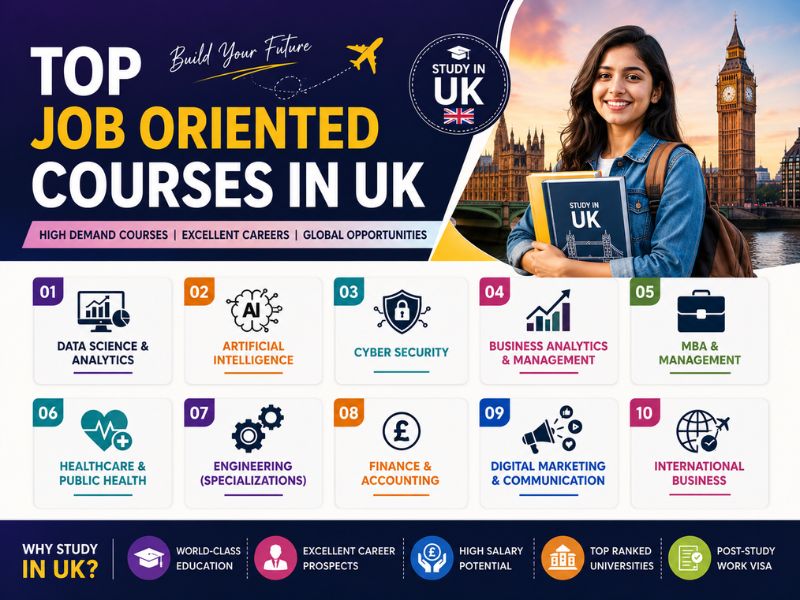
Table of Contents
Top Job-Oriented Courses in the UK: Highlights 2026
The UK continues to attract international students seeking practical, career-focused education that leads directly to employment opportunities. In 2026, job-oriented courses remain a top priority for students who want strong return on investment through quicker industry entry and better placement outcomes.
These courses are specifically designed to bridge the gap between academic learning and real-world job requirements, emphasising practical skills, industry certifications, and hands-on training over purely theoretical
knowledge.
Popular job-oriented fields in the UK include Data Science, Cybersecurity, Business Analytics, Digital Marketing, Nursing, Artificial Intelligence, and Supply Chain Management. Many universities have restructured their curriculum to include mandatory internships, live industry projects, and professional certifications alongside academic coursework.
A major advantage is the UK's Graduate Route visa, allowing international students to stay and work for 2-3 years after graduation, making job-oriented degrees even more valuable for building work experience directly in the UK job market.
Additionally, many UK universities now offer courses co-designed with industry leaders, ensuring curriculum relevance and stronger placement partnerships. With increasing global demand for specialised skills in technology, healthcare, and business analytics, choosing a job-oriented course in the UK positions students for strong career outcomes in 2026 and beyond.
Why Study Job-Oriented Courses in the UK?
Thinking about pursuing a career-focused degree in the UK? Here's why it makes strategic sense in 2026.
1. Strong industry alignment
UK universities frequently update their curriculum in collaboration with industry partners, ensuring you learn skills that are immediately relevant to current job market demands.
2. Post-study work opportunities
The UK's Graduate Route visa allows international students to work for up to 2 years (3 years for PhD graduates) after completing their studies, giving you valuable time to gain work experience and secure long-term employment.
3. Global recognition
UK degrees hold strong international recognition, making job-oriented qualifications valuable not just within the UK but across global job markets.
4. Practical, hands-on learning
Unlike traditional theory-heavy programs, job-oriented courses emphasise internships, live projects, and industry certifications, helping you build a practical skill set employers actually want.
5. High-demand sectors
The UK offers specialised job-oriented courses in booming sectors like technology, healthcare, finance, and data analytics — fields experiencing consistent talent shortages.
6. Strong placement support
Many UK universities maintain dedicated career services and industry connections, actively helping students secure internships and job placements before and after graduation.
The bottom line: If your priority is quick, practical career entry with strong global recognition, job-oriented courses in the UK offer a smart, results-driven path forward in 2026.
Benefits of Choosing a Career-Focused Course in the UK
Considering a career-focused course over a traditional academic degree? Here are the key benefits worth knowing.
1. Faster route to employment
Career-focused courses are designed with direct industry application in mind, often leading to quicker job placement compared to purely theoretical programs.
2. Practical skill development
These courses prioritise hands-on training, live projects, and real-world case studies, ensuring you graduate with applicable skills rather than just theoretical knowledge.
3. Industry-recognised certifications
Many career-focused programs include certifications from recognised industry bodies, adding extra credibility and value to your resume alongside your degree.
4. Better ROI on education investment
With clearer career pathways and stronger employability, career-focused courses often provide better return on investment, especially considering the cost of international education.
5. Networking opportunities
These programs frequently involve guest lectures, industry mentorship, and networking events, helping you build valuable professional connections before you even graduate.
6. Alignment with visa work rights
Career-focused courses often align well with the UK's Graduate Route visa, allowing you to immediately apply your specialised skills in the UK job market after graduation.
7. Adaptability to market trends
These courses are frequently updated to reflect current industry needs, ensuring your skills remain relevant even as job markets evolve.
The takeaway: Choosing a career-focused course means prioritising practical employability over purely academic prestige — a smart strategy for students focused on strong career outcomes in 2026.
Eligibility Criteria for Job-Oriented Courses in the UK
Before applying to job-oriented courses in the UK, make sure you meet these general eligibility requirements for 2026 admissions.
For undergraduate job-oriented courses:
- Completion of 12th grade (or equivalent) with a minimum aggregate score, typically 60-70%, depending on the university and program
- Relevant subject background may be required for specialised courses (e.g., Mathematics for Data Science programs)
For postgraduate job-oriented courses:
- A recognised Bachelor's degree in a relevant field, generally requiring a minimum of 60-65% aggregate marks or equivalent GPA
- Some specialised courses may require prior work experience or specific undergraduate coursework as prerequisites
English language proficiency:
Since UK courses are taught in English, you'll need to demonstrate proficiency through:
- IELTS: Typically 6.0-7.0 overall, depending on the course level
- TOEFL: Generally 80-100, depending on university requirements
- PTE Academic: Usually 58-65 overall score
Additional requirements:
- Statement of Purpose (SOP) highlighting career goals and course relevance
- Letters of Recommendation (LORs)
- Updated CV/Resume, especially important for career-focused programs
- Portfolio or work samples (for certain specialised courses like Design or Digital Marketing)
Admission Process for UK Universities
Applying to UK universities follows a well-structured process. Here's what to expect for 2026 admissions.
Step 1: Research and shortlist universities
Start by identifying universities and job-oriented courses that align with your career goals, checking rankings, curriculum structure, and industry connections.
Step 2: Check eligibility and prepare documents
Ensure you meet academic and language requirements, then gather essential documents including transcripts, SOP, LORs, and CV.
Step 3: Apply through UCAS (for undergraduate courses)
Most undergraduate applications go through the UCAS portal, allowing you to apply to up to five universities simultaneously using one centralised application.
Step 4: Direct application (for postgraduate courses)
Postgraduate applications are typically submitted directly through each university's online application portal, as UCAS mainly handles undergraduate admissions.
Step 5: Submit application fee
Pay the required application fee, which varies by university and course level.
Step 6: Await offer letter
Universities typically respond within 4-8 weeks with either a conditional or unconditional offer, depending on whether you've met all academic requirements.
Step 7: Accept offer and pay deposit
Confirm your seat by accepting the offer and paying the required tuition deposit within the specified deadline.
Step 8: Apply for CAS and student visa
Once your offer is confirmed, the university issues a CAS (Confirmation of Acceptance for Studies) number, which you'll need to apply for your Student Visa (Tier 4/Student Route).
Our advice: Start your application process at least 8-10 months before your intended intake to allow sufficient time for visa processing and financial arrangements for 2026.
Documents Required to Study in the UK
Having your documents ready and organised is essential for a smooth application process. Here's your complete checklist for 2026.
Academic documents:
- 10th and 12th grade mark sheets and certificates
- Bachelor's degree transcripts and certificate (for postgraduate applicants)
- Course-specific prerequisite certificates, if applicable
Language proficiency proof:
- IELTS/TOEFL/PTE/Duolingo scorecard, based on university requirements
Application essentials:
- Statement of Purpose (SOP) outlining career goals and course relevance
- 2-3 Letters of Recommendation (LORs)
- Updated CV/Resume, particularly important for job-oriented programs
- Portfolio or work samples (for design, marketing, or creative courses)
Financial documents:
- Proof of funds covering tuition and living expenses (bank statements, loan approval letters, or scholarship confirmation)
- Financial sponsor affidavit, if applicable
Visa-specific documents:
- Valid passport (with sufficient validity)
- CAS (Confirmation of Acceptance for Studies) letter
- Tuberculosis (TB) test results, if required based on your home country
- Academic Technology Approval Scheme (ATAS) certificate, for certain technical courses
Additional documents:
- Passport-sized photographs meeting visa specifications
- Health insurance/immigration health surcharge payment proof
Our advice:
Start organising these documents at least 3-4 months in advance, as visa processing requires precise documentation, and missing paperwork can delay your admission for the 2026 intake.
English Language Requirements (IELTS, PTE, TOEFL & Duolingo)
Meeting English proficiency requirements is a crucial step for studying in the UK. Here's what you need to know for 2026.
IELTS (International English Language Testing System)
Most UK universities require an overall IELTS score of 6.0 to 7.0, with no individual band typically below 5.5-6.0. IELTS remains the most widely accepted test for UK visa and university applications.
PTE (Pearson Test of English)
Increasingly popular due to faster results, PTE Academic scores generally need to fall between 58-65 overall, depending on the university and course level.
TOEFL (Test of English as a Foreign Language)
While less commonly required than IELTS, some UK universities accept TOEFL iBT scores, typically ranging from 80-100, depending on program requirements.
Duolingo English Test
A growing number of UK universities now accept Duolingo scores, generally requiring 110-120, offering a convenient, quicker alternative to traditional tests.
Exemptions:
Students who completed previous education in English-medium institutions, particularly from countries where English is an official language, may be eligible for a language requirement waiver at certain universities.
Our tip:
Always verify specific score requirements directly with your target university, as thresholds vary based on course level (undergraduate vs postgraduate) and specialisation for the 2026 intake.
Top 15 Job-Oriented Courses in the UK
Looking for the best career-focused courses to study in the UK in 2026? Here's our curated list.
1. Data Science and Analytics
High demand across industries, offering strong salary potential in tech, finance, and consulting sectors.
2. Cybersecurity
Critical skills shortage globally, making this one of the most in-demand career-focused courses.
3. Artificial Intelligence and Machine Learning
A rapidly growing field with applications across healthcare, finance, and technology sectors.
4. Business Analytics
Combines business acumen with data-driven decision-making skills, popular among management-focused students.
5. Digital Marketing
Essential skills for the growing e-commerce and digital advertising industry.
6. Nursing
Consistently high demand in the UK healthcare system, often with clear pathways to employment.
7. Supply Chain and Logistics Management
Growing importance post-pandemic, with strong industry connections and placement opportunities.
8. Finance and Investment Management
Strong ties to London's global financial hub status.
9. Software Engineering
Consistent demand across nearly every industry sector.
10. Renewable Energy Engineering
Growing field aligned with the UK's sustainability and green energy initiatives.
11. Human Resource Management
Practical, business-focused course with steady demand across industries.
12. Project Management
Cross-industry applicability with strong certification options (PRINCE2, PMP).
13. UX/UI Design
High demand in tech and digital product companies.
14. Healthcare Management
Combines healthcare knowledge with administrative and management skills.
15. International Business Management
Ideal for students seeking global career flexibility across multinational companies.
Our recommendation: Choose a course aligned with both your interests and current market demand — Data Science, Cybersecurity, and AI currently offer the strongest job prospects for 2026 graduates.
Best Universities for Job-Oriented Courses in the UK
Choosing the right university significantly impacts the value of your job-oriented course. Here are the top UK universities known for strong career-focused programs in 2026.
University of Manchester
Known for strong industry ties in Data Science, Business Analytics, and Engineering, with excellent placement records and employer partnerships across multiple sectors.
University of Leeds
Offers well-regarded job-oriented courses in Business, Data Analytics, and Healthcare Management, backed by a strong careers service and industry mentorship programs.
University of Birmingham
Recognised for its practical approach to Business, Finance, and Engineering courses, with dedicated employability programs integrated into the curriculum.
Coventry University
Particularly popular for career-focused courses in Cybersecurity, Logistics, and Digital Marketing, with strong industry placement partnerships.
University of Sheffield
Offers highly regarded Engineering, Data Science, and Healthcare-related job-oriented programs, known for practical, industry-aligned teaching.
Northumbria University
Known for strong Business Analytics and Computer Science programs with excellent graduate employment outcomes.
Aston University
Consistently ranked high for graduate employability, particularly in Business, Engineering, and Healthcare-related courses.
University of Hertfordshire
Offers affordable, career-focused programs with strong industry links, particularly in Computer Science and Business fields.
What to look for:
When comparing universities, check graduate employment rates, industry partnerships, internship opportunities, and alumni networks — these factors matter more than rankings alone for job-oriented education in 2026.
Course Fees for Job-Oriented Programs in the UK
Understanding tuition costs helps you plan your budget realistically. Here's a breakdown of fees for job-oriented courses in the UK for 2026.
Undergraduate courses:
International student tuition typically ranges from £13,000 to £25,000 per year, depending on the university, course specialisation, and location (London-based universities often charge more).
Postgraduate courses:
Master's programs in job-oriented fields generally range between £15,000 and £30,000 per year, with specialised courses like Data Science, AI, and Business Analytics often at the higher end due to strong industry demand.
Fee variation by course type:
- Business and Management courses: £16,000-25,000/year
- Computer Science/Data Science: £18,000-28,000/year
- Engineering courses: £20,000-30,000/year
- Healthcare-related courses: £15,000-24,000/year
Additional costs to consider:
- Application fees (varies by university, often £20-75)
- Course-specific equipment or software costs
- Professional certification exam fees, if included in the curriculum
Money-saving tip:
Universities outside London and major cities often offer significantly lower tuition while still maintaining strong industry connections, making them worth considering for budget-conscious students.
Our advice:
Always check for early application discounts, merit-based scholarships, or alumni discounts offered by universities, as these can meaningfully reduce your overall tuition costs for 2026.
Scholarships for Indian Students
Good news for Indian students planning to study in the UK — several scholarship opportunities can help ease your financial burden in 2026.
1. Chevening Scholarships
A prestigious UK government-funded scholarship covering full tuition, living expenses, and travel costs for outstanding Indian students pursuing a one-year Master's degree.
2. GREAT Scholarships
Offered in partnership with the British Council, these scholarships provide financial support (typically £10,000) to Indian students pursuing postgraduate studies at partner UK universities.
3. Commonwealth Scholarships
Available for Indian students pursuing Master's or PhD programs, covering tuition, travel, and living expenses, particularly for students committed to development-focused fields.
4. University-Specific Scholarships
Most UK universities offer their own merit-based scholarships specifically for Indian students, ranging from partial tuition waivers to full scholarships, based on academic excellence.
5. Inlaks Scholarships
A well-known scholarship for Indian students pursuing postgraduate studies at top global universities, including several UK institutions.
6. Charles Wallace India Trust Scholarships
Focused on Arts, Humanities, and Social Sciences, offering financial support for Indian students pursuing relevant postgraduate programs in the UK.
How to apply:
Most scholarships require strong academic records, a compelling SOP, and sometimes a separate scholarship application submitted alongside your university application.
Our advice:
Start researching and applying for scholarships early, ideally 6-8 months before your intended intake, as many have limited slots and early deadlines for 2026 admissions.
Cost of Living in the UK
Planning your budget for daily expenses is just as important as tuition planning. Here's a realistic breakdown of living costs in the UK for 2026.
Accommodation:
The largest monthly expense, typically ranging from:
- London: £700-1,200/month
- Outside London: £400-800/month
Food and groceries:
Budget approximately £150-250/month for groceries if cooking at home, with eating out adding significantly more to monthly expenses.
Transportation:
Monthly transport costs typically range between £50-150, depending on the city, with student discounts often available on public transport passes.
Utilities and internet:
Expect to pay around £80-120/month for utilities and internet if not already included in accommodation costs.
Health coverage:
International students pay the Immigration Health Surcharge (IHS) upfront during visa application, covering NHS healthcare access throughout your stay.
Miscellaneous expenses:
Budget an additional £100-150/month for personal expenses, entertainment, and study materials.
Total monthly estimate:
- London: Approximately £1,300-1,800/month
- Outside London: Approximately £900-1,300/month
Our advice:
Choosing a university outside London can significantly reduce your overall living costs while still providing excellent job-oriented education and career opportunities in 2026.
Part-Time Jobs While Studying in the UK
Want to earn extra income while studying? Here's what you need to know about part-time work opportunities in the UK for 2026.
Work permit rules:
International students on a Student visa are typically allowed to work up to 20 hours per week during term time, with full-time work permitted during scheduled academic breaks and holidays.
Popular part-time job sectors:
- Retail and hospitality: Supermarkets, cafes, and restaurants frequently hire student staff across UK cities
- Campus jobs: Universities often offer on-campus roles like library assistants, student ambassadors, or research assistants
- Tutoring: Subject tutoring or language tutoring is in demand, especially in university towns
- Delivery and gig work: Food delivery services offer flexible hours popular among students
- Administrative roles: Part-time office or administrative positions are available through university job boards
Average hourly wage:
The UK's National Minimum Wage for workers aged 21+ is approximately £11-12 per hour, though rates vary by age bracket and location, with London often offering slightly higher wages.
How to find jobs:
- University career services and job boards
- Online platforms like Indeed, Totaljobs, and StudentJob UK
- Networking through student societies and campus events
Our advice:
While part-time work helps offset living expenses, remember visa regulations strictly limit working hours during term time — prioritise academics first and treat part-time work as supplementary income during your 2026 studies.
Post-Study Work Visa (Graduate Route)
One of the biggest advantages of studying in the UK is the ability to stay and work after graduation. Here's what the Graduate Route visa offers in 2026.
What is the Graduate Route?
The Graduate Route is a post-study work visa that allows international students to remain in the UK and work (or look for work) after completing their degree, without needing employer sponsorship.
Duration of stay:
- Bachelor's and Master's graduates: 2 years
- PhD graduates: 3 years
Key eligibility requirements:
- Must hold a valid Student visa at the time of application
- Must have completed an eligible course at a UK higher education provider with a track record of compliance
- Application must be submitted before your current Student visa expires
What you can do on this visa:
- Work in any job or sector, at any skill level
- Switch employers freely without visa restrictions
- Start a business or be self-employed
- Search for work without a job offer in hand
Transitioning to long-term work visas:
During your Graduate Route period, you can apply for the Skilled Worker visa if you secure a qualifying job offer, allowing you to continue building your UK career long-term.
Our advice:
Use your Graduate Route period strategically — focus on gaining relevant work experience and actively networking within your industry to secure a Skilled Worker visa sponsorship before your Graduate Route visa expires in 2026.
Highest-Paying Jobs in the UK After Graduation
Wondering which career paths offer the best financial returns after your UK education? Here's a look at the top-paying job sectors for 2026 graduates.
1. Investment Banking and Finance
Entry-level analyst roles at major banks often start at £45,000-60,000, with rapid salary growth for high performers.
2. Data Science and AI
Given the massive skills shortage, data scientists and AI specialists can command starting salaries of £40,000-55,000.
3. Cybersecurity
With critical skills shortages across industries, cybersecurity analysts typically earn £35,000-50,000 at entry level.
4. Management Consulting
Graduate consultants at top firms often start with packages of £40,000-55,000, including performance bonuses.
5. Software Engineering
Skilled software developers, particularly in fintech and tech hubs like London, can earn £35,000-48,000 starting.
6. Actuarial Science
A niche but highly rewarding field, with starting salaries often around £35,000-45,000, plus strong professional certification-linked salary growth.
7. Law (Corporate/Commercial)
Trainee solicitors at top law firms can earn £45,000-60,000, particularly at prestigious City of London firms.
8. Engineering (Specialised fields)
Petroleum, aerospace, and renewable energy engineers often start at £32,000-42,000, depending on specialisation.
Our advice:
While these sectors offer strong starting salaries, factor in London's higher cost of living when evaluating job offers, as take-home value can differ significantly compared to roles outside major cities.
Average Salary After Job-Oriented Courses in the UK
Here's a realistic breakdown of what you can expect to earn after completing job-oriented courses in the UK in 2026.
Overall average starting salary:
Fresh graduates from job-oriented courses typically earn between £28,000-40,000 annually, depending on the field, university reputation, and location.
Salary by course type:
- Data Science/AI: £35,000-45,000
- Business Analytics: £30,000-40,000
- Cybersecurity: £32,000-42,000
- Digital Marketing: £26,000-35,000
- Nursing: £28,000-32,000 (NHS Band 5 starting scale)
- Supply Chain/Logistics: £28,000-36,000
- Finance/Investment: £35,000-50,000
- Software Engineering: £32,000-42,000
What influences your salary?
- University reputation and location (London-based roles often pay more)
- Internship experience gained during studies
- Industry certifications completed alongside your degree
- Specific employer and company size
Career growth potential:
With 3-5 years of experience, professionals in high-demand fields like Data Science, Finance, and Cybersecurity often see salaries rise to £50,000-70,000, especially with additional certifications or specialised skills.
The bigger picture:
Job-oriented courses consistently deliver strong ROI, particularly in technology, finance, and healthcare sectors, where skills shortages continue driving competitive salaries for UK graduates well into 2026 and beyond.
Top Recruiters in the UK
Curious which companies are actively hiring international graduates in the UK? Here's a look at major employers across key sectors in 2026.
Banking and finance:
- HSBC
- Barclays
- Deloitte
- PwC
- Goldman Sachs (London offices)
- JPMorgan Chase
Technology and IT:
- Google (London hub)
- Microsoft
- Amazon
- IBM
- ARM Holdings
Consulting:
- McKinsey & Company
- Boston Consulting Group (BCG)
- KPMG
- EY
Healthcare:
- NHS (National Health Service)
- GlaxoSmithKline (GSK)
- AstraZeneca
Retail and e-commerce:
- Tesco
- Unilever
- Sainsbury's
Engineering and manufacturing:
- Rolls-Royce
- BAE Systems
- Jaguar Land Rover
Telecommunications:
- BT Group
- Vodafone
Our advice:
These recruiters often prioritise candidates with relevant internship experience, industry certifications, and strong academic performance from recognised universities. Building connections through university career fairs, LinkedIn networking, and internships significantly improves your chances of landing roles with these top employers in 2026.
In-Demand Skills in the UK Job Market
Understanding which skills employers actually want can help you tailor your coursework and stand out after graduation. Here's what's in demand across the UK job market in 2026.
1. Data Analysis and Interpretation
Nearly every industry now relies on data-driven decision-making, making data analysis skills valuable across sectors — not just tech roles.
2. Artificial Intelligence and Machine Learning
As businesses increasingly integrate AI tools, professionals with hands-on ML and AI knowledge are highly sought after.
3. Cybersecurity Awareness
With rising cyber threats, organisations across all sectors need professionals who understand security protocols and risk management.
4. Digital Marketing and SEO
As businesses expand their online presence, skills in SEO, content strategy, and social media marketing remain consistently in demand.
5. Project Management
Certifications like PRINCE2 or PMP, combined with practical project management skills, are valued across nearly every industry.
6. Cloud Computing
Familiarity with platforms like AWS, Azure, or Google Cloud is increasingly essential as businesses migrate to cloud-based systems.
7. Communication and Soft Skills
Employers consistently rank strong communication, teamwork, and adaptability as critical skills alongside technical expertise.
8. Financial Literacy and Analytics
Understanding financial data and analytics tools remains valuable, especially for business and finance-related roles.
Our advice:
While your course provides foundational knowledge, actively building these in-demand skills through certifications, online courses, and practical projects significantly strengthens your employability in the competitive 2026 UK job market.
How to Choose the Right Job-Oriented Course in the UK
With so many options available, choosing the right job-oriented course can feel overwhelming. Here's a practical framework to guide your decision for 2026.
1. Assess your interests and strengths
Start by honestly evaluating what genuinely interests you — choosing a course purely based on salary potential without personal interest often leads to burnout.
2. Research industry demand
Look into current and projected job market trends. Fields like Data Science, Cybersecurity, and Healthcare consistently show strong demand, but research specific to your target industry.
3. Check university industry connections
Prioritise universities with strong employer partnerships, internship programs, and dedicated career services relevant to your chosen field.
4. Evaluate curriculum structure
Look for courses that include practical components — internships, live projects, industry certifications — rather than purely theoretical coursework.
5. Consider location factors
Courses in London often provide better networking opportunities but come with higher living costs; weigh this against your budget and career goals.
6. Review graduate outcomes data
Check university-published graduate employment statistics and average starting salaries for your specific course, not just overall university rankings.
7. Factor in visa and long-term goals
Consider how well the course aligns with Graduate Route visa opportunities and potential Skilled Worker visa sponsorship in your target industry.
Our advice:
Don't just chase trending fields — choose a course that combines genuine interest, strong industry demand, and solid university support to maximise both job satisfaction and career success in 2026.
Career Opportunities After Studying in the UK
Wondering what career doors open up after graduating from a UK job-oriented course? Here's a look at the opportunities awaiting you in 2026.
Technology sector
With London established as a major European tech hub, graduates find strong opportunities in software development, data science, AI, and cybersecurity roles across startups and established tech companies.
Financial services
As a global financial centre, London offers extensive career paths in banking, investment management, fintech, and insurance, particularly for finance and business analytics graduates.
Healthcare sector
The NHS and private healthcare providers offer consistent demand for nursing, healthcare management, and allied health professionals.
Consulting industry
Global consulting firms maintain a strong UK presence, offering career paths in strategy, technology consulting, and business advisory services.
Creative and digital industries
The UK's strong creative sector offers opportunities in digital marketing, UX/UI design, and content strategy roles, particularly in London and Manchester.
Engineering and manufacturing
Established engineering firms provide opportunities in aerospace, automotive, and renewable energy sectors, especially in cities like Birmingham and Coventry.
The bigger picture:
The UK's diverse economy across finance, technology, healthcare, and creative sectors, combined with the Graduate Route visa, creates genuine pathways for international graduates to build meaningful careers in 2026 and directly transition from study to sustained employment.
Why Choose Your Global Mentors for Studying in the UK?
Planning your UK education journey involves countless decisions — from selecting the right job-oriented course to navigating the visa process. That's where Your Global Mentors makes all the difference.
1. Personalised course guidance
Our expert counsellors understand the UK's diverse university landscape and help you choose job-oriented courses that genuinely align with your career goals and industry demand trends.
2. End-to-end application support
From shortlisting universities to preparing your SOP, LORs, and UCAS or direct applications, we handle every step of your UK application process with precision.
3. Visa assistance
Navigating the UK Student visa process, including CAS documentation and financial proof requirements, can be complex. Our team guides you through each step to maximise approval chances.
4. Scholarship guidance
We help you identify and apply for relevant scholarships — from Chevening to university-specific funding — to ease your financial burden.
5. Career-focused counselling
Since job-oriented courses are all about employability, we help you evaluate universities based on placement records, industry connections, and Graduate Route visa alignment.
6. Pre-departure support
From accommodation assistance to travel guidance, we ensure you're fully prepared before you head to the UK.
7. Proven track record
With years of experience guiding students through successful UK admissions, we bring insider knowledge and honest, practical advice to every step of your journey.
The bottom line: Choosing a job-oriented course in the UK is a smart career move — partnering with Your Global Mentors ensures that decision translates into real success in 2026.
FAQs
1. What are job-oriented courses?
Job-oriented courses are career-focused programs designed with strong industry alignment, practical training, and direct employability outcomes, unlike traditional theory-heavy degrees.
2. Which are the most in-demand job-oriented courses in the UK?
Data Science, Cybersecurity, Artificial Intelligence, Business Analytics, and Nursing are among the most in-demand fields for 2026.
3. Can international students work after completing a job-oriented course in the UK?
Yes, graduates can apply for the Graduate Route visa, allowing them to stay and work in the UK for 2 years (3 years for PhD holders) after graduation.
4. How much does it cost to study a job-oriented course in the UK?
Tuition fees typically range from £13,000 to £30,000 per year, depending on the course level and university, with additional living expenses to budget for.
5. Are scholarships available for Indian students pursuing job-oriented courses?
Yes, scholarships like Chevening, GREAT Scholarships, and university-specific awards are available for eligible Indian students.
6. What is the average salary after completing a job-oriented course in the UK?
Graduates typically earn between £28,000-40,000 annually, with fields like Data Science and Finance often offering higher starting salaries.
7. How do I choose the right job-oriented course?
Consider your genuine interests, current industry demand, university industry connections, and long-term visa and career goals before deciding.
Conclusion
Job-oriented courses in the UK offer a practical, results-driven pathway for international students seeking strong career outcomes in 2026. With an industry-aligned curriculum, hands-on training, and the valuable Graduate Route visa, these programs bridge the gap between education and employment more effectively than traditional academic degrees.
From technology and finance to healthcare and cybersecurity, the UK offers diverse, high-demand fields with strong salary potential and global career recognition. While costs remain a consideration, the combination of practical skills, industry connections, and post-study work rights makes this investment worthwhile for career-focused students.