



Study MBA in Denmark: Top Universities, Fees, and Career Scope
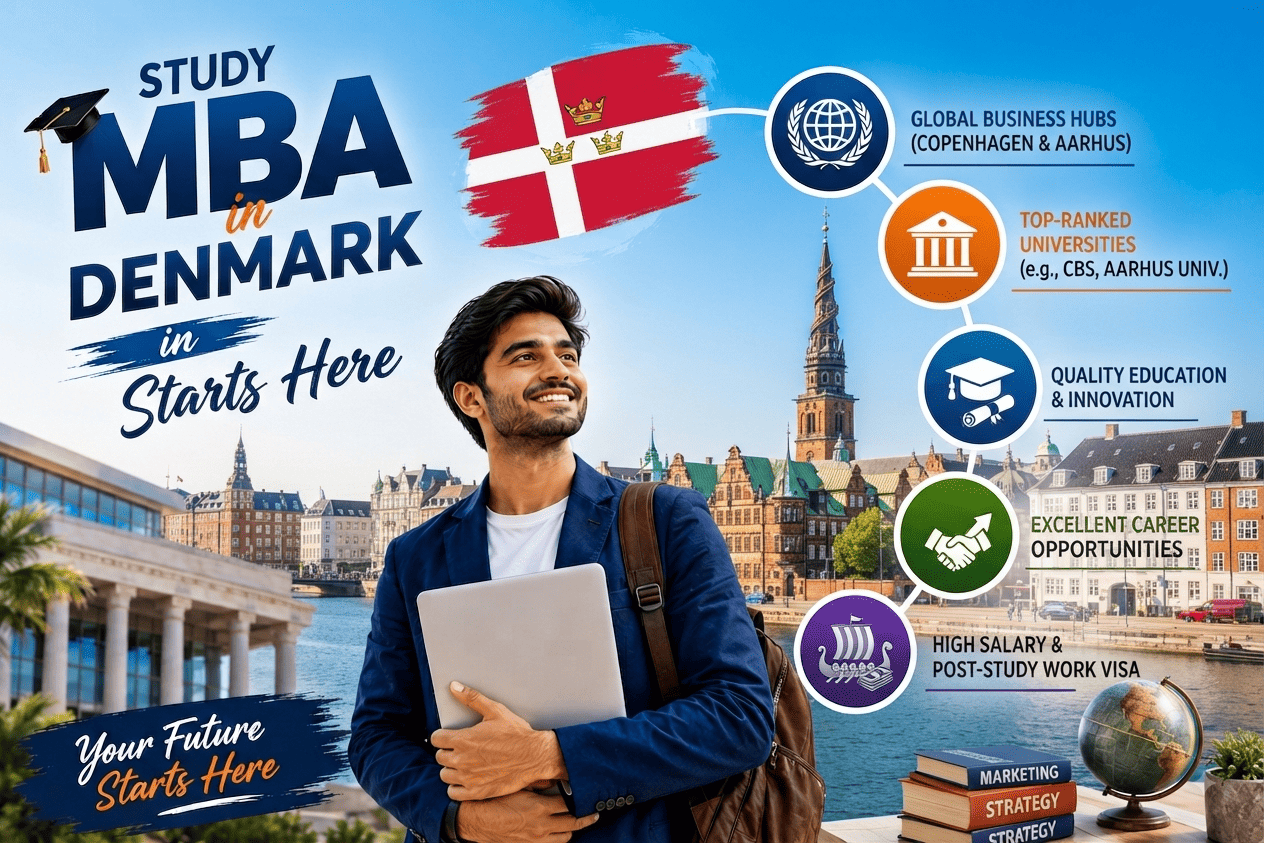
Table of Contents
Study MBA in Denmark 2026: Highlights
Denmark has emerged as a genuinely compelling MBA destination for Indian students seeking a European degree with a structured post-study work pathway. For Indian students targeting a full-time MBA with a post-study work path in Europe, Copenhagen Business School is the clear first choice — it holds triple-crown accreditation, ranks #11 in Europe on QS Global MBA Rankings 2026, and offers a structured 3-year post-MBA work visa scheme.
Denmark MBA college fees for Indian students range from ₹34-40 Lakhs for a total of 2 years, though costs vary significantly by city — Copenhagen is the most expensive, while cities like Aarhus or Aalborg offer more affordable alternatives. Entry-level managerial salaries after graduation range between DKK 400,000-550,000 (₹58.1-79.9 Lakhs) annually across consulting, finance, supply chain, and technology roles — genuinely strong ROI relative to program cost.
Denmark's growing economy and focus on pharma, green energy, and logistics are creating a wealth of opportunities for MBA graduates, with leading organisations like Novo Nordisk and Maersk actively seeking professionals who can think strategically while demonstrating strong leadership skills — making Denmark particularly attractive for students interested in these specific, distinctively Danish industry strengths.
Why Study MBA in Denmark?
Considering Denmark for your MBA? Here's why it makes strategic sense in 2026.
1. Genuinely elite accreditation at CBS
Copenhagen Business School holds triple-crown accreditation and ranks #11 in Europe in the QS Global MBA Rankings 2026, placing it among Europe's genuinely elite business schools.
2. Structured, meaningful post-study work pathway
CBS offers a structured 3-year post-MBA work visa scheme, giving graduates a genuine, extended runway to build local career experience.
3. Strong industry alignment with pharma, green energy, and logistics
Denmark's growing economy focuses specifically on pharma, green energy, and logistics, with leading organisations like Novo Nordisk and Maersk actively recruiting MBA talent — a distinctive advantage for students interested in these sectors.
4. Comparatively affordable relative to program quality
Average tuition fees range from EUR 6,000-16,000, comparatively cheaper than most other European nations, though top-tier programs like CBS command higher fees within this broader landscape.
5. Genuinely strong post-MBA earning potential
Entry-level managerial salaries range between DKK 400,000-550,000 (₹58.1-79.9 Lakhs) annually across consulting, finance, supply chain, and technology roles.
6. Flexible program formats
Popular program formats include Full-time MBA, Executive MBA, and specialised tracks like MBA in Shipping and Logistics, reflecting Denmark's distinctive maritime and logistics industry strength.
The bottom line: If you want a genuinely elite, triple-crown-accredited European MBA with a structured post-study work pathway and strong alignment with pharma, green energy, and logistics industries, Denmark offers a strategically compelling choice for 2026.
Eligibility Criteria to Study an MBA in Denmark
Before applying to MBA programs in Denmark, make sure you meet the following eligibility requirements for 2026 admissions.
Academic qualification
- A bachelor's degree from a recognised university, with specific minimum academic thresholds varying by institution
Work experience
- While not always mandatory, a few Danish colleges prefer candidates with at least 3 years of working experience. Some programs accept students without a GMAT score if you have work experience of 4-5 years, combined with a minimum 3.2 cumulative undergraduate percentage and an LSAT score.
Standardised test scores
- Standardised exams such as GRE (minimum score of 300+) or GMAT (score of 555+) are often required by top B-schools in Denmark. CBS's class average GMAT score is 655, with a 580 considered a meaningful disadvantage for admission.
English proficiency
- Classes are conducted in English, and Indian students must take an English proficiency test — aim for an IELTS score of 6.5 or 7.0 to qualify, though CBS specifically requires IELTS 7.0/TOEFL 94.
Application essentials
- Standard requirements include a valid passport copy, completed online application form, and application fee where applicable, alongside letters of recommendation and a Statement of Purpose explaining your motivation and career goals.
Our advice: Since CBS's class average GMAT sits at 655 while broader Danish programs may accept scores as low as 555, honestly benchmark your own GMAT readiness against your specific target school — a 580 score that's fine at a mid-tier Danish university becomes a genuine disadvantage at CBS specifically.
Admission Process for MBA in Denmark 2026
Here's a step-by-step breakdown of what the admission process looks like for 2026.
Step 1: Research and compare universities
Compare MBA colleges in Denmark based on fees, duration, specialisations, and program format such as full-time or Executive MBA.
Step 2: Check eligibility requirements
Ensure you meet academic criteria, English proficiency scores, GMAT/GRE requirements, and work experience expectations for your specific target schools.
Step 3: Take required standardised tests
Prepare for IELTS or TOEFL, and GMAT/GRE if required by your university.
Step 4: Order your academic transcripts early
The single document that delays Indian applications most often is the sealed academic transcript — many Indian universities take 4-6 weeks to issue these, and some require in-person requests. Order them the moment you decide to apply, even if you're still working on your GMAT.
Step 5: Prepare your complete application documents
Gather transcripts, test scores, SOP, LORs, CV, passport copy, and work experience documents (particularly for executive programs).
Step 6: Submit your application within the correct round
Watch CBS's specific application rounds carefully — if applying in early 2026, Rounds 1 and 2 have already passed, making Round 3 (April 10, 2026) your next realistic option for the October 2026 intake, with Round 4 open until June 10, 2026 but carrying no scholarship eligibility. For Aarhus BSS's September intake, shift all dates one month earlier — the non-EU application deadline for September 2026 was January 15, 2026.
Step 7: Attend your interview
Shortlisted candidates may be invited for an interview to assess their profile and career goals.
Step 8: Confirm admission and begin your visa process
Accept the offer, pay the deposit, and begin the student visa process.
Our advice: If your Indian university transcripts are delayed, email CBS admissions proactively before the deadline — they can issue a conditional offer while awaiting documentation, but only if you've told them about the situation in advance. Given how far ahead scholarship-eligible rounds close, if you're planning for October 2027 intake, begin your GMAT preparation now and target Round 1 (likely November 2026) to maximise your scholarship chances.
GMAT, GRE & English Language Requirements
Here's what you need to know about standardised testing and English proficiency for MBA programs in Denmark in 2026.
GMAT/GRE requirements genuinely vary by school
CBS accepts standardised tests for some MBA applicants, while DTU's Executive MBA accepts GMAT/GRE for competitive profiles — many non-executive business master's programs may waive the requirement for strong profiles.
Typical competitive score benchmarks
A GMAT score of 555+ or a GRE score of 300+ is commonly required by top B-schools, though CBS's own class average sits notably higher at 655.
What to do if your GMAT score falls short
Do not apply hoping the holistic review will compensate for a below-600 GMAT score — spend 8-12 weeks on a structured retake plan, since a 560 can realistically reach 630 with focused preparation. If GMAT remains a consistent barrier, consider Aarhus BSS's more flexible holistic review process, or explore a GMAT-free EMBA track.
GMAT-free pathways worth knowing
Since 2009, many B-schools have allowed students to apply without a GMAT score, though this typically requires an LSAT score with a minimum 3.2 cumulative undergraduate percentage, combined with 4-5 years of work experience.
English proficiency requirements
Aim for an IELTS score of 6.5 or 7.0 to qualify, though CBS specifically requires the higher threshold of IELTS 7.0/TOEFL 94.
Our advice: Since CBS genuinely holds applicants to a higher bar (GMAT 655 average, IELTS 7.0) compared to broader Danish program requirements (GMAT 555+, IELTS 6.5), be honest about which tier your current profile realistically targets — Aarhus BSS's more flexible holistic review process offers a genuinely strong alternative if CBS's benchmarks feel out of reach.
Top MBA Universities in Denmark
Denmark keeps its MBA landscape genuinely compact — quality over quantity. Here's what's worth considering for 2026.
1. Copenhagen Business School (CBS)
The flagship institution for an MBA in Denmark — the Full-time Copenhagen MBA is a 12-month intensive program starting every October, highly ranked for its focus on sustainable management and digital transformation. CBS is among the top MBA colleges in the world, holding triple-crown accreditation. The class profile skews toward 27- 32-year-olds from consulting, finance, and technology.
2. Aarhus BSS (Aarhus University's School of Business and Social Sciences)
Also a triple-crown business school (AACSB, AMBA, EQUIS), offering a highly flexible MBA program designed for professionals combining theoretical knowledge with practical management roles — a perfect fit for those looking to pivot into the European green energy or tech sectors. Offers research-based programs across economics, finance, accounting, logistics, HR management, marketing, innovation, and entrepreneurship.
3. AVT Business School
An executive education school in Copenhagen offering Leadership Tracks, an Executive MBA, and an Executive MBA in Life Sciences, alongside Corporate Programs. AVT is AMBA-accredited and uses visiting faculty, emphasising practical executive education.
4. Aalborg University (AAU)
Ranked Top 250 for Engineering & Management, based in Aalborg — a genuinely affordable city with a growing tech scene, offering programs with an International Business, Innovation Management, and Tech-based Development focus rather than a traditional "MBA" label.
5. Technical University of Denmark (DTU)
DTU's Executive MBA accepts GMAT/GRE for competitive profiles, offering a strong option for students specifically interested in technology-management crossover programs.
Our advice: Denmark has three core business schools worth prioritising — CBS, Aarhus BSS, and AVT — with CBS leading on prestige and salary outcomes, Aarhus BSS offering more flexible admissions with strong green energy/tech alignment, and AVT serving senior professionals through its executive-focused format.
Best MBA Colleges in Denmark for International Students
Here's what genuinely matters for international students specifically weighing Denmark for 2026.
CBS's structured post-study advantage
CBS offers a structured 3-year post-MBA work visa scheme — a genuinely meaningful advantage for international students planning to build a career in Denmark or broader Europe after graduation.
Aarhus BSS's flexible holistic review
Aarhus BSS is known for a more flexible holistic admissions review compared to CBS's stricter GMAT benchmarks, making it a genuinely strong alternative for international applicants whose test scores don't quite match CBS's class average.
English-taught alternatives worth knowing
CBS and Aarhus BSS both offer English-taught master's programs (MSc in Management, MSc in Business Economics) that carry the same post-study work rights without CBS's strict 3-year work experience requirement — a genuinely useful pathway for younger applicants or recent graduates not yet eligible for the full MBA.
Strong industry ties across the ecosystem
Denmark's universities maintain strong ties to Europe's corporate, tech, and design ecosystems, with globally recognised MBA and MBA-equivalent management programs backed by real industry exposure.
City choice as a genuine international-student consideration
Copenhagen is the most international and most expensive city; Aarhus, Odense, and Aalborg are cheaper and still genuinely lively — your choice of city meaningfully shapes both your budget and your day-to-day international student experience.
Our advice: If you're under CBS's 3-year work experience threshold, don't rule Denmark out entirely — the MSc in Management or MSc in Business Economics tracks at CBS or Aarhus BSS offer the same post-study work rights as the MBA, making them a genuinely smart pathway to build experience before returning for the full MBA or EMBA later.
MBA Specialisations in Denmark
Here's what specialisation options are genuinely available and in-demand across Denmark's MBA landscape in 2026.
1. Sustainable Management and Digital Transformation
A genuine CBS speciality, reflecting Denmark's global leadership in sustainability-focused business practices.
2. Shipping and Logistics
Given Denmark's maritime heritage (home to Maersk),e the MBA in Shipping and Logistics stands out as a genuinely distinctive specialisation not commonly offered elsewhere.
3. Green Energy and Sustainability
Strongly aligned with Aarhus BSS's flexible MBA format, appealing to students wanting to pivot into Europe's green energy sector specifically.
4. Innovation and Technology Management
Available at Aalborg University and DTU, reflecting Denmark's genuine strength in problem-based engineering and IT innovation.
5. Finance, Accounting, and Business Economics
Core offerings across Aarhus BSS's research-based programs, alongside broader coverage at CBS and other institutions.
6. Human Resource Management and Organisation
Well-supported at Aarhus BSS specifically, alongside marketing, management information systems, and entrepreneurship tracks.
7. Life Sciences (Executive-focused)
AVT Business School's Executive MBA in Life Sciences caters specifically to senior professionals in Denmark's genuinely strong pharmaceutical sector.
Our advice: MBA specialisations in Denmark are aligned with industry demand, especially in innovation, sustainability, and global business — choose Shipping/Logistics or Green Energy specialisations if you want genuinely distinctive Danish industry positioning, since these aren't commonly available with this depth elsewhere in Europe.
MBA Fees in Denmark
Understanding the fee landscape helps you budget realistically across Denmark's MBA programs for 2026.
Overall national tuition range
Leading institutions like CBS, Aarhus University, DTU, and Aalborg University offer MBA and management programs with tuition ranging from DKK 100,000-390,000 (₹14.5-56.7 Lakhs).
Copenhagen Business School (Full-time MBA)
The all-in cost for the CBS Full-time MBA runs approximately ₹71-76 Lakhs, including living expenses, with entry-level Copenhagen salaries of ₹58.4-87.6 Lakhs/year (DKK 4,00,000-6,00,000), resulting in a payback period of roughly 3-4 years.
CBS Executive MBA
Total fee is ₹65.7 Lakhs (DKK 4,50,000) plus a non-EU government surcharge of ₹2.51 Lakhs (DKK 17,200) — runs part-time over 21-25 months, with approximately 60% of participants receiving employer sponsorship. No GMAT required (CBS Admissions Test accepted instead).
AVT Business School
The current listed investment is DKK 397,500 plus VAT for either Executive MBA option, and DKK 69,500 plus VAT for a single standalone Leadership Track.
Aalborg University (AAU)
Tuition fees run DKK 1.00-1.50 Lakh (approximately ₹12.1-18.2 Lakhs) — among the most affordable options nationally.
Broader institutional cost context
Aarhus University's full-time master's programs cost approximately EUR 16,000 per year for tuition-paying (non-EU/EEA) students.
Optional pre-MBA course
CBS offers a one-week optional pre-MBA course to refresh business fundamentals like accounting and economics, costing approximately DKK 8,000, with around 25% of admitted participants signing up.
Our advice: Since CBS's all-in cost (₹71-76 Lakhs) genuinely dwarfs Aalborg's (₹12-18 Lakhs), decide early whether you're prioritising CBS's premium brand and salary outcomes or a more budget-conscious path — a non-refundable reservation fee is required within three weeks of accepting your CBS offer, so don't commit until you've genuinely confirmed your funding plan.
Cost of Living in Denmark for MBA Students
Here's a realistic breakdown of monthly living expenses across Denmark's major MBA cities for 2026.
Overall national range
International students in Denmark spend between €1,000-1,800 per month (₹89,000-1.6 Lakh), with accommodation as the largest expense, followed by food, transport, and insurance.
City-by-city breakdown
- Copenhagen: €1,200-1,800/month (₹1.07-1.6 Lakh) — Denmark's most international and most expensive city
- Aarhus: Moderately priced, Denmark's second-largest city and a major education hub
- Aalborg and Odense: Among the most affordable, averaging €800-1,000/month (₹71,000-89,000)
Money-saving strategies for students
Apply early for student housing (dorms), since they're much cheaper than private flats. Indian students can also work 20 hours a week to help cover living costs, and using your student ID for bus and train tickets can save 30-50% on transport.
Post-graduation residency pathway
Graduates can apply for a job-seeking residence permit valid for up to 2 years — if they secure employment, they can transition to a work permit, and after continuous residence and meeting integration requirements, students may eventually apply for permanent residency or citizenship.
Visa processing timeline
Visa processing usually takes 2-3 months, requiring proof of admission, financial documents, health insurance, and biometric data — applying early is strongly recommended to avoid delays, especially before the semester begins.
Our advice: Choosing smaller cities like Aalborg or Odense over Copenhagen can save students several lakhs annually — if minimising costs matters more than Copenhagen's networking intensity, this city choice compounds meaningfully over your 1-2 year MBA program.
Scholarships to Study MBA in Denmark
Good news for Indian applicants — Denmark offers genuine scholarship pathways for MBA students in 2026, though these are tightly tied to specific application timing.
CBS Merit-Based Scholarships
The DSEB (Danish Society for Business and Education) Scholarship offers a 40% tuition waiver (approximately ₹21.6 Lakhs off total fees) for one exceptional applicant per cohort. The Scholarship for Excellence targets candidates demonstrating leadership potential, international experience, sustainability focus, or a strong GMAT score — awarded as a tuition fee discount of up to 40%, applied through the same online application form as your program application.
A crucial timing rule
All CBS scholarships are allocated in Rounds 1 and 2 only — meaning if you're applying in later rounds (Round 3 or 4), you're no longer scholarship-eligible regardless of profile strength. This makes early application genuinely essential if funding matters to you.
Erasmus Mundus Joint Master's Scholarship
EU-funded scholarships covering full tuition, monthly allowance, and travel — in 2024-25, 146 Indian students received Erasmus Mundus Scholarships for higher studies in Europe. Not all programs cover MBA specifically, so verify which participating programs apply to your target field before assuming eligibility.
University-specific scholarships beyond CBS
Many Danish universities offer scholarships specifically for international students pursuing MBA programs, based on academic excellence, leadership qualities, or other criteria — worth researching individually for Aarhus BSS and other institutions beyond CBS.
Financing alternative if scholarships fall short
CBS lists Prodigy Finance on its official fee page as a recommended collateral-free lender for international students, with repayment tied to post-graduation income — a genuinely useful option if scholarship funding doesn't fully cover your budget.
Our advice: Since CBS scholarships are strictly limited to Rounds 1 and 2, treat your application timeline as inseparable from your funding strategy — applying in Round 3 or 4 might still get you admitted, but you'll be self-funding the entire ₹71-76 Lakh program regardless of how strong your profile is.
MBA in Denmark for Indian Students
Here's what genuinely matters specifically for Indian applicants weighing Denmark for 2026.
No language barrier for coursework
Most courses available in Denmark are in English, and the teaching style focuses on real-world learning and teamwork — genuinely easing the transition for Indian students without requiring Danish proficiency for academics.
A structural disadvantage worth planning around
Most Indian students targeting the CBS October intake face one structural disadvantage — they graduate in May-June, meaning their academic records aren't finalised until mid-year, right when CBS's earlier application rounds are already underway. Plan your transcript timeline accordingly, ideally requesting documents the moment you decide to apply rather than waiting for final results.
CBS's holistic evaluation genuinely rewards strong narratives
CBS evaluates holistically — a GMAT of 620 with a compelling career story can outperform a 680 with a generic essay. This genuinely benefits Indian applicants who invest real effort into their SOP and career narrative rather than relying purely on test scores.
Class profile fit for Indian applicants
The typical CBS class profile skews 27- 32-year-olds from consulting, finance, and technology — genuinely representative of common Indian MBA applicant backgrounds, meaning you won't be an outlier in terms of age or industry experience.
Our advice: Since the mid-year transcript timing mismatch specifically disadvantages Indian applicants targeting CBS's early rounds, proactively email admissions about your situation rather than assuming it will resolve itself — CBS can issue a conditional offer while awaiting your finalised documentation if you communicate this early.
MBA Colleges in Denmark Without GMAT
Here's what genuinely GMAT-free or GMAT-flexible pathways exist across Denmark's MBA landscape in 2026.
CBS Executive MBA — no GMAT required
The CBS Executive MBA does not require the GMAT — the CBS Admissions Test is accepted instead. This runs part-time over 21-25 months, with approximately 60% of participants receiving employer sponsorship, making it a genuinely strong option for senior professionals with 10+ years of experience and possible employer backing.
Aarhus BSS's flexible holistic review
If the GMAT is a consistent barrier for your regular full-time MBA application, Aarhus BSS offers a more flexible holistic review process compared to CBS's stricter benchmarks.
GMAT-free master's alternatives with equivalent post-study rights
Both CBS and Aarhus BSS offer English-taught master's programs (MSc in Management, MSc in Business Economics) that carry the same post-study work rights as the MBA — without CBS's strict work experience requirement, and often with more flexibility on standardised testing.
GMAT-free routes requiring alternative qualifications
Since 2009, many B-schools have allowed applications without a GMAT score, though this typically requires an LSAT score with a minimum 3.2 cumulative undergraduate percentage, combined with 4-5 years of relevant work experience — a genuine alternative pathway if you have strong professional experience but a weaker standardised test profile.
The honest reality if your GMAT score is below 600
Don't apply hoping holistic review alone will compensate for a below-600 score at CBS specifically — the class average sits at 655. Instead, spend 8-12 weeks on a structured retake plan, since a 560 can realistically reach 630 with focused preparation.
Our advice: If you're under CBS's 3-year work experience threshold and don't yet have a competitive GMAT score, the MSc programs at CBS or Aarhus BSS genuinely offer the smartest entry point — same post-study work rights, without the dual hurdle of both work experience and a high GMAT benchmark.
MBA in Denmark: Course Duration & Curriculum
Here's what the actual program structure and curriculum look like for 2026.
Program duration by format
Full-time MBAs (like CBS) are one-year intensive programs, while Executive MBAs (DTU, Aarhus) are flexible and designed for working professionals, typically running longer — CBS's own Executive MBA specifically runs part-time over 21-25 months.
Curriculum structure
MBA programs in Denmark follow a structured European format combining core business fundamentals, specialisation tracks, and practical industry exposure — these B-schools blend core business fundamentals, a specialisation track, and hands-on industry exposure rather than treating theory and practice as separate.
Practical and internship components
Internships vary by program — CBS's full-time MBA includes practical components and company engagement during the academic year, while many Danish universities integrate projects, industry collaborations, or consulting assignments that support real-world exposure instead of separate, standalone internship modules.
Optional pre-MBA preparation
CBS offers a one-week optional pre-MBA course to refresh or pick up business fundamentals like accounting and economics, costing approximately DKK 8,000 — around 25% of admitted participants choose to take this before their program formally begins.
Language of instruction
All MBA programmes across Danish institutions are available in English, not Danish — a genuine and consistent advantage across the entire country's MBA landscape.
Our advice: If you're choosing between the intensive one-year full-time format (CBS) and a longer, flexible executive track, factor in your current work situation honestly — the full-time format demands you step away from employment entirely, while executive tracks let you continue working, often with employer sponsorship covering a meaningful portion of your tuition.
MBA Placements in Denmark
Here's what employment outcomes genuinely look like after completing an MBA in Denmark in 2026.
Strong entry-level salary outcomes
Entry-level managerial salaries range between DKK 400,000-550,000 (₹58.1-79.9 Lakhs) annually across consulting, finance, supply chain, and technology roles — genuinely strong given Denmark's overall program cost.
CBS-specific salary and payback reality
At entry-level Copenhagen salaries of ₹58.4-87.6 Lakhs/year (DKK 4,00,000-6,00,000), payback on CBS's ₹71-76 Lakh all-in program cost is realistically 3-4 years — a genuinely honest timeline worth planning your finances around rather than expecting immediate recovery.
Common career paths after graduation
MBA graduates with a marketing specialisation commonly pursue roles as marketing managers, creating and implementing marketing strategies to promote products or services — reflecting the broader pattern of graduates moving into functional management roles across consulting, finance, and marketing.
Employer engagement built into the program itself
Rather than relying purely on separate placement drives, CBS's full-time MBA includes practical components and company engagement during the academic year itself, meaning genuine employer relationships often begin well before formal graduation.
Danish economic strengths shaping hiring demand
Denmark's growing economy and focus on pharma, green energy, and logistics are creating a wealth of opportunities for MBA graduates, with leading organisations such as Novo Nordisk and Maersk actively seeking professionals who combine strategic thinking with strong leadership skills.
Our advice: Since payback at even Denmark's top program (CBS) genuinely takes 3-4 years rather than 1-2, go in with realistic financial expectations — the salary outcomes are strong, but the ₹71-76 Lakh all-in cost means Denmark isn't a "quick ROI" destination the way some more affordable European alternatives can be, so weigh this honestly against your specific financial planning for 2026.
Average MBA Salary in Denmark
- National MBA benchmark — Denmark's average MBA salary benchmark stands at DKK 581,000 per annum (~₹84.4 lakh), depending on specialisation and experience level.
- Role-based salary range — Common MBA roles typically pay between DKK 400,000-650,000 per year (₹58.1-94.4 lakh)
- Entry-level managerial salaries — Range between DKK 400,000-550,000 (₹58.1-79.9 lakh) annually across consulting, finance, supply chain, and technology roles
- Executive MBA appeal — The Executive MBA in Denmark particularly appeals to mid-career professionals given its leadership focus, innovation-centric modules, and direct industry engagement.t
- Employer sponsorship trend (EMBA) — The CBS Executive MBA sees approximately 60% of participants receiving employer sponsorship, reflecting strong corporate buy-in for the program.
- Tax consideration —Unlike the UAEE, Denmark has meaningful income tax, so gross salary figures don't translate directly into take-home pay — factor this into any ROI comparison
Career Opportunities After MBA in Denmark
- Consulting, Technology, Finance, and Operations — MBA graduates in Denmark have strong career opportunities across these four core sectors.
- Sustainability-driven roles — Denmark's job market for skilled graduates spans industries like tech, logistics, consulting, and sustainability-driven sectors specifically
- City choice impacts opportunity — Your city choice in Denmark impacts industry exposure, job opportunities, and overall student experience, with major cities offering strong links to business, technology, and innovation sectors.s
- Shortage-occupation fast track — Landing a role on Denmark's Positive List of shortage occupations — common in engineering, IT, and health — allows a move to a faster work-permit track.
- Innovation economy alignment — Denmark is frequently described as one of the world's most innovative economies, and specialisations in tech and sustainability align particularly well with this national economic positioning.
- Employer sponsorship reality — Since Denmark sits outside the EU Blue Card system, skilled migration runs through national schemes, making securing an actual job offer (not just graduation) the real gateway to long-term career building here
Post-Study Work Opportunities in Denmark
- Standard job-seeking permit duration — After completing a state-approved professional bachelor's, bachelor's, master's, or PhD in Denmark, you can be granted a job-seeking residence permit valid for up to three years
- Shorter window for certain programs — Graduates of a master's for working professionals or a business academy programme get a 6-month window instead of the full 3 years
- Alternative reported duration — Some sources describe this more simply as a 2-year job-seeking permit, so confirming your exact program category's entitlement with SIRI directly is important.t
- Work rights during job search — During the job-seeking period, you keep the same work rights as during study: 90 hours a month, and full-time during summer
- Fast-track option — Landing a role on the Positive List of shortage occupations (engineering, IT, health) allows a move to a faster work-permit track
- Bridge to longer-term work — Skilled routes like the Pay Limit Scheme (2026 threshold around DKK 552,000/year) are the usual bridge to longer-term workstatuss
- No EU Blue Card route — Denmark sits outside the EU Blue Card system, so skilled migration runs through these national schemes instead.e ad.
ROI of Studying MBA in Denmark (Fees vs Salary)
- CBS Executive MBA — Total fee of ~₹65.7 lakh (DKK 4,50,000) plus a non-EU government surcharge of ~₹2.51 lakh (DKK 17,200) vs. avg. salary DKK 400,000-650,000/year → Strong long-term ROI given 60% employer sponsorship rate, but high upfront cost
- Regular full-time MBA/Master's programs — Tuition generally ranges from DKK 45,000-120,000/year (~₹6.44-17.18 lakh) vs Avg salary of DKK 400,000-650,000/year → Considerably stronger ROI than the Executive MBA route, given the much lower tuition base
- Overall ROI positioning — ROI in Denmark is considered exceptionally high due to the high quality of life and competitive salaries, especially compared to the UK or USA
- Living cost factor — Monthly living costs of €800-1,200 add meaningfully to total program cost and should be factored into any payback-period calculation.
- Alternative pathway for cost-conscious candidates without work experience — CBS and Aarhus BSS both offer English-taught master's programs (MSc in Management, MSc in Business Economics) that carry the same post-study work rights without the strict 3-year work experience requirement, often at a lower cost than the full MBA/EMBA route
- General ROI trend — Given Denmark's combination of moderate tuition, strong salaries, and a genuinely generous (up to 3-year) post-study job-seeking window, most graduates who secure employment can expect better payback timelines than in higher-tuition, shorter-visa-window destinations
Student Visa & Residence Permit for Denmark
- No traditional "student visa" — As a non-EU citizen, you apply for a student residence permit through SIRI (the Danish Agency for International Recruitment and Integration), not a conventional student visa.
- SIRI-approved institution requirement (2026 update) — From 2026, Indian students must enrol at a SIRI-approved state institution to qualify for the ST1 student residence permit — enrolling at an unapproved institution disqualifies you from the permit process entirely.y
- Proof of funds requirement — Indian students must show proof of funds of about €11,904 per year (~₹10.7 lakh), deposited in a "blocked account" to demonstrate ability to cover living expenses — an alternative figure of DKK 7,426/month (capped at DKK 89,112 for 12 months) is also cited, tracking the Danish state education grant (SU) rate
- Application process — Once you receive your Admission Letter and pay your first semester's tuition, the university initiates the application on the SIRI portal; biometrics are completed at a VFS Global centre in India (Delhi, Mumbai, or Bangalore)
- Visa fee and processing time (2026) — The visa fee is approximately DKK 2,115 (~₹30,287), with processing times of 60-90 days, so applying by June for a September start is recommended
- Work rights during study — Students can work up to 90 hours per month during semesters and full-time in June, July, and August.
- Family reunification option — Spouses, registered partners, and unmarried children under 15 can join the main applicant through Denmark's Family Reunification programme, provided both spouses are at least 24 years old
Frequently Asked Questions (FAQs)
Q1. How much does an MBA in Denmark cost for Indian students?
Regular MBA/master's tuition ranges from DKK 45,000-120,000/year (~₹6.44-17.18 lakh), while the CBS Executive MBA costs around ₹65.7 lakh plus a non-EU surcharge of ~₹2.51 lakh for the full program.
Q2. What is the average salary after an MBA in Denmark?
Denmark's average MBA salary benchmark is around DKK 581,000/year (~₹84.4 lakh), with common roles rangingfrom DKK 400,000-650,000/year depending on specialisation and experience.
Q3. Do I need a student visa to study in Denmark?
Not a traditional visa — non-EU citizens, including Indians, apply for a student residence permit through SIRI, and from 2026 must enrol at a SIRI-approved state institution to qualify.
Q4. Can I work while studying in Denmark?
Yes, students can work up to 90 hours per month during semesters and full-time during June, July, and August.
Q5. How long can I stay in Denmark to find a job after graduation?
Most graduates get a job-seeking residence permit valid for up to three years, though graduates of certain master's-for-working-professionals or business academy programmes get only a 6-month window instead.
Q6. Is there a fast-track work permit route in Denmark?
Yes, landing a role on Denmark's Positive List of shortage occupations (common in engineering, IT, and health) allows a move to a faster work-permit track, alongside the salary-based Pay Limit Scheme.
Q7. What proof of funds is required for the Danish residence permit?
Indian students must show proof of funds of about €11,904/year (~₹10.7 lakh) in a blocked account, though this is sometimes calculated instead as DKK 7,426/month capped at DKK 89,112 for 12 months.
Q8. Is an MBA in Denmark a good alternative to the UK or USA?
Yes — Denmark offers considerably lower tuition than many UK/US programs, strong salaries, a genuinely generous up-to-3-year post-study job-seeking window, and an exceptionally high quality of life, making its overall ROI compare favourably.
Conclusion
An MBA in Denmark offers Indian students a distinctive combination of moderate tuition costs, strong post-MBA salaries (averaging around DKK 581,000/year), and one of Europe's more generous post-study job-seeking windows, extending up to three years for most graduates. This stands out clearly against destinations with tighter post-study timelines, giving Danish MBA graduates genuine breathing room to secure the right role rather than rushing into any available position. That said, prospective students need to navigate some real complexity — the 2026 requirement to enrol only at a SIRI-approved institution, Denmark's position outside the EU Blue Card system, and the meaningful gap between gross salary figures and actual take-home pay after Danish income tax.