


Study in Luxembourg 2026: Universities, Admission, Visa, Fees, Scholarships & Career Opportunities
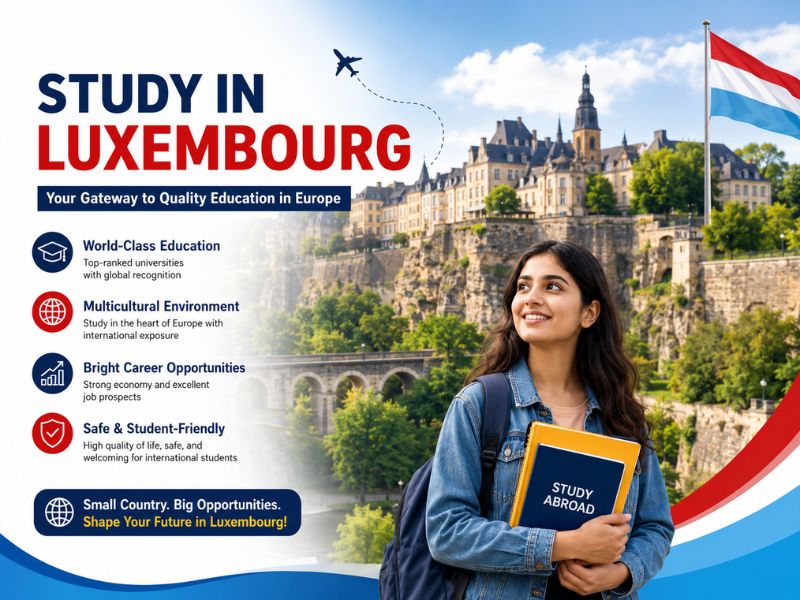
Table of Contents
Study in Luxembourg: Highlights 2026
Luxembourg may be one of Europe's smallest countries, but it packs a serious punch when it comes to quality education and career opportunities for international students in 2026.
Known for its high standard of living, multilingual environment, and strong economy, Luxembourg offers a unique study experience combining academic excellence with practical career exposure. The country's central location in Europe makes it an ideal base for students wanting easy access to major European cities like Brussels, Paris, and Frankfurt.
Luxembourg's education system emphasizes research-driven learning, international collaboration, and strong industry partnerships, particularly in fields like finance, technology, and European studies. As home to major EU institutions and global financial companies, the country offers excellent internship and networking opportunities for students.
One standout feature is the multilingual academic environment — most programs are taught in English, French, or German, helping students build valuable language skills alongside their degree.
Additionally, Luxembourg offers relatively affordable tuition fees compared to other Western European countries, along with a safe, clean, and welcoming environment for international students.
With its strong economy, strategic location, and quality education system, Luxembourg is steadily becoming an attractive study destination for students planning their international education journey in 2026.
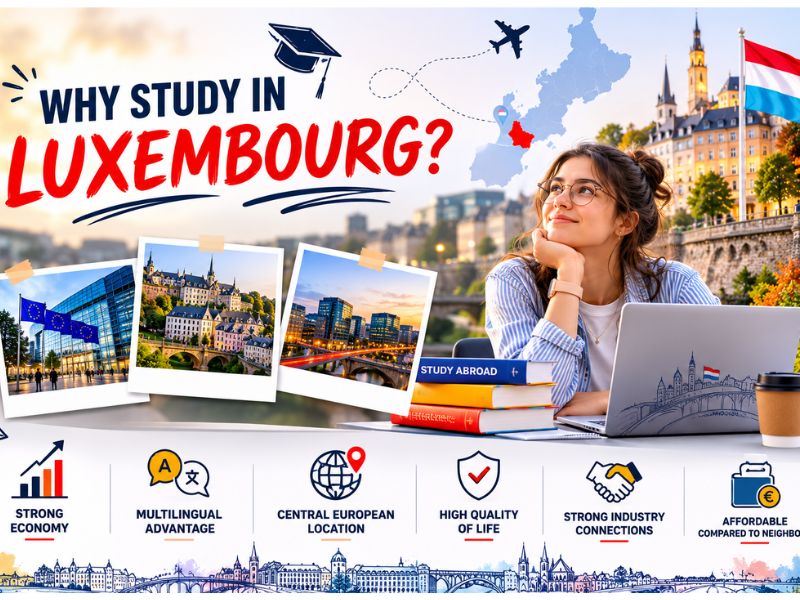
Considering Luxembourg for your international education? Here's why it deserves a serious look.
1. Strong economy, strong opportunities
Luxembourg boasts one of the highest GDP per capita in the world, driven by thriving finance, banking, and technology sectors. This creates excellent internship and job opportunities for international students.
2. Multilingual advantage
Programs are typically offered in English, French, or German, helping students develop valuable language skills while studying — a huge advantage in the global job market.
3. Central European location
Luxembourg's strategic position makes it easy to travel across Europe, giving students access to diverse cultures, internship opportunities, and networking events throughout the continent.
4. High quality of life
The country consistently ranks high in safety, healthcare, and overall living standards, providing a comfortable and secure environment for international students.
5. Strong industry connections
As home to major EU institutions and global financial companies, Luxembourg offers unique exposure to international business, finance, and policy-making environments.
6. Affordable compared to neighbors
Tuition fees are often more reasonable compared to other Western European countries like the UK or Switzerland.
The bottom line: Luxembourg combines academic quality, career opportunities, and quality of life — making it a smart, underrated study destination for 2026.
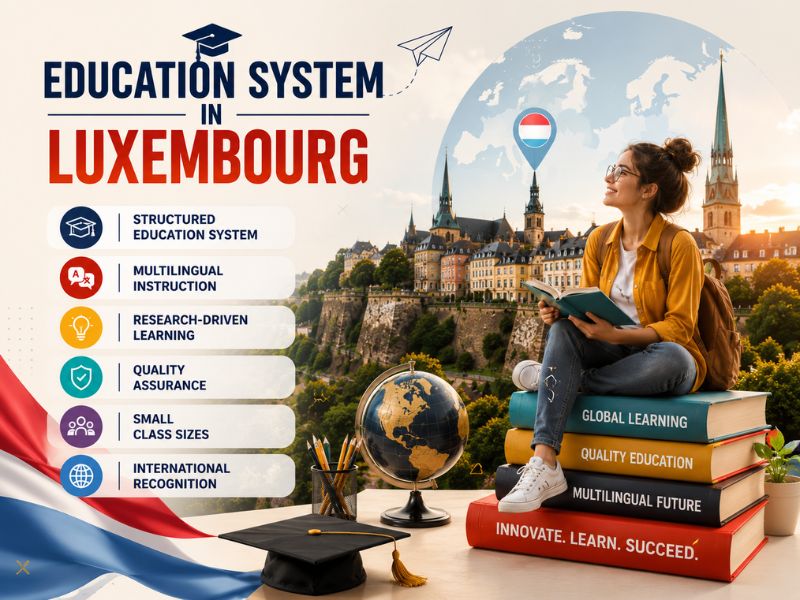
Understanding how Luxembourg's education system works can help you plan your academic journey more effectively.
Structure overview:
Luxembourg follows a structured higher education system aligned with the Bologna Process, making degrees easily recognized and transferable across European countries. This includes the standard three-tier system: Bachelor's (3 years), Master's (2 years), and Doctoral programs.
Multilingual instruction:
One of the most distinctive aspects of Luxembourg's education system is its multilingual approach. Depending on the program, courses may be taught in English, French, or German — sometimes a combination of all three, reflecting the country's trilingual culture.
Research-driven learning:
Luxembourg emphasizes research and practical application, with strong ties between academic institutions and industries like finance, technology, and European governance. Students often engage in real-world projects and internships as part of their coursework.
Quality assurance:
Higher education institutions in Luxembourg operate under strict quality assurance frameworks, ensuring programs meet high academic standards recognized across the European Union.
Small class sizes:
Due to the country's compact size, universities typically maintain smaller class sizes, allowing for more personalized attention and closer interaction with faculty.
This combination of international recognition, multilingual instruction, and research focus makes Luxembourg's education system well-suited for globally minded students in 2026.
Top Universities in Luxembourg
Luxembourg may have a limited number of universities, but what it lacks in quantity, it makes up for in quality and international recognition.
University of Luxembourg
The country's primary public university stands out as the top choice for international students. It offers a wide range of programs across three faculties: Science, Technology and Medicine; Law, Economics and Finance; and Humanities, Education and Social Sciences. Known for its multilingual teaching approach and strong research output, it consistently ranks well in international university rankings.
Sacred Heart University Luxembourg
A private institution offering American-style education with a focus on business and management programs. It's particularly popular among students seeking US-accredited degrees within a European setting.
Luxembourg School of Business
Known for specialized business and management programs, this institution focuses on practical, industry-relevant education with strong connections to Luxembourg's thriving finance sector.
Miami University John E. Dolibois European Center
An American university campus located in Luxembourg, offering study-abroad programs and select degree options for international students seeking a US-European blended experience.
What to consider:
When choosing a university in Luxembourg, evaluate factors like program accreditation, language of instruction, industry connections, and post-graduation career support to find the best fit for your academic and career goals in 2026.
Best Courses to Study in Luxembourg
Wondering which courses make the most sense to study in Luxembourg? Here's a breakdown of the fields where the country truly excels.
1. Finance and Banking
Given Luxembourg's status as a global financial hub, courses in Finance, Banking, and Wealth Management are among the most popular choices, offering direct exposure to leading financial institutions.
2. European Studies and International Relations
As home to major EU institutions, Luxembourg offers unique programs in European Law, Politics, and International Relations, ideal for students interested in policy-making and diplomacy.
3. Business Administration and Management
MBA and business management programs benefit from Luxembourg's strong corporate presence, providing excellent networking and internship opportunities with multinational companies.
4. Computer Science and ICT
With growing investment in technology and digital innovation, Luxembourg offers strong programs in Computer Science, Data Science, and Information Technology.
5. Law
Particularly European and International Law, given Luxembourg's role as the seat of the European Court of Justice.
6. Engineering
Programs in Systems Engineering and Space Technology are gaining traction, especially with Luxembourg's growing investment in space resources and satellite technology.
Our recommendation:
If you're aiming for strong career prospects, Finance, Business Management, and European Studies remain the smartest choices, directly leveraging Luxembourg's economic strengths in 2026.
Intakes in Luxembourg 2026
Planning your application timeline? Here's what you need to know about university intakes in Luxembourg for 2026.
Primary intake: Winter Semester (September/October)
Most universities in Luxembourg follow a September intake as their primary admission cycle, aligning with the broader European academic calendar. This is when the majority of programs, especially Bachelor's and Master's degrees, begin.
Secondary intake: Summer Semester (February)
Some programs, particularly at the University of Luxembourg, also offer a February intake, though options are typically more limited compared to the September cycle. This works well for students who missed the primary deadline or need additional preparation time.
Application timeline:
For the September 2026 intake, students should ideally begin their application process 6-8 months in advance, meaning around December 2025 to February 2026, to allow sufficient time for document preparation, language proficiency tests, and visa processing.
Our advice:
Since Luxembourg universities often have limited seats due to smaller class sizes, applying early significantly improves your chances of securing admission. Always check individual university websites for exact deadlines, as they can vary by program and faculty.
Missing the September intake isn't the end of the road — the February intake offers a solid backup option for select programs in 2026.
Eligibility Criteria for Studying in Luxembourg
Before applying to universities in Luxembourg, make sure you meet the following eligibility requirements for 2026 admissions.
For Bachelor's programs:
- Completion of 12th grade (or equivalent) with a minimum aggregate score, typically 60% or above, though requirements vary by program.
- Relevant subject background depending on the chosen field of study (e.g., Science stream for Engineering programs).
For Master's programs:
- A recognized Bachelor's degree in a relevant field, generally with a minimum of 60-65% aggregate marks or equivalent GPA.
- Some specialized programs may require specific undergraduate coursework or prerequisite subjects.
Language proficiency requirements:
Since programs are taught in English, French, or German, you'll need to demonstrate proficiency in the relevant language:
- English-taught programs: IELTS (typically 6.0-6.5) or TOEFL scores
- French-taught programs: DELF/DALF certification
- German-taught programs: TestDaF or Goethe-Institut certification
Additional requirements:
- Statement of Purpose (SOP)
- Letters of Recommendation (LORs)
- Updated CV/Resume
- Valid passport
- Proof of financial funds to support living expenses
Important note:
Specific eligibility criteria can vary significantly between universities and programs, so always cross-check requirements on official university websites before applying for the 2026 intake.
Admission Process for Luxembourg Universities
Understanding the admission process can help you navigate your application to Luxembourg universities smoothly for 2026.
Step 1: Research and shortlist programs
Begin by researching universities and programs that align with your academic interests and career goals, checking eligibility criteria and language requirements for each.
Step 2: Prepare required documents
Gather essential documents including academic transcripts, language proficiency scores (IELTS/TOEFL/DELF/TestDaF), Statement of Purpose, Letters of Recommendation, and updated CV.
Step 3: Submit online application
Most Luxembourg universities accept applications through their official online portals. Fill out the application form carefully, ensuring all information matches your supporting documents.
Step 4: Pay application fee
Submit the required application fee, which varies by university and program, as part of your application submission process.
Step 5: Await admission decision
Universities typically review applications and communicate admission decisions within a few weeks to a couple of months, depending on the program and application volume.
Step 6: Accept offer and pay tuition deposit
Once admitted, confirm your seat by accepting the offer letter and paying the required tuition deposit within the specified deadline.
Step 7: Apply for a student visa
After securing admission, apply for a Luxembourg student visa, submitting proof of acceptance, financial resources, and accommodation arrangements.
Final tip: Start your application process early, ideally 6-8 months before your intended intake, to ensure smooth processing and avoid last-minute visa complications for 2026.
Documents Required to Study in Luxembourg
Getting your paperwork right is crucial for a smooth application process. Here's a complete checklist of documents required to study in Luxembourg in 2026.
Academic documents:
- 10th and 12th grade mark sheets and certificates
- Bachelor's degree transcripts and certificate (for Master's applicants)
- Course/program-specific prerequisite certificates, if applicable
Language proficiency proof:
- IELTS/TOEFL scorecard (for English-taught programs)
- DELF/DALF certification (for French-taught programs)
- TestDaF or Goethe-Institut certificate (for German-taught programs)
Application essentials:
- Statement of Purpose (SOP) outlining your academic and career goals
- 2-3 Letters of Recommendation (LORs) from professors or employers
- Updated CV/Resume highlighting academic and extracurricular achievements
Identity and financial documents:
- Valid passport (with at least 6 months validity beyond your intended stay)
- Passport-sized photographs meeting visa specifications
- Proof of financial funds (bank statements, scholarship letters, or sponsor affidavits) demonstrating ability to cover tuition and living expenses
Additional requirements:
- Health insurance proof or coverage plan
- Accommodation confirmation or proof of housing arrangement
- Visa application form and supporting documents
Our advice:
Start collecting these documents well in advance, ideally 3-4 months before your application deadline, to avoid last-minute stress. Always verify specific document requirements with your chosen university, as they can vary slightly by program.
English Language Requirements (IELTS, TOEFL, PTE & Duolingo)
If you're applying to an English-taught program in Luxembourg, meeting language proficiency requirements is essential. Here's what you need to know for 2026.
IELTS (International English Language Testing System)
Most Luxembourg universities require an overall IELTS score of 6.0 to 6.5, with no individual band below 5.5-6.0. This remains the most widely accepted English proficiency test across universities.
TOEFL (Test of English as a Foreign Language)
Universities typically accept TOEFL iBT scores ranging from 80 to 90, though specific requirements may vary depending on the program and academic level.
PTE (Pearson Test of English)
While less commonly required compared to IELTS or TOEFL, some universities do accept PTE Academic scores, generally in the range of 58-65, as an alternative proficiency proof.
Duolingo English Test
Increasingly accepted post-pandemic, Duolingo scores typically need to fall between 105-120 for admission consideration, offering a convenient, faster alternative to traditional tests.
Exemptions:
Students who completed their previous education (especially at the undergraduate level) in English-medium institutions may be eligible for a language requirement waiver, though this varies by university policy.
Our tip:
Always check the specific score requirements on your target university's website, as thresholds can differ based on the program level (Bachelor's vs Master's) and field of study for the 2026 intake.
Cost of Studying in Luxembourg
Planning your budget is a crucial part of preparing to study in Luxembourg. Here's a realistic breakdown of costs for 2026.
Tuition fees:
Luxembourg offers relatively affordable tuition compared to other Western European countries:
- Bachelor's programs: Approximately €200-400 per semester at public universities like the University of Luxembourg
- Master's programs: Ranges from €200-500 per semester, depending on the specialization
- Private institutions: Tuition can range higher, typically between €5,000-15,000 per year, depending on the program
Living expenses:
Monthly living costs in Luxembourg typically range between €1,000-1,500, covering:
- Accommodation: €600-900/month (varies by location and housing type)
- Food and groceries: €200-300/month
- Transportation: Often free or heavily subsidized for students
- Utilities and miscellaneous expenses: €100-150/month
Additional one-time costs:
- Health insurance: Approximately €50-100/month
- Student visa application fee: Around €50-100
- Initial settlement costs (deposits, essentials): €500-1,000
Money-saving tip:
Luxembourg offers free public transportation for residents, including students, significantly reducing monthly commuting expenses — a unique advantage compared to other European study destinations.
Bottom line:
While tuition remains budget-friendly, especially at public universities, living costs in Luxembourg align with Western European standards. Planning for approximately €12,000-18,000 annually (tuition plus living expenses) offers a realistic estimate for 2026.
Scholarships for International Students in Luxembourg
Worried about funding your education? Luxembourg offers several scholarship opportunities to ease the financial burden for international students in 2026.
1. Luxembourg Government Scholarships
The Luxembourg government offers merit-based financial aid programs for both local and international students, covering partial tuition and living expenses, particularly for Master's and Doctoral candidates.
2. University of Luxembourg Scholarships
The university offers various scholarships based on academic merit and financial need, including specific funding for students in STEM fields and doctoral research positions.
3. Erasmus+ Scholarships
As an EU member state, Luxembourg participates in the Erasmus+ program, offering funding opportunities for students pursuing joint degree programs or exchange semesters within European partner universities.
4. Bourse de Formation-Recherche (Financial Aid)
Available primarily for research-focused programs, this need-based aid helps cover tuition and research costs for eligible international students, particularly at the PhD level.
5. Private and Corporate Scholarships
Various Luxembourg-based banks, financial institutions, and private organizations offer scholarships to attract talented international students, particularly in Finance and Business programs.
How to apply:
Most scholarships require a strong academic record, a well-written SOP, and sometimes a separate scholarship application submitted alongside your university application.
Our advice:
Start researching and applying for scholarships early, ideally alongside your university application, since many scholarships have limited slots and early deadlines for the 2026 academic year.
Student Visa for Luxembourg
Securing your student visa is one of the final steps before heading to Luxembourg. Here's what you need to know for 2026.
Who needs a visa?
Non-EU/EEA students typically need a long-stay visa (Type D) combined with a temporary residence permit to study in Luxembourg. EU/EEA students generally don't need a visa but must register their residence upon arrival.
Required documents:
- Valid passport
- University acceptance letter
- Proof of financial means (approximately €800-900/month coverage)
- Health insurance proof
- Accommodation confirmation
- Academic transcripts and certificates
- Passport-sized photographs
- Visa application form
Application process:
- Apply for the temporary authorization to stay through the Luxembourg immigration directorate
- Once approved, apply for the Type D visa at the nearest Luxembourg embassy or consulate
- After arrival in Luxembourg, register with local authorities and obtain your residence permit within the specified timeframe
Processing time:
Visa processing typically takes 6-8 weeks, so it's important to apply well in advance of your intended travel date.
Financial requirement:
Students must demonstrate sufficient funds, generally around €9,000-10,800 per year, to cover living expenses during their stay.
Our advice:
Start your visa application process as soon as you receive your university acceptance letter, ideally 3 months before your intake, to avoid delays that could affect your enrollment for 2026.
Cost of Living in Luxembourg
Understanding day-to-day living expenses helps you budget realistically for your time as a student in Luxembourg.
Accommodation:
The biggest expense for most students, ranging from €600-900/month, depending on whether you choose university dormitories, shared apartments, or private studios.
Food and groceries:
Budget approximately €200-300/month for groceries if cooking at home. Eating out regularly can push this higher, with a mid-range restaurant meal costing around €15-25.
Transportation:
Here's a huge advantage — Luxembourg offers free public transportation for all residents, including students, covering buses, trains, and trams nationwide. This significantly reduces monthly commuting costs compared to other European countries.
Utilities and internet:
Expect to pay around €100-150/month for utilities (electricity, water, heating) and internet if not already included in your accommodation costs.
Health insurance:
Mandatory health insurance typically costs €50-100/month, depending on your coverage plan and student status.
Miscellaneous expenses:
Budget an additional €100-150/month for personal expenses, entertainment, and study materials.
Total monthly estimate:
Combining all expenses, students should budget approximately €1,000-1,500/month, translating to roughly €12,000-18,000 annually for comfortable living in Luxembourg.
Money-saving tip: Cooking at home and taking advantage of free public transport can significantly reduce your monthly expenses.
Accommodation Options for International Students
Finding the right place to stay is a key part of settling into student life in Luxembourg. Here are your main options for 2026.
1. University Dormitories
Many universities, including the University of Luxembourg, offer on-campus or affiliated student housing. These are often the most affordable and convenient option, typically costing €400-700/month, though availability can be limited.
2. Shared Apartments (Colocation)
A popular choice among international students, sharing an apartment with roommates helps split costs significantly. Expect to pay around €500-800/month for a shared space in a well-located area.
3. Private Studio Apartments
For students preferring more independence, private studios are available but come at a higher cost, typically ranging from €800-1,200/month, depending on location and amenities.
4. Homestays
Living with a local host family offers a more immersive cultural experience and sometimes includes meals, generally costing €600-900/month.
5. Student Residences (Private Providers)
Several private student housing providers operate in Luxembourg City, offering furnished rooms with amenities like study areas and communal spaces, priced similarly to private studios.
Our advice:
Start your accommodation search early, ideally 2-3 months before arrival, since Luxembourg's compact size means housing demand can be high, especially near university campuses and city centers. University housing offices often provide assistance connecting students with verified listings.
Part-Time Jobs in Luxembourg for International Students
Want to earn some extra income while studying? Here's what you need to know about part-time work opportunities in Luxembourg for 2026.
Work permit rules:
International students (non-EU) are typically allowed to work up to 15 hours per week during the academic term, with full-time work permitted during semester breaks and holidays. EU/EEA students generally have unrestricted work rights.
Popular part-time job sectors:
- Retail and hospitality: Cafes, restaurants, and shops frequently hire student staff, especially in Luxembourg City
- Tutoring: Language tutoring (especially English) is in demand given the multilingual environment
- Administrative roles: Universities and local businesses sometimes offer part-time administrative or research assistant positions
- Banking and finance internships: Given Luxembourg's status as a financial hub, part-time or internship roles in banking are available for relevant degree students
Average hourly wage:
Luxembourg has one of the highest minimum wages in Europe, with student part-time jobs typically paying around €13-15 per hour, helping meaningfully offset living costs.
How to find jobs:
- University career centers and job boards
- Local job portals like moovijob.com or jobs.lu
- Networking through student associations and campus events
Post-Study Work Opportunities in Luxembourg
Finished your degree in Luxembourg and wondering what's next? Here's what post-study work opportunities look like in 2026.
Job seeker permit:
Luxembourg allows international graduates to apply for a temporary residence permit for job searching, typically valid for several months, giving you time to find employment after completing your studies without immediately leaving the country.
Who's hiring graduates?
Given Luxembourg's status as a global financial and EU administrative hub, graduates often find opportunities in:
- Banking and financial services
- EU institutions and international organizations
- Consulting firms
- Technology and IT companies
- Logistics and supply chain management
Switching from student to work visa:
Once you secure a job offer, you can transition from your student residence permit to a work permit, provided your employer sponsors the application and the role matches your qualification level.
Advantages for graduates:
- Multilingual skills gained during studies make you highly employable across various European markets
- Strong local industry connections built through internships often lead directly to job offers
- Luxembourg's compact professional network makes networking and follow-ups easier compared to larger countries
Our advice:
Start networking and applying for jobs during your final semester, leveraging university career services and internship connections, to maximize your chances of securing employment before your student visa expires in 2026.
Permanent Residency (PR) in Luxembourg
Thinking long-term about settling in Luxembourg? Here's an overview of the permanent residency process for international students and graduates.
Eligibility requirements:
To apply for permanent residency in Luxembourg, applicants generally need to have resided legally in the country for a minimum continuous period, typically 5 years, holding valid residence permits throughout this time (student, job seeker, and work permits combined can count toward this).
Key conditions:
- Continuous legal residence in Luxembourg for the required period
- Stable and sufficient financial resources
- Valid health insurance coverage
- No significant criminal record
- Basic integration requirements, which may include language proficiency (Luxembourgish, French, or German)
Application process:
- Ensure you meet the minimum residency duration requirement
- Gather proof of continuous legal residence, employment, and financial stability
- Submit your application to the Luxembourg Immigration Directorate
- Attend any required interviews or assessments
- Await processing and approval
Benefits of PR status:
- Right to live and work in Luxembourg without needing renewable permits
- Greater job flexibility without employer-specific sponsorship requirements
- Pathway toward eventual citizenship, if desired
Our advice:
Since exact requirements and processing details can change, it's important to verify current PR criteria directly through the Luxembourg Immigration Directorate's official website or consult an immigration advisor when you're closer to meeting the eligibility timeline.
Career Opportunities After Studying in Luxembourg
Wondering what career doors open up after graduating in Luxembourg? Here's a look at the opportunities awaiting you in 2026.
Finance and banking sector
As one of the world's leading financial centers, Luxembourg offers strong career opportunities in private banking, wealth management, investment funds, and fintech — making it especially attractive for finance and business graduates.
European Union institutions
Luxembourg hosts several major EU bodies, including the European Court of Justice and European Investment Bank, offering unique career paths for graduates in Law, Political Science, and International Relations.
Technology and IT
With growing investment in digital innovation and data centers, Luxembourg offers expanding opportunities in software development, cybersecurity, and data science.
Logistics and e-commerce
Home to major logistics hubs and companies like Amazon's European operations, Luxembourg offers solid career prospects in supply chain and logistics management.
Space and satellite industry
Luxembourg has positioned itself as a pioneer in space resources and satellite technology, creating niche opportunities for engineering and technology graduates.
Consulting and professional services
Global consulting firms maintain a strong presence in Luxembourg, offering career paths in strategy, audit, and advisory services.
The bigger picture:
Luxembourg's compact size means less competition compared to larger job markets, while its multilingual, multicultural business environment offers graduates a genuinely international career launchpad in 2026.
Top Recruiters in Luxembourg
Curious which companies are actively hiring graduates in Luxembourg? Here's a look at the major employers across key industries.
Banking and finance:
- Banque et Caisse d'Épargne de l'État (BCEE)
- BGL BNP Paribas
- Deutsche Bank Luxembourg
- Société Générale
- RBC Investor Services
EU institutions and organizations:
- European Court of Justice
- European Investment Bank
- European Commission (Luxembourg offices)
Technology and e-commerce:
- Amazon (European headquarters presence)
- Microsoft Luxembourg
- PayPal Europe
Consulting and professional services:
- Deloitte Luxembourg
- PwC Luxembourg
- KPMG Luxembourg
- EY Luxembourg
Logistics and industrial:
- ArcelorMittal
- Cargolux (major cargo airline)
- Goodyear (European operations)
Space and satellite technology:
- SES (Société Européenne des Satellites)
Salary After Studying in Luxembourg
Curious what you can actually earn after completing your studies in Luxembourg? Here's a realistic look at salary prospects for 2026.
Average starting salary:
Fresh graduates in Luxembourg typically earn between €35,000-45,000 annually, one of the highest starting salary ranges in Europe, reflecting the country's high cost of living and strong economy.
Salary by sector:
- Banking and finance: €40,000-55,000 for entry-level roles, given Luxembourg's status as a financial hub
- EU institutions: €45,000-60,000, though these roles often require competitive entrance exams (concours)
- Technology and IT: €38,000-48,000 for software developers and data professionals
- Consulting: €40,000-50,000 for graduate consultant positions
- Logistics and supply chain: €35,000-42,000 for entry-level management roles
What affects your salary?
- University reputation and academic performance
- Language proficiency (multilingual candidates often command premium salaries)
- Internship experience gained during studies
- Specific sector and company size
Career growth:
With 3-5 years of experience, professionals can see salaries rise significantly, particularly in finance and consulting, where mid-level roles often reach €60,000-80,000.
The bigger picture:
Luxembourg's minimum wage is among the highest in Europe, and this trickles up across salary scales, making it a financially rewarding destination for graduates entering the workforce in 2026.
Benefits of Studying in Luxembourg
Still weighing your options? Here's a clear rundown of the key benefits of studying in Luxembourg.
1. Multilingual skill development
Studying in an environment where English, French, and German are commonly used helps you build valuable language skills that significantly boost your global employability.
2. Strong economy and job market
Luxembourg's thriving finance, EU administrative, and technology sectors create abundant internship and job opportunities for graduates, both during and after studies.
3. High quality of life
The country consistently ranks among the safest and most livable nations, offering excellent healthcare, clean cities, and a comfortable living environment.
4. Free public transportation
A unique perk — Luxembourg offers free public transport for residents, including students, significantly reducing daily living costs.
5. Central European location
Its strategic position allows easy weekend travel to major cities like Paris, Brussels, and Frankfurt, enriching your cultural and academic experience.
6. Internationally recognized degrees
Following the Bologna Process, degrees from Luxembourg universities are widely recognized and transferable across European and global institutions.
7. Diverse, multicultural environment
With a large expat population, Luxembourg offers a genuinely international, welcoming atmosphere for students from all backgrounds.
The bottom line: Luxembourg combines academic quality, career opportunities, and lifestyle benefits, making it a smart, underrated choice for international education in 2026.
Challenges of Studying in Luxembourg
While Luxembourg offers many advantages, it's important to be aware of certain challenges before making your decision for 2026.
1. High cost of living
Despite affordable tuition, Luxembourg's overall cost of living, especially accommodation, remains relatively high compared to many other European study destinations.
2. Limited university options
With only a handful of higher education institutions, program diversity is narrower compared to countries like Germany or the UK, potentially limiting specialized course choices.
3. Language barrier
While many programs are taught in English, daily life often involves navigating French, German, or Luxembourgish, which can initially feel challenging for students without prior language exposure.
4. Limited housing availability
Due to the country's small size, student accommodation can be competitive and sometimes difficult to secure, especially closer to intake deadlines.
5. Smaller social/student scene
Compared to larger European student hubs, Luxembourg's compact size means a smaller, less bustling student community and fewer large-scale campus events.
6. Competitive job market for EU roles
While EU institution jobs are prestigious, they often require passing competitive entrance exams (concours), making entry more challenging than standard job applications.
Our advice:
These challenges are manageable with proper planning — budgeting early, securing accommodation in advance, and building language skills can help you navigate them successfully in 2026.
Study in Luxembourg vs Other European Countries
Trying to decide between Luxembourg and other popular European study destinations? Here's an honest comparison for 2026.
Luxembourg vs Germany
Germany offers significantly more university and program options, along with well-established international student communities. However, Luxembourg offers a smaller, more personalized learning environment and higher average post-graduation salaries, particularly in finance.
Luxembourg vs France
France provides richer cultural diversity and more program choices, especially in arts and humanities. Luxembourg, meanwhile, offers a more compact, safer environment with stronger ties to the finance and EU sectors, along with better multilingual immersion.
Luxembourg vs Netherlands
The Netherlands offers more English-taught programs and larger, well-known universities. Luxembourg counters with lower tuition fees and unmatched access to EU institutions and international banking careers.
Luxembourg vs Switzerland
Switzerland is renowned for prestigious universities but comes with a considerably higher cost of living and tuition. Luxembourg offers a more budget-friendly alternative while still providing strong finance-sector career opportunities.
Key differentiators for Luxembourg:
- Free public transportation
- Strong multilingual environment
- High salaries in finance and EU sectors
- Central location for easy European travel
Why Choose Your Global Mentors for Study in Luxembourg?
Planning to study in Luxembourg can feel overwhelming — from selecting the right university to navigating visa processes. That's where Your Global Mentors makes the difference.
1. Personalized guidance
Our expert counselors understand Luxembourg's unique education system and help you choose universities and programs that genuinely match your academic background and career goals.
2. End-to-end application support
From shortlisting universities to preparing your SOP, LORs, and application forms, we handle every step of your Luxembourg study application with precision and care.
3. Visa assistance
Navigating Luxembourg's student visa process can be complex. Our team guides you through documentation, financial proof requirements, and interview preparation to maximize approval chances.
4. Scholarship guidance
We help you identify and apply for relevant scholarships, government aid, and university-specific funding opportunities to ease your financial burden.
5. Pre-departure support
From accommodation assistance to travel guidance, we ensure you're fully prepared before you set foot in Luxembourg.
6. Proven track record
With years of experience helping students achieve their study-abroad dreams, we bring insider knowledge and honest advice to every step of your journey.
The bottom line: Choosing Luxembourg is a smart decision — choosing Your Global Mentors ensures that decision turns into a successful reality in 2026.
FAQs
1. Is Luxembourg a good option for international students?
Yes, Luxembourg offers strong career opportunities, especially in finance and EU institutions, along with a high quality of life and multilingual academic environment.
2. What language are courses taught in?
Most programs are taught in English, French, or German, depending on the university and specialization.
3. Is Luxembourg expensive for international students?
Tuition fees are relatively affordable, but overall living costs, particularly accommodation, remain moderately high compared to other European countries.
4. Can international students work part-time while studying?
Yes, non-EU students can typically work up to 15 hours per week during term time, with full-time work allowed during breaks.
5. What are the popular courses to study in Luxembourg?
Finance, Business Administration, European Studies, Law, and Computer Science are among the most popular fields.
6. Is it easy to get a job after studying in Luxembourg?
Graduates with strong multilingual skills and relevant internship experience generally find good job prospects, especially in banking, finance, and EU-related sectors.
7. Does Luxembourg offer scholarships for international students?
Yes, various government, university, and Erasmus+ scholarships are available for eligible international students.
Conclusion
Luxembourg may be small in size, but it offers big opportunities for international students in 2026. With its strong economy, multilingual academic environment, and unmatched access to global finance and EU institutions, it stands out as a smart, underrated study destination in the heart of Europe.
From affordable tuition and free public transportation to excellent post-study career prospects, Luxembourg combines practical benefits with genuine quality of life. While challenges like housing availability and language adaptation exist, they're manageable with the right planning and support.
If you're looking for a safe, multicultural environment that opens doors to prestigious careers in finance, law, and international relations, Luxembourg deserves serious consideration for your study-abroad journey.
Ready to take the next step? Partnering with experienced education consultants like Your Global Mentors can simplify your application process, helping you turn your Luxembourg study dreams into reality in 2026.