






Study in Canada for Indian Students: Colleges, Cost & Intakes (2026 Guide)
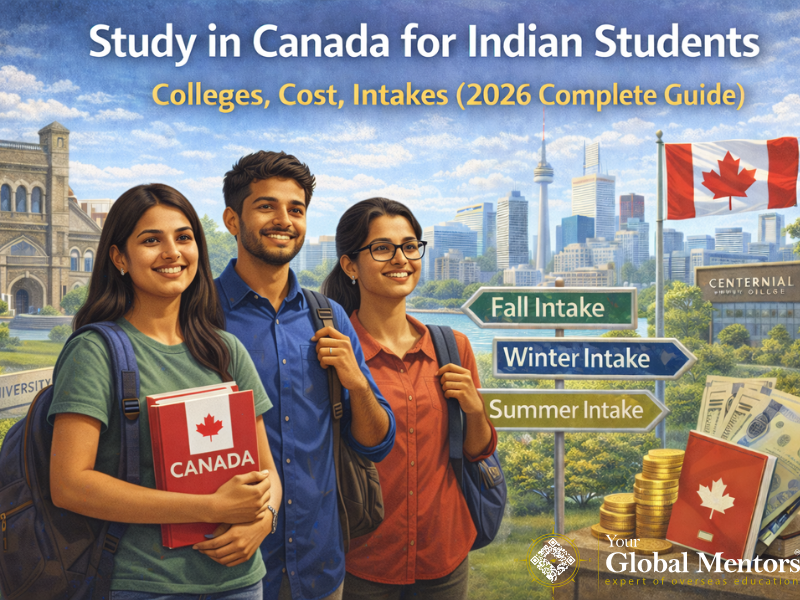
Table of Contents
Study in Canada for Indian Students – Colleges, Cost, Intakes (2026 Complete Guide)
Canada has firmly established itself as one of the most trusted and student-friendly study abroad destinations for Indian students. Year after year, thousands of students from India choose Canada not just for its quality education, but for its transparent immigration system, affordable study options compared to other countries, strong job market, and long-term settlement opportunities.
For students and parents planning overseas education in 2026, Canada offers a balanced combination of education, employability, and permanent residency (PR) pathways, making it a convenient choice rather than a risky one.
This detailed guide is written from the perspective of a senior study abroad counsellor with over 30 years of experience, to help Indian students understand where to study, how much it costs, which intakes to target, and how to plan studies in Canada realistically and safely.
Why Study in Canada in 2026?
Canada’s popularity among Indian students is not accidental. It is the result of consistent policies, quality institutions, and student-focused regulations.
Key Reasons Canada Is a Top Choice
Globally recognised universities and colleges
Strong focus on practical and job-oriented education
Affordable tuition compared to the USA and UK
Liberal part-time work rights
Clear post-study work permits (PGWP)
Well-defined PR pathways
Safe, multicultural environment with a large Indian community
Canada is not just a study destination—it is a long-term career and settlement destination for many Indian students.
Who Should Consider Studying in Canada?
Studying in Canada is suitable for Indian students who:
Want international education with affordability
Are you looking for job opportunities during and after your studies
Prefer a structured immigration system
Are open to studying in both universities and colleges
Plan to work and possibly settle abroad after studies
Canada welcomes students from:
Science, Commerce, and Arts
Diploma, Undergraduate, and Postgraduate backgrounds
Freshers and students with work experience
Education System in Canada – Universities vs Colleges
One of the most important decisions while planning for Canada is choosing between a university and a college. Both are valuable, but serve different career goals.
Universities in Canada
Universities focus on:
Academic depth
Research-based learning
Bachelor’s, Master’s, and PhD degrees
Best for students who want:
Theoretical + research exposure
Higher academic credentials
Long-term professional roles
Colleges in Canada
Colleges focus on:
Practical skills
Industry-ready training
Diplomas and postgraduate certificates
Best for students who want:
Faster job entry
Skill-based learning
Strong PR alignment
Important counselling insight:
Colleges are not inferior to universities in Canada. In fact, many colleges offer better employability and PR outcomes for certain profiles.
Top Universities in Canada for Indian Students (2026)
Canada has world-ranked universities known for quality education and strong global recognition.
Popular Canadian Universities
University of Alberta
McMaster University
These universities are competitive and generally require:
Strong academic background
English proficiency
Well-written SOP
Top Colleges in Canada for Indian Students (2026)
Colleges are extremely popular among Indian students due to their affordability and focus on job prospects.
Well-Known Canadian Colleges
Seneca College
Humber College
George Brown College
Centennial College
Sheridan College
Fanshawe College
Conestoga College
Colleges are ideal for:
IT, business, healthcare, engineering technology
Students aiming for PR through work experience
Popular Courses to Study in Canada (High Demand in 2026)
Canada’s labour market heavily influences course demand.
1. Information Technology & Data Programs
Computer Programming
Data Analytics
Cybersecurity
Software Development
Why popular: High demand + strong PR prospects
2. Business & Management
Business Analytics
International Business
Supply Chain Management
Finance & Accounting
3. Engineering & Technology
Mechanical Engineering
Civil Engineering
Electrical Engineering
Engineering Technology (College programs)
4. Healthcare & Life Sciences
Nursing
Healthcare Administration
Biotechnology
Public Health
5. Hospitality & Tourism
Hotel Management
Culinary Arts
Tourism Management
Cost of Studying in Canada for Indian Students (2026)
Understanding the total cost is essential for safe planning.
Tuition Fees in Canada
Universities (Annual Tuition)
Level | Tuition Fees (CAD) | Approx INR |
|---|---|---|
Bachelor’s | 20,000–40,000 | ₹12–24 lakhs |
Master’s | 18,000–45,000 | ₹11–27 lakhs |
Colleges (Annual Tuition)
Program Type | Tuition Fees (CAD) | Approx INR |
|---|---|---|
Diploma | 13,000–20,000 | ₹8–12 lakhs |
PG Diploma | 14,000–22,000 | ₹8.5–13 lakhs |
Living Expenses in Canada
Expense | Annual Cost (CAD) | Approx INR |
|---|---|---|
Accommodation | 8,000–12,000 | ₹4–6 lakhs |
Food | 3,000–4,000 | ₹1.8–2.4 lakhs |
Transport | 1,000–1,500 | ₹60k–90k |
Miscellaneous | 2,000–3,000 | ₹1–1.8 lakhs |
Total Average Annual Cost
👉 ₹18–30 lakhs, depending on city and lifestyle.
Intakes in Canada for Indian Students
Canada offers three main intakes, giving students flexibility.
1. Fall Intake (September)
Most popular intake
Maximum course availability
Best scholarship opportunities
Application timeline:
Apply between October – January
2. Winter Intake (January)
Second most popular
Slightly fewer course options
Good alternative if you miss Fall
Application timeline:
Apply between June – August
3. Summer Intake (May)
Limited courses
Mostly colleges
Application timeline:
Apply between January – February
Part-Time Work in Canada
Canada allows students to work while studying.
Work Rights
20 hours per week during study
Full-time during scheduled breaks
Average Pay
CAD 15–22 per hour
Part-time work helps cover:
Living expenses
Local work experience
Canada Student Visa (Study Permit) – 2026
Key Requirements
Letter of Acceptance (LOA)
Proof of funds
IELTS / PTE
SOP (Statement of Purpose)
Medical & police clearance
English Requirements
Test | Typical Score |
|---|---|
6.0–6.5 | |
58–65 | |
80–90 |
Visa Approval Reality
Visa success depends on:
Academic consistency
Course relevance
Financial clarity
Genuine study intent
Weak SOPs and poor planning are major reasons.
Post-Study Work Permit (PGWP) in Canada
After completing studies, students can apply for PGWP.
PGWP Duration
Up to 3 years, depending on course length
PGWP allows:
Full-time work
Canadian experience
PR eligibility
PR Pathways in Canada for Indian Students
Canada offers some of the clearest PR systems globally.
Popular PR Routes
Express Entry
Provincial Nominee Program (PNP)
Canadian Experience Class (CEC)
PR depends on:
Work experience
CRS score
Language ability
Province of study
Best Cities in Canada for Indian Students
City | Why Choose |
|---|---|
Toronto | Jobs & exposure |
Vancouver | Tech & lifestyle |
Calgary | Affordable |
Winnipeg | PR-friendly |
Halifax | Regional advantage |
Studying in regional areas often improves PR chances.
Common Mistakes Indian Students Make
Choosing Canada only for PR
Selecting irrelevant courses
Poor financial planning
Weak SOP
Trusting unverified agents
Why Choose Your Global Mentors for Studying in Canada
Studying in Canada requires careful planning, transparent counselling, and long-term thinking. At Your Global Mentors, students receive experience-driven guidance focused on the right course selection, safe visa filing, realistic job outcomes, and PR strategy, not shortcuts or false promises. The emphasis is always on building a sustainable international career, not just securing admission.
Final Conclusion: Is Canada Worth It for Indian Students in 2026?
Yes—when planned correctly.
Canada offers:
Quality education
Affordable study options
Job opportunities
Strong PR pathways
But success depends on:
Choosing the right institution
Selecting the right intake
Clear financial planning
Trusted guidance
When approached with clarity, studying in Canada can be one of the most rewarding decisions for Indian students and their families.