
Netherlands MBA Colleges Top Business Schools, Fees, Eligibility & Career Opportunities
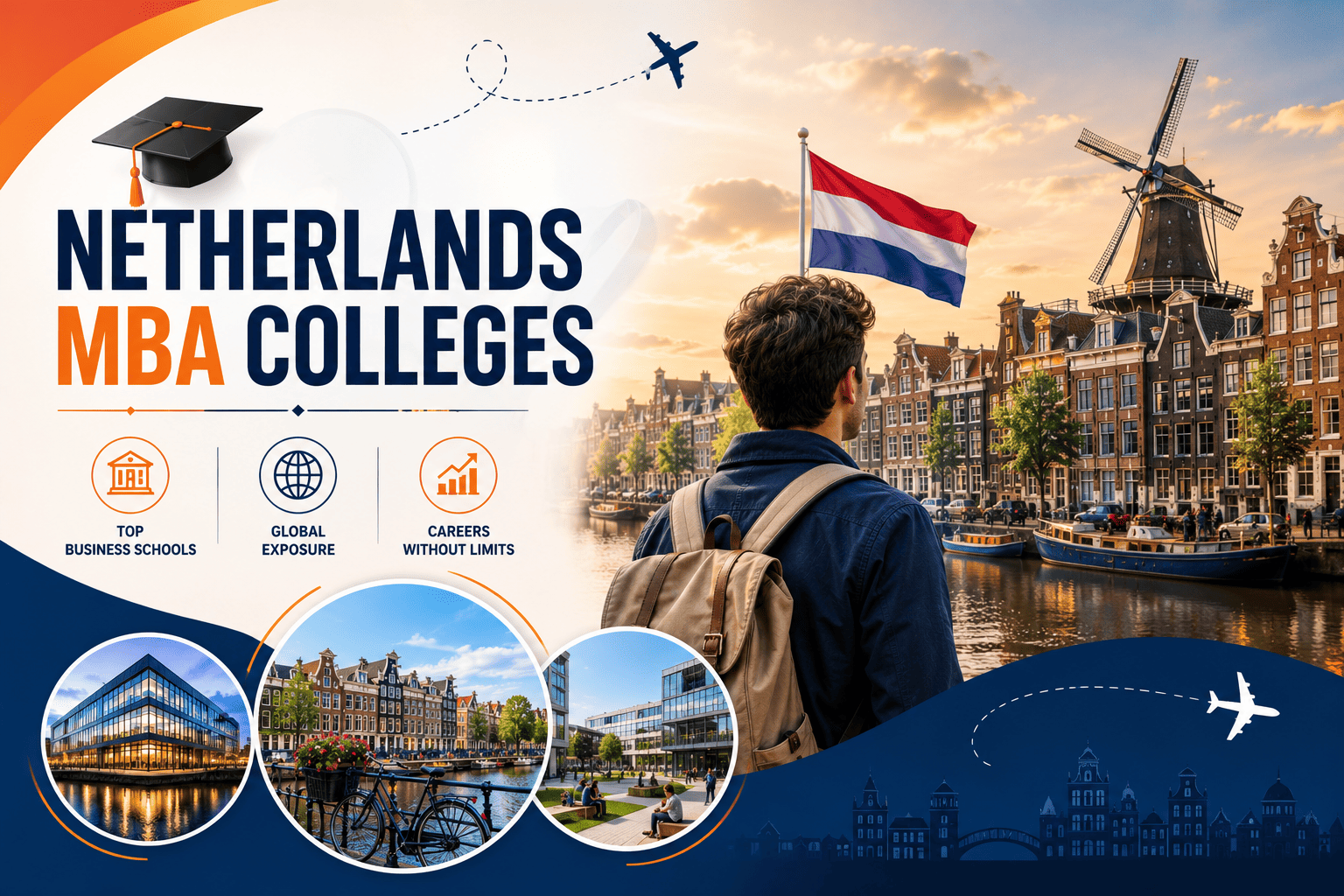
Table of Contents
Netherlands MBA Colleges: Highlights 2026
The Netherlands has established itself as one of Europe's most practical MBA destinations, combining globally ranked business schools with genuinely lower costs than the US or UK. The Netherlands has 3 globally ranked universities for MBA, with Rotterdam School of Management (RSM) at #34 and Amsterdam Business School at #60 in the QS MBA Rankings 2026, alongside TIAS Business School ranked #37 for Full-time MBA in Europe.
Tuition fees range from €44,500 (₹49.61 Lakh) at TIAS Business School to €70,000 (₹78.04 Lakh) at RSM, significantly lower than equivalent programs in the US or UK that cost ₹80 Lakh–1.5 Crore. All top programs are 12-month full-time MBAs, most requiring around 3 years of work experience, and graduates receive a 1-year Orientation Visa after graduation with no job offer required upfront — a genuinely flexible post-study pathway.
Why Choose MBA Colleges in the Netherlands?
Considering Dutch MBA colleges specifically? Here's why they make strategic sense in 2026.
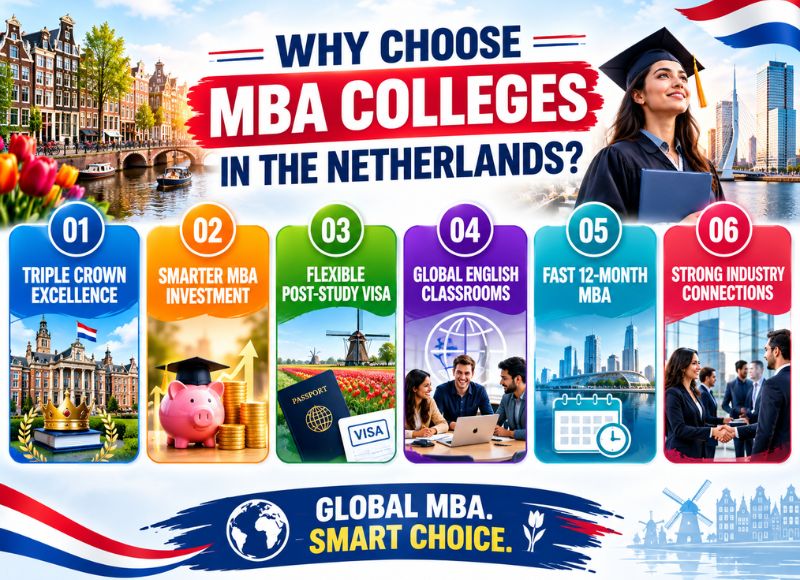
1. Genuine Triple Crown accreditation at top schools
RSM and Amsterdam Business School both hold Triple Crown accreditation (AACSB, AMBA, EQUIS) — a distinction shared by fewer than 1% of business schools globally, giving your degree genuine international credibility.
2. Meaningfully lower cost than US/UK equivalents
Total program cost of ₹62–100 Lakh, including living expenses, compares favourably against ₹1–2 Crore for equivalent US programs, without sacrificing global ranking recognition.
3. Flexible, no-job-offer-required post-study visa
Graduates receive a 1-year Orientation Visa after graduation with no job offer required upfront — genuinely more flexible than the US H-1B lottery system or the UK's Graduate Route structure.
4. Fully English-medium, genuinely international classrooms
40–60% international students in a fully English-medium environment with no Dutch language requirement, creating genuinely diverse cohorts and easing the transition for non-Dutch speakers.
5. Fast, compressed program format
All top Dutch MBA programs run as 12-month full-time formats, meaningfully reducing your total opportunity cost compared to longer two-year structures elsewhere.
6. Strong employer connections across major industries
These institutions offer excellent opportunities with strong connections to multinational companies — Philips, ING, Shell, and Unilever are among the major organisations actively engaging with Dutch business schools.
The bottom line: If you want a globally ranked, English-medium MBA at a meaningfully lower cost than the US or UK, combined with a genuinely flexible post-study visa pathway, Dutch MBA colleges offer a strategically compelling choice for 2026.
Eligibility Criteria for Netherlands MBA Colleges
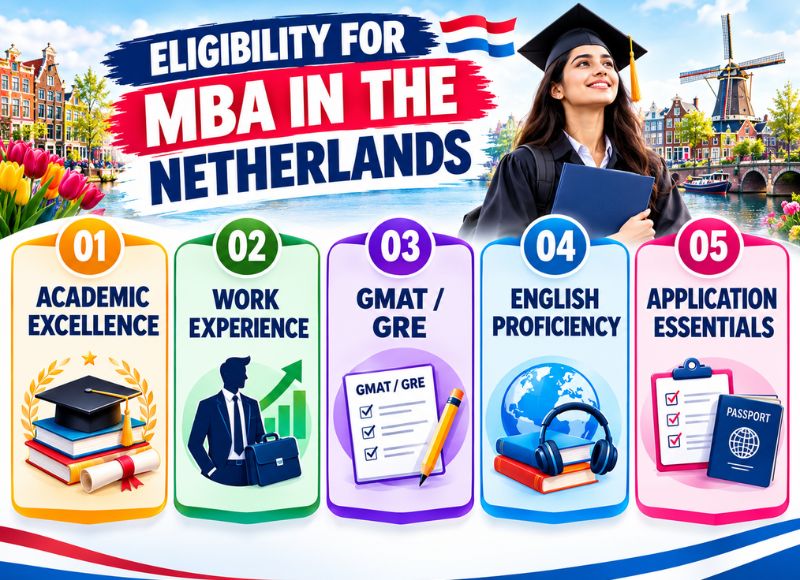
Before applying to MBA colleges in the Netherlands, make sure you meet the following eligibility requirements for 2026 admissions.
Academic qualification
- A recognised undergraduate degree with at least 50-60% aggregate marks (or equivalent GPA) is the general baseline, though Amsterdam Business School accepts a bachelor's, master's, or PhD from a recognised research university.
Work experience
- Most Business & MBA programs require 2–5 years of professional work experience, though this genuinely varies by institution — some schools like RSM and Amsterdam Business School show flexibility for candidates with slightly less experience if the rest of their profile is strong.
Standardised test scores
- Most Business & MBA programs require GMAT 600+ or GRE equivalent, though several universities offer genuine flexibility — Maastricht School of Management allows you to avoid the GMAT requirement by completing five online preparatory courses (Accounting, Finance, Statistics, Economics, and Write & Cite Academic Writing Readiness) after paying the first installment, while Amsterdam Business School accepts an in-house test (assessing Numerical Reasoning, Abstract Reasoning, and Verbal Reasoning) as an alternative to GMAT/GRE.
English proficiency
- IELTS 6.5–7.0 or TOEFL 90-100+ is standard, though waivers exist for applicants whose prior education was conducted entirely in English.
Application essentials
- A completed online application form, academic transcripts, letters of recommendation, a Statement of Purpose explaining your motivation and career goals, a valid passport copy, and an application fee (where applicable) are standard across Dutch institutions.
Our advice: Since GMAT requirements genuinely vary — mandatory at some schools but replaceable through Maastricht's prep-course pathway or Amsterdam's in-house test — don't assume a below-600 GMAT rules you out of the Netherlands entirely; instead, identify which specific alternative pathway your target school offers.
Admission Process for MBA Colleges in the Netherlands 2026
Here's a step-by-step breakdown of what the admission process looks like for 2026.
Step 1: Research and shortlist colleges
Compare Dutch MBA colleges based on fees, duration, specialisations (Finance, Sustainability, Supply Chain, AI, Food & Agribusiness), and program format.
Step 2: Check eligibility requirements
Review academic qualifications, GMAT/GRE requirements (or alternative pathways), and English proficiency scores for your specific target schools.
Step 3: Take required standardised tests
Complete GMAT/GRE and language tests (IELTS/TOEFL) as required, or pursue your target school's specific alternative assessment route.
Step 4: Prepare your application documents
Gather academic transcripts, test scores, SOP, LORs, CV, passport copy, and work experience documentation.
Step 5: Submit your application, watching institution-specific deadlines
Deadlines vary significantly by institution — Rotterdam School of Management's deadline falls around November, TIAS School for Business and Society around September, Amsterdam Business School around December, Nyenrode Business Universiteit around December, and Maastricht School of Management around August — treat these as reference points for planning your equivalent 2026-cycle application with each specific school.
Step 6: Attend your interview
Prepare for behavioural and career-focused questions as part of your admissions interview.
Step 7: Confirm admission and begin your visa process
Accept the offer, pay the deposit, and start the visa process — international students need a Dutch student visa (MVV) and a residence permit for full-time study.
Step 8: Complete your MVV application
Submit through the Dutch Immigration (IND) portal, pay the visa fee (approximately €210), and schedule biometrics and your interview at the Dutch embassy or consulate.
Our advice: Start your application process 8–10 months before your preferred intake — given how far in advance several Dutch colleges' deadlines fall (some as early as August-September for the following year's intake), early planning genuinely protects your options and scholarship eligibility.
GMAT, GRE & English Language Requirements
Here's what you need to know about standardised testing and English proficiency for MBA colleges in the Netherlands in 2026.
GMAT is the standard requirement, though genuine flexibility exists
Most Business & MBA programs in the Netherlands require a GMAT 600+ or GRE equivalent. Universities accepting GMAT scores for MBA admission include the University of Amsterdam, Erasmus University Rotterdam, Maastricht School of Management, TIAS School for Business and Society, and Nyenrode Business University.
Genuine GMAT-waiver pathways worth knowing
- Maastricht School of Management: Avoid the GMAT by completing five online preparatory courses (Accounting, Finance, Statistics, Economics, Write & Cite Academic Writing) after your first instalment payment
- Amsterdam Business School: Choose between GMAT/GRE or an in-house test assessing Numerical Reasoning, Abstract Reasoning, and Verbal Reasoning
- RSM: Accepts GMAT, GRE, or BAT (Business Admissions Test) results — giving you three possible testing routes rather than just one
English proficiency requirements
IELTS 6.5–7.0 or TOEFL 90-100+ is standard, with waivers available for candidates whose prior degree was conducted entirely in English.
Our advice: Since RSM alone accepts three different test options (GMAT, GRE, or BAT), and Maastricht and Amsterdam Business School both offer genuine non-GMAT pathways, map out each target school's specific flexibility before assuming you need a traditional GMAT score to gain admission to a strong Dutch MBA college in 2026.
Top MBA Colleges in the Netherlands 2026
Here's a rundown of the Netherlands' leading MBA institutions worth considering for 2026.
1. Rotterdam School of Management (RSM), Erasmus University
The Netherlands' flagship MBA program — ranked #16 for Full-time MBA in Europe and #34 globally on QS Global MBA Rankings 2026. RSM holds Triple Crown accreditation, a rare distinction earned by only ~1% of business schools worldwide. For 2026, the International Full-time MBA program fee is €67,000, payable in instalments
2. Amsterdam Business School, University of Amsterdam
Sits at #60 in QS Global MBA Rankings 2026, also holding Triple Crown accreditation. Offers a GMAT/GRE alternative through an in-house test assessing Numerical Reasoning, Abstract Reasoning, and Verbal Reasoning.
3. TIAS School for Business and Society, Tilburg University
Ranks #37 for Full-time MBA in Europe, with its Executive MBA ranked #1. According to TIAS's 2024 Placement Report, over 85% of graduates secure a job within six months, with many working in consulting, finance, and tech. Offers distinctive tracks in Food & Agribusiness and Global Business Management.
4. Maastricht School of Management, Maastricht University
A genuinely accessible option given its GMAT-alternative pathway through five online preparatory courses (Accounting, Finance, Statistics, Economics, Write & Cite Academic Writing) after your first instalment
5. Nyenrode Business Universiteit
One of the Netherlands' established business schools, featured among the country's top four institutions in global business school rankings.
6. Wittenborg University of Applied Sciences
Offers 11 distinct MBA specialisations, backed by a total of 10 MBA scholarships awarding EUR 5,000 each.
7. Tio Business School
Offers a flexible, industry-focused MBA suitable for both full-time students and working professionals, with close connections to Dutch businesses for networking.
Our advice: If Triple Crown accreditation and top-tier global ranking matter most, RSM and Amsterdam Business School are your clear top choices. If GMAT flexibility genuinely matters, Maastricht's alternative prep-course pathway or Amsterdam's in-house test offer accessible routes without sacrificing institutional credibility.
MBA Colleges in the Netherlands: Rankings
Here's how the Netherlands' top MBA programs currently stack up in global rankings for 2026.
QS Global MBA Rankings 2026 presence
Three Dutch business schools feature prominently — RSM at #16 for Full-time MBA in Europe (and #34 globally), Amsterdam Business School at #60, and TIAS Business School at #37 for Full-time MBA in Europe, with its EMBA ranking #1.
Broader institutional excellence beyond MBA-specific rankings
In the World University Rankings 2025 by Times Higher Education, five Dutch schools ranked in the top 100 — Delft University of Technology at #56, University of Amsterdam at #58, Wageningen University & Research at #67, Leiden University at #73, and University of Groningen at #80, with several others ranking in the top 200.
Accreditation as a genuine quality signal
RSM and Amsterdam Business School both hold Triple Crown accreditation (AACSB, AMBA, EQUIS) — a rare distinction shared by fewer than 1% of business schools globally, adding real credibility beyond ranking position alone.
Historical ranking presence
Four business schools offering MBA programs in the Netherlands have featured in the Global 200 Business Schools Report — Rotterdam School of Management, Amsterdam Business School, Maastricht School of Management, and Nyenrode Business Universiteit — reflecting sustained, consistent international recognition over time.
Our advice: Don't rely on QS rankings alone — cross-reference Triple Crown accreditation status (RSM and Amsterdam Business School) alongside ranking position, since this combination genuinely signals sustained institutional quality rather than a single year's ranking fluctuation.
Best MBA Universities in the Netherlands for International Students
Here's what genuinely matters for international students specifically weighing the Netherlands for 2026.
Universal English-medium instruction
Many universities in the Netherlands offer Business & MBA programs taught entirely in English, particularly at Master's and PhD level — removing language barriers for genuinely diverse international cohorts.
Strong ties to multinational employers
These institutions offer excellent opportunities with strong connections to multinational companies — Philips, ING, Shell, and Unilever are among the major multinational organisations based in the Netherlands actively engaging with these business schools.
Genuinely strong employment outcomes
The Netherlands has a high employment rate, with 85% of MBA graduates securing jobs within six months.
International recognition through triple accreditation
MBA programs are recognised by AACSB, AMBA, and EQUIS — meaning they carry value worldwide, not just within the Netherlands or broader EU.
Genuinely diverse international cohorts
40–60% international students in a fully English-medium environment creates authentic cross-cultural classroom experiences, easing the transition for non-Dutch applicants specifically.
Flexible program formats for different student profiles
Programs differ in duration and format, with full-time and part-time options available across specialisations like general management, finance, sustainability, and AI — genuinely accommodating both career-focused fast-trackers and working professionals.
Our advice: Since employment outcomes (85% within 6 months) and multinational employer connections are consistently strong across the Netherlands' top institutions, prioritise your decision based on specialisation fit and program format rather than worrying that any Triple-Crown-accredited Dutch school will limit your international career prospects.
MBA Specialisations Offered in the Netherlands
Here's what specialisation options are genuinely available across the Netherlands' MBA landscape in 2026.
1. General Management
Many business schools offer general MBA programs, where students study all aspects of business and management — the broadest, most widely available track across Dutch institutions.
2. Finance
A consistently strong specialisation given the Netherlands' role as a major European financial and trade hub.
3. Supply Chain Management
Some Dutch schools offer specialised MBA programs specifically in supply chain management, leveraging the Netherlands' position as a genuine European logistics gateway centred around Rotterdam, Europe's largest port.
4. Business Analytics
An increasingly available specialisation reflecting growing demand for data-driven decision-making across Dutch and broader European businesses.
5. Sustainability
A genuine Dutch and broader European strength, reflecting the region's regulatory and cultural emphasis on environmental and social governance.
6. AI (Artificial Intelligence)
An emerging, forward-looking specialisation now offered at select institutions, reflecting growing industry demand for AI-literate business leaders.
7. Food & Agribusiness
A genuinely distinctive TIAS specialisation, reflecting the Netherlands' global leadership in agricultural technology and food industry innovation.
8. Global Business Management
Also available at TIAS, catering to students interested in cross-border business strategy given the Netherlands' central European trade positioning.
Our advice: If you're drawn to the Netherlands' most distinctive local industry strengths, prioritise Food & Agribusiness or Supply Chain Management specialisations — these leverage the country's genuinely unique economic positioning (agricultural innovation and Rotterdam's port logistics) in ways that generic specialisations elsewhere in Europe can't replicate.
Netherlands MBA Colleges: Fees Comparison
Understanding the fee landscape helps you budget realistically across the Netherlands' MBA colleges for 2026.
Top-tier program fees
RSM's International Full-time MBA program fee for 2026 is €67,000, payable in instalments — while TIAS Business School's programs run around €44,500 (₹49.61 Lakh).
Overall tuition range across sources
Tuition fees genuinely span a wide range depending on source and institution tier — from €8,000 to €64,000 per year at the broadest end, to €20,000-€80,000 annually at other institutions.
Mid-range and budget-friendly options
More affordable options are available at institutions like Maastricht School of Management and TIAS School for Business and Society, compared to top-ranked schools like RSM and Amsterdam Business School.
Public university tier (via EU/non-EU fee structure)
Tuition for Business & MBA programs at public universities ranges from €2,314/year (EU/EEA) to €8,000–20,000/year (non-EU) — a significant difference worth confirming which fee tier applies to you as an international applicant.
Scholarship impact worth factoring in
The RSM MBA Scholarship covers up to a 50% reduction in tuition fees for deserving MBA students, while Wittenborg University offers 10 MBA scholarships worth EUR 5,000 each — genuinely meaningful reductions worth actively pursuing.
Total program cost reconciliation
Given the genuine variation across sources, treat €20,000-€67,000/year as your realistic core planning range for a reputable, internationally recognised MBA college, while verifying your specific target school's current, official fee structure directly.
Our advice: Since fee figures genuinely vary significantly across different sources and reporting periods, always verify your specific target college's current official tuition directly from their admissions website before finalising your budget — and actively research scholarship eligibility (like RSM's 50% tuition relaxation) since these can substantially shift your total investment.
Cost of Living for MBA Students in the Netherlands
Here's a realistic breakdown of monthly living expenses across the Netherlands' major MBA cities for 2026.
Overall national range
Living expenses genuinely vary by source, spanning roughly €800-€1,500 per month, with a more specific single-person estimate (excluding rent) averaging around €924/month.
City-by-city cost differences
Living expenses in cities like Amsterdam, Rotterdam, and Maastricht generally range between €1,000–€1,200 each month, depending on lifestyle — though major cities such as Amsterdam, Rotterdam, and The Hague tend to be more expensive, while smaller towns like Maastricht, Tilburg, or Nijmegen sit on the more affordable end.
Annual cost of living estimate
The average cost of living for an international student in the Netherlands is around ₹ 12- 18 lakh (€14,000-22,000) per year, depending on the city and lifestyle — with Amsterdam and Rotterdam more expensive, and Tilburg and Maastricht offering more budget-friendly alternatives.
Total program cost including living expenses
Total annual costs including your living expenses range between €40,000–€70,000 (₹35-59.5 Lakh), depending on the university and your lifestyle — genuinely useful as an all-in planning benchmark beyond tuition alone.
Monthly budget planning figure
Some institutions cite that students should plan monthly living expenses of around €1,013 (₹1.05 Lakh) in addition to tuition, for a more precise budgeting benchmark.
Our advice: If minimising costs matters, prioritise smaller cities like Maastricht, Tilburg, or Nijmegen over Amsterdam and Rotterdam — the meaningful cost difference between these city tiers compounds significantly over your 1-2 year MBA program, without coming at the expense of career outcomes given the country's strong overall employment rate.
Scholarships for MBA Colleges in the Netherlands
Good news for international applicants — the Netherlands offers genuine scholarship pathways across several institutions for 2026.
RSM MBA Scholarship
Awarded by Rotterdam School of Management, this scholarship covers up to a 50% reduction in tuition fees for deserving MBA students — a genuinely substantial reduction on RSM's €67,000 headline fee.
Wittenborg University Scholarships
A total of 10 MBA scholarships awarding EUR 5,000 each are available to prospective students across Wittenborg's 11 MBA specialisations.
Scholarships are available for international students across multiple Dutch business schools, though specific eligibility criteria, amounts, and application timelines genuinely vary by institution — always check directly with your shortlisted schools' admissions offices.
GMAT-linked scholarship incentive (Amsterdam Business School)
The Amsterdam MBA GMAT Scholarship rewards high GMAT scores with amounts up to €12,000 for the strongest performers — genuinely worth factoring into your test-prep decision even at schools offering GMAT-free alternative pathways.
How to maximise your scholarship chances
Since most scholarships are merit-based and tied to either academic performance, GMAT scores, or specific application rounds, applying early and submitting the strongest possible profile (test scores, SOP, recommendations) genuinely improves your odds across nearly every Dutch institution's award programs.
Our advice: Don't treat scholarships as a secondary consideration — RSM's 50% tuition relaxation alone can save you tens of thousands of euros, so research and apply for these opportunities alongside your main application rather than after receiving an admission offer.
MBA Colleges in the Netherlands for Indian Students
Here's what genuinely matters specifically for Indian applicants weighing the Netherlands for 2026.
No language barrier for coursework
Programs are taught entirely in English at Master's level, meaning Indian students — particularly those from English-medium undergraduate backgrounds — face no genuine language hurdle for academics.
Multiple GMAT pathways genuinely benefit Indian applicants
Given how competitive GMAT preparation can be for Indian applicants pursuing MBAs globally, the Netherlands' multiple alternative pathways — RSM's GMAT/GRE/BAT options, Amsterdam's in-house test, and Maastricht's prep-course route — genuinely reduce one major source of application pressure compared to more rigid testing requirements elsewhere.
Genuinely lower total cost than US/UK alternatives
For Indian students specifically, the Netherlands offers a total program cost of ₹62–100 Lakh including living expenses, compared to ₹1–2 Crore for equivalent US programs — a meaningful difference for Indian families weighing education loan capacity.
A flexible post-study visa without a job offer requirement
The 1-year Orientation Visa after graduation, granted with no job offer required upfront, is genuinely more flexible than the US H-1B lottery system or the UK's Graduate Route structure — offering Indian graduates real breathing room to search for employment.
Strong multinational employer access
Major companies like Philips, ING, Shell, and Unilever maintain strong Dutch business school connections, giving Indian graduates genuine access to globally recognised employers without needing separate international relocation post-graduation.
Our advice: Since Indian applicants specifically benefit from the Netherlands' combination of lower total cost, flexible GMAT alternatives, and a no-job-offer-required post-study visa, weigh this destination seriously against pricier US/UK options — particularly if your GMAT score isn't yet at a traditionally competitive level, since Dutch institutions offer genuinely more accessible pathways around this requirement.
MBA Colleges in the Netherlands: Placements
Here's what employment outcomes genuinely look like after completing an MBA in the Netherlands in 2026.
Strong overall employment rate
The Netherlands has a high employment rate, with 85% of MBA graduates securing jobs within six months of graduation.
TIAS-specific placement data
According to TIAS's 2024 Placement Report, over 85% of graduates secure a job within six months, with many working in consulting, finance, and tech industries.
Popular post-MBA industries
Popular post-MBA industries in the Netherlands include consumer products, consulting, technology, financial services, and healthcare, among others — reflecting genuinely broad employer demand across the Dutch economy.
Where graduates actually land
Many students opt to stay in the Netherlands after graduating, gravitating to international cities such as Amsterdam, The Hague, or Rotterdam — while other students go on to other countries in Europe, and some end up elsewhere, reflecting the genuinely global mobility a Dutch MBA can support.
Strong multinational employer connections built into the ecosystem
Institutions maintain excellent opportunities with strong connections to multinational companies — Philips, ING, Shell, and Unilever are among the major organisations actively engaging with Dutch business school graduates.
Our advice: Since placement outcomes are consistently strong (85%+ within six months) across the Netherlands' top institutions, and graduates genuinely go on to careers both within the Netherlands and across broader Europe, request each specific school's detailed placement report — including industry breakdown and geographic destination data — to see which program's outcomes most closely match your specific career goals.
Average MBA Salary in the Netherlands
Here's a realistic breakdown of what you can expect to earn after completing an MBA in the Netherlands in 2026.
Overall salary range
MBA graduates from the Netherlands may earn anywhere from €60,000 to €104,000, with an average income of roughly €80,000 — genuinely solid outcomes relative to program cost.
Alternative salary range cited
Some sources cite a slightly broader starting salary range of €50,000 to €100,000 for graduates landing jobs within six months of completing their program.
What influences your salary?
- Institute reputation and specific program ranking
- Chosen specialisation (Finance and Supply Chain Management often align with strong Dutch industry demand)
- Prior work experience before pursuing the MBA
- Whether you remain in the Netherlands, move elsewhere in the EU, or return to India.
Realistic planning benchmark
Given the range across sources (€50,000-€104,000, with an average around €80,000), treat €60,000-€90,000 as your realistic planning benchmark for most graduates, with genuine upside for top-tier program graduates or those entering consulting and finance roles specifically.
ROI context relative to program cost
Since total program investment (tuition plus living expenses) genuinely ranges from ₹62-100 Lakh, and average salaries translate to roughly ₹53-92 Lakh annually (at current exchange rates), most graduates can expect meaningful ROI within a reasonable timeframe, particularly those securing roles in the Netherlands' strong finance and consulting sectors.
Our advice: Since salary outcomes vary meaningfully across sources and specialisations, use the €60,000-€90,000 range as your realistic planning benchmark rather than anchoring to the higher €104,000 figure, while recognising that Finance and Consulting roles at top-tier schools like RSM genuinely offer stronger upside within this broader range.
Student Visa & Residence Permit for MBA Students
- Two-document system (TEV procedure) — Non-EU/EEA students, including Indians, need both an MVV (entry visa) and a VVR (residence permit), applied for together through a combined "Toelating en Verblijf" (TEV) application submitted by your university
- University-led application — Your university submits the MVV/VVR application to IND on your behalf — you don't apply directly; you simply need an unconditional admission offer and confirmed tuition deposit before the process begins
- MVV collection and travel — Once approved, collect your MVV sticker at the Dutch Embassy/Consulate in India (valid for 90 days), then travel to the Netherlands, typically 1-4 weeks before your course start date
- Post-arrival steps — Register at your local municipality (gemeente) within 5 days to receive your BSN (Citizen Service Number), provide biometric data at the IND desk, and complete a mandatory TB test organised through your university during orientation
- Fees (2026) — MVV fee around €190, with the combined MVV + residence permit application fee at €210 (~₹19,300) when your university applies on your behalf; total first-year visa cost approximately €400 (~₹37,200), with €210 annual renewal thereafter
- Financial proof requirement — Proof of sufficient funds is mandatory, cited around €13,000, to cover living expenses and study costs
- Processing time — Typically 2-4 weeks for IND processing when applied through your university, though the total end-to-end timeline (admission to travel) commonly spans April-August for a September intake
- Mandatory health insurance — Dutch basic health insurance (~€130/month, ~₹12,000/month) is required for all residents, alongside the TB test after arrival.
Career Opportunities After MBA in the Netherlands
- Consulting — Strong pipeline into firms like McKinsey & Company, EY, and Accenture, reflecting the Netherlands' position as a major European consulting hub
- Supply Chain & Logistics — Particularly strong given RSM's Rotterdam location — Europe's largest port city — offering direct access to logistics and operations roles
- Business Development — A consistently strong outcome area for Indian MBA graduates specifically, alongside Consulting and Supply Chain
- Corporate roles at multinational HQs — The Netherlands hosts European headquarters of Unilever, Shell, Philips, KPMG, and Maersk, creating strong in-house demand for MBA-level talent
- Technology & Pharma — SAP and Medtronic are among active recruiters, reflecting tech and healthcare-sector opportunities alongside traditional consulting/business roles
- Sustainability roles — Growing specialisation in this area, particularly strong at RSM alongside its consulting and supply chain strengths
- Emerging fields with growing Indian interest — Data science, AI, business analytics, sustainable engineering, water management, and supply chain logistics are seeing increasing demand and Indian student enrollment.
Post-Study Work Opportunities in the Netherlands
- Orientation Year (Zoekjaar) permit — A 12-month post-study residence permit allowing graduates to search for employment or start a business, with open work rights and no job offer required
- Application window — Indian students can apply within 3 years of graduation, via the IND portal.l
- Work rights during Orientation Year — Unlimited/unrestricted work is permitted — no separate work permit (TWV) needed during this period.
- Application requirements — Graduation certificate, valid passport, proof of previous Dutch residence, and a €210 application fee
- Conversion to long-term status — The permit is renewable into the Highly Skilled Migrant (Kennismigrant) permit once you secure qualifying employment, requiring a gross salary of at least €5,331/month in 2026
- One of Europe's most generous post-study pathways — Widely described as a critical, well-regarded gateway between graduation and securing employment in one of Europe's wealthiest economies
- During-study work rights (for context) — Up to 16 hours/week during the academic year, or full-time in June, July, and August, with curriculum-linked internships not requiring a separate work permit
ROI of Netherlands MBA Colleges (Fees vs Salary)
- Maastricht School of Management, Nyenrode, TIAS — Lower-fee, GMAT-flexible options vs. solid €50,000-80,000 salary outcomes → Strong ROI, particularly for candidates using scholarship offsets
- Amsterdam Business School (ABS) — Fees vs. Amsterdam Merit Scholarship (full tuition + €5,000 living allowance for top non-EU/EEA candidates) → Potentially the strongest ROI case among top-tier schools when scholarship-eligible
- Rotterdam School of Management (RSM) — Higher fee bracket vs. strongest reported placement outcomes (especially Supply Chain/Consulting) and RSM Fellows Award (up to 50% tuition waiver, up to €35,000) → Strong ROI when scholarship-adjusted, given RSM's consistently highlighted placement edge among Indian graduates
- Overall fee range — €20,000-80,000 annually (or total program costs of ₹9-44 lakh depending on source), against salaries of €50,000-90,000/year — a generally favourable ratio compared to costlier destinations like the US or UK
- Work-experience prerequisite boosts ROI — Since most Dutch MBA programs require 3+ years of prior work experience, graduates typically re-enter the workforce at a meaningfully higher salary band than their pre-MBA earnings, improving payback spe...
- Orientation Year as an ROI enabler — The 12-month unrestricted work-search period reduces the risk of an extended, unemployed job search post-graduation, indirectly protecting the overall ROI calculation
- Honest positioning — The Netherlands isn't the cheapest MBA destination, nor does it carry brand prestige on par with INSEAD or LBS — its ROI case rests on solid (not peak) salaries combined with strong scholarship access and a genuinely generous post-study work window
Compare the Best MBA Colleges in the Netherlands
| University | GMAT Policy | Fees (Annual, approx.) | Notable Strength |
|---|---|---|---|
| Rotterdam School of Management (RSM) | Waiver for strong profiles; avg 640-660 typical | Higher tier | Consulting, Supply Chain (Rotterdam port), strongest Indian-graduate outcomes |
| Amsterdam Business School (ABS) | Not mandatory with a strong quant background | Higher tier | Amsterdam Merit Scholarship (full tuition + stipend) |
| Maastricht School of Management (MSM) | No GMAT required | Lower-mid tier | Accessible admission, Academic Excellence Scholarship |
| Nyenrode Business University | Not mandatory with a business background | Mid tier | Flexible admission, business-focused pedagogy |
| TIAS School for Business and Society | Not mandatory with a strong profile | Mid tier | Tilburg University affiliation |
Frequently Asked Questions (FAQs)
Q1. Can I do an MBA in the Netherlands without GMAT?
Yes — Maastricht School of Management, Nyenrode Business University, TIAS, Saxion, Hanze, and Webster University all offer GMAT-free pathways, typically for candidates with strong academic records or relevant work experience.
Q2. How much does an MBA in the Netherlands cost?
Total program costs range roughly from ₹9 lakh to ₹44 lakh, with annual fees generally between €20,000-80,000 depending on the university and program tier.
Q3. What is the average salary after an MBA in the Netherlands?
Salaries generally range €50,000-90,000/year, with Indian graduates specifically reporting €60,000-80,000 as solid, though lower than peak US MBA salaries.
Q4. Do Dutch MBA programs require work experience?
Yes — nearly all Dutch MBA programs require a minimum of 3 years of post-graduate work experience, making them designed almost exclusively for working professionals rather than fresh graduates.
Q5. Can I stay and work in the Netherlands after my MBA?
Yes, through the Orientation Year (Zoekjaar) permit — a 12-month residence permit with unrestricted work rights and no job offer required, applicable within 3 years of graduation.
Q6. Which university offers the best placement outcomes for Indian MBA graduates?
RSM is consistently highlighted by Indian graduates as the strongest option, particularly for Consulting, Supply Chain, and Sustainability roles, given its Rotterdam port-city location.
Q7. Are scholarships available for Indian MBA students in the Netherlands?
Yes — options include the RSM Fellows Award (up to 50% tuition, €35,000), Amsterdam Merit Scholarship (full tuition + €5,000 stipend), Holland Scholarship, and the Orange Tulip Scholarship specific to Indian applicants.
Q8. Is an MBA in the Netherlands worth it compared to the UK or US?
It offers one of Europe's most international MBA environments and a genuinely strong post-study work pathway, though it isn't the cheapest option nor does it carry the brand prestige of schools like LBS or INSEAD — its value lies in practicality and solid, dependable outcomes rather than peak salary numbers.
Conclusion
An MBA in the Netherlands occupies a distinctive niche in the European business education landscape — not the cheapest option, and without the global brand recognition of London Business School or INSEAD, but offering something more practical: one of Europe's most genuinely international MBA environments, a pragmatic, work-experience-driven curriculum, and dependable career outcomes averaging €50,000-90,000/year. RSM stands out consistently among Indian applicants for its Rotterdam port-city advantage in Supply Chain and Consulting placements, while GMAT-flexible options at Maastricht, Nyenrode, and TIAS widen access for candidates without an elite standardised test score. The genuinely strong 12-month Orientation Year work permit — offering unrestricted work rights with no job offer required — meaningfully de-risks the post-graduation job search compared to more restrictive visa regimes elsewhere. That said, prospective students should approach salary and fee figures with some caution given how much they vary across sources, and should weigh the Netherlands' solid-but-not-peak earning potential against its genuine strengths: strong scholarships, flexible admissions, and one of Europe's more welcoming post-study pathways.