





Medical (MBBS) Abroad: Russia, Georgia ya Philippines
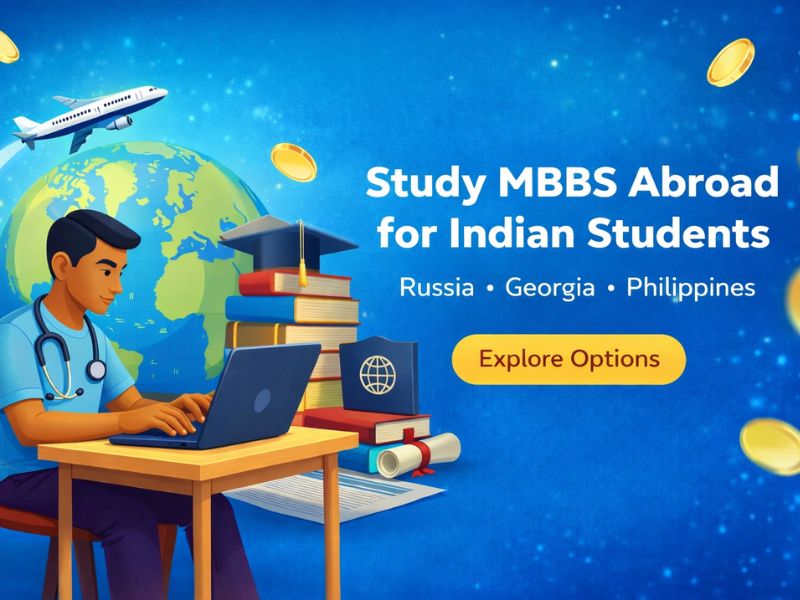
Table of Contents
Every year, thousands of Indian students dream of becoming doctors, but limited government medical seats and high private college fees make it difficult to study MBBS in India. Because of this, many students explore MBBS abroad options in countries like Russia, Georgia, and the Philippines.
This guide is designed for Indian students and parents who want a clear and practical understanding of studying MBBS abroad. By the end of this article, you will understand admission requirements, costs, eligibility, and how to choose the right country for your medical career.
Why Indian Students Choose MBBS Abroad
Russia vs Georgia vs Philippines – Quick Comparison
MBBS Abroad Admission Process Flow Chart
MBBS in Russia for Indian Students
MBBS in Georgia for Indian Students
MBBS in the Philippines for Indian Students
Eligibility Requirements for Indian Students
Total Cost of MBBS in Russia, Georgia, and the Philippines
Recognition, NMC Guidelines, and FMGE/NExT
Advantages and Challenges of Studying MBBS Abroad
How to Choose the Right Country and University
Why Indian Students Choose MBBS Abroad
Medical education abroad has become a popular option for Indian students due to several practical advantages.
Limited Seats in India
India has intense competition for government MBBS seats. Every year, over 20 lakh students appear for NEET, but only a small percentage get government seats.
Affordable Medical Education
Private medical colleges in India can charge between:
₹60 lakh – ₹1.2 crore
In comparison, many international universities offer MBBS programs between:
₹20 lakh – ₹40 lakh total cost
Russia vs Georgia vs Philippines – Quick Comparison
Factor
Russia
Georgia
Philippines
Course Duration
6 Years
6 Years
5.5 – 6 Years
Language
English
English
English
Average Cost
₹18L – ₹35L
₹30L – ₹45L
₹25L – ₹40L
Climate
Very Cold
Moderate
Tropical
Clinical Exposure
Good
Moderate
Strong
NMC Recognition
Yes
Yes
Yes
Each country offers different advantages depending on budget, learning style, and career plans.
MBBS Abroad Admission Process Flow Chart
MBBS Abroad Admission Process Flow Chart
1. Qualify NEET Exam The first mandatory step for Indian students is to qualify for the NEET exam, as it is required to practice medicine in India after completing their degree abroad.
2. Choose Country and University Research and select a country (like Russia, Georgia, or Kazakhstan) and a university that fits your budget and offers high-quality medical education.
3. Submit Application to University: Fill out the application form for your chosen university and submit your 10th and 12th-grade transcripts for eligibility review.
4. Receive Admission Letter Once the university reviews your profile and confirms your eligibility, it will issue an official admission letter.
5. Pay Initial Fees Pay the university's registration or initial tuition fees as required to confirm your seat and receive the necessary documents for your visa.
6. Apply for a Student Visa. Submit your passport, admission letter, and financial documents to the respective embassy to obtain your student visa.
7. Travel to Country Once your visa is approved, book your flight and travel to the university's location to begin your medical journey.
8. Start MBBS Program. Attend the university orientation and begin your first year of medical studies.
9. Complete Degree Dedicate yourself to your clinical and theoretical studies over the next 5 to 6 years to earn your MBBS degree.
10. Appear for FMGE / NEXT Exam. After graduation, you must pass the Foreign Medical Graduate Examination (FMGE) or NEXT exam to obtain your license to practice in India.
11. Practice Medicine in India. Complete your mandatory internship in India to become a registered medical practitioner.
MBBS in Russia for Indian Students
Here is the professional, headline-based structure for the MBBS in Russia section of your blog:
Why Students Choose Russia for MBBS
Russia remains a top-tier destination for Indian medical aspirants due to its long-standing reputation for excellence in medical training and its globally recognised degrees.
Government-Funded Universities. Most medical colleges in Russia are state-owned and heavily subsidised by the government. This ensures high academic standards, well-maintained campuses, and degrees that are recognised by the World Health Organisation (WHO) and the National Medical Commission (NMC) of India.
Affordable Tuition Fees Compared to private medical colleges in India or Western countries, Russia offers high-quality education at a fraction of the cost. Because the universities are government-funded, they can provide world-class training without the heavy financial burden on international students.
Advanced Medical Infrastructure: Russian universities are known for their advanced medical laboratories and research facilities. Students get access to modern diagnostic tools and equipment, ensuring they are well-prepared for the technological side of modern medicine.
Vibrant International Community Russia hosts thousands of students from India and across the globe. This creates a multicultural environment where Indian students find familiar food, cultural celebrations, and a strong support network of seniors.
MBBS Course Duration in Russia
The medical program in Russia follows a comprehensive structure designed to produce skilled doctors.
6-Year Integrated Program The MBBS program (officially called "General Medicine") lasts for a total of 6 years. The first 3 years focus on pre-clinical subjects and theoretical knowledge, while the final 3 years are dedicated to clinical rotations and practical training in hospitals.
Estimated Cost of Studying MBBS in Russia
The financial feasibility is one of the biggest reasons for Russia's popularity among Indian families.
Total Budget Breakdown: The total cost typically ranges between ₹18 lakh and ₹35 lakh. This is a comprehensive estimate that includes tuition fees for the entire 6-year duration and basic living expenses such as hostel accommodation and food.
MBBS in Georgia for Indian Students
Here is the professional, headline-based structure for the MBBS in Georgia section of your blog:
Why Students Choose Georgia for MBBS
Georgia is rapidly emerging as a premier destination for medical aspirants due to its strategic focus on aligning with global healthcare standards.
European-Style Education System Medical universities in Georgia follow the European curriculum, which emphasises high academic rigour and modern clinical practices. Most universities are recognised by the World Federation for Medical Education (WFME) and the National Medical Commission (NMC) of India, ensuring degrees are globally valid.
English-Taught Medical Programs. One of the biggest advantages for Indian students is that the entire MBBS program is taught in English. This eliminates the language barrier for academic learning and makes it easier for students to focus on complex medical subjects from the very first year.
Safe and Student-Friendly Environment: Georgia is consistently ranked as one of the safest countries in the world for international students. The cities are welcoming, and the universities provide dedicated support systems to help Indian students adjust to the local culture and lifestyle.
MBBS Course Duration in Georgia
The medical training in Georgia is designed to provide a balance between classroom learning and hands-on experience.
6-Year Comprehensive Program The MBBS program in Georgia typically lasts for 6 years. This period includes intensive theoretical study and integrated clinical rotations in various hospitals, ensuring students get sufficient exposure to patient care before they graduate.
Estimated Cost of Studying MBBS in Georgia
While Georgia offers premium European-standard facilities, it remains more cost-effective than most private medical colleges in India.
Total Budget Breakdown: The total cost for the entire program usually ranges between ₹30 lakh and ₹45 lakh. This estimate includes tuition fees, hostel accommodation, and living expenses. While this is slightly higher than the cost in Russia, the investment is justified by the advanced infrastructure and the European exposure provided.
MBBS in the Philippines for Indian Students
. The Philippines is another popular option for Indian students due to its American-based medical education system.
Unique Education System
Medical education in the Philippines follows a US-based curriculum, which focuses heavily on clinical practice.
Course Structure
The program usually includes:
Pre-medical course (BS)
Doctor of Medicine (MD)
Total duration: 5.5 to 6 years
Advantages of Studying in the Philippines
English widely spoken
Strong clinical exposure
Similar disease patterns to India
Average Cost
TotalCoste inthe Philippines:
₹25 lakh – ₹40 lakh
To ensure your blog remains professional and structured, here is the vertical layout for the eligibility criteria section:
Eligibility Requirements for Indian Students
Before applying for an MBBS program abroad, Indian students must fulfil specific academic and regulatory criteria set by both the host universities and the National Medical Commission (NMC) of India.
Basic Academic Qualification The candidate muhave completedted their Higher Secondary Education (12th Grade) frorecognisedized board. The core subjects must include Physics, Chemistry, and Biology (PCB), along with English as a compulsory language.
Minimum Percentage Required:ment Lenders and universities verify the aggregate marks in the PCB subjects. The standard requirements are:
General Category: A minimum of 50% aggregate in Physics, Chemistry, and Biology.
Reserved Categories (SC/ST/OBC): A minimum of 40% aggregate in Physics, Chemistry, and Biology.
Mandatory NEET Qualification As per the latest regulations, qualifying for the NEET-UG exam is mandatory for any Indian student who wishes to study medicine abroad and intends to practice in India later. The NEET scorecard is valid for a period of three years for admission to an MBBS course outside India.
Age Crit:eria The student must be at least 17 years of age on or before the 31st of December of the year in which the admission is being sought.
NEET Qualification
Indian students musqualify forfy NEET to pursue MBBS abroad and later practice medicine in India.
Withan out NEET qualification, NMC registration in India is not possible.
Total Cost of MBBS in Russia, Georgia, and the Philippines
Country
Tuition Fees
Living Expenses
Total Cost
Russia
₹15L – ₹25L
₹3L – ₹8L
₹18L – ₹35L
Georgia
₹25L – ₹35L
₹5L – ₹10L
₹30L – ₹45L
Philippines
₹20L – ₹30L
₹5L – ₹10L
₹25L – ₹40L
Costs vary depending on the university and the city.
Recognition, NMC Guidelines, and FMGE/NExT
Students planning to practice in India must ensure their university follows NMC guidelines.
Important requirements include:
Minimum 54 months medical course
Internship included in the program
English medium instruction
Clinical training in hospital
After graduation, students must pthe ass FMGE or NExT exam to practice medicine in India.
To round out your blog post, here is the vertical, headline-based structure for the advantages and challenges of pursuing a medical degree overseas:
Major Advantages of Studying MBBS Abroad
Lower Cost Compared to Private College. In India One of the primary drivers for Indian students is the financial aspect. While private medical seats in India can cost between ₹60 lakhando over ₹1 crore, several reputable international universities offer the entire 6-year program for ₹15 lakh to ₹40 lakh. This makes high-quality medical education accessible to middle-class families.
International Exposure and Global Perspective Studying in a foreign country allows students to interact with peers from across the globe. This multicultural environment fosters a global perspective on healthcare and helps students develop adaptability, which is a crucial trait for any medical professional in today’s interconnected world.
Modern Medical I.nfrastructure Many medical universities abroad, particularly in countries like Russia and Georgia, are government-funded and equipped with state-of-the-art laboratories and research facilities. Students often get hands-on experience with advanced diagnostic tools and medical technology that might not be available in many private colleges in India.
Possible Challenges and How to Overcome Them
Climate Adjustment Countries like Russia and parts of Europe can have extremely cold winters, with temperatures often dropping below zero. Students from India may find this transition difficult initially. However, most campuses and hostels are centrally heated, and students quickly adapt by investing in proper winter gear.
Language Barriers During Hospice.Tal Training. While the medium of instruction is English, students must often interact with local patients during their clinical rotations in the final years. To overcome this, most universities include local language classes (like Russian or Georgian) in the first few years of the curriculum to ensure students can communicate effectively during hospital training.
FMGE/NExT Exam. Preparation: To practice in India, foreign medical graduates must pass the Foreign Medical Graduate Examination (FMGE) or the upcoming NExT exam. This requires rigorous preparation and a deep understanding of the Indian medical curriculum. Many students begin preparing for this exam alongside their regular studies,s starting from the third or fourth year.
How to Choose the Right Country and University
Budget an.d Total finalisinge finalizing a destination, calculate the "All-Inclusive" cost. This should not only cover the tuition fees for all 6 years but also hostel charges, food, annual visa renewals, flight tickets, and personal pocket money. Countries like Russia generally offer a more budget-friendly path (₹18L–₹35L), while Georgia offers European standards at a slightly higher range (₹30L–₹45L).
University Recognition: and Ranking Ensure the university recognisedy reorganisationsrganizations like the WOrganisationOrganization (WHO) and the World Federation for Medical Education (WFME). A high-ranking university often has better faculty and a stronger reputation, which can be beneficial when you apply for residency or jobs in different countries later.
Quality of Clinical Training: MBBS is a practical profession. Research the hospitals affiliated with the university. A good medical college should have a high "patient inflow" and modern diagnostic facilities, allowing you to gain hands-on clinical experience during your final three years of study.
Safety and Student. Environment: Since you will be living abroad for 6 years, the safety of the country is paramount. Look for student-friendly environments with a significant Indian community. This makes the cultural transition easier and ensures you have a support system for festivalsemergenciesy situations.
Mandatory: NMC Approval. This is the most important check for Indian students. Always verify that the unrecogniseds recognized by the National Medical Commission (NMC) of India. If the university is not approved, you will not be allowed to sit for the FMGE/NExT exam or practice medicine in India upon your return. Studying MBBS abroad has become a practical option for many Indian students who cannot secure government seats in India. Countries like Russia, Georgia, and the Philippines offer affordable medical education, modern infrastructure, arecognisedy recognized degrees.
However, choosing the right country and university is extremely important. Students must carefully consider cost, university recognition, clinical exposure, and future licensing exams before making a decision.
With proper research, guidance, and preparation, MBBS abroad can become a powerful pathway toward building a successful medical career.
With proper research, guidance, and preparation, MBBS abroad can become a powerful pathway toward building a successful medical career.
Start Your MBBS Abroad Journey with Your Global Mentors
Choosing the right country and university for MBBS abroad is one of the most important decisions in a student’s life. With so many options available in countries like Russia, Georgia, and the Philippines, expert guidance can make the entire process easier and more reliable.
At Your Global Mentors, we help students and parents understand every step of the MBBS abroad journey — from selecting the right university to completing admission, visa processing, and travel preparation. Our counsellorsd counsepersonalised personalized guidance so that students can confidently pursue their dream of becoming a doctor.
If you are planning to study MBBS abroad, let our experts guide you toward the best opportunities that match your goals and budget.
Conclusion
Studying MBBS abroad has become a practical option for many Indian students who cannot secure government seats in India. Countries like Russia, Georgia, and the Philippines offer affordable medical education, modern infrastructure, andrecognisedd degrees.
However, choosing the right country and university is extremely important. Students must carefully consider cost, university recognition, clinical exposure, and future licensing exams before making a decision.
With proper research, guidance, and preparation, MBBS abroad can become a powerful pathway toward building a successful medical career.