
MBBS in Russia with Scholarship Eligibility, Top Universities, Fees & Admission Guide
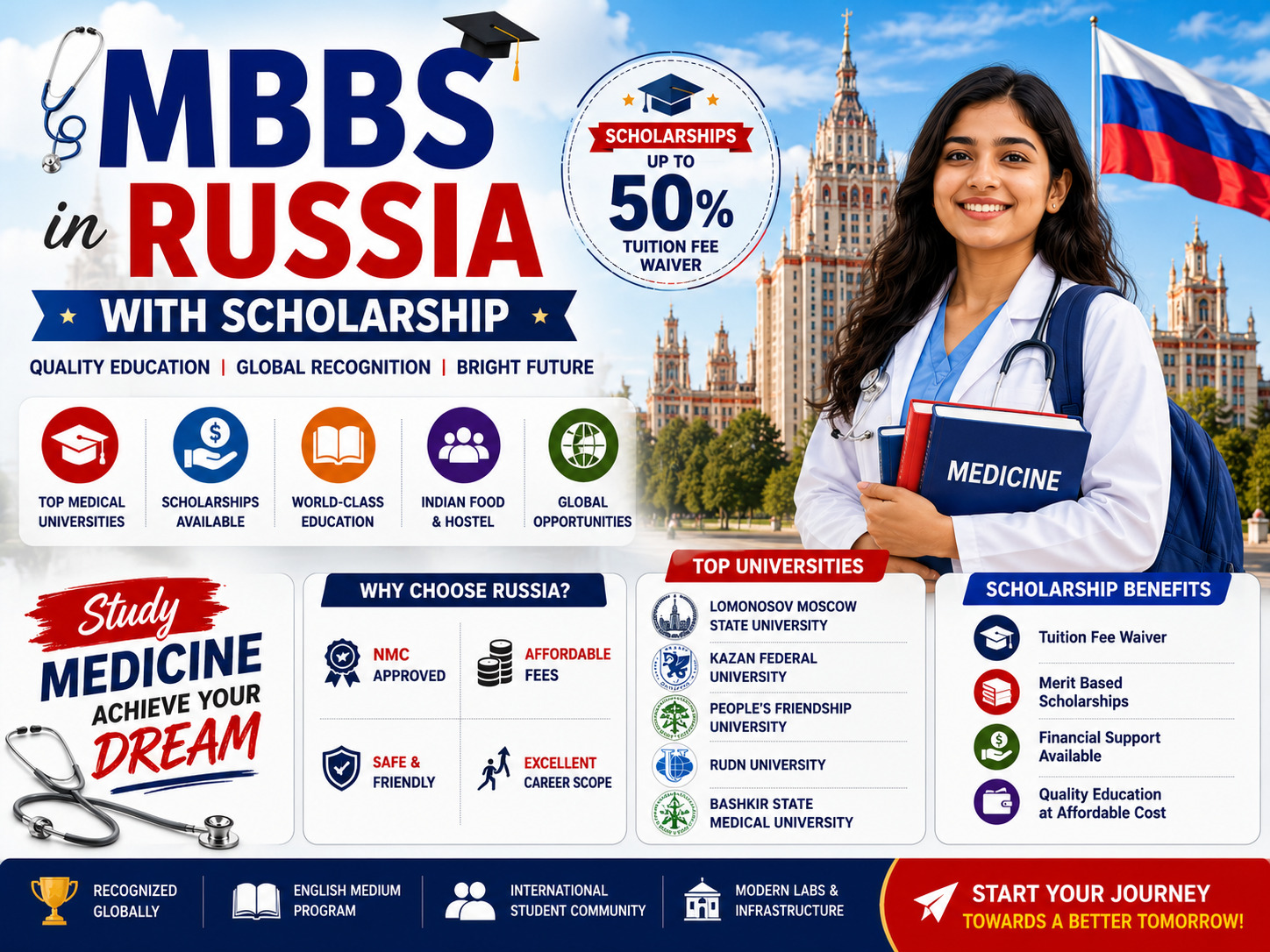
Table of Contents
MBBS in Russia with a Scholarship: Highlights 2026
Studying MBBS in Russia is already significantly more affordable than private medical colleges in India, but for genuinely high-achieving students, scholarship opportunities can reduce this cost even further in 2026. Several pathways exist — from the highly competitive Russian Government Scholarship to university-specific merit awards and private organisation funding.
The flagship opportunity remains the Russian Government Scholarship, which has 300 seats specifically reserved for Indian students for the 2026-27 session, out of over 15,000 total grants offered to foreign students across all programs. This scholarship can cover tuition fees, a monthly stipend, accommodation, and even a preparatory Russian language course if your specific program isn't fully English-medium.
Why Choose MBBS in Russia with a Scholarship?
Considering the scholarship route for your MBBS in Russia? Here's why it's worth pursuing in 2026.
1. Dramatically reduced financial burden
A full scholarship can effectively make your medical education "virtually free," covering tuition, accommodation, and even a monthly stipend — a genuinely transformative difference for many families.
2. Access to quality education without financial strain
Rather than choosing a university based purely on what you can afford, a scholarship allows you to select institutions based on genuine academic and career fit.
3. Psychological and motivational benefits
Beyond the financial relief, securing a scholarship enhances self-esteem and motivation, and successful scholars often gain access to additional opportunities like working with NGOs and international programs.
4. Same quality medical education as fee-paying students
Scholarship recipients study alongside regular fee-paying students in the same WHO/NMC-recognized programs — there's no difference in curriculum quality or degree recognition.
5. Reduced dependency on education loans
For families who might otherwise need to take on significant debt to fund an MBBS abroad, scholarships can substantially reduce or eliminate this financial pressure.
6. Strong recognition boost for merit-based awards
Being selected for a competitive scholarship, particularly the Russian Government Scholarship, adds a genuine credibility marker to your academic profile.
The bottom line: If you have strong academic credentials and are willing to navigate a competitive, sometimes lengthy application process, pursuing MBBS in Russia with a scholarship offers meaningful long-term financial relief in 2026 — though it shouldn't be your only plan, given genuine competitiveness.
Benefits of Studying MBBS in Russia with a Scholarship
Still weighing whether to pursue the scholarship route? Here's a clear breakdown of the concrete benefits for 2026.
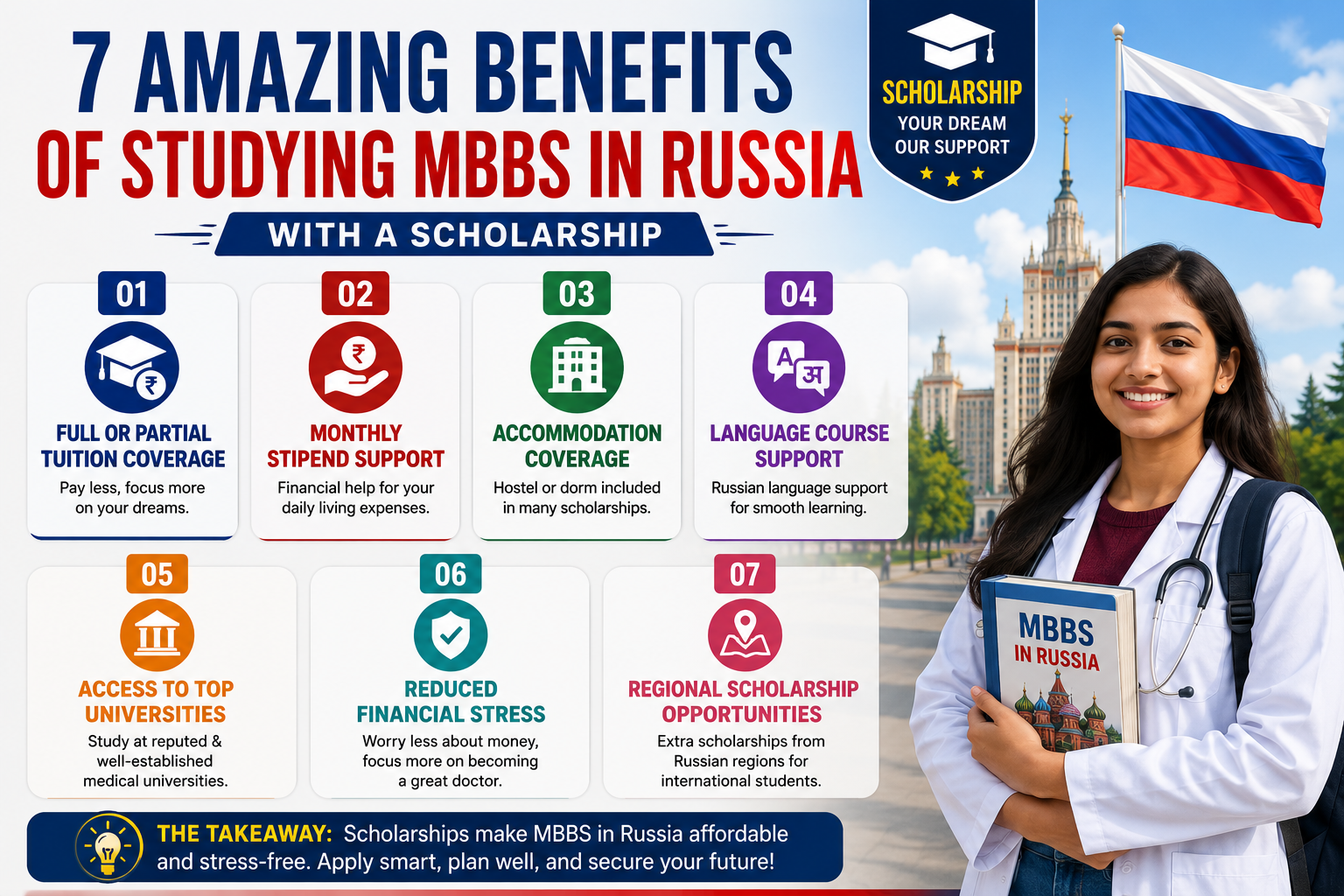
1. Full or partial tuition fee coverage
Depending on the specific scholarship, you could receive full tuition waivers for your entire program duration, or substantial partial coverage that meaningfully reduces your out-of-pocket costs.
2. Monthly stipend support
Many scholarships, particularly the Russian Government Scholarship, include a monthly stipend to help cover daily living expenses beyond just tuition.
3. Accommodation coverage
Scholarship packages frequently include hostel or dormitory accommodation, removing one of the higher recurring costs of studying abroad.
4. Language course support
If your specific program isn't fully English-medium, scholarship funding can include a preparatory Russian language course, easing your academic transition.
5. Access to prestigious, well-established universities
Scholarships aren't limited to lesser-known institutions — many well-regarded Russian medical universities participate in these funding programs, giving you access to strong education even on a scholarship.
6. Reduced financial stress throughout your program
With major costs covered upfront, you can focus more energy on academics and clinical training rather than managing tight family finances throughout your 5.5+ year program.
7. Regional scholarship variations
Beyond the national government scholarship, some regional Russian governments offer additional funding specifically to attract international students to their local universities, creating multiple funding avenues to explore.
The takeaway: Scholarship funding genuinely transforms the affordability equation for MBBS in Russia, though given competitiveness, it's wise to prepare both a scholarship application strategy and a realistic backup plan involving regular paid admission.
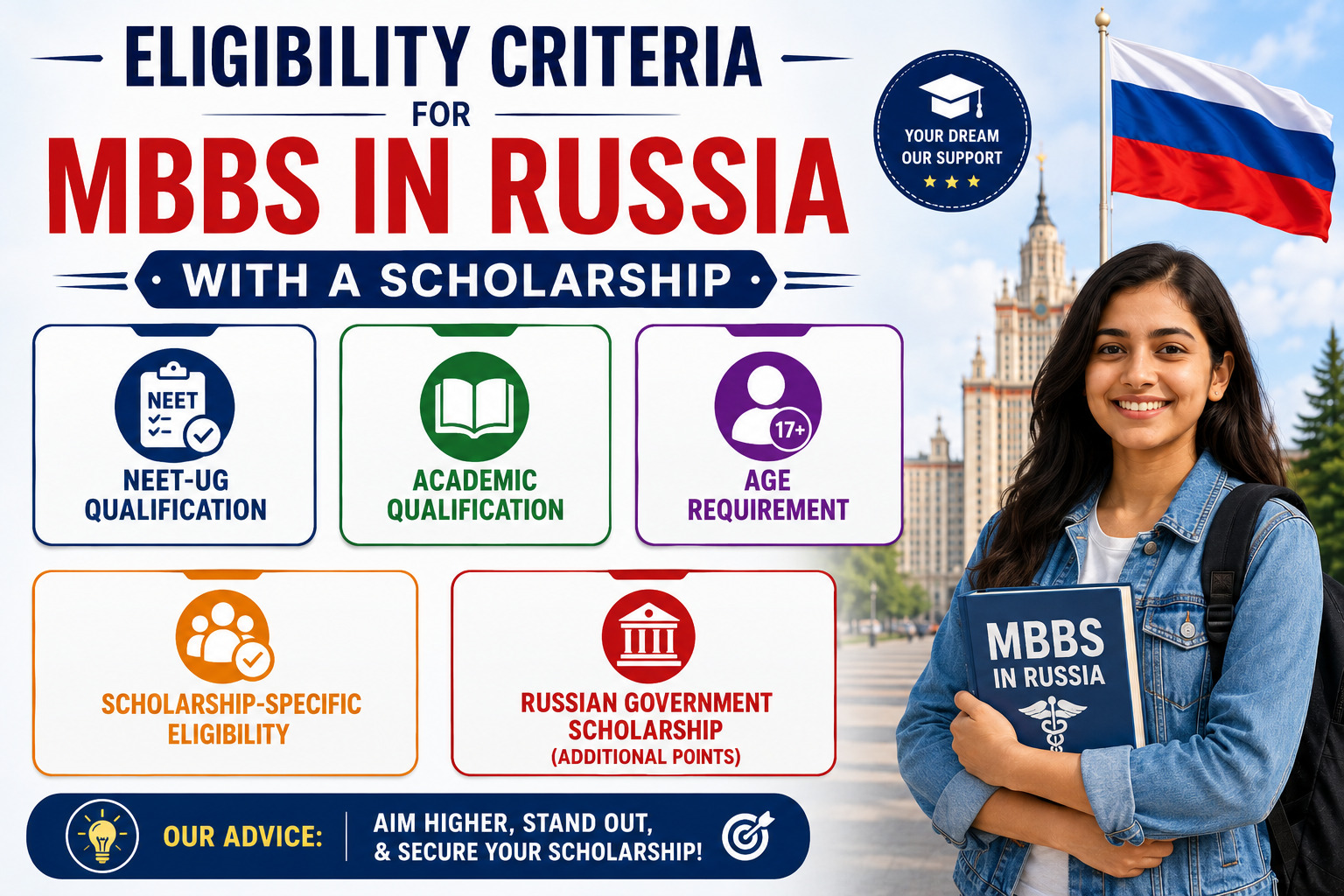
Before applying for MBBS scholarships in Russia, make sure you meet the following eligibility requirements for 2026.
NEET-UG qualification (mandatory for Indian recognition)
- Indian students generally need a minimum NEET score of around 137-140 marks for the General category and 107-110 marks for OBC/SC/ST categories
- This qualification remains essential regardless of scholarship status, since it determines your eventual ability to practice medicine in India
Academic qualification
- Completion of 12th grade with an aggregate of 50% marks in Physics, Chemistry, and Biology from a recognised board
- Strong academic performance significantly improves your competitiveness for merit-based scholarship selection specifically.
Age requirement
- Must be 17 years of age on or before December 31 of the admission year
Scholarship-specific eligibility
- Successful completion of secondary education, along with clearing the competitive selection process conducted specifically for your home country's applicant pool
- Students with strong school academic scores and NEET performance stand a meaningfully better chance of qualifying for merit-based scholarships.s
Additional considerations for the Russian Government Scholarship specifically
- Competition is genuinely intense, given only 300 seats are reserved for Indian students against a much larger applicant pool.
- Early application meaningfully improves your chances, since the number of invited seats under scholarship schemes remains limited each cycle.
Our advice: Since scholarship selection heavily weighs both your school academic record and NEET performance, aim to exceed minimum eligibility thresholds by a meaningful margin if you're specifically targeting scholarship consideration, rather than just meeting bare qualifying criteria.
Admission Process for MBBS in Russia with a Scholarship
Here's a step-by-step breakdown of how the scholarship application process actually works for 2026.
Step 1: Qualify NEET-UG first
Before pursuing any scholarship application, ensure you've cleared the NEET-UG qualifying cutoff, since this remains mandatory for future Indian medical recognition regardless of scholarship status.
Step 2: Register on the official government portal
For the Russian Government Scholarship specifically, applications are submitted exclusively through the official portal, education-in-russia.com — third-party or unofficial application routes should be avoided entirely.
Step 3: Complete the detailed application form
Register on the portal, fill out the comprehensive application form, and select up to six universities in order of preference, giving yourself multiple potential placement options within the scholarship scheme.
Step 4: Upload required documents
Submit all required documents as specified, including academic transcripts, NEET scorecard, passport details, and photographs.
Step 5: Understand the application timeline
The process typically begins in the latter half of the preceding year — generally around September to January — for the following academic year's intake, so early awareness and preparation are essential.
Step 6: Navigate the two-stage selection process
Government Scholarship selection typically involves a two-stage evaluation process, assessing your academic credentials and overall application strength.
Step 7: For university-specific scholarships, apply directly
If pursuing merit-based scholarships from individual universities rather than the government scheme, contact your shortlisted university's international admissions office directly to understand their specific application process and deadlines.
Step 8: Confirm scholarship terms in writing
Once selected, get complete written confirmation of exactly what your scholarship covers (tuition, stipend, accommodation, language course) and any conditions for maintaining it throughout your program.
Our advice: Given the September-January application window for the Russian Government Scholarship, start your preparation well in advance — ideally right after receiving your NEET results — since missing this narrow timeline means waiting an entire additional year for the next opportunity.
Documents Required for MBBS in Russia with a Scholarship
Having accurate, complete documentation ready is essential for both your university admission and scholarship application in 2026. Here's your checklist.
Academic documents
- 10th and 12th grade mark sheets and certificates (with Physics, Chemistry, Biology as core subjects)
- Valid NEET-UG scorecard showing your qualifying percentile/marks
- Migration certificate
Identity and travel documents
- Valid passport with sufficient validity for your entire program duration
- Passport-sized photographs meeting Russian visa and scholarship application specifications
Medical documents
- Medical fitness certificate confirming you're fit to pursue medical studies.s
Scholarship-specific documents (for Government Scholarship applicants)
- Completed application form submitted through the official education-in-russia.com portal
- Proof of successful secondary education completion
- Academic performance records demonstrating merit (particularly significant since scholarship selection weighs this heavily)
- University preference list (up to six institutions, ranked in order of preference)
Additional documentation some universities may request
- Notarised or apostilled copies of academic transcripts
- Additional certificates or supporting documents specific to individual university scholarship programs
Our advice: Since some universities may request notarised or apostilled document copies beyond the standard checklist, confirm exact documentation requirements directly with your target university or the official scholarship portal well in advance, ideally 3-4 months before application deadlines, to avoid processing delays for the 2026-27 cycle.
Top Scholarships for MBBS in Russia
Here's a breakdown of the primary scholarship pathways available to Indian students pursuing MBBS in Russia for 2026.
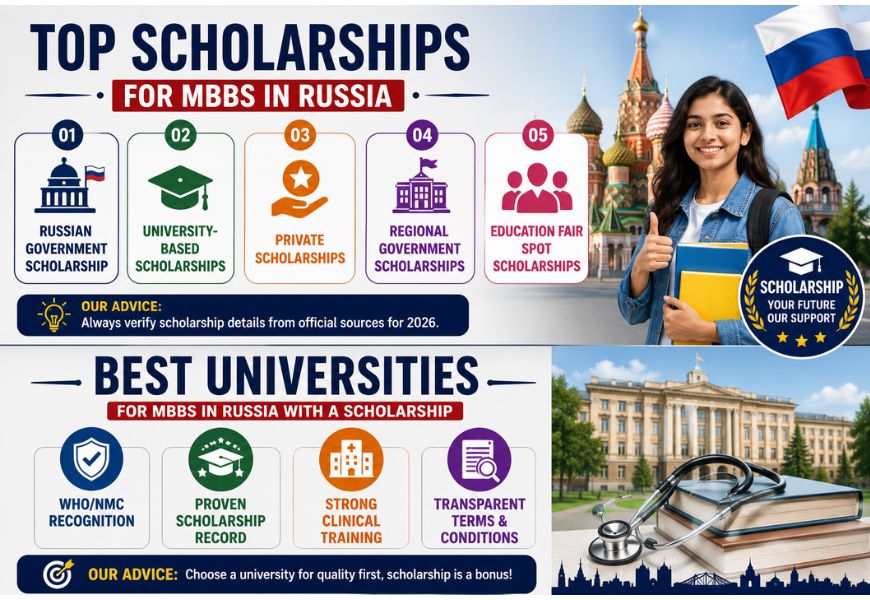
1. Russian Government Scholarship (Government Quota)
The most significant and sought-after funding opportunity, offering full tuition fee coverage for your entire medical program, plus a grant for the mandatory preparatory Russian language course if your program isn't English-medium. This scholarship has 300 seats specifically reserved for Indian students for the 2026-27 session, out of over 15,000 total grants available to foreign students across various programs and countries.
What it covers: Full tuition fee waiver, preparatory Russian language course, monthly stipend, and accommodation.
2. University-Based Scholarships
Selective Russian medical universities offer tuition fee waivers directly to individual students, typically based on strong academic performance during their studies or admission profile. Many well-known, globally recognised universities participate in these programs.
3. Private Scholarships
Various private organisations and entities within Russia offer scholarship opportunities to international students, providing either partial or fully covered funding depending on specific eligibility requirements.
4. Regional Government Scholarships
In certain parts of Russia, regional (rather than federal) governments offer additional financial incentives specifically to attract international students to their local universities — an often-overlooked funding avenue worth researching.
5. Education Fair Spot Scholarships
Recent Russian education fairs conducted in India have started offering scholarship-based admissions and spot scholarship opportunities during recruitment events, with reports suggesting hundreds of scholarship opportunities across fairs for the 2026-27 cycle.
Our advice: Since scholarship availability and terms genuinely change year to year, always verify current offerings directly through official university announcements, the government portal, or an authorised education consultant before finalising any application strategy for 2026.
Best Universities for MBBS in Russia with a Scholarship
Several well-established Russian medical universities actively participate in scholarship programs for international students. Here's what to know when evaluating your options for 2026.
What makes a university genuinely good for scholarship-seeking students
- Confirmed WHO/NMC recognition status (non-negotiable regardless of scholarship availability)
- A track record of actually awarding scholarships to Indian students in previous cycles, not just advertising theoretical availability
- Strong clinical training infrastructure, since a scholarship shouldn't come at the expense of education quality
- Transparent scholarship terms and conditions available directly from official sources
How to identify scholarship-participating universities
Since specific university names offering scholarships can change based on annual agreements and available funding, the most reliable approach is:
- Checking the official Russian Government Scholarship portal (education-in-russia.com) for the current list of participating universities for your target academic year
- Directly contacting your shortlisted universities' international admissions offices to confirm current scholarship availability.
- Verifying through authorised education consultants who maintain updated relationships with Russian universities
Universities generally known for hosting substantial international scholarship programs.
Many of Russia's established medical universities — those with decades of experience training international students and strong NMC/WHO recognition — tend to participate more consistently in both government and university-specific scholarship schemes, given their established international student support infrastructure.
Important verification step
Before committing based on scholarship promises, confirm the university's current NMC and WHO recognition status independently, since a scholarship offer doesn't automatically guarantee your degree's usability for Indian medical practice — recognition and scholarship are two separate things you must verify independently.
Our advice: Don't select a university purely because it offers a scholarship — first confirm it meets all your core recognition and quality requirements, then treat scholarship availability as a valuable bonus rather than your primary selection criterion for 2026.
MBBS in Russia with a Scholarship: Fees Comparison
Understanding the financial difference between scholarship and regular admission helps you plan realistically for 2026. Here's a comparison.
Regular (non-scholarship) MBBS fees in Russia
Total program fees for regular, fee-paying admission typically range from approximately ₹15 Lakhs to ₹45 Lakhs for the complete 6-year program, depending on the specific university and city.
With full Russian Government Scholarship
If you secure the full Government Scholarship, your tuition fees are entirely waived, potentially reducing your total out-of-pocket cost to primarily living expenses only — a dramatic reduction from the standard ₹15-45 Lakh range.
With partial university-based scholarships
Merit-based tuition waivers from individual universities can reduce your fees by varying percentages depending on your specific academic performance and the university's specific scholarship terms — savings can range from modest partial reductions to substantial waivers.
With private/regional scholarships
These vary significantly in coverage, from small partial contributions to more substantial funding, depending on the specific organisation or regional program.
Realistic cost comparison scenario
- No scholarship: ₹15-45 Lakhs total program cost
- Partial scholarship (university-based): Potentially ₹8-25 Lakhs, depending on waiver percentage
- Full Government Scholarship: Primarily living expenses only, since tuition is fully covered
Important honest caveat
Given how limited and competitive these scholarships remain (300 seats for Indian students against a much larger applicant pool), most Indian students should realistically plan and budget for regular, fee-paying admission, while simultaneously applying for scholarships as a genuine but uncertain opportunity to reduce costs.
Our advice: Build your financial plan around standard fee-paying admission as your baseline, and treat any scholarship you secure as a bonus that reduces this baseline — this approach prevents financial planning gaps if scholarship applications don't succeed for the 2026-27 cycle.
Cost of Living for Indian Students in Russia
Beyond tuition and scholarships, here's what you can realistically expect to spend on living expenses while studying MBBS in Russia in 2026.
Monthly living expense range
Living costs for Indian students in Russia typically range from $150 to $250 per month (roughly ₹12,000-21,000), covering food, local transportation, and basic personal expenses.
With scholarship stipend support
If you've secured a scholarship that includes a monthly stipend, this can meaningfully offset or even fully cover your daily living expenses, depending on the specific stipend amount and your personal spending habits.
City-based cost differences
- Moscow and St. Petersburg: Higher living costs, given these are Russia's most expensive cities
- Regional university towns: Generally more budget-friendly, often falling toward the lower end of the range
Accommodation costs (without scholarship coverage)
If your scholarship doesn't include accommodation, most universities offer dormitory-style hostel accommodation at modest additional annual costs, providing a safe, structured living environment.
What scholarship students should still budget for
Even with a comprehensive scholarship covering tuition, stipend, and accommodation, students should still plan for:
- Winter clothing and seasonal essentials, given Russia's cold climate
- Personal expenses beyond the stipend amount
- Travel costs for periodic trips home
- Health insurance, if not separately covered by your specific scholarship terms
Important financial planning note
Even affordable MBBS in Russia comes with real total expenses (tuition, hostel, and living combined) that can add up meaningfully over your 6-year program — which is exactly why scholarship support, even partial, makes such a genuine difference to overall affordability.
Our advice: Whether or not you secure a scholarship, carry some funds or a forex card in USD (easily exchanged for Russian Rubles) for unexpected expenses, and confirm your first-year tuition fee arrangements well before departure to avoid last-minute financial stress during your initial transition to Russia.
How to Apply for an MBBS Scholarship in Russia
Here's a practical, step-by-step roadmap for applying to MBBS scholarships in Russia for 2026.
Step 1: Qualify NEET-UG with strong marks
Since scholarship selection weighs academic merit heavily, aim to score comfortably above the minimum qualifying threshold (137-140 for the General category, 107-110 for OBC/SC/ST), as stronger scores meaningfully improve your competitiveness.
Step 2: Register on the official government portal
For the Russian Government Scholarship, applications go exclusively through education-in-russia.com. Avoid any third-party or unofficial application routes claiming to offer shortcuts into this scheme.
Step 3: Complete your application during the correct window
The application process typically opens in the latter half of the preceding year, generally September to January, for the following academic year's intake — mark this window carefully, since missing it means waiting a full additional year.
Step 4: Select up to six universities in order of preference
The portal allows you to rank up to six universities, giving you multiple potential placement options within the scholarship scheme rather than betting everything on a single institution.
Step 5: Upload all required documents accurately
Submit academic transcripts, NEET scorecard, passport details, and photographs exactly as specified, since incomplete or inconsistent documentation can disqualify an otherwise strong application.
Step 6: Navigate the two-stage selection process
Government Scholarship selection typically involves an initial screening stage followed by a more detailed evaluation, assessing your overall academic credentials and application strength.
Step 7: For university-specific scholarships, apply directly
If you're pursuing merit-based scholarships from individual universities rather than the government scheme, contact your shortlisted university's international admissions office directly to understand their specific process, deadlines, and required materials.
Step 8: Apply early — this genuinely matters
Since the number of invited seats under scholarship schemes is limited, applying as early as possible within the window meaningfully increases your chances of selection.
Step 9: Get scholarship terms confirmed in writing
Once selected, obtain complete written confirmation of exactly what's covered (tuition, stipend, accommodation, language course) and any conditions required to maintain the scholarship throughout your program.
Our advice: Treat your scholarship application and your regular admission application as parallel tracks — don't delay standard university applications while waiting for scholarship results, since this protects your admission timeline even if the scholarship doesn't come through.
MBBS Course Duration and Curriculum in Russia
Understanding exactly what you'll study — and for how long — helps set realistic expectations, whether you're on scholarship or regular admission in 2026.
Program duration
MBBS in Russia is structured as a 6-year program, comprising 5 years of classroom and clinical studies plus a mandatory 1-year internship, meeting the NMC's minimum requirement of 54 months of academic study plus 12 months of internship.
Language of instruction
Programs are primarily taught in English, and notably, Russian medical universities generally don't require a separate English proficiency test for admission, since programs are specifically designed for international students. Scholarship recipients whose program requires some Russian language proficiency may receive a preparatory language course as part of their scholarship package.
Core subjects covered
The curriculum aligns closely with Indian MBBS standards, covering:
- Anatomy, Physiology, Biochemistry
- Pathology, Pharmacology, Microbiology
- Community Medicine
- Internal Medicine, Surgery
- Pediatrics, Obstetrics and Gynecology
- Psychiatry, Dermatology, ENT, Ophthalmology
Typical structure breakdown
- Years 1-2: Pre-clinical foundational subjects
- Years 3-4: Para-clinical and clinical subjects
- Year 5: Advanced clinical rotations across specialities
- Year 6 (Internship): Mandatory 12-month supervised internship, completed within the same university/country
Scholarship students follow the identical curriculum
It's worth emphasising: scholarship recipients study the same coursework, clinical rotations, and internship requirements as fee-paying students — there's no difference in academic rigour or degree value based on funding source.
Our advice: Regardless of scholarship status, request your specific university's detailed year-wise curriculum breakdown in writing before enrolling, ensuring the program structure genuinely meets NMC's duration and content requirements.
NMC Guidelines, FMGE & NExT for MBBS in Russia
This regulatory framework applies equally to scholarship and fee-paying students — understanding it thoroughly is essential before committing to MBBS in Russia in 2026.
University recognition requirement
Your university must be listed in the World Directory of Medical Schools (WDOMS), recognised by the WHO, and hold current NMC approval status — this applies regardless of whether you're attending on scholarship or as a fee-paying student.
FMGE: the current licensing exam
After completing your MBBS in Russia, you must clear the Foreign Medical Graduate Examination (FMGE) to register with the NMC and legally practice medicine in India.
The shift to NExT
From 2027 onwards, the National Exit Test (NExT) will replace FMGE as the licensing exam for foreign medical graduates.
NEET remains mandatory regardless of scholarship status
Even if you secure a full scholarship covering your entire tuition, qualifying NEET-UG remains absolutely mandatory for your degree to be recognised for practising medicine in India — a scholarship doesn't exempt you from this requirement in any way.
2026 clarification on online coursework
Students who joined Russian universities between 2020-2022 and completed some coursework online during pandemic disruptions may need additional "compensation training" — mandatory in-person training to fully count that period toward their required duration. This applies to scholarship and fee-paying students alike.
No mid-program transfers
Switching universities partway through your program isn't permitted under current NMC regulations, regardless of funding source.
Scholarship-specific compliance note
Since scholarship placements are sometimes assigned to specific universities based on availability rather than your top preference, double-check that whichever university you're ultimately placed with still meets all NMC recognition and duration requirements — don't assume this automatically, even within an official government scholarship scheme.
Our advice: Treat your NEET qualification as equally critical whether you're pursuing scholarship or regular admission — this single requirement, not your funding source, determines your long-term ability to practice medicine in India.
Emerging Scholarship Opportunities for 2026
Beyond the established Russian Government Scholarship, several emerging and evolving funding avenues are worth watching for 2026.
Expanded education fair scholarship offerings
Russian education fairs conducted across Indian cities have recently started offering scholarship-based admissions and spot scholarship opportunities during recruitment events, with reports suggesting hundreds of scholarship opportunities being made available across these fairs for the 2026-27 academic cycle — a genuinely newer, more accessible pathway worth exploring.
Growing regional government initiatives
Certain Russian regional governments have been expanding their own financial aid programs specifically to attract international talent, supplementing the national government scholarship scheme with additional, sometimes lesser-known funding opportunities.
Increased institutional financial aid focus
In 2026, the Russian government and various institutions have been actively expanding their financial aid programs to welcome international talent, suggesting a broader institutional push toward making Russian medical education more accessible to strong international candidates.
Instalment-based fee structures
While not a scholarship in the traditional sense, some universities are increasingly offering instalment-based fee payment options, which — combined with partial scholarships — can meaningfully ease the financial burden even without securing full funding.
What this means for prospective students
The scholarship landscape for MBBS in Russia appears to be gradually expanding rather than shrinking, with education fairs and regional programs creating additional entry points beyond just the traditional government scholarship application.
Important caution
Since these emerging opportunities are relatively new and less standardised than the established Government Scholarship, verify any spot scholarship or education fair offer extremely carefully — confirm it's officially backed by the university or government, not just a marketing incentive from a private recruiting agency.
Our advice: Attend Russian education fairs in your city if genuinely accessible, but always cross-verify any scholarship offer made on the spot with the university's official international admissions office before making any financial commitment, since verbal promises at recruitment events aren't always binding.
Career Opportunities After MBBS in Russia
Whether you studied on scholarship or as a fee-paying student, your career path after MBBS in Russia looks identical in 2026 — funding source has no bearing on your professional opportunities.
Practising medicine in India
After clearing FMGE/NExT and registering with the NMC, graduates can:
- Work as General Practitioners in private clinics or hospitals
- Join government hospitals through relevant recruitment processes
- Pursue postgraduate (PG) specialisation through NEET-PG
- Work in public health, community medicine, or preventive healthcare roles
Practising in Russia or internationally
Depending on additional local licensing requirements, some graduates pursue certification to practice in Russia itself or explore international opportunities through further exams like USMLE (USA) or PLAB (UK).
Further specialization
Many graduates pursue MD/MS specialisation either in India (via NEET-PG) or internationally, building on their strong theoretical foundation from Russian medical education.
A note for scholarship recipients specifically
Some government scholarship programs may include informal expectations or soft encouragement around contributing back to bilateral educational relationships, though this typically doesn't restrict your actual practice location or career choices after graduation — verify any specific post-graduation conditions attached to your particular scholarship in writing.
Realistic career timeline
- Years 1-6: MBBS program in Russia (academic study plus internship)
- Post-graduation: FMGE/NExT preparation and clearance (typically 6-12 months)
- NMC registration: Final step enabling legal practice in India
The bigger picture
Since your career outcome depends entirely on successfully clearing FMGE/NExT and NMC registration rather than your funding source, scholarship and fee-paying graduates from equally recognised universities enjoy identical career prospects and salary trajectories once practising in India.
Our advice: Whether or not you secured a scholarship, focus your preparation energy equally on academic excellence throughout your program and early FMGE/NExT preparation — these factors, not your funding source, determine your ultimate career success in 2026 and beyond.
Salary After Completing MBBS in Russia
Here's a realistic look at salary expectations after completing MBBS from Russia — whether on scholarship or as a fee-paying student — and successfully practising in India for 2026.
Starting salary in India (after NMC registration)
Fresh graduates from Russian medical universities, once registered with the NMC, typically start with salaries comparable to any MBBS graduate — generally in the range of ₹4-8 LPA in private hospitals or clinics.
Government sector salaries
Doctors joining government hospitals through relevant recruitment processes generally receive salaries as per government pay scales, often in the range of ₹6-10 LPA, along with strong long-term benefits and job security.
Salary by practice setting
- Private clinics/hospitals (entry-level): ₹4-8 LPA
- Government hospitals: ₹6-10 LPA (as per pay scale)
- Corporate hospital chains: ₹6-12 LPA, often with performance incentives
Post-specialization earning potential
After pursuing MD/MS specialisation via NEET-PG, earning potential rises significantly, with specialists often earning ₹10-25 LPA depending on specialisation, location, and years of experience.
Does scholarship status affect your salary?
No — your salary trajectory depends entirely on clearing FMGE/NExT, choosing your practice setting, and building your career over time, not on whether you funded your education through scholarship or paid fees.
The real financial advantage of scholarships
While scholarships don't boost your future salary, they meaningfully improve your overall financial outcome by reducing or eliminating upfront debt — meaning scholarship graduates often reach genuine financial independence faster since they aren't repaying education loans alongside building their careers.
Our advice: Focus your financial planning on the combination of reduced upfront costs (via scholarship, if secured) and standard Indian doctor salary trajectories — the real long-term financial win from a scholarship isn't a higher salary, but significantly less debt to pay off during your early career years.
Advantages and Disadvantages of Studying MBBS in Russia with a Scholarship
Making an informed decision requires an honest look at both sides. Here's a balanced breakdown for 2026.
Advantages
1. Dramatically reduced or eliminated tuition costs
A full scholarship can reduce your total program cost from ₹15-45 Lakhs down to primarily living expenses only — a genuinely transformative financial difference.
2. Monthly stipend and accommodation support
Many scholarships include living cost coverage, reducing financial pressure throughout your entire program duration.
3. Access to the same quality education as fee-paying students
Scholarship recipients study identical coursework, clinical training, and internship requirements — no compromise on education quality.
4. Reduced reliance on education loans
Families avoid taking on significant debt, allowing graduates to start their careers with greater financial freedom.
5. Enhanced credibility and motivation
Securing a competitive scholarship adds genuine credibility to your academic profile and can boost confidence throughout your program.
Disadvantages
1. Genuinely limited and highly competitive
With only 300 seats reserved for Indian students against a much larger applicant pool, most students won't secure this specific scholarship, requiring realistic backup planning.
2. Less control over university selection
Government scholarship placements are sometimes assigned based on availability across your six preferences rather than guaranteeing your top choice, meaning you might not end up at your most preferred university.
3. Application timeline pressure
The narrow September-January application window means missing this period costs you a full additional year before the next opportunity.
4. Verification burden remains on you
Scholarship or not, you must still independently verify your assigned university's NMC/WHO recognition status — a scholarship doesn't automatically guarantee this.
5. Potential informal expectations
Some scholarship programs may carry soft expectations around bilateral relations or program completion, which, while not typically restricting career choices, are worth clarifying in writing beforehand.
6. NEET requirement remains unchanged
A scholarship provides zero exemption from qualifying NEET-UG — this remains just as mandatory as it would be for a fee-paying student.
Our advice: Pursue scholarship applications enthusiastically given the genuine financial upside, but build your primary plan around standard fee-paying admission — treating any scholarship as a valuable bonus rather than your only pathway protects you from missing your target admission cycle entirely.
How to Increase Your Chances of Getting an MBBS Scholarship in Russia
Want to genuinely improve your odds rather than just hoping for the best? Here's practical, actionable advice for 2026 applicants.
1. Score well above minimum NEET thresholds
Students who have achieved good scores in school and NEET stand a meaningfully better chance of qualifying for merit-based scholarships — don't just aim for the qualifying cutoff; aim to exceed it significantly.
2. Apply as early as possible within the window
Since the number of invited seats under scholarship schemes is limited, applying early in the September-January window genuinely improves your chances compared to last-minute applications.
3. Maintain strong overall academic records, not just NEET
Scholarship selection weighs your complete academic profile, including consistent performance across your 10th and 12th grade records, not NEET scores in isolation.
4. Apply through official channels only
Submit your Government Scholarship application exclusively through education-in-russia.com — avoid unofficial intermediaries claiming to offer guaranteed placement or shortcuts.
5. Select your six university preferences strategically
Rather than only listing the most competitive, well-known universities, include a realistic mix of options to genuinely maximise your chances of being matched with at least one institution.
6. Ensure complete, error-free documentation
Incomplete or inconsistent documents are a common reason for otherwise qualified applications to be rejected — double-check every document against official requirements before submission.
7. Explore multiple scholarship types simultaneously
Don't rely solely on the Government Scholarship — simultaneously research university-specific merit scholarships, private organisation funding, and regional government programs to diversify your chances.
8. Attend Russian education fairs when accessible
These events increasingly offer spot scholarship opportunities and direct access to university representatives who can clarify current funding availability.
9. Verify and follow up diligently
Given the volume of international applicants, proactively follow up on your application status through official channels rather than passively waiting for updates.
Our advice: Treat your scholarship application with the same seriousness and preparation as your NEET exam itself — strong, consistent academic performance combined with early, accurate applications genuinely maximises your realistic chances for the 2026-27 cycle.
Why Choose Your Global Mentors?
Navigating MBBS scholarship applications in Russia — with competitive government schemes, varying university-specific offers, and critical NMC compliance requirements — involves genuinely high stakes. That's where Your Global Mentors makes the difference.
1. Honest, compliance-focused guidance
We prioritise your long-term career outcome, ensuring you understand that NEET qualification and NMC recognition remain non-negotiable regardless of scholarship status.
2. Verified scholarship and university shortlisting
We help you identify genuine, currently active scholarship opportunities and WHO/NMC-recognized universities, rather than relying on unverified marketing claims or outdated information.
3. End-to-end application support
From government portal registration to document preparation and university-specific scholarship applications, we handle every step of your process with precision.
4. Transparent guidance on realistic expectations
We help you build both a scholarship application strategy and a solid backup plan for regular fee-paying admission, ensuring you're never left without options.
5. Direct verification of scholarship terms
We help you get scholarship coverage details confirmed in writing directly from official sources, protecting you from unclear or informal promises.
6. NEET and FMGE/NExT preparation guidance
Beyond just admissions and scholarships, we connect you with resources to prepare effectively for both NEET qualification and your eventual licensing exam.
7. Proven track record
With years of experience guiding students through successful, compliant MBBS admissions and scholarship applications in Russia, we bring honest, practical advice to every step of your journey.
The bottom line: MBBS in Russia with a scholarship is a genuinely valuable opportunity worth pursuing — partnering with Your Global Mentors ensures your application strategy is realistic, compliant, and maximises your actual chances of success in 2026.
Frequently Asked Questions (FAQs)
1. Can I study MBBS in Russia completely for free?
Yes, potentially — if you secure the full Russian Government Scholarship, which covers tuition, accommodation, and a monthly stipend, though this scholarship is highly competitive, with only 300 seats reserved for Indian students.
2. Do I still need NEET if I get a scholarship?
Yes, absolutely. NEET-UG qualification remains mandatory for Indian students regardless of scholarship status, since it determines whether your degree will be recognised for practising medicine in India.
3. How many seats are reserved for Indian students under the Russian Government Scholarship?
300 seats are reserved for Indian students for the 2026-27 session, out of over 15,000 total grants available to foreign students across all programs and countries.
4. When should I apply for the Russian Government Scholarship?
The application window typically opens in the latter half of the preceding year, generally September to January, for the following academic year's intake.
5. Does a scholarship affect my degree's recognition or quality?
No, scholarship recipients study the identical curriculum, clinical training, and internship requirements as fee-paying students — there's no difference in academic quality or degree value.
6. What if I don't get a scholarship — is regular admission still worth it?
Yes, definitely. Russia's regular MBBS fees (₹15-45 Lakhs total) remain significantly more affordable than most private medical colleges in India, making it a solid option even without scholarship support.
7. Can I apply for multiple scholarship types simultaneously?
Yes, and you should — combining Government Scholarship applications with university-specific merit scholarships and private funding options maximises your overall chances of securing some form of financial support.
Conclusion
Pursuing MBBS in Russia with a scholarship offers Indian students a genuinely compelling pathway to affordable, quality medical education in 2026 — potentially reducing total costs from ₹15-45 Lakhs down to primarily living expenses for those who secure full government funding. With 300 dedicated seats for Indian students, university-specific merit awards, and emerging opportunities through education fairs and regional programs, the scholarship landscape offers multiple avenues worth exploring