

MBBS in Nepal 2026: Admission, Fees, Eligibility, Top Medical Colleges & Career Scope
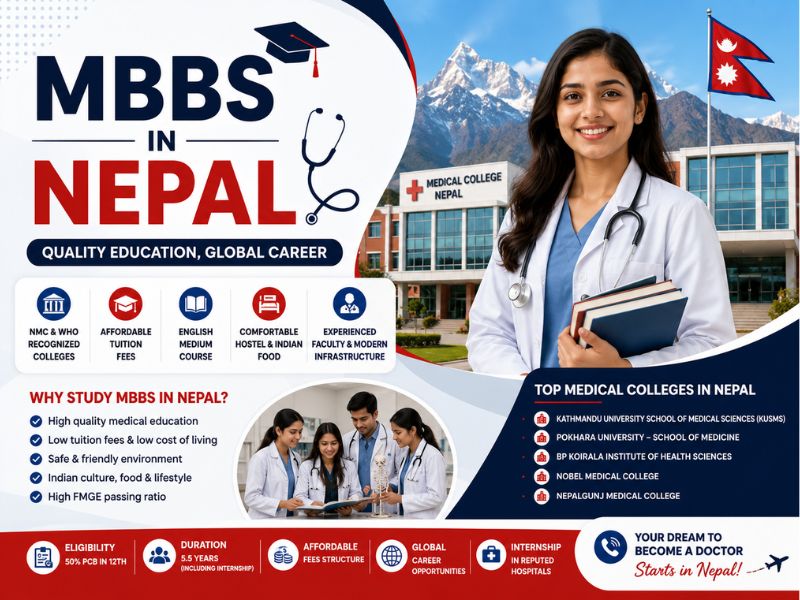
Table of Contents
MBBS in Nepal: Highlights 2026
Nepal holds a genuinely unique position among MBBS-abroad destinations for Indian students in 2026 — it's the only country you can enter without a visa, study in English inside a curriculum modelled closely on India's own system, and return from with some of the strongest FMGE outcomes of any foreign medical education route.
As of 2026, there are approximately 15 NMC-approved medical colleges in Nepal, including both government and private institutions. These colleges are affiliated with leading institutions such as Kathmandu University and Tribhuvan University and are approved by both India's National Medical Commission and Nepal's Medical Council.
Why Choose MBBS in Nepal?
Considering Nepal for your MBBS journey? Here's why it stands apart from other MBBS abroad destinations in 2026.
1. No visa required
Nepal is genuinely unique among MBBS abroad destinations — it's the only country Indian students can enter without a visa, given its open border and long-standing bilateral travel arrangement with India.
2. Language and cultural familiarity
Nepali and Hindi are intelligible to each other to a large extent, so Indian students can easily communicate with locals and acclimatise themselves — a genuinely underrated advantage that reduces the typical culture shock of studying abroad.
3. Curriculum closely mirrors India's own
Many medical colleges in Nepal follow an Indian-style curriculum and employ experienced faculty, directly supporting students preparing for licensing exams back home. Many faculty members currently teaching in Nepal's medical universities are Indian themselves, easing classroom understanding significantly.
4. Strong FMGE track record
Nepal is known for producing some of the best FMGE outcomes among foreign medical education routes, reflecting genuinely strong curriculum alignment and clinical training quality.
5. Simplified admission procedures
Nepal offers a student-friendly academic environment with simplified admission procedures, making it particularly appealing for Indian students compared to more bureaucratically complex destinations.
6. Genuine cost advantage over private Indian colleges
The overall expense of MBBS in Nepal is much cheaper compared to private medical colleges in India, with students receiving quality education at a fraction of the price.
The bottom line: If proximity, cultural ease, and a strong licensing exam track record matter to you, Nepal offers a genuinely practical MBBS abroad pathway in 2026 — without visa hassles or drastic cultural adjustment.
Benefits of Studying MBBS in Nepal
Still weighing your options? Here's a clear breakdown of the key benefits Nepal offers.
1. Minimal travel and adjustment barriers
The cultural similarity, familiar food habits, and minimal travel barriers significantly reduce the adjustment challenges typically associated with studying abroad.
2. Strong recognition pathway
Nepal's colleges hold recognition from Nepal's Medical Education Commission, India's NMC (subject to compliance), the WHO, and the World Directory of Medical Schools (WDOMS) — a genuinely comprehensive recognition stack when you choose the right college.
3. Realistic clinical training relevance
Students gain real patient exposure with disease patterns similar to India, which directly helps build practical skills and prepares them for exams like FMGE/NExT.
4. No language-based classroom barrier
Unlike some other MBBS abroad destinations requiring separate language training, Nepal's English-medium instruction combined with Hindi-Nepali mutual intelligibility removes both academic and daily-life language obstacles simultaneously.
5. Established Indian student pathway
Given decades of Indian students choosing Nepal, there's a well-understood, predictable admission and academic experience, backed by substantial historical FMGE outcome data to inform your college choice.
6. Geographic convenience for family connection
The open border and short travel distance mean significantly easier, more affordable trips home during breaks compared to more distant MBBS abroad destinations.
7. Modern infrastructure at several institutions
Nepal provides a comfortable learning environment with modern infrastructure and a curriculum similar to India, making it a reliable destination for medical education abroad.
The takeaway: Nepal's combination of proximity, cultural ease, and genuinely strong FMGE outcomes makes it a practical, lower-friction MBBS abroad choice — provided you choose an NMC-recognized institution and enter with NEET qualification secured.
Eligibility Criteria for MBBS in Nepal 2026
Here's what you need to be eligible for MBBS admission in Nepal in 2026.
Academic qualification
Should have passed 10+2 with Physics, Chemistry, and Biology (PCB)
Should have obtained a minimum of 50% aggregate marks in PCB (40% for SC/ST/OBC categories) for
Age requirement
Should be 17 years or older as of 31st December of the admission year.
NEET-UG qualification
Should have passed NEET-UG — while some admission routes may technically focus on local Nepalese entrance exams, for Indian students who want to practice in India later, NEET qualification is considered essential under National Medical Commission regulations.
NEET is not required for admission to Nepalese colleges themselves, but it is non-negotiable for Indian students who intend to practice medicine in India — without a valid NEET qualifying score, you cannot sit for the FMGE, making the degree unusable in India.
Entrance exam for government quota seats
MECEE-BL (Medical Education Common Entrance Examination – Bachelor Level) is Nepal's national medical entrance exam, mandatory for admission to government quota seats at public medical colleges like BPKIHS and Tribhuvan University Teaching Hospital.
University compliance requirements
The university must be verifiable on the WHO AVICENNA Directory and confirmed as currently NMC-recognized before you commit.it
Our advice: Since NEET remains essential despite not being required by Nepalese colleges themselves, qualify NEET-UG before finalising any university commitment — this single requirement determines whether your Nepal MBBS degree translates into a usable medical career in India.
Admission Process for MBBS in Nepal
Here's a step-by-step breakdown of what the admission process looks like for 2026.
Step 1: Qualify NEET-UG first
Before researching universities, appear for and clear the NEET-UG qualifying cutoff, since this remains mandatory for future Indian medical registration regardless of Nepal's own admission requirements.
Step 2: Choose between government and private college pathways
Government/deemed university route (e.g., BPKIHS, Tribhuvan University): Requires clearing MECEE-BL, Nepal's national medical entrance exam
Private college route (e.g., Kathmandu Medical College, Manipal College of Medical Sciences Pokhara, Chitwan Medical College, Gandaki Medical College, Nobel Medical College): Typically follows a more merit-based admission process
Step 3: Verify NMC recognition and WHO listing
Before applying, confirm your shortlisted college's current status on the WHO AVICENNA Directory and cross-check NMC recognition through official Indian government sources.
Step 4: Apply to your chosen university
Submit your application along with academic transcripts, NEET scorecard, passport copy, and photographs — most universities have straightforward, streamlined application processes for Indian students.
Step 5: Receive your offer/admission letter
Once accepted, the university issues an official offer letter confirming your admission, program details, and fee structure.
Step 6: Complete travel formalities (no visa required)
Given the open border arrangement, Indian students can travel to Nepal without a visa — though you'll still need to complete standard university enrollment and local registration formalities upon arrival.
Step 7: Complete on-arrival enrollment and orientation
Complete local registration, medical fitness verification, and any orientation programs before beginning coursework.
Step 8: Track your internship placement
Ensure your mandatory 12-month internship is arranged within the same institution, since NMC requires the internship to be completed at the same university where you studied.
Our advice: Since seat availability and specific college options can shift year to year, confirm the college's recent FMGE track record before deciding, alongside your budget and seat availability for that given year
Entrance Exams Required for MBBS in Nepal
NEET-UG (India) — Mandatory for every Indian student, regardless of college or admission route. A qualifying NEET-UG score is required for the degree to be recognised in India, with no way around this requirement.
MECEE-BL (Nepal) — Required specifically for government quota colleges like BPKIHS and Tribhuvan University Teaching Hospital,l with a minimum 50% score expected
Direct/Foreign Quota Route — At NMC-approved private colleges, NEET qualification alone may be sufficient for admission without needing a separate Nepal entrance test.
NEET validity — Valid for 3 years for MBBS admission purposes in Nepal
No separate English proficiency test (IELTS/TOEFL) required for Indian applicants
Choice of exam route affects seat type — government quota (MECEE-BL) is more competitive but cheaper than private/direct quota
Full exam-wise eligibility comparison: <a href="YOUR-URL-HERE" target="_blank">complete guide to MBBS in Nepal 2026</a>
Documents Required for MBBS Admission in Nepal
NEET-UG scorecard — Mandatory proof of eligibility for Indian applicants
Class 10 & 12 mark sheets and certificates — Original + attested copies
Passport — Valid for at least 12-18 months from admission date
Passport-size photographs — Multiple copies as per college requirement
Migration certificate and transfer certificate (TC) from previous school/board
Medical fitness certificate — Confirming fitness to pursue medical studies
NEET admit card — Sometimes required alongside the scorecard
Affidavits/undertakings — As required by specific universities or the Nepal Medical Education Commission
Documents typically need notarization/attestation before submission to Nepali universities
Full document checklist and submission process: <a href="YOUR-URL-HERE" target="_blank">MBBS in Nepal admission guide 2026</a>
Top Medical Colleges for MBBS in Nepal
BPKIHS (Dharan) — Government/deemed university; among the most reputed institutes in Nepal, recognised as a top government/deemed-university institution,ution
IOM – Tribhuvan University (Kathmandu) — A leading government institute affiliated with Tribhuvan University
PAHS (Lalitpur) — Recognised government/deemed medical institution
KUSMS – Kathmandu University School of Medical Sciences (Dhulikhel) — Affiliated with Kathmandu University, popular among Indian students
Colleges are approved by both the National Medical Commission (NMC) and the Nepal Medical Council, ensuring recognised degree status.
Government colleges have limited, highly competitive seats; private colleges offer more seats via direct/foreign quota.
Full college-wise fee and ranking comparison: <a href="YOUR-URL-HERE" target="_blank">top medical colleges in Nepal directory</a>
MBBS in Nepal Fees 2026
Overall fee range: ₹45 lakh to ₹65 lakh for most private colleges, with total costs (including living expenses) reaching ₹50 lakh to ₹75 lakh.
Government/deemed colleges (BPKIHS, IOM-TU) — Lower fees but highly competitive, limited seats
Private colleges — Higher fees but more accessible via direct/foreign quota admission
Course duration: 5.5 years total, including 4.5 years of academic study and 1 year of compulsory internship
Compared to India: private medical colleges in India can cost ₹80-90 lakhs, making Nepal a notably cheaper alternative.e
Fee structure covers tuition; hostel, food, and living costs are usually separate/addition.al.
A March 2026 NMC notice clarified that any portion of the course conducted online must be compensated with additional physical, on-campus training — worth confirming with any shortlisted college. ege
Full fee breakdown by college and year: <a href="YOUR-URL-HERE" target="_blank">MBBS in Nepal fees comparison 2026</a>
Cost of Living in Nepal for Indian Students
Monthly living expenses: roughly ₹10,000 to ₹15,000, covering accommodation and food
No visa required — Indian nationals do not need a visa to study or stay in Nepal, reducing entry-related costs.
Food familiarity — most colleges serve Indian food in their dining halls, keeping daily expenses predictable.e
Hostel/accommodation — Usually included within or billed alongside overall college fees
Local transport — Generally inexpensive due to proximity and smaller campus towns
Currency advantage — Indian Rupee is widely accepted alongside Nepali Rupee, simplifying day-to-day spending
Overall cost of living in Nepal is considerably lower than in India's metro cities or other MBBS-abroad destinations.
Full cost-of-living and budget planning guide: <a href="YOUR-URL-HERE" target="_blank">MBBS in Nepal cost of living guide 2026</a>
Note: MBBS fees, admission rules, aur NMC guidelines frequently update hote hain — publish karne se pehle official NMC notices aur specific college websites se latest 2026 figures cross-verify kar lena strongly recommend karta hoon, especially entrance exam aur documentation requirements ke liye.
Scholarships for MBBS in Nepal
SAARC Quota/Scholarship — Reserved seats at preferential rates, notably available at BP Koirala Institute of Health Sciences (BPKIHS), an autonomous government institution.
Merit-based scholarships — Available at select private colleges based on academic merit.
Government schemes through IOM — Additional scholarship routes offered through the Institute of Medicine
No capitation/donation fees — NMC-approved Nepal colleges do not charge capitation fees, unlike many private Indian medical colleges, making the fee structure more transparent overall.l
Education loans — Widely available through Indian banks for NMC-approved foreign universities, financing a large share of total cost
Scholarship seat availability varies by intake and college — always confirm directly with the university or NMC-listed source, not just a consultancy. cy
Full scholarship eligibility and application details: <a href="YOUR-URL-HERE" target="_blank">MBBS in Nepal scholarships guide 2026</a>
MBBS Course Duration and Curriculum in Nepal
Total duration: 5.5 years — 4.5 years of academic instruction followed by a 1-year internship at the same institution
Clinical exposure begins early, with hands-on clinical training starting from Year 2
Medium of instruction: Fully English-medium across NMC-approved universities
Curriculum alignment: Closely mirrors the Indian MBBS structure, which helps with later FMGE/NExT preparation
No IELTS requirement — since English is the standard language of medical education across South Asia
Compensatory training rule (2026): any online-conducted portion of the course must now be supplemented with additional physical, on-campus training as per a recent NMC clarification
Full year-wise curriculum breakdown: <a href="YOUR-URL-HERE" target="_blank">MBBS Nepal course structure guide 2026</a>
NMC Guidelines, FMGE & NExT for MBBS in Nepal
NEET-UG is mandatory — without a valid NEET qualifying score, a student cannot sit for the FMGE, making the degree unusable in India
NMC compliance rules — Program must include 54+ months of academic instruction, a 12-month internship in the same country, and English-medium instruction throughout
Post-return requirement — Graduates must clear FMGE (or NExT once implemented) and complete a 12-month CRMI at an NMC-recognised Indian hospital
FMGE pass rate for Nepal — Ranges between 30% and 70% depending on the institution, generally higher than most other MBBS-abroad destinations
Institution-level variation matters — BPKIHS shows a consistent 70%+ pass rate with a larger student cohort, a more reliable indicator than smaller colleges showing artificially high 100% rates.
NExT transition — Once implemented, NExT will eventually replace FMGE as the licensing exam for foreign medical graduates
Full NMC rules and FMGE/NExT preparation guide: <a href="YOUR-URL-HERE" target="_blank">NMC guidelines for MBBS Nepal 2026</a>
MBBS in Nepal vs MBBS in India
Fees: Nepal costs ₹45-65 lakh total, compared to ₹80-90 lakh for private medical colleges in India
Capitation fees: Nepal has no capitation or donation fees; Indian private colleges often charge substantial capitation on top of the list fee
Seat availability: Government MBBS seats in India are extremely limited — only a small fraction of the 20+ lakh NEET-UG aspirants secure one — while Nepal offers more accessible private/direct-quota seats
Licensing requirement: Indian MBBS graduates practice directly; Nepal graduates must additionally clear FMGE/NExT to practice in India
Curriculum familiarity: Nepal's curriculum closely mirrors India's MBBS structure, easing the eventual licensing transition
Best fit: India suits students who secure a government or affordable private seat via NEET rank; Nepal suits NEET-qualified students who don't get an Indian seat but want a curriculum-aligned, lower-risk foreign option
Full India vs Nepal comparison table: <a href="YOUR-URL-HERE" target="_blank">MBBS Nepal vs India comparison guide 2026</a>
MBBS in Nepal vs MBBS in Russia
Fees: Nepal costs ₹45-65 lakh total, while Russia is cheaper at roughly ₹26-44 lakh
Duration: Nepal is 5.5 years; Russia is 6 years, including 5 years academic + 1 year internship
FMGE pass rate: Nepal generally shows 30-70% pass rates, while overall Russia-origin FMGE performance trails behind, with around 16-20% passing in 2024
Visa requirement: Nepal requires no visa for Indian students; Russia requires a standard student visa process
Cultural/language ease: Nepal offers close cultural and linguistic familiarity plus Indian food availability; Russia offers English-medium instruction but a more distinct cultural environment. ment
Recognition: Both are NMC-approved with degrecognisednized by WHO and other global bodies.
Best fit: Nepal suits students prioritising curriculum alignment, easier transition, and stronger FMGE outcomes; Russia suits students prioritising lower fees and who are prepared for more rigorous FMGE preparation post-return
Full Nepal vs Russia comparison: <a href="YOUR-URL-HERE" target="_blank">MBBS Nepal vs Russia comparison guide 2026</a>
Note: FMGE pass rates, NMC rules, aur fee ranges frequently update hote hain (jaise recent 2026 NMC notice on online-training compensation) — publish se pehle latest official NMC circulars aur specific university sources se cross-verify kar lena strongly recommend karta hoon, especially scholarship availability ke liye jo intake-wise vary karta hai.
Career Opportunities After MBBS in Nepal
Government Medical Services (India) — Eligible for government doctor posts through UPSC, State PSCs, or other recruitment boards after clearing FMGE/NExT
Private Hospitals (India) — Many private hospitals in India hire doctors with degrees from NMC-recognised foreign universities
Postgraduate Studies (MD/MS) — Eligible to appear for NEET-PG in India to pursue specialisation after licensing
Own Clinical Practice — Option to open a private clinic or practice under a senior doctor once permanent registration is obtained
NGOs & Health Projects — National and international NGOs in healthcare regularly hire qualified MBBS doctors
Career within Nepal — Opportunities to work as a physician, surgeon, medical researcher, or academic within Nepal itself
International practice — Pathways like USMLE (USA), PLAB (UK), or AMC (Australia) are viable for graduates open to further licensing exams abroad
Full career pathway breakdown: <a href="YOUR-URL-HERE" target="_blank">career guide after MBBS in Nepal 2026</a>
Salary After MBBS in Nepal
Post-FMGE starting salary (India) — Typically ₹40,000 to ₹80,000 per month, broadly similar to Indian MBBS graduates at the same career stage.
General practitioner average (India) — Around ₹6-12 lakh per annum, with specialists and experienced consultants earning upwards of ₹30 lakh annually
Government sector entry roles — Medical Officer positions typically pay ₹40,000-70,000/month, with PSUs like ONGC offering ₹1 lakh+
Post-PG specialisation boost — Government specialists earn ₹1.5-3 lakh/month starting, while private-sector specialists can earn ₹2-5 lakh/month.
Working within Nepal — Specialists in Nepal typically earn NPR 1-3 lakh/month at private hospitals, with superspecialists earning NPR 3-5 lakh or more.e
International pathway earnings — Nepali-trained doctors moving to the USA can earn USD 200,000-350,000 annually, while UK NHS salaries range G30,000- 100,000..00
Salary depends heavily on FMGE/Nclearance, specialisation, and sector (government vs. private) — not on foreign vs. Indian degree origin alone
Full salary and growth trajectory guide: <a href="YOUR-URL-HERE" target="_blank">salary guide after MBBS Nepal 2026</a>
Advantages and Disadvantages of Studying MBBS in Nepal
Advantages:
No visa required for Indian students, simplifying entry and stay
Curriculum closely aligned with India's MBBS structure, easing FMGE/NExT preparation
No capitation/donation fees at NMC-approved colleges — transparent fee structure
Cultural and linguistic familiarity, including availability of Indian food in hostels
Comparatively strong FMGE pass rates versus several other MBBS-abroad destinations
Disadvantages:
Higher total cost (₹45-65 lakh) compared to some other MBBS-abroad options like Russia or Kyrgyzstan
FMGE/NExT clearance is still mandatory — degree alone doesn't allow practice in India
Limited government/deemed college seats (BPKIHS, IOM-TU) make the most affordable route highly competitive
Institution-level quality varies significantly, so college choice matters more than country choice.
Full pros-and-cons comparison with other countries: <a href="YOUR-URL-HERE" target="_blank">MBBS Nepal advantages and disadvantages 2026</a>
How to Choose the Best Medical College in Nepal
Check NMC and Nepal Medical Council approval status — non-negotiable for degree recognition in India.a
Look at FMGE track record with cohort size — a college with a smaller pool showing a 100% pass rate is less reliable than one with a larger, consistent pass rate.
Verify physical, on-campus teaching compliance — especially relevant after the 2026 NMC clarification on online-instruction compensation.
Compare total cost transparently — tuition, hostel, mess, and internship-related charges should all be itemised upfront.
Check clinical exposure timeline — colleges offering exposure from Year 2 tend to produce stronger practical readiness.
Talk to current students/alumni — first-hand feedback on hostel life, faculty, and campus safety
Confirm scholarship/SAARC quota availability directly with the university, not solely through a consultancy.y
Full college shortlisting checklist: <a href="YOUR-URL-HERE" target="_blank">best medical colleges in Nepal guide 2026</a>
Student Life in Nepal for Indian Students
Cultural familiarity — Shared language, food habits, and festivals make the transition smoother than most other MBBS-abroad destinations.
Availability of Indian food — Most college hostels and nearby markets serve familiar Indian cuisine
Affordable living — Monthly living costs generally stay within a modest, predictable range for accommodation and food.
Safety and community — Large Indian student communities across major medical colleges provide peer support and mentorship.p
Travel convenience — Open border and no visa requirement make trips home during breaks straightforward.
Campus environment — Government colleges (like BPKIHS) offer well-established infrastructure; private colleges vary more widely in facilities
Extracurricular life — Most colleges have student clubs, sports facilities, and cultural events reflecting a mixed Indo-Nepali student environment
Full student life and campus guide: <a href="YOUR-URL-HERE" target="_blank">student life guide for MBBS Nepal 2026</a>
Note: Salary figures, FMGE pass rates, aur career pathway details market surveys aur recent industry sources par based hain — inme saal-dar-saal significant variation hoti hai. Publish se pehle latest NMC/NBEMS official data aur specific college placement records se cross-verify kar lena strongly recommend karta hoon.
Frequently Asked Questions (FAQs)
Q1. Is NEET mandatory for MBBS in Nepal?
Yes. Every Indian student needs a qualifying NEET-UG score, regardless of the college or admission route, since without it you cannot sit for the FMGE later and the degree becomes unusable in India.
Q2. What is the total cost of MBBS in Nepal for Indian students?
Total cost typically ranges between ₹45-65 lakh for most private colleges, and can go up to ₹75 lakh when including hostel and living expenses across the full 5.5-year program.
Q3. Do I need a visa to study MBBS in Nepal?
No. Indian nationals do not require a visa to study or reside in Nepal, which is a major advantage over most other MBBS-abroad destinations.
Q4. What is the FMGE pass rate for Nepal MBBS graduates?
Nepal's FMGE pass rate generally ranges between 30-70% depending on the specific institution, with larger, established colleges like BPKIHS showing more consistent results than smaller ones.
Q5. Are there scholarships available for MBBS in Nepal?
Yes, including SAARC quota seats (notably at BPKIHS), merit-based scholarships at select private colleges, and government scholarship schemes through IOM — though availability varies by intake.
Q6. Can I get a government job in India after MBBS from Nepal?
Yes, once you clear FMGE/NExT and obtain your medical license, you become eligible for government doctor posts through UPSC, State PSCs, and other recruitment boards, just like an Indian MBBS graduate.
Q7. Is MBBS in Nepal cheaper than MBBS in India?
It's typically cheaper than private medical colleges in India (which can cost ₹80-90 lakh or more with capitation), though it costs more than several other MBBS-abroad destinations like Russia or Kyrgyzstan.
Full FAQ and detailed answers: <a href="YOUR-URL-HERE" target="_blank">MBBS in Nepal FAQ guide 2026</a>
Conclusion
MBBS in Nepal continues to stand out in 2026 as one of the most reliable and accessible options for Indian students who don't secure a government seat through NEET in India. Its biggest strengths lie not in being the cheapest MBBS-abroad destination, but in offering a curriculum closely aligned with India's own MBBS structure, no visa hassle, transparent fee structures without capitation charges, and comparatively stronger FMGE pass rates — all of which meaningfully reduce the risk of struggling with licensing exams after returning home.