

mbbs in italy for indian students fees
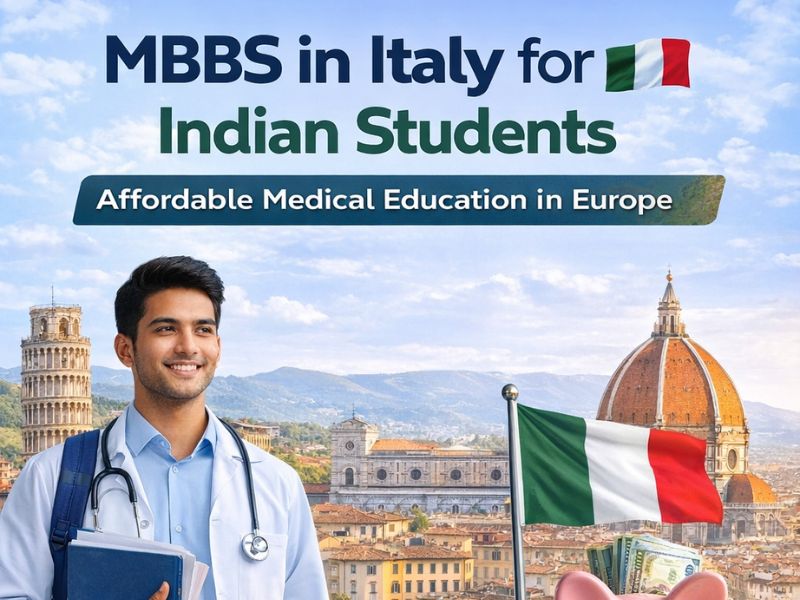
Table of Contents
If you are an Indian student dreaming of wearing the white coat but find yourself hit by the "Wall of High Fees" in Indian private colleges, you are not alone. With private MBBS seats in India often costing upwards of ₹60 Lakhs to ₹1 Crore, many brilliant minds feel stuck.
But what if you could get a World-Class MD degree for almost zero tuition fees?
Italy has emerged as the smartest strategic move for medical aspirants in 2026. This isn't just about "studying abroad"; it’s about accessing an EU-recognised degree, gaining global clinical exposure, and doing it all without the burden of massive student loans.
The Strategic Edge: Why Italy is the #1 Medical Destination in 2026
Italy has quietly disrupted the global medical education market. While other European countries have become overcrowded and expensive, Italy continues to offer an elite, English-taught MD program that is accessible to middle-class Indian families. Here is exactly why thousands of international students are choosing the Italian route.
The "Income-Based" Fee Revolution
The most disruptive feature of the Italian medical system is the ISEE (Income-Based) Fee System. Unlike Indian private colleges that charge a flat, massive fee, Italian public universities adjust your tuition based on your family’s financial standing. In 2026, many Indian students pay near-zero tuition fees, with the maximum cap usually staying under €4,000 (₹3.5 Lakhs) per year. This makes it more affordable than even some semi-government seats in India.
The Passport to Global Practice
An Italian Medical Degree is not just a piece of paper; it is a Globally Recognized Credential. Every public university in Italy is recognised by the World Health Organisation (WHO) and the National Medical Commission (NMC) of India. This means your degree is 100% valid for the NEXT (National Exit Test) in India, and it gives you a direct "Green Channel" to practice across the entire European Union. If your goal is the USMLE (USA) or PLAB (UK), an Italian background provides a massive clinical advantage.
The English-Taught Advantage (No Language Barrier)
A common misconception is that you need to be fluent in Italian to start your journey. In reality, Italy offers over 15 public universities with medicine programs taught entirely in English. From your first day of anatomy to your final exams, the medium of instruction is English. You only need to learn basic conversational Italian during your clinical years (3rd year onwards) to interact with patients, giving you plenty of time to adapt to the culture.
Top Medical Universities in Italy for 2026
Choosing the right university is about balancing Global Ranking, Clinical Exposure, and IMAT Cut-offs. In 2026, Italian medical schools are split into two powerhouse categories: Historic Public Universities (Low Cost) and State-of-the-Art Private Institutes (High Tech).
1. University of Milan (Statale)
Ranked among the top 80 globally for Medicine, Milan Statale is the crown jewel of Italian medical education. Located in Italy’s economic capital, it offers unparalleled clinical rotations in some of Europe's most advanced hospitals. The competition here is fierce, but the ROI—given its global prestige—is unmatched.
2. Sapienza University of Rome
Founded in 1303, Sapienza is one of the oldest and largest universities in Europe. It is the perfect choice for students who want to study in the heart of history while accessing massive public hospitals like Policlinico Umberto I. In 2026, it remains a top choice for Indian students due to its strong research focus and affordable fee structure.
3. University of Bologna
Home to the world’s oldest medical school, Bologna offers a prestigious 6-year program that emphasises practical, hands-on learning. With over 1,000 hours of mandatory internships, students here graduate with more clinical experience than almost any other European program. It is a "High-Value" destination for those aiming for the UK (PLAB) or USA (USMLE).
4. University of Pavia (Harvey Course)
Pavia was the first to offer an English-taught medical course in Italy (The Harvey Course). This experience makes them experts in handling international students. The city is a "University Town," meaning the entire infrastructure is built around student life, making it one of the most welcoming environments for Indians in 2026.
5. Humanitas University, Milan (Private Elite)
If budget is not your primary concern and you want "Hospital-Inside-Campus" learning, Humanitas is the gold standard. It is a private medical school integrated with the Humanitas Research Hospital. In 2026, it is famous for its MEDTEC program, which combines Medicine with Biomedical Engineering—a unique hybrid degree for the future of robotic surgery.
The Global Horizon: Career Scope After MBBS in Italy (2026)
Completing your MD in Italy doesn't just make you a doctor; it turns you into a Global Medical Professional. Because Italian degrees are recognised by the NMC, WHO, and the European Union, you aren't restricted to one country. You have the "Velocity" to choose your own territory and income bracket.
The India Pathway: Cracking the NEXT Exam
If your goal is to return home, your Italian degree is your strongest asset. Since Italian public universities follow high EU standards, the curriculum is naturally aligned with the NExT (National Exit Test) in India. In 2026, students coming back from Italy have one of the highest passing percentages in licensing exams because of their strong foundation in clinical research and European medical protocols. Once you clear NExT, you are officially a licensed doctor in India, eligible for both private and government hospital roles.
The Barrier of Entry: Eligibility for MBBS in Italy (2026)
Admission to Italian medical schools is strictly meritocratic. Unlike the "donation-heavy" private sector in India, Italy focuses on your potential as a doctor rather than your financial background. To secure your seat in 2026, you must clear these fundamental criteria.
The Academic Foundation (The 10+2 Rule)
Your high school credentials act as the first gatekeeper. While Italy is merit-based, you must meet the baseline academic standards set by the Ministry of Education. You must have completed your 12th standard with Physics, Chemistry, and Biology (PCB). You need a minimum of 50% marks in PCB for the General category, while the Reserved categories require 40%. Most importantly, Italy strictly requires a total of 12 years of formal education under a recognised 10+2 system.
The NEET Requirement (The Indian Mandate)
For Indian students, the National Eligibility cum Entrance Test (NEET) is a non-negotiable legal requirement. According to the National Medical Commission (NMC), any Indian student wishing to study medicine abroad must be NEET Qualified to practice in India later. Your NEET score remains valid for three years for overseas admission. You do not need a high rank; you only need to clear the qualifying cutoff, which typically stays within the 140–160 mark range.
The IMAT Gateway (The Final Frontier)
This is the most critical step of your journey. Admission to 15+ English-taught public universities is determined 100% by the IMAT (International Medical Admissions Test) score. This 100-minute test covers Biology, Chemistry, Physics, Mathematics, and Logical Reasoning. Your 12th-grade marks do not influence your ranking. The seat is awarded solely to the highest scorers in the IMAT, ensuring a transparent and fair selection process for everyone globally.
Age and Legal Documentation
To be eligible for the 2026 intake, you must be at least 17 years old by December 31st of the admission year. There is no upper age limit, making it accessible for those who took a gap year. A valid Indian Passport is mandatory for the Pre-enrolment process on the University portal. While the courses are in English, having an IELTS (6.0+) or TOEFL score is recommended, though many universities waive this if your medium of instruction in school was English.
The Documentation Blueprint: Essential Paperwork for 2026
Navigating the Italian bureaucracy requires precision. Missing even a single stamp can delay your dream by an entire year. For the 2026 intake, the documentation process is divided into academic verification and legal authentication.
The Academic Portfolio
Your journey starts with your basic schooling records. You will need your 10th and 12th Standard Marksheets and Passing Certificates. These documents must be original and should clearly show your subjects (Physics, Chemistry, Biology). Since Italy follows a 12-year education rule, these certificates act as the primary proof of your eligibility. Additionally, if you have already graduated or are in the middle of another degree, those transcripts should also be kept ready.
The Legal Authentication (Apostille & HRD)
This is where most students get stuck. All your educational documents must be Apostilled by the Ministry of External Affairs (MEA) in India. Before the Apostille, you typically need an HRD authentication from your respective state's education department. This process proves to the Italian authorities that your Indian degrees are genuine. In 2026, many students use authorised agencies to speed up this "Super-Legalisation" process.
The Declaration of Value (DoV) or CIMEA
The Italian government needs to understand how your Indian grades translate to the Italian system. You will need a Declaration of Value (Dichiarazione di Valore) issued by the Italian Embassy, or, more commonly in 2026, a CIMEA Statement of Comparability. This document is the "Bridge" that officially validates your 12 years of Indian schooling as equivalent to the Italian high school diploma.
Identity and Entrance Credentials
Your Valid Indian Passport is your primary identity throughout the University portal registration and the IMAT exam. Alongside this, you must have your NEET Qualification Certificate. Remember, the Italian universities might not check your NEET score, but the Indian Embassy will require it for your Study Visa, and the NMC will require it for your future practice in India.
Financial and Language Proofs
To secure your Visa, you must demonstrate Financial Sustainability. This usually involves showing a bank balance that covers your stay for at least one academic year (approx. €6,000 - €10,000). While many universities waive the language requirement for English-medium students, having an IELTS or TOEFL Certificate is a massive "Trust Signal" for the visa officer, ensuring there are no hurdles in your interview. Here are some of the key subjects taught as part of the MBBS program in Italy. These can differ to some extent depending on the university you choose for the course:
Syllabus for MBBS in Italy
| Year | Subjects |
| First Year | Anatomy |
| History | |
| Second Year | Anatomy |
| Histology | |
| Biochemistry | |
| Physiology | |
| Microbiology | |
| Third Year | Pharmacology |
| Microbiology | |
| Pathology Path Physical Clinical Subject | |
| Clinical Posting | |
| Fourth Year | Pharmacology |
| Microbiology | |
| Pathology Path Physical Clinical Subject | |
| Clinical Posting | |
| Fifth Year | Specialisation and Project |
| Sixth Year | Internship |
The Global Horizon: Career Scope After MBBS in Italy (2026)
Completing a 6-year MD in Italy is not just about earning a degree; it is about obtaining a Global Medical Passport. Because Italian universities follow rigorous European Union standards, your professional mobility is unmatched. Whether you want to practice in the heart of Europe or return to India, your career trajectory in 2026 is designed for high-velocity growth.
The Clinical Leadership Path
Once you obtain your license to practice in Italy, the entire European Union becomes your workplace. You have the immediate authority to start your own private clinic or join established healthcare networks as a specialist. In 2026, the demand for multilingual, Western-trained doctors is at an all-time high, allowing you to command premium consultation fees and a high-status lifestyle within the EU.
The Research and Academic Frontier
Italy is a global hub for medical innovation. If your interest lies beyond clinical practice, you can join reputed research institutes as part of their core medical teams. Italian graduates are highly sought after for clinical trials and biotechnological research, especially in fields like Oncology and Robotics. This path leads to a prestigious academic career, where you contribute to the future of global medicine.
The "Big League" Markets: USA, UK, and India
Your Italian MD is recognised by the WHO and NMC, making you eligible for the world's most competitive licensing exams. You can seamlessly transition to the United States by clearing the USMLE or move to the UK via the PLAB/UKMLA. For those returning home, the deep clinical foundation provided by Italian "Policlinicos" ensures a high success rate in the National Exit Test (NExT), allowing you to practice as a licensed physician in India’s top hospitals.
Medium of Instruction: Breaking the Language Barrier
A common myth among Indian aspirants is that they must be fluent in Italian to study medicine. In 2026, the reality is far more student-friendly.
100% English-Taught Curriculum
The top 15+ public universities in Italy offer medical programs that are conducted entirely in English. From your very first lecture in Human Anatomy to your final thesis defence, the medium of instruction is English. All textbooks, examinations, and laboratory manuals are standardised in English to align with global medical requirements.
The Clinical Integration Strategy
While your academic foundation is 100% English, Italian universities provide integrated Italian language classes during the first two years. This is not for your exams, but for your "Clinical Readiness." By the time you start your hospital rotations in the 3rd year, you will have the basic conversational skills needed to interact with local patients. This bilingual edge makes you a more versatile doctor, capable of practising in diverse international environments.
MBBS in India v/s MBBS in Italy
Pursuing MBBS abroad is a totally different experience when compared to studying MBBS in India. If you are planning to study MBBS in Italy, here are some key differences between the same program offered by the two countries:
| Aspect | MBBS in India | MBBS in Italy |
| Duration of the course | 5.5 – 6 years | 5+1 years |
| Medium of Teaching | English | English |
| NEET Examination | Mandatory | Mandatory |
| Annual Tuition Fee | 10-40 L | 4-5 L |
| Accreditation & Recognition | NMC, WHO, FAIMER | NMC, WHO, FAIMER, Ministry of Health, Italy and other global bodies |
| Internship & Practical Exposure | Difficult to get internships due to the smaller number of hospitals | Internships available at university-affiliated hospitals |
| Cultural Exposure | No cultural exposure and a similar working environment | Good cultural exposure and opportunities to work in a different environment with people from different nationalities |
Strategic Advantages of MBBS in Italy (2026)
Italy has quietly disrupted the global medical education market by offering a "Gold-Standard" degree without the "Platinum-Price" tag. For an Indian student in 2026, choosing Italy is no longer a "Plan B"—it is a calculated move to join the global medical elite.
The World-Class Education at Indian School Fees
The most significant advantage is the Economic Arbitrage. While private medical colleges in India can cost between ₹60 Lakhs and ₹1.2 Crores, Italian public universities operate on an income-based fee system. In 2026, most Indian students qualify for "Low-Bracket" fees, often paying less than ₹2 Lakhs per year. When you combine this with the DSU Regional Scholarships, which cover your stay and meals, you are essentially getting a world-class European MD degree for a fraction of the cost of a local Indian degree.
Global Licensing and The "EU Passport"
An Italian medical degree is a Global Currency. Because Italy is a key member of the European Union, your degree is automatically recognised across all 27 EU nations. Whether you want to practice in the high-paying hospitals of Germany or the research hubs of Switzerland, you don't need to re-sit for major licensing exams within the Union. Furthermore, the curriculum is 100% aligned with international standards like the USMLE (USA) and PLAB/UKMLA (UK), giving you a massive head start in the global race.
Clinical Exposure in "Policlinicos"
Italy doesn't just teach you medicine; it immerses you in it. Most Italian medical schools are integrated with "Policlinicos"—massive teaching hospitals that have been centres of excellence for centuries. From your 3rd year onwards, you are on the front lines, learning bedside manners and surgical protocols in some of the most advanced healthcare systems in the world. This hands-on clinical foundation is why Italian graduates have such high success rates in the NExT (National Exit Test) when they return to India.
The Research-First Mindset
Italy is at the forefront of medical innovation, particularly in robotic surgery, oncology, and genetics. By studying here in 2026, you gain access to high-tech laboratories and international research grants that are often unavailable to undergraduate students in other countries. This "Research-Heavy" approach builds a powerful CV, making you a preferred candidate for prestigious residency programs worldwide.
The Financial Lifeline: Scholarships for MBBS in Italy (2026)
The most disruptive part of studying medicine in Italy is not just the low fees—it is the fact that you can study for virtually zero cost. Italy offers some of the most generous regional and national scholarships in Europe, designed to attract global talent regardless of their financial background. In 2026, these grants are the primary reason why thousands of Indian students choose Italy over any other destination.
The DSU Regional Scholarship (The Full Ride)
The Diritto allo Studio Universitario (DSU) is the "Gold Standard" of Italian scholarships. Each region in Italy (like Lombardy, Lazio, or Tuscany) has its own DSU body. These are Need-Based Scholarships, meaning they are awarded based on your family income (ISEE), not your IMAT rank. A successful DSU applicant in 2026 typically receives a 100% Tuition Fee Waiver, free or highly subsidised University Accommodation, one Free Meal per day at the university canteen, and a yearly Stipend of €5,000 to €7,000 (approx. ₹4.5L – ₹6L) for personal expenses.
The "Invest Your Talent in Italy" (IYT) Grant
If you are a student with a stellar academic record and a passion for innovation, the IYT scholarship is your target. This is a government-funded initiative specifically for students from 15 selected countries, including India. Unlike the DSU, this is a Merit-Based Grant. It provides a monthly allowance and covers your entire tuition fees, while also providing opportunities for internships at top Italian firms. It is the perfect bridge for students who want to combine their medical degree with professional networking in the EU.
MAECI: The Ministry of Foreign Affairs Scholarship
The Italian Ministry of Foreign Affairs (MAECI) offers specialised grants for international students to encourage cultural and scientific cooperation. These scholarships are highly competitive and are usually awarded for a period of 6 or 9 months, renewable based on academic performance. In 2026, the MAECI grant is often used by medical students to fund their research projects or advanced clinical rotations, providing a significant boost to their global medical CV.
University-Specific Merit Awards
Beyond regional and government grants, many top-tier universities like the University of Milan, Bologna, and Pavia offer their own "Excellence Awards." These are typically given to the top 5–10 rankers in the IMAT entrance exam. These awards can range from a direct cash prize to a 50% reduction in living costs. Even if you don't qualify for a need-based DSU grant, your high performance in the IMAT can still make your Italian MBBS journey incredibly affordable.
Phase 1: The University Pre-Enrolment
Before you even touch a visa application form, you must complete your Pre-Enrolment on the official University portal. This is where you select your university and upload your academic transcripts and IMAT registration details. Once the university validates your profile, they send an "Admission Summary" directly to the Italian Embassy in India. In 2026, this digital handshake is the "Green Signal" that the embassy needs to even consider your visa file.
Phase 2: The Financial Sustainability Proof
The Visa Officer’s primary concern is whether you can support yourself without working. You must demonstrate a minimum of €6,000 to €10,000 in liquid funds for one academic year. This can be shown through personal or parental bank statements, Fixed Deposits, or a sanctioned Education Loan letter. If you have already secured a DSU Scholarship letter, your financial requirement becomes much easier to prove, as the Italian government is essentially vouching for your expenses.
Phase 3: The VFS Global Appointment
Italy uses VFS Global as its primary partner for visa processing in India. Once your documents are ready, you must book an appointment at the VFS centre in your jurisdiction (Delhi, Mumbai, Kolkata, etc.). During this stage, you will submit your National Visa (D-Type) Application, your original Apostilled documents, and your flight itinerary. In 2026, it is highly recommended to book your VFS slot at least 60 days before your course start date to avoid the peak-season rush.
Phase 4: The Visa Interview and Travel Insurance
While not always mandatory, some candidates are called for a personal interview at the Consulate. The key here is to demonstrate a clear "Study Intent"—explaining why you chose Italy over India or other EU nations. Additionally, you must provide proof of Schengen Travel Insurance with a minimum coverage of €30,000. This ensures that any medical emergencies during your initial days in Italy are fully covered, protecting both you and the Italian healthcare system.
The Financial Blueprint: Scholarships for Indian Students in Italy (2026)
The Italian scholarship ecosystem is divided into three high-impact tiers: Regional, National, and University-specific. If navigated correctly, these grants can transform a high-cost international degree into a fully-funded global career.
The DSU Regional Grant: The "Full-Ride" Strategy
The Diritto allo Studio Universitario (DSU) is the most sought-after scholarship for Indian students. Unlike merit-based awards, the DSU is a Need-Based Grant determined by your family's financial standing (ISEE). In 2026, a successful DSU applicant typically receives a 100% Tuition Fee Waiver, free or highly subsidised University Accommodation, and one Free Meal per day at the university canteen. Additionally, students receive a yearly Stipend of €5,000 to €7,000 to cover personal books and travel, effectively making the education "cost-free."
Invest Your Talent in Italy (IYT): The Professional Fast-Track
If you are an Indian student with a strong academic background in Engineering, Architecture, Economics, or Management, the IYT Scholarship is your premier target. This is a merit-based initiative that combines high-level academic study with a mandatory 9-month internship at a leading Italian company. The scholarship provides a monthly allowance of €900 and covers all tuition fees. It is designed for students who want to bridge the gap between an Italian classroom and a high-paying European corporate role.
MAECI: The Ministry of Foreign Affairs Excellence Grant
The Italian Ministry of Foreign Affairs (MAECI) offers specialised grants to foster international scientific and cultural cooperation. These scholarships are highly competitive and are usually awarded for a period of 6 or 9 months, with the possibility of renewal. In 2026, the MAECI grant is particularly popular among research-focused medical and PhD students. It provides a monthly stipend and comprehensive health insurance, acting as a "Trust Signal" on your CV for future global recruitment.
University-Specific Excellence Awards
Beyond government funding, top-tier institutions like the University of Milan, Politecnico di Milano, and University of Bologna offer their own internal merit scholarships. These are often automatically considered during the admission process based on your entrance exam scores (like IMAT, SAT, or GRE). These awards can range from a €5,000 to €10,000 cash prize per year or a complete exemption from administrative fees, providing a significant financial cushion for students who perform in the top 5% of their intake.
The Financial Blueprint: Monthly Cost of Living in Italy (2026)
The cost of living in Italy is not uniform; it is heavily dictated by geography. Living in a northern fashion hub like Milan is a vastly different financial experience compared to a historic southern city like Bari or Naples.
The Accommodation Variable
Housing will be your single largest expense. In "Tier-1" cities like Milan or Rome, a single room in a shared apartment can cost between €500 to €800 per month. However, if you opt for university towns like Pavia, Padua, or Pisa, this drops significantly to €300 - €450. For those who secure a DSU Scholarship, this cost can effectively drop to Zero, as regional grants often provide free or highly subsidised student dormitories.
The Culinary Budget (Eating Like a Local)
Italy is famous for high-quality, affordable produce. If you cook at home and shop at discount supermarkets like Eurospin, Lidl, or Esselunga, your monthly grocery bill will hover around €150 to €200. Most university canteens (Mensa) offer full-course meals for as low as €2 to €5 for students. In 2026, many Indian students use their scholarship meal cards to cover at least one major meal a day, drastically reducing their out-of-pocket food expenses.
The Mobility and Utilities Factor
Public transport in Italy is exceptionally student-friendly. A monthly unlimited pass for buses, trams, and metro usually costs between €20 to €35. For utilities—including high-speed internet, electricity, heating, and water—you should budget approximately €70 to €100 per month if you are sharing an apartment. In 2026, almost all Italian campuses offer "Eduroam" (free global Wi-Fi), which helps save on mobile data costs.
The "Lifestyle" and Buffer Fund
Being in the heart of Europe means you will want to explore. A budget of €50 to €100 per month is usually enough for a modest social life, including the occasional pizza, espresso, or a regional train trip to a nearby historic site. It is always recommended to keep a small "Emergency Buffer" of at least €500 in your Italian bank account to handle unforeseen medical or administrative costs
At Your Global Mentors, we specialise in transforming Indian aspirants into global medical professionals. Our expertise goes beyond simple applications. We provide a comprehensive, 360-degree roadmap that covers everything from expert IMAT preparation strategies to the "Super-Legalisation" of your academic documents. Whether you are navigating the intricate ISEE income brackets for a full-ride scholarship or preparing for the Italian Consulate visa interview, our senior counsellors in Indore are with you at every step. We ensure your profile is 100% compliant, maximising your chances of securing a seat in top-tier universities like Milan, Rome, or Pavia.
conclusion
Choosing where to study medicine is perhaps the most significant decision of your professional life. The traditional path in India is becoming increasingly congested, with private college fees reaching astronomical levels that often don't justify the return on investment. In this landscape, Italy represents more than just an affordable alternative; it is a strategic gateway to a global medical career. By offering a world-class MD degree, recognised by the NMC and WHO, for nearly zero tuition fees, the Italian medical system has effectively democratised elite education for Indian students.
1. What is the total MBBS cost in Italy?
Around ₹5–15 lakh total with scholarships.
2. Is NEET required for MBBS in Italy?
Yes, mandatory for Indian students.
3. What is IMAT?
Entrance exam for medical universities in Italy.