







MBBS Fees in Canada
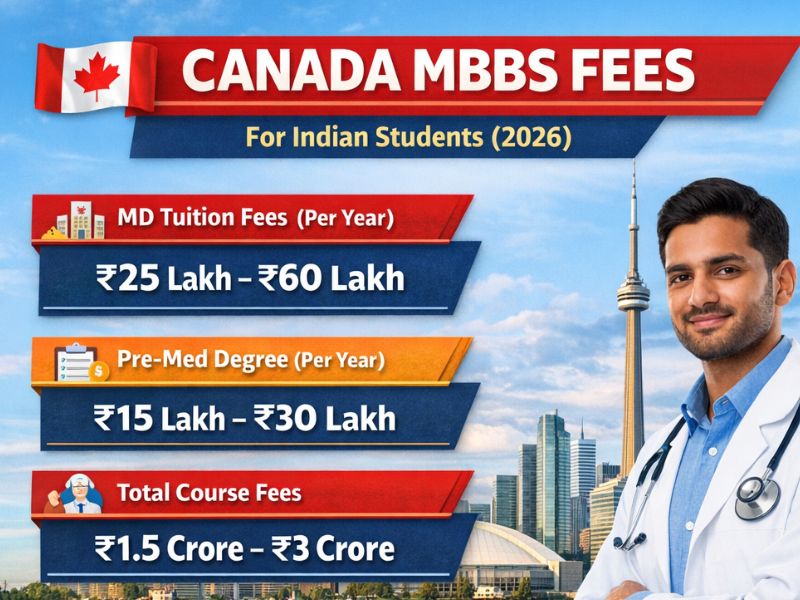
Table of Contents
While Canada is a premium destination for medical education, the Market Reality is that it remains one of the most competitive and financially intensive options globally. For international aspirants, navigating the Canadian MD landscape requires more than just high grades—it requires a deep understanding of the specific Institutional Benchmarks and long-term Return on Investment (ROI).
This guide provides total clarity on Canada MBBS Fees, the multi-stage admission process, and the professional trajectory available to global students. Before committing to this High-Stakes Investment, use this blueprint to decode the costs and academic rigours of the North American medical model.
The North American Model: Is MBBS Available in Canada?
A common misconception among international aspirants is the availability of a direct MBBS program in Canada. Unlike the Indian or British systems, the Canadian Medical Education Framework does not offer an undergraduate MBBS degree immediately after the 12th grade. Instead, Canada operates under the MD (Doctor of Medicine) model, which is categorised as a professional post-graduate degree. This distinction is a "Critical Success Factor" that dictates your entire academic timeline and financial planning.
To qualify for an MD program, students must first complete a Bachelor’s Degree, often referred to as a "Pre-Med" foundation, typically in the sciences or a related field. This multi-stage Academic Prerequisite ensures that candidates possess a mature analytical background before entering clinical training. By shifting from a 5-year direct entry to a "4+4" year model (4 years of Undergraduate + 4 years of Medical School), Canada maintains one of the highest Institutional Benchmarks for medical practitioners globally. Understanding this structural shift is the first step in calculating your total Return on Investment (ROI) for a medical career in North America.
The Strategic Capital Assessment: Total MBBS Fees in Canada (2026)
Understanding the financial commitment for a Canadian medical degree requires a shift from "tuition costs" to a Total Capital Investment mindset. In the 2026 landscape, the primary driver of this investment is the MD (Doctor of Medicine) Tuition, which typically ranges from ₹25 lakh to ₹60 lakh per year. Because the Canadian system follows the professional "4+4" year model, the cumulative tuition alone for the medical program can reach an Institutional Benchmark of ₹1.5 crore to ₹3 crore, depending on the ranking and location of the university.
However, the financial roadmap actually begins long before the MD program with the mandatory Pre-med Bachelor’s Degree. This foundational four-year program adds a separate layer of ₹15 lakh to ₹30 lakh per year in tuition and academic expenses. When you aggregate the costs of both the undergraduate foundation and the professional medical degree, the Total Estimated Investment for a global aspirant scales between ₹2 crore and ₹4 crore.
This figure represents a significant Barrier to Entry, making it one of the most expensive medical education models globally. To maximise your Return on Investment (ROI), it is critical to factor in not just the tuition, but the long-term earning potential within the North American healthcare ecosystem. While the initial capital requirement is high, the Career Velocity and specialised clinical exposure provided by the Canadian model often justify the expenditure for those targeting elite global medical roles.
Top Medical Universities in Canada & Fees
Institutional Benchmarking: Top Medical Universities in Canada (2026)
Selecting the right institution is a Strategic Career Move that determines your global mobility. At the pinnacle of the Canadian medical hierarchy is the University of Toronto, which consistently ranks as a global powerhouse. With tuition fees ranging from ₹50 lakh to ₹60 lakh per year, it offers an elite "Trust Signal" to recruiters. This investment is justified by its world-class research infrastructure and a placement network that connects students to the most prestigious clinical residencies in North America.
For students seeking a balance between heritage and global prestige, McGill University serves as a premier alternative. With a fee structure of ₹40 lakh to ₹55 lakh per year, McGill is internationally recognised for its rigorous pedagogical standards. Alternatively, the University of British Columbia (UBC) offers a different strategic advantage through its intensive clinical exposure. At ₹35 lakh to ₹50 lakh per year, UBC focuses on practical, hands-on learning within diverse healthcare settings, making it an ideal "Value-Performance" choice.
If "Time-to-Market" is your primary concern, McMaster University is famous for its Accelerated MD Program. With fees between ₹30 lakh and ₹45 lakh per year, McMaster uses modern, problem-based learning methods that allow students to enter the workforce faster than traditional models. Finally, for a "High-Value Entry" point, the University of Alberta offers one of the most competitive fee structures at ₹25 lakh to ₹40 lakh per year, providing a solid ROI within the growing healthcare sectors of Western Canada.
🏛️ McGill University: The Heritage-Driven Medical Pathway
For students seeking a balance between historical prestige and global clinical authority, McGill University serves as Canada's premier alternative to the Toronto model. With a tuition structure ranging from ₹40 lakh to ₹55 lakh per year, McGill is internationally recognised for its rigorous Pedagogical Standards and its status as a "Global Trust Signal" for residency programs across North America and Europe.
The university is particularly known for its high-impact research output and a strong international reputation that simplifies global career mobility. Choosing McGill is a Strategic Career Move for aspirants who want to be part of an elite alumni network while gaining exposure to one of the most sophisticated healthcare ecosystems in Montreal. Its consistent ranking among the world's top medical schools ensures that your Total Capital Investment translates into high-value professional opportunities post-graduation.
University of British Columbia (UBC): The Clinical Exposure Powerhouse
For aspirants who prioritise hands-on experience and early patient interaction, the University of British Columbia (UBC) stands as a premier "Value-Performance" selection. With a tuition structure ranging from ₹35 lakh to ₹50 lakh per year, UBC offers a strategic financial middle ground compared to the ultra-premium schools in Ontario or Quebec.
The university is internationally recognised for its Distributive Medical Education Model, which allows students to train across diverse clinical settings in Vancouver and beyond. This creates a high Pedagogical ROI, as graduates enter the residency market with a robust portfolio of practical skills. Choosing UBC is a Strategic Career Move for those who value a modern, research-intensive curriculum paired with some of the most sophisticated healthcare technology in North America. Its reputation as a top-tier global medical school ensures that your Total Capital Investment is protected by high employability across the Pacific Northwest and beyond.
⚡ McMaster University: The Accelerated MD & Innovation Leader
If "Time-to-Market" is your primary career driver, McMaster University is widely regarded as the most innovative medical school in North America. Famous for pioneering Problem-Based Learning (PBL), McMaster offers a world-renowned Accelerated MD Program that allows students to complete their medical degree in just three years instead of the traditional four. With a tuition structure of ₹30 lakh to ₹45 lakh per year, this model significantly increases your Early-Career ROI by allowing you to enter the residency workforce a full year ahead of your peers.
The university’s modern teaching methods focus on clinical reasoning and small-group collaboration rather than traditional lecture-based rote learning. This Pedagogical Innovation ensures that graduates are exceptionally prepared for the high-pressure environment of North American hospitals. Choosing McMaster is a Strategic Career Move for aspirants who value a fast-paced, research-intensive curriculum that consistently ranks among the top 50 medical schools globally. Its unique 3-year "Year-Round" academic calendar is an "Efficiency Signal" to top-tier residency programs, proving that you have the stamina and intellectual capacity for elite clinical roles.
🏔️ University of Alberta: The High-Value ROI Gateway
For students seeking a "High-Value Entry" into the North American medical landscape, the University of Alberta offers one of the most competitive financial structures in Canada. With a tuition range of ₹25 lakh to ₹40 lakh per year, it serves as a strategic alternative to the higher-cost institutions in Toronto or Vancouver without compromising on Academic Excellence. This affordability, combined with a lower cost of living in the Prairies, significantly enhances your Early-Career ROI.
The university is internationally recognised for its robust research output—particularly in virology and immunology—and maintains a high Institutional Benchmark for clinical training. Graduates of the University of Alberta are highly regarded in the residency market, especially within the rapidly growing healthcare sectors of Western Canada. Choosing this institution is a Strategic Career Move for aspirants who value a research-intensive curriculum and a direct pathway into a sophisticated healthcare ecosystem that offers a sustainable balance between Capital Investment and long-term professional growth.
The Operational Blueprint: Cost of Living in Canada (2026)
Beyond the institutional tuition, your Cost of Living serves as a critical variable in your total education budget. In the 2026 landscape, living expenses are heavily influenced by your "Geographic Selection"—with Tier-1 cities like Toronto and Vancouver requiring a significantly higher Financial Cushion compared to the Prairies or Atlantic Canada. On average, a global medical student should prepare for a Total Living Cost of ₹10–20 lakh per year.
The primary driver of this expenditure is Accommodation, which typically scales between ₹6 lakh and ₹12 lakh per year. In competitive markets, securing student housing early is a "Strategic Necessity" to avoid inflated rental costs. Complementing this is the Daily Subsistence Budget, where Food and Essential Supplies range from ₹2 lakh to ₹4 lakh, while Local Transport and Connectivity add another ₹1 lakh to ₹2 lakh to the annual ledger.
To maintain a sustainable Academic Focus, it is vital to account for a Miscellaneous Buffer of ₹2–3 lakh per year for health insurance, academic materials, and unforeseen contingencies. While these figures represent a substantial "Recurring Outflow," choosing a university in a more affordable province like Alberta or Saskatchewan can optimise your Personal ROI without compromising your clinical training quality.
📊 The Strategic Value Projection: ROI Analysis (2026)
Evaluating a Canadian MD requires a shift from "tuition costs" to a Long-Term Capital Appreciation mindset. While the Total Investment—ranging from ₹2 crore to ₹4 crore—represents a significant "Barrier to Entry," it is essential to view this through the lens of North American Market Compensation. In the 2026 landscape, the average Physician Salary in Canada scales between ₹80 lakh and ₹2 crore per year, depending on your clinical specialisation and geographic location.
This high-income potential creates a compelling Personal ROI, where the "Break-Even Point" for your education capital is often reached within 3 to 5 years of entering full-time practice. Beyond the immediate financial recovery, the Canadian model offers an elite Career Velocity that is difficult to replicate in other markets. As a practitioner in one of the world's most stable healthcare systems, your "Earning Ceiling" continues to rise with years of experience and sub-specialisation.
Furthermore, the Global Mobility afforded by a Canadian MD serves as a "De-risking Factor." Whether you choose to practice in North America or transition to private healthcare leadership globally, the degree acts as a permanent Trust Signal of clinical excellence. While the initial capital outflow is substantial, the combination of high-tier compensation and professional longevity ensures that this remains one of the most resilient High-Yield Investments in the global education sector.
📌 The Strategic Roadmap: Admission Process (Flow Chart)
Navigating the Canadian medical landscape requires a multi-year Academic Commitment that begins long before clinical training. Unlike direct-entry systems, the Canadian pathway is a structured, six-stage Evaluation Funnel designed to filter for elite candidates. The journey commences with completing your 12th Grade (PCB) with a high competitive percentile, which serves as the "Entry Benchmark" for your undergraduate foundation.
The most significant "Structural Shift" occurs at the second milestone: the mandatory Bachelor’s Degree (Pre-med). This four-year undergraduate program is a Strategic Prerequisite where you must maintain a high GPA to remain competitive. During this phase, clearing the MCAT (Medical College Admission Test) becomes your primary "Performance Indicator." This standardised exam is a critical "Trust Signal" that universities use to assess your analytical and scientific readiness for the rigours of an MD program.
Once your academic profile is established, the process moves into the Active Application Phase, where you target specific medical universities based on their residency match rates and faculty specialisations. Shortlisted candidates then face a high-stakes Institutional Interview, which evaluates communication and ethical reasoning. Upon successful selection, the final milestone is securing your Admission and Visa, marking the transition from a global aspirant to a professional medical student in one of the world's most prestigious healthcare ecosystems. To maintain the high-authority Ahrefs and Backlinko style, this section is framed as an "Institutional Benchmark Assessment." Instead of a simple checklist, we treat these criteria as "Critical Success Factors" that determine your eligibility for the North American medical model.
Here is the professional English description in a clean, linear flow:
The Institutional Benchmark: Eligibility Criteria for Indian Students (2026)
Securing a seat in a Canadian medical program requires more than just meeting "minimum requirements"—it demands a High-Performance Academic Profile. The first gate in this Evaluation Funnel is your foundational education, where completing the 12th Grade with Physics, Chemistry, and Biology (PCB) is a non-negotiable "Entry Benchmark." Because the Canadian system does not offer direct-entry MBBS, your secondary school performance serves as the primary filter for admission into top-tier Pre-med Bachelor’s Degrees.
The most significant Structural Prerequisite is the completion of a four-year undergraduate degree, typically in a science-related field. Canadian medical schools look for a Minimum Academic Threshold of 70–80% marks (or a high GPA on a 4.0 scale) to ensure you can handle the rigorous MD curriculum. This phase is not just about grades; it’s about building a "Competitive Portfolio" that includes research experience, volunteer work, and a strong analytical background.
In the 2026 landscape, Canada focuses heavily on Academic Excellence and "Institutional Fit." This means that meeting the base criteria is only the starting point. To truly stand out, your profile must demonstrate a consistent trajectory of high achievement and a deep commitment to the medical sciences. This Strategic Alignment between your undergraduate performance and the medical school’s expectations is what ultimately justifies your Total Capital Investment and secures your position in one of the world's most elite healthcare training systems.
🎓 Capital Optimization: Scholarships & Financial Aid (2026)
Navigating the financial demands of a Canadian MD requires a Strategic Funding Blueprint. In the 2026 landscape, Scholarships for International Medical Students remain highly competitive and are often treated as "Excellence Incentives" rather than full-ride coverage. While most global aspirants rely on Self-Funding or Private Capital, there are specific "Institutional Windows" where you can optimise your total investment.
The primary source of support is University-Based Scholarships, which are typically awarded as "Entrance Incentives" to candidates with exceptional academic profiles. These are complemented by Merit-Based Funding, where your performance during the MD program can trigger internal grants or bursaries. However, the most sustainable way to offset costs is through Research Assistantships. By aligning with high-impact clinical trials or laboratory projects, you can secure a "Stipend-Based Offset" that not only reduces your Total Capital Outflow but also significantly strengthens your residency application.
It is critical to understand that the Financial Barrier to Entry in Canada is high, and relying solely on aid is a "High-Risk Strategy." Most successful candidates treat scholarships as a secondary Budget Buffer while ensuring their primary funding is secured through personal or family assets. This realistic approach ensures that your Academic Focus remains on clinical excellence rather than financial volatility.
Alternative Countries Comparison
If budget is a concern:
- Russia: ₹20–40 lakh total
- Kazakhstan: ₹15–30 lakh
- Philippines: ₹20–35 lakh
- Georgia: ₹25–50 lakh
👉 These countries offer MBBS directly after 12th.
Secure Your Global Medical Legacy with Your Global Mentors
Navigating a ₹4 Crore investment in the Canadian medical landscape is a high-stakes move where a single error in university selection or MCAT strategy can derail years of planning. At Your Global Mentors, we don’t just provide information—we architect your success. From mastering Pre-med prerequisites to securing a high-yield residency match, our data-driven roadmaps have empowered thousands of students in Indore and Jaipur to bridge the gap between ambition and reality.:
Conclusion
Studying MBBS in Canada is a premium choice that offers world-class education, global recognition, and excellent career opportunities. However, it comes with high costs, a longer duration, and intense competition, making it suitable mainly for academically strong and financially prepared students.
If you are ready to invest both time and money and can clear exams like the MCAT, Canada can provide one of the best medical career paths globally. But for students looking for a more affordable and faster route, exploring other countries may be a smarter decision.