



MBBS Abroad Without NEET 2026: Top Countries, Eligibility, Fees, Admission & Career Guide
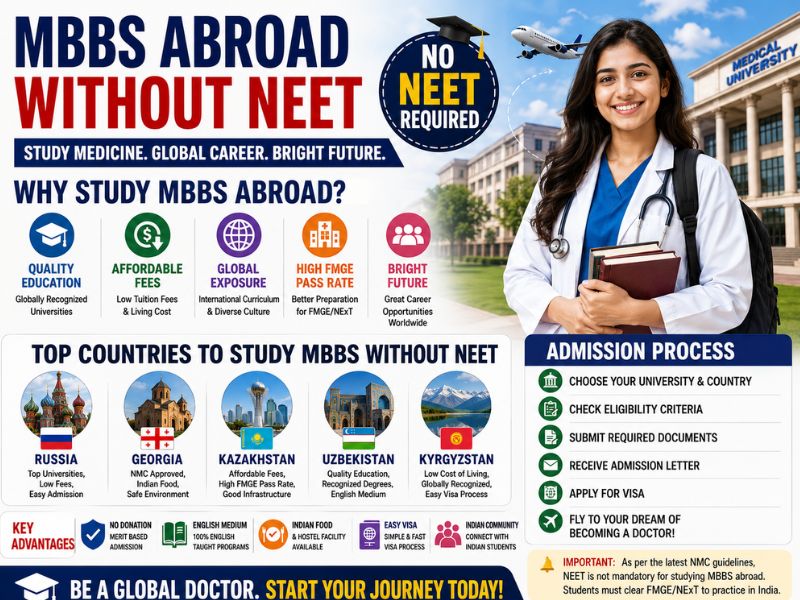
Table of Contents
MBBS Abroad Without NEET 2026: Highlights
The phrase "MBBS Abroad Without NEET" is one of the most searched terms among Indian medical aspirants, but it's also one of the most misunderstood in 2026. Here's the clear picture.
While it's true that many foreign universities admit Indian students based purely on Class 12 marks and English proficiency, without requiring a NEET score for admission itself, this doesn't mean NEET becomes irrelevant to your medical career. The National Medical Commission (NMC) has clearly stated that NEET qualification remains mandatory for any Indian student who wants their foreign MBBS degree recognised in India after graduation.
This distinction matters enormously. You can technically enrol in certain foreign medical universities without a NEET score. However, without NEET qualification, you cannot appear for the licensing exam (FMGE/NExT), cannot register with the NMC, and effectively cannot practice medicine in India.
For 2026, the NMC has also tightened related regulations — mandating a minimum of 54 months of academic study plus 12 months of supervised internship, and introducing stricter rules around online coursework completed during and after the pandemic.
Understanding this NEET-admission versus NEET-recognition distinction is the single most important thing to get right before committing to any MBBS abroad program in 2026.
Can Indian Students Study MBBS Abroad Without NEET?
Yes — technically, Indian students can gain admission to certain foreign medical universities without a NEET score. Several universities, particularly in countries like the Philippines and parts of Europe, admit students based on Class 12 academic performance, English proficiency, and university-specific entrance criteria, without asking for a NEET scorecard.
However, this is where students need to pause and think carefully. Being admitted without NEET and being able to practice medicine in India afterwards are two completely different things.
According to NMC guidelines, qualifying NEET is mandatory for Indian citizens who want to appear for the FMGE/NExT licensing exam and register as practising doctors in India — regardless of whether their host university required NEET for admission.
So who can genuinely skip NEET?
Only students who have no intention of returning to India to practice medicine, and instead plan to work permanently in the country where they studied (or elsewhere abroad, depending on that country's own licensing requirements), could realistically consider this path. For the vast majority of Indian students who eventually want to work in India, skipping NEET isn't a viable long-term strategy — it's a serious career risk.
Our advice: Be extremely cautious of agents or consultancies claiming "NEET is not required" without clearly explaining this distinction — it's a common and costly misconception.
Is MBBS Abroad Without NEET Valid for Indian Students?
This is the single most important question to get right, and the honest answer requires some nuance.
Your foreign MBBS degree itself is valid — recognised by the university and country where you studied. The problem arises specifically around practising in India.
If you complete an MBBS abroad without ever qualifying NEET, you are permanently disqualified from appearing for the FMGE/NExT exam, which is required for Indian medical registration. Without this registration, you legally cannot practice medicine in India, pursue postgraduate (PG) medical studies in India, or apply for government medical jobs.
Important technical detail: Unlike NEET score validity for Indian admissions (just 1 year), your NEET score remains valid for 3 years for MBBS abroad admissions — meaning if you qualify NEET in 2026, you could use that qualification to join an MBBS program abroad in 2026, 2027, or even 2028.
Cutoff requirements are more accessible than many students assume: You don't need a high rank to qualify — just the qualifying percentile (50th percentile for General/EWS category, roughly around 137 marks; 40th percentile for OBC/SC/ST categories, roughly around 107 marks).
The bottom line: Given how achievable the NEET qualifying cutoff actually is, and how severe the consequences of skipping it are, there's very little practical reason for most Indian students to pursue the "without NEET" route if they have any intention of practising in India down the line.
Why Choose MBBS Abroad in 2026? (With NEET Qualification)
Given that NEET remains essential for Indian recognition, the real question isn't "how to skip NEET" — it's why MBBS abroad remains an attractive path even with NEET qualification required. Here's why it still makes sense for 2026.
1. Lower NEET cutoff pressure
Since MBBS abroad only requires you to clear the qualifying percentile (not a competitive rank), students who qualify NEET but don't secure a seat in India's limited government college seats still have a genuine pathway forward.
2. More affordable tuition than private Indian colleges
Many MBBS abroad programs, particularly in countries like Russia, Georgia, Kyrgyzstan, and the Philippines, offer significantly lower tuition compared to private medical colleges in India, which often charge extremely high capitation fees.
3. English-medium instruction
Reputable foreign medical universities conduct all classes, practicals, and clinical rotations in English, easing the transition for Indian students.
4. Global exposure and clinical training
Students gain international clinical exposure and diverse patient case studies, which can be valuable for building a well-rounded medical foundation.
5. Structured pathway back to India
As long as you've qualified NEET before enrolling, your degree — provided the university is WHO/NMC-recognized and meets duration requirements — remains a valid pathway toward Indian practice via FMGE/NExT.
The bottom line: MBBS abroad remains a smart option in 2026, but only when approached correctly — qualify NEET first, then use your 3-year score validity to choose the right international program.
Eligibility Criteria for MBBS Abroad (With Mandatory NEET Qualification)
Here's what you actually need to be eligible for a recognised MBBS abroad pathway in 2026.
NEET qualification (mandatory for Indian recognition)
- Must clear the qualifying percentile: 50th percentile (General/EWS) or 40th percentile (OBC/SC/ST)
- NEET score remains valid for 3 years, giving you flexibility in timing your abroad admission
Academic qualification
- Completion of 12th grade with Physics, Chemistry, and Biology (PCB) as core subjects
- Minimum aggregate marks typically required: 50% for General category, 40% for reserved categories, though specific university requirements may vary.
Age requirement
- Most countries require a minimum age of 17 years at the time of admission
University recognition requirements
- The university must be listed in the World Directory of Medical Schools (WDOMS) and recognised by the World Health Organisation (WHO)
- Program duration must meet NMC's minimum requirement of 54 months of academic study plus 12 months of supervised internship.
Internship location rule
- Internship must be completed in the same country/university where you studied — India does not accept internships completed domestically if your degree is from a foreign university.y
Additional considerations
- No mid-program transfers are allowed under current NMC rules
- Programs involving significant online coursework may require additional mandatory onsite training to compensate, per 2026 NMC clarifications
Our advice: Before finalising any MBBS abroad program, verify the university's WHO/NMC recognition status directly, confirm the exact program duration meets the 54+12 month requirement, and most importantly — ensure you've qualified NEET before enrolling to protect your future practising rights in India.
Admission Process for MBBS Abroad (NEET Qualification Still Required for India Recognition)
Even though many foreign universities don't ask for NEET during their own admission process, here's the realistic step-by-step process Indian students should follow in 2026 — one that protects your ability to practice in India later.
Step 1: Qualify NEET-UG first
Before anything else, appear for and clear the NEET-UG qualifying cutoff. Since your score remains valid for 3 years, this gives you flexibility to plan your abroad admission timeline without rushing.
Step 2: Research WHO/NMC-recognized universities
Shortlist universities listed in the World Directory of Medical Schools (WDOMS) and recognised by the NMC, since unrecognised universities will make your degree unusable for Indian practice regardless of your NEET status.
Step 3: Verify program duration compliance
Confirm the program meets the mandatory 54 months of academic study plus 12 months of internship — shorter programs are no longer valid for Indian licensing purposes under 2026 NMC rules.
Step 4: Apply directly to the university
Most foreign medical universities have simplified application processes, typically requiring your academic transcripts, passport, and application form, without needing NEET at this admission stage.
Step 5: Receive your offer letter
Once accepted, universities issue an offer or admission letter confirming your seat, program duration, and fee structure.
Step 6: Apply for a student visa
Submit your offer letter, financial proof, and required documents to apply for a student visa for your host country.
Step 7: Complete pre-departure formalities
Arrange travel, accommodation, and any pre-departure orientation programs offered by your university or education consultant.
Step 8: Begin your program and track internship placement
Ensure your mandatory internship is arranged within the same university or country, as India does not recognise internships completed elsewhere.
Our advice: Complete Step 1 (NEET qualification) before finalising any university commitment abroad — reversing this order is the single most common and costly mistake students make.
Documents Required for MBBS Abroad Admission
Having your documentation ready and accurate is essential for a smooth application process. Here's your complete checklist for 2026.
Academic documents
- 10th and 12th grade mark sheets and certificates (with PCB as core subjects)
- NEET-UG scorecard (qualifying percentile achieved)
- Any additional entrance exam scores, if required by the specific university
Identity and travel documents
- Valid passport (with sufficient validity for your program duration)
- Passport-sized photographs meeting visa specifications
- Birth certificate
Application essentials
- Completed university application form
- Statement of Purpose (SOP), if required by the university
- Letters of Recommendation (LORs), for select universities
Financial documents
- Proof of funds covering tuition and living expenses (bank statements or loan approval letters)
- Fee payment receipts once admission is confirmed
Medical and health documents
- Medical fitness certificate
- Vaccination records, as required by the host country
- Health insurance proof or enrollment confirmation
Visa-specific documents
- University offer/admission letter
- Visa application form
- Proof of accommodation arrangements
Our advice: Keep both original and multiple photocopies of every document, particularly your NEET scorecard and academic transcripts, since these will be repeatedly required throughout your abroad education and later during Indian licensing procedures.
Top Countries to Study MBBS Abroad (Admission Without NEET, Recognition Still Requires It)
Several countries have become popular among Indian students specifically because their universities don't mandate NEET for admission itself. Here's where to consider for 2026 — provided you've still qualified NEET for future Indian recognition.
1. Philippines
Popular for English-medium instruction, American-style medical curriculum, and relatively straightforward admission based on academic records rather than entrance exams.
2. Russia
Long-standing popularity among Indian students due to affordable tuition, WHO-recognized universities, and admission processes based on academic qualifications.
3. Georgia
Known for modern infrastructure, English-medium programs, and increasingly popular among Indian students for its straightforward, merit-based admission process.
4. Kyrgyzstan
Offers affordable tuition and simplified admission, though students should carefully verify specific university recognition status given varying quality across institutions.
5. Uzbekistan
An emerging destination offering budget-friendly MBBS programs with growing recognition among Indian students, though thorough due diligence on university accreditation remains essential.
6. Nepal
Geographically convenient for Indian students, with several NMC-recognized universities offering quality medical education at moderate costs.
7. Bangladesh
Offers relatively affordable MBBS programs with cultural and geographic proximity to India, though thorough verification of specific university recognition is important.
Important reminder: In every one of these countries, admission without NEET doesn't change the mandatory NEET requirement for Indian practice — always verify this distinction regardless of destination.
Our advice: Beyond just checking whether NEET is needed for admission, prioritise researching each university's WHO/NMC recognition status, actual clinical training quality, and previous students' FMGE/NExT pass rates before committing to any of these destinations.
Best Universities for MBBS Abroad (Verify NMC Recognition Before Enrolling)
While specific "best" rankings vary by source and change frequently, here's what genuinely matters when evaluating universities for MBBS abroad in 2026 — regardless of country.
What actually makes a university "best" for Indian students
Rather than focusing on marketing claims about low fees or "no entrance exam," prioritise these verifiable factors:
- WHO/NMC recognition status: Confirmed listing in the World Directory of Medical Schools
- Program duration compliance: Meeting the mandatory 54 months of academic study plus 12 months of internship structure
- Historical FMGE/NExT pass rates: Universities with strong track records of graduates successfully clearing India's licensing exam
- Clinical training quality: Access to real hospital rotations and adequate patient exposure, not just classroom-based theoretical learning
- English-medium instruction: Full program delivery in English across theory, practicals, and clinical work
How to verify legitimacy yourself
- Check the university's listing directly on the official WDOMS website
- Cross-reference with the NMC's officially published list of approved foreign medical institutions
- Research independent student reviews and previous FMGE/NExT outcomes from that specific university, not just the country in general
Red flags to watch for
- Universities or agents claiming NEET is "not needed at all" without clarifying the India-recognition distinction
- Programs advertising unusually short durations that don't meet the 54+12 month requirement
- Universities not clearly listed on official WHO/NMC recognition databases
- Heavy reliance on online coursework without adequate physical clinical training
Our advice: Don't rely solely on educational consultants' recommendations — independently verify any university's recognition status through official NMC and WHO sources before making any financial commitment for 2026 admission.
MBBS Abroad Fees 2026
Understanding realistic cost expectations helps you budget properly and avoid falling for unusually cheap offers that might indicate quality or recognition concerns. Here's a breakdown for 2026.
Total program cost estimates by country (approximate, for full program duration)
- Philippines: Approximately ₹25-35 Lakhs for the complete program (tuition plus living expenses)
- Russia: Approximately ₹20-30 Lakhs for the complete program
- Georgia: Approximately ₹18-28 Lakhs for the complete program
- Kyrgyzstan: Approximately ₹15-25 Lakhs for the complete program
- Uzbekistan: Approximately ₹15-22 Lakhs for the complete program
- Nepal: Approximately ₹30-45 Lakhs for the complete program (higher due to proximity and demand)
- Bangladesh: Approximately ₹25-35 Lakhs for the complete program
What's typically included in tuition
- Academic coursework and lectures
- Laboratory and practical sessions
- Basic clinical rotation access (verify this specifically, as quality varies)
Additional costs to budget for
- Living expenses (accommodation, food, personal expenses): varies significantly by country, typically ₹3-6 Lakhs annually.
- Health insurance: mandatory in most countries, adding to annual costs
- Travel costs: initial travel plus periodic visits home
- Visa and documentation fees
- NEET coaching/preparation costs, if not already qualified
Hidden costs to watch for
- Some universities charge separate fees for clinical rotations, hostel accommodation, or examination fees not included in advertised tuition.n
- Currency fluctuation can affect total costs over a 5+ year program significantly.
Our advice: Be genuinely cautious of extremely low-cost programs significantly below these ranges — unusually cheap MBBS programs abroad sometimes correlate with inadequate clinical training, questionable recognition status, or hidden costs that emerge later. Always request a complete, itemised fee breakdown directly from the university before committing for 2026 admission.
Scholarships for MBBS Abroad
Studying MBBS abroad is a significant financial investment, but several scholarship opportunities can help ease that burden for Indian students in 2026.
University-specific merit scholarships
Many foreign medical universities, particularly in countries like Georgia, Russia, and the Philippines, offer merit-based tuition waivers ranging from 10% to 50% for students with strong academic records in their 12th-grade examinations.
Government scholarships from host countries
Some countries offer government-funded scholarships to attract international medical students, though these are typically limited in number and highly competitive, often requiring additional qualifying criteria beyond academics.
Early admission/early bird discounts
Several universities offer reduced tuition or waived application fees for students who complete their admission process well before standard deadlines, effectively functioning as a scholarship for proactive applicants.
Sibling or family discounts
Certain universities offer fee reductions for students whose siblings or family members are already enrolled or have graduated from the same institution.
Education loan support (not a scholarship, but a practical alternative)
Given the limited scholarship availability specifically for MBBS abroad, most Indian students rely on education loans from Indian banks (public and private) or NBFCs, often covering up to 100% of tuition and living expenses, particularly for NMC-recognized universities.
What to watch for
Be cautious of consultancies or universities offering unusually generous "scholarships" that seem disconnected from genuine merit criteria — sometimes these are marketing tactics rather than real fee reductions, and the advertised fee excludes hidden costs that offset any apparent discount.
Our advice: Since dedicated MBBS abroad scholarships remain limited compared to other fields, research each university's specific scholarship policy directly, and simultaneously explore education loan options through Indian banks as your primary funding strategy for 2026.
Cost of Living in Popular MBBS Destinations
Beyond tuition, living expenses significantly impact your total budget. Here's a realistic breakdown across popular MBBS abroad destinations for 2026.
Philippines
Monthly living costs typically range from ₹25,000-35,000, covering accommodation, food, and local transportation, with Manila and Cebu being relatively affordable compared to other international study destinations.
Russia
Monthly living expenses generally range between ₹20,000-30,000, varying significantly by city — Moscow and St. Petersburg run higher, while smaller university towns remain more budget-friendly.
Georgia
Living costs are relatively affordable, typically ₹18,000-28,000 per month, with Tbilisi offering a reasonable balance of affordability and quality of life for international students.
Kyrgyzstan
One of the more budget-friendly destinations, with monthly living expenses around ₹12,000-20,000, making it attractive for cost-conscious students.
Uzbekistan
Similarly affordable, with monthly costs typically ranging from ₹12,000-18,000, reflecting the country's lower overall cost of living.
Nepal
Given geographic and cultural proximity to India, monthly living costs run somewhat higher at ₹20,000-30,000, though travel costs back home remain minimal compared to other destinations.
Bangladesh
Comparable to Nepal in terms of proximity benefits, with monthly living expenses around ₹18,000-25,000.
What these estimates typically cover
- Hostel or shared accommodation
- Daily food expenses
- Local transportation
- Basic personal expenses
What they often don't cover
- Health insurance premiums (budget separately)
- Travel expenses home during breaks
- Study materials, books, and equipment
Our advice: Build a realistic monthly budget using the higher end of these ranges for your first year, since unfamiliarity with local costs, currency exchange rates, and unexpected expenses often push actual spending higher than initial estimates for 2026 arrivals.
MBBS Course Duration and Curriculum
Understanding what you'll actually study — and for how long — helps set realistic expectations for your MBBS abroad journey in 2026.
Mandatory duration under 2026 NMC rules
The National Medical Commission requires a minimum of 54 months of academic study plus 12 months of supervised internship, meaning any program shorter than this combined 5.5-year structure is no longer valid for Indian licensing purposes.
Core subjects covered
The foreign MBBS curriculum must align closely with Indian MBBS standards, covering:
- Anatomy
- Physiology
- Biochemistry
- Pathology
- Pharmacology
- Microbiology
- Community Medicine
- Medicine
- Surgery
- Pediatrics
- Obstetrics and Gynaecology
- Psychiatry
- Dermatology
- ENT (Otorhinolaryngology)
- Ophthalmology
Language of instruction requirement
All classes, practicals, tests, and clinical rotations must be conducted in English, ensuring Indian students can fully engage with coursework without language barriers.
Internship requirements
The mandatory 12-month internship must be completed at the same medical university or within the same country where you studied — India does not recognise internships completed domestically if your degree is from a foreign institution.
Structure breakdown (typical)
- Years 1-2: Pre-clinical subjects (Anatomy, Physiology, Biochemistry)
- Years 3-4: Para-clinical and clinical subjects (Pathology, Pharmacology, Medicine, Surgery)
- Year 5 (partial) + Internship: Clinical rotations across specialities, culminating in the mandatory 12-month internship
2026-specific clarification on online coursework
Students who completed part of their coursework through online classes (a pandemic-era practice) must now undergo mandatory additional physical onsite training to compensate, including clinical exposure, theory classes, and practical hospital experience.
Our advice: Before enrolling, request your target university's detailed year-wise curriculum breakdown and confirm in writing that your internship will be arranged within the same country/university to avoid recognition issues later.
FMGE/NExT & NMC Guidelines for Indian Students
This is the single most important section for any Indian student pursuing MBBS abroad — understanding exactly what stands between your foreign degree and practising medicine in India.
What is FMGE?
The Foreign Medical Graduate Examination (FMGE) is currently the licensing exam that Indian students who studied MBBS abroad must clear to register with the NMC and practice medicine in India.
The shift to NExT
From 2027 onwards, the National Exit Test (NExT) will replace FMGE as the licensing exam for foreign medical graduates seeking Indian registration — students should stay updated on this transition and how it affects their specific graduation timeline.
NEET remains the foundational requirement
Before you can even appear for FMGE/NExT, you must have qualified NEET-UG. The NMC has stated clearly that NEET qualification is the primary eligibility criterion for obtaining the Eligibility Certificate (now automated) required to sit for the licensing exam.
University recognition requirement
Your foreign university must be listed in both the World Health Organisation's database and the World Directory of Medical Schools (WDOMS) for your degree to even be considered for FMGE/NExT eligibility.
No mid-program transfers
Under current NMC rules, transfers made in the middle of a foreign MBBS program are not allowed — starting and finishing at the same recognised institution is mandatory.
Duration compliance is non-negotiable.
Programs under the mandatory 54 months academic plus 12 months internship structure are no longer considered valid for Indian licensing, regardless of when you enrolled.
What happens if you skip NEET entirely
If you complete your MBBS abroad without ever qualifying NEET, you become permanently disqualified from appearing for FMGE/NExT — meaning no amount of academic excellence abroad can retroactively fix this gap.
Our advice: Treat your NEET scorecard as more valuable than your admission letter itself — verify its validity period, keep it secure throughout your program, and confirm your university's WHO/NMC recognition status in writing before making any financial commitments for 2026.
Career Opportunities After MBBS Abroad
Once you've navigated NEET, university selection, and licensing requirements correctly, here's what your career path can look like after MBBS abroad in 2026.Practising in India (the most common goal)
After clearing FMGE/NExT and registering with the NMC, graduates can:
- Work as a General Practitioner in private clinics or hospitals
- Join government hospitals through relevant recruitment processes
- Pursue postgraduate (PG) specialisation through NEET-PG
- Work in public health, community medicine, or preventive healthcare roles
Practise in the country where you studied
Depending on that country's specific licensing requirements (which vary significantly), graduates may also pursue local licensing to practice medicine in their host country, particularly relevant for students genuinely interested in building a career abroad long-term.
Pursuing further specialization
Many MBBS graduates pursue postgraduate specialisation (MD/MS) either in India through NEET-PG or abroad, depending on career goals and the recognition pathways available in their target country.
Research and academic careers
Graduates interested in medical research or teaching can pursue positions in medical colleges, research institutions, or pharmaceutical companies, leveraging their clinical training and academic background.
Healthcare administration and management
Some MBBS graduates transition into hospital administration, healthcare policy, or medical management roles, particularly valuable for those combining their medical degree with additional management education (like an MBA in Healthcare Management).
International career pathways
Depending on additional licensing exams (like USMLE for the US or PLAB for the UK), some graduates pursue international medical careers beyond just their host country and India.
The realistic timeline
- Years 1-5.5: MBBS program (academic + internship)
- Post-graduation: FMGE/NExT preparation and clearance (typically 6-12 months)
- NMC registration: Final step before legal practice in India
Our advice: Start planning your FMGE/NExT preparation strategy during your final year of MBBS abroad rather than after graduation — this significantly improves your chances of a smooth transition into practising medicine in India without unnecessary career delays in 2026 and beyond.