

MBA in Luxembourg for International Students
Table of Contents
MBA in Luxembourg for International Students: Highlights 2026
Luxembourg offers a genuinely distinctive, if compact, MBA landscape for international students in 2026 — the country has just one public university and 5 private MBA schools, making this one of Europe's smaller but genuinely high-quality study destinations. The University of Luxembourg, the country's sole public institution, occupies position #381 worldwide in the QS World University Rankings 2026 among more than 1,500 universities across 104 locations — placing it among the top 24% of institutions globally.
What genuinely sets Luxembourg apart is its economic positioning — the country boasts the highest GDP per capita in the entire world, translating into strong graduate earning potential, with minimum salaries around €2,100/month even at entry level. The University of Luxembourg's MBA-relevant programs cost between 0 and €5,200 per academic year — genuinely remarkable value for a European public university — while private MBA schools charge more, with full-time programs for non-EU students ranging from approximately €10,000 to €25,000 or more for the entire program.
Why Study MBA in Luxembourg?
Considering Luxembourg for your MBA? Here's why it makes strategic sense in 2026.
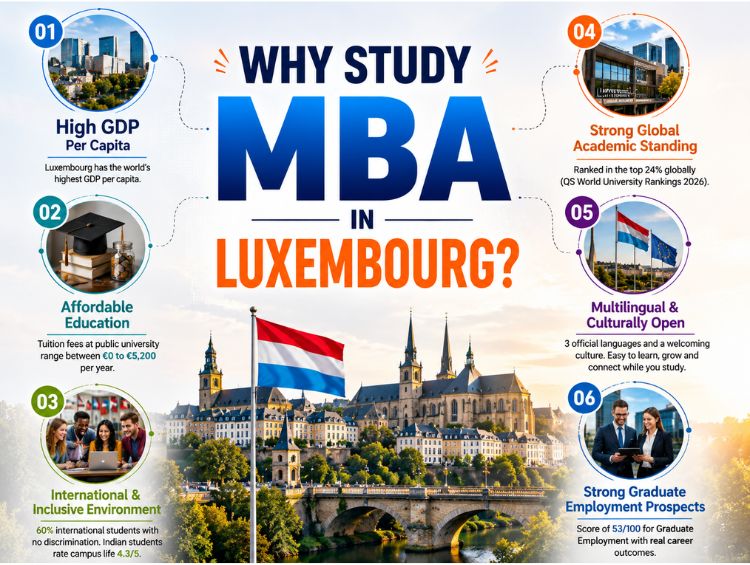
1. World's highest GDP per capita
Luxembourg is the country with the highest GDP per capita in the entire world — a genuine reflection of the country's economic strength and corresponding earning potential for graduates.
2. Remarkably affordable public university option
The cost of studying at the University of Luxembourg, the only public university, ranges between 0 and €5,200 per academic year — genuinely exceptional value compared to most European MBA destinations.
3. Genuinely international, low-discrimination environment
60% of the students are from foreign countries, and students have not reported any discrimination at the University — Indian students specifically have rated the University 4.3 stars out of five for overall campus life quality.
4. Strong global academic standing despite small size
Despite being a small country, the University of Luxembourg ranks among the top 24% of institutions globally per QS World University Rankings 2026, with particularly strong scores in international character and academic staff-to-student ratio.
5. Multilingual, culturally open environment
Luxembourg is known for its friendliness towards internationals and an overall open culture, with three official languages (Luxembourgish, French, German) — you can learn the basics or advance your level easily while studying and living there, even while pursuing your MBA primarily in English.
6. Strong graduate employment prospects
The University of Luxembourg scores 53 out of 100 for Graduate Employment based on university-provided data and global listings such as Forbes 30 under 30 — a genuine signal of real career outcomes for graduates.
Eligibility Criteria for MBA in Luxembourg
Before applying to MBA programs in Luxembourg, make sure you meet the following eligibility requirements for 2026 admissions.
Academic qualification
- A relevant bachelor's degree is required for postgraduate admission, with international applicants needing to obtain recognition of equivalence for non-Luxembourg degrees from Luxembourg's Ministry of Education, Children and Youth — a process requiring at least six weeks.
Work experience
- Relevant work experience is typically expected for MBA programs, particularly at private business schools, though specific requirements genuinely vary by institution.
Standardised test scores
- Most MBA programs typically require GMAT or GRE scores, with studying an MBA in Luxembourg without a GMAT generally not possible at most institutions — though post-pandemic, several business schools have begun waiving this requirement, so it's genuinely worth confirming directly with your chosen MBA school.
English proficiency
- Since English is often the language of instruction in MBA programs in Luxembourg, international applicants need to demonstrate English proficiency through exams like TOEFL (minimum 87) or IELTS.
Application essentials
- A completed application, letters of recommendation, a CV, academic transcripts, and — for postgraduate programs — GRE/GMAT scores are standard requirements across Luxembourg's universities
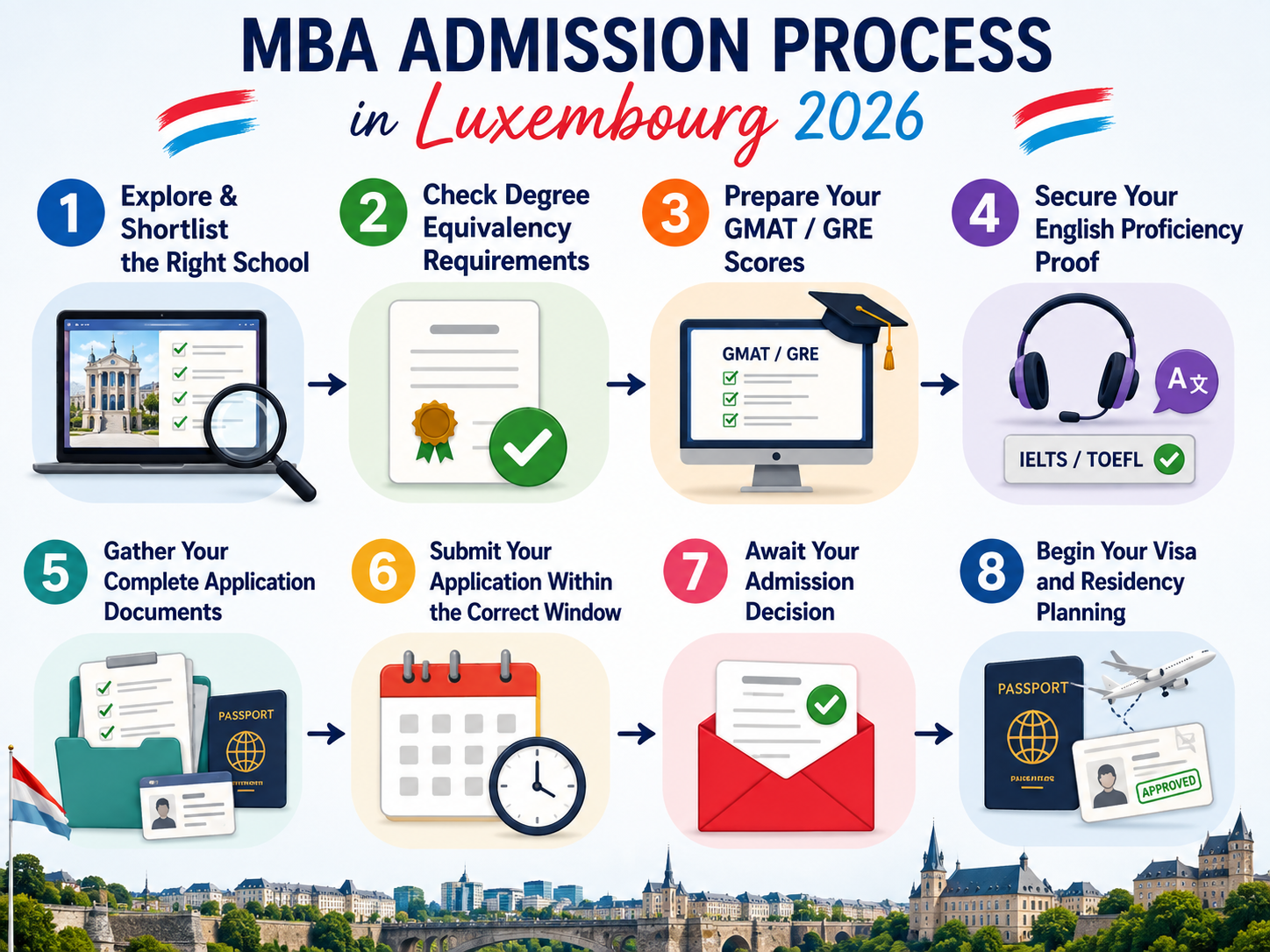
Here's a step-by-step breakdown of what the admission process looks like for 2026.
Step 1: Research and shortlist your institution
Choose between the University of Luxembourg (the sole public option, offering exceptional value) and Luxembourg's 5 private MBA schools, based on your budget and program format preferences.
Step 2: Verify degree equivalence requirements
If your undergraduate degree isn't from Luxembourg, initiate the recognition of equivalence process with the Ministry of Education, Children and Youth early — this alone requires at least six weeks.
Step 3: Prepare your standardised test scores
Take the GMAT or GRE as required, and confirm your specific target school's current policy on waivers.
Step 4: Secure your English proficiency proof
Complete IELTS or TOEFL (minimum 87 for TOEFL) as required for your program.
Step 5: Gather your complete application documents
Prepare your bachelor's degree certificate, academic transcripts, CV, letters of recommendation, GRE/GMAT scores, and English proficiency documentation.
Step 6: Submit your application within the correct window
The application cycle for the University of Luxembourg's 2025-2026 academic year opened on February 1, 2025, with the 2026 academic year application window similarly opening around February 1, 2026 for both UG and PG programs — apply early, since additional documents may be requested for review, and note that competitive programs sometimes have earlier admission deadlines.
Step 7: Await your admission decision
The University of Luxembourg employs a selective approach with a 21% acceptance rate, ensuring high academic standards while maintaining its multilingual educational environment — build realistic expectations around this competitiveness.
Step 8: Begin your visa and residency planning
International students planning to study in Luxembourg should research visa and residency requirements early, ensuring you have the necessary documents and permits well ahead of your intended start date.
GMAT, GRE & English Language Requirements
Here's what you need to know about standardised testing and English proficiency for MBA programs in Luxembourg in 2026.
GMAT/GRE is genuinely standard, with limited waiver availability
MBA programs may require you to submit scores from standardised tests like the GMAT or GRE, and studying an MBA in Luxembourg without a GMAT is generally not possible — though the post-pandemic landscape has led some business schools to waive this requirement, so confirming with your chosen school directly remains essential.
PG-level requirements at the University of Luxembourg specifically
The application criteria for PG-level programs require a UG Degree, reference letters, a CV, an English Language Test (IELTS or TOEFL 87), and GRE/GMAT — a genuinely comprehensive, standard European postgraduate application package.
English proficiency benchmarks
TOEFL scores around 87 or equivalent IELTS scores are commonly required, since English serves as the primary language of instruction for many MBA programs despite Luxembourg's three official languages (Luxembourgish, French, German).
Score requirement variation across programs
The score requirements for GMAT/GRE can vary by program, so checking the specific requirements of your target institutions directly remains essential rather than assuming uniform benchmarks across Luxembourg's small pool of MBA-offering institutions.
Since Luxembourg's MBA landscape is genuinely smaller than other European destinations (just 1 public university plus 5 private schools), the administrative benefit is that you can realistically research every single option's exact testing requirements individually rather than navigating dozens of institutions — invest that saved research time into confirming current GMAT waiver policies directly with each of your target schools.
Top MBA Universities in Luxembourg for International Students
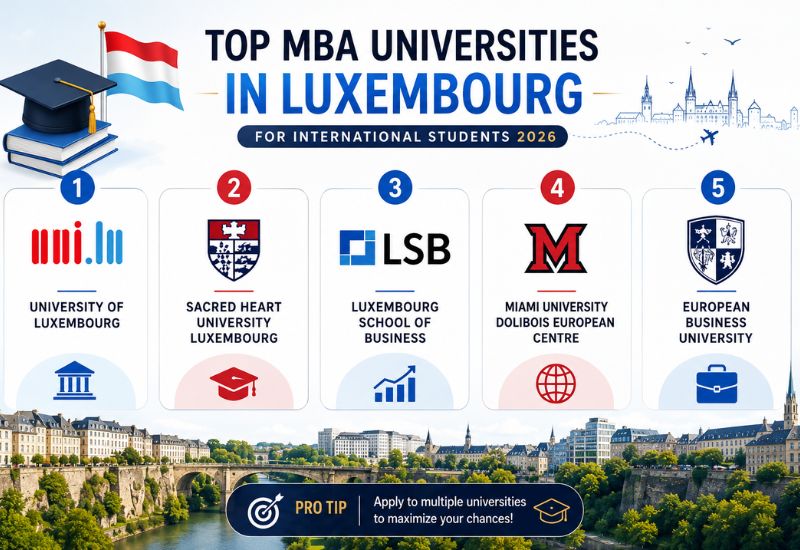
Here's a rundown of Luxembourg's genuinely compact but quality MBA landscape for 2026.
1. University of Luxembourg
The country's sole public university, achieving perfect scores of 100 points for both International Faculty Ratio and International Student Ratio — genuinely exceptional value with tuition between € 0 and € 5,200 per academic year for eligible programs.
2. Sacred Heart University Luxembourg
A branch of an American university specialising in business education, ranked among Luxembourg's top institutions alongside the University of Luxembourg. Tuition ranges between €29,000-39,000 for the full study programme (all years combined).
3. Luxembourg School of Business (LSB)
The first graduate business school in Luxembourg, founded in 2014, offering five accredited degree programs including a part-time Weekend MBA (60 ECTS), Full-time MBA (60 ECTS), Master in Management, Master in International Finance, and a Bachelor in International Business. LSB was the first business school in Luxembourg required to meet the stricter legal framework introduced in 2016, raising quality standards specifically for institutions like itself.
4. Miami University Dolibois European Centre
An American satellite campus providing liberal arts education, offering a distinctly US-style academic experience within Luxembourg.
5. European Business University
A private institution with business-focused degrees, rounding out Luxembourg's small but genuinely diverse MBA-adjacent landscape.
Given Luxembourg's genuinely small university count, apply to more than one university to help your chances — with just a handful of institutions total, comparing across all of them (rather than settling on just one) is genuinely manageable and worth doing for your 2026 application.
Best MBA Colleges in Luxembourg
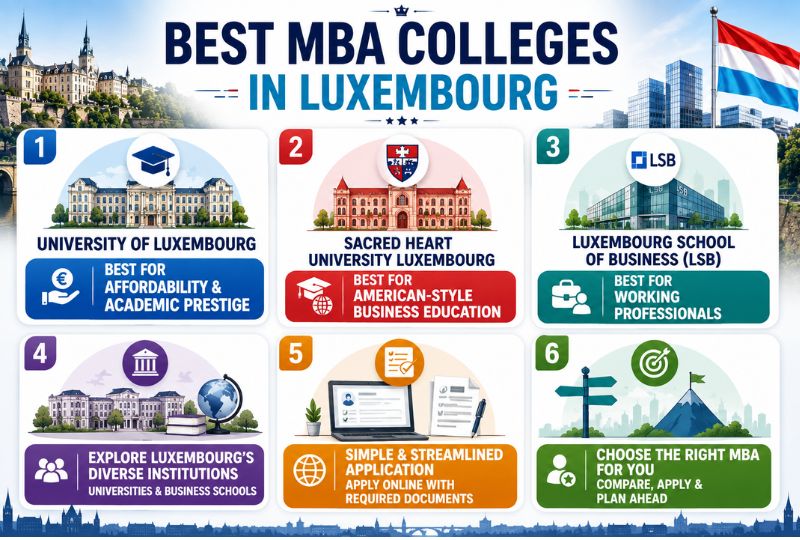
Here's what genuinely distinguishes Luxembourg's top MBA options for 2026.
University of Luxembourg — best for affordability and academic prestige
The clear standout for value, with tuition as low as €0-5,200/year, backed by a QS World University Ranking of #381 globally — though note the admissions process is genuinely selective, with acceptance rates cited between approximately 21-30% depending on the specific source and program.
Sacred Heart University Luxembourg — best for American-style business education
A branch of an American university specifically specialising in business education, appealing to students wanting a US-style curriculum within a European setting.
Luxembourg School of Business — best for working professionals
Genuinely designed with busy working professionals in mind, offering flexible modular options for its Weekend MBA and Master's in Management — a strong fit if you're balancing employment alongside your degree. LSB forges partnerships with major multinational companies and universities across the globe, attracting current and aspiring business leaders from all corners of the world.
Genuine institutional variety despite the small count
Luxembourg is home to 2 universities, 2 business schools, and one institution dedicated to Public Administration studies — a compact but genuinely purposeful spread of institution types.
Application process consistency
For all universities in Luxembourg, you can simply apply online by submitting the application form along with all requested application documents — a genuinely streamlined process compared to more bureaucratically complex destinations, though carefully check that all documents are translated into English where required.
Our advice: If affordability and prestige matter most, prioritise the University of Luxembourg. If you're a working professional needing flexibility, Luxembourg School of Business's modular Weekend MBA format offers a genuinely practical alternative without requiring you to pause your career.
MBA Specialisations in Luxembourg
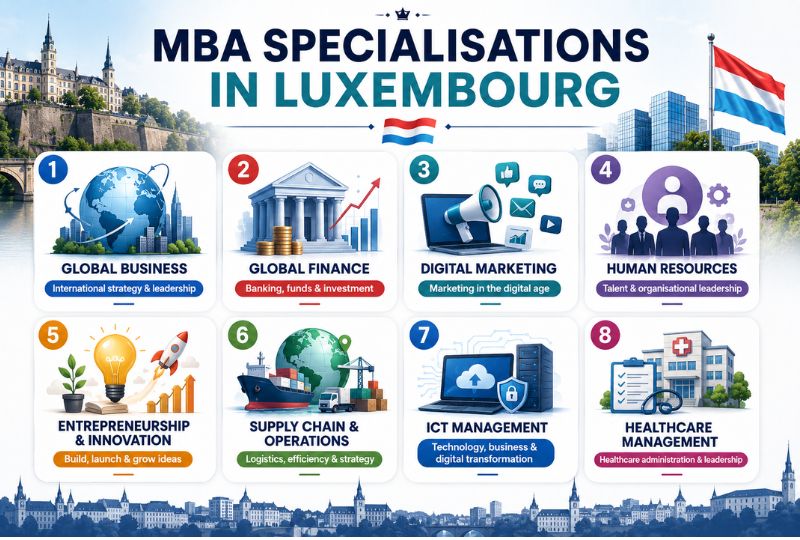
Here's what specialisation options are genuinely available across Luxembourg's MBA landscape in 2026.
1. Global Business
A broad, internationally-oriented specialisation reflecting Luxembourg's position as a genuine international financial and business hub.
2. Global Finance
Strong given Luxembourg's status as one of the world's leading financial centres, particularly for investment funds and private banking.
3. Marketing in the Digital Age
A modern, technology-integrated specialisation reflecting broader shifts in how businesses engage customers.
4. Human Resources Management
A consistently available track preparing graduates for talent management and organisational leadership roles.
5. Entrepreneurship and Innovation
Appealing to students with startup ambitions, leveraging Luxembourg's supportive business environment for new ventures.
6. Supply Chain and Operations Management
Genuinely relevant given Luxembourg's strategic Central European logistics positioning.
7. ICT Management
Reflecting the country's growing technology sector alongside its traditional financial services strength.
8. Healthcare Management
A specialised track for students interested in the business side of healthcare administration and management.
Structural note on this specialisation list
This eight-specialisation framework (Global Business, Global Finance, Marketing in the Digital Age, HR Management, Entrepreneurship and Innovation, Supply Chain and Operations Management, ICT Management, and Healthcare Management) specifically comes from a one-year (or two-year full-time) General Business and Management program awarded by CASS Europe — worth confirming whether your specific target school offers this exact specialisation structure or a different framework.
Our advice: Given Luxembourg's genuine strength as a global financial centre, Global Finance stands out as a particularly well-supported specialisation here — but since specialisation offerings can vary by specific school and program, confirm the exact list available at your shortlisted institution before finalising your application.
MBA Fees in Luxembourg for International Students
Understanding the fee landscape helps you budget realistically across Luxembourg's MBA programs for 2026.
Public university tier
The University of Luxembourg charges between € 0 and € 5,200 per academic year for most programs — though more specialised courses, like a Master's in Logistics and Supply Chain Management, can cost €24,000 per academic year, so verify your specific program's exact fee structure rather than assuming the lower baseline applies universally.
Private university tier
At private universities, tuition costs are usually much higher — Sacred Heart University Luxembourg, for example, charges between €29,000-39,000 for a full study programme (covering all years of study).
Full-time MBA program range (non-EU students)
Tuition fees for full-time MBA programs in Luxembourg for non-EU students can range from approximately €10,000 to €25,000 or more for the entire program, with EU students typically paying lower rates.
Citizenship-based fee variation
During your application, always check what tuition applies specifically to you — non-EU citizens might have to pay more than EU/EEA citizens across most Luxembourg institutions.
Part-time and Executive MBA cost considerations
Part-time and executive MBA programs are often designed for working professionals and may carry different fee structures than full-time equivalents — confirm this directly with your target school if you're considering the Weekend MBA or similar flexible formats.
Our advice: Since Luxembourg's fee landscape genuinely spans from near-free (University of Luxembourg's €0-5,200 range) to premium private tuition (€29,000-39,000 at Sacred Heart), match your institution choice to your budget realistically — and always verify your specific citizenship-based fee tier before finalising your financial planning.
Cost of Living in Luxembourg for MBA Students
Here's a realistic breakdown of monthly living expenses for MBA students in Luxembourg in 2026.
Accommodation costs
- University dormitories: The cheapest option, ranging between €350-400/month, with utility costs included
- Private flat rental: Depending on apartment type and area, expect to pay anywhere between €600-1,000/month — you can lower expenses by sharing a 2- or 3-bedroom apartment with other students
- Utilities (if renting independently): Around €180-250/month in total
Food and groceries
Students usually spend between €250-350 per month on food and groceries, though your specific eating habits (cooking vs. eating out) will meaningfully determine where you land within this range.
Transportation — a genuine standout advantage
Since March 2020, public transport — trains, buses, trams — is completely free in Luxembourg, a genuinely significant cost-saving advantage compared to nearly every other European study destination.
Overall living cost context
While you'll enjoy Luxembourg's high standard of living, it doesn't come cheap overall — though the combination of free public transport and dormitory-based accommodation options genuinely helps offset what would otherwise be a costly European capital-adjacent lifestyle.
Our advice: Since public transport is entirely free nationwide, factor this genuine cost advantage into your overall budget comparison against other European MBA destinations — and prioritise university dormitories or shared apartments over solo private rentals to keep your monthly accommodation costs meaningfully lower during your program
Scholarships for MBA in Luxembourg
- Luxembourg School of Business (LSB) Scholarships — Offers partial tuition waivers and merit-based scholarships covering up to 50% of MBA tuition fees for exceptional international candidates.
- International Entrepreneur Scholarships (LSB) — Specifically designed for entrepreneurs managing businesses, covering more than 50% (up to 75%) of the MBA programme's tuition fee
- European Business University Scholarships — Provide financial aid to outstanding international students pursuing undergraduate and graduate degrees, promoting cultural exchange and global learning.g
- University of Luxembourg Guillaume Dupaix International Master's Scholarship — Supports students pursuing master's programmes that bridge multiple disciplines.
- External scholarships for Indian students — Options like the JN Tata Endowment Fund Scholarships support Indian students pursuing postgraduate, doctoral, and postdoctoral studies abroad, covering tuition, stipends, and travel
- AFR PhD Individual Grants — Provided by Luxembourg's National Research Fund (FNR) for early-stage researchers, relevant if pursuing further academic pathways beyond the MBA
- Application strategy — Start applying at least 6-9 months in advance, since scholarship deadlines often fall before university admission deadlines, and carefully match eligibility criteria for each specific scholarship before applying
MBA in Luxembourg for Indian Students
- MBA as the top choice — MBA programs are the top choice among Indian students looking for higher studies in Luxembourg, reflecting strong existing interest in this specific degree
- High visa acceptance rate — The Luxembourg study visa application process has an acceptance rate of 96-99%, making it a highly accessible destination for Indian applicants
- Low-cost public university option — The University of Luxembourg, the country's only public university, charges just €200 per semester after the first year — one of the most affordable options in Western Europe. ope
- Diverse, international environment — The university is exceptionally diverse, with students and staff from all over the globe, easing the cultural transition for Indian students .ents
- No language barrier for coursework — Most graduate programs are taught entirely in English, though learning basic French or German helps with daily life, part-time jobs, and social integration.
- Strong post-study sector alignment — Post-study work opportunities are particularly strong in finance, IT, logistics, and EU institutions, given Luxembourg's status as a major EU financial hub.
- Easy EU travel access — A Luxembourg student visa also enables easy travel to other EU countries, adding broader European mobility value beyond the degree itself.lf
- Safety and quality of life — Luxembourg is one of the safest and richest countries in the world, with excellent healthcare, transport, and infrastructure
MBA in Luxembourg Without GMAT
- GMAT not universally required — Most universities in Luxembourg allow students to apply without a mandatory GMAT, though some business schools (like Luxembourg School of Business and Sacred Heart University Luxembourg) may prefer or recommend it for MBA applicants specifically
- Profile-based alternative — For candidates without a strong GMAT score, a solid academic background and relevant professional experience can often substitute, particularly at smaller or newer business schools.
- Research-program distinction — For research-based master's programs (like Data Science or Engineering), a strong academic background and math skills matter more than GRE/GMAT scores — a useful reference point if considering a related management-adjacent specialisation
- Check program-specific requirements — Since exact requirements vary by program and institution, confirming whether GMAT is mandatory, recommended, or waived directly with your shortlisted school (LSB, SHU Luxembourg, or others) is essential before applying.
- English proficiency is still required — Even without GMAT, English proficiency (or French/German for non-English programs) remains a standard requirement across nearly all Luxembourg MBA options.
MBA in Luxembourg: Course Duration & Curriculum
- Standard MBA providers — Luxembourg School of Business and Sacred Heart University Luxembourg are the primary institutions offering dedicated MBA programs, alongside a Master in Management option at L.S.
- Program structure — MBA programs in Luxembourg follow standard international formats, generally taught fully in English to accommodate the diverse, international student body
- Business school specialisation strength — Luxembourg School of Business (LSB) is specifically known for its high-quality MBA and specialised Master's programs in finance and management, leveraging the country's status as a major EU financial centre
- Complementary specialisation options — Related programs at the University of Luxembourg include finance-adjacent tracks like Advanced Economics (blending economics with quantitative analysis, financial modelling, and investment analysis), useful for students considering a finance-focused MBA specialisation
- Application-to-decision timeline — After submitting your application, universities typically take a few weeks to a couple of months to process applications and issue admission offers
- Interdisciplinary research strength — The University of Luxembourg is home to renowned interdisciplinary research centres (like SnT for security/reliability/trust), reflecting the country's broader innovation-focused academic environment that can complement management education
MBA Placements in Luxembourg
- Strong local retention rate (University-wide benchmark) — 86% of University of Luxembourg Master's graduates stay in Luxembourg for their first job, indicating strong local employability for graduates broadly
- Key employing industries — IT Services, Legal Services, Banking/Finance/Accounting, and Education are the primary sectors absorbing Master's graduates from the university.
- Finance-sector strength — Given Luxembourg's status as a major EU financial and banking hub, MBA and finance-specialisation graduates find particularly strong local placement opportunities in Banking/Finance/Accounting.
- Post-study sector alignment — Finance, IT, logistics, and EU institutions represent the strongest post-study career pathways for international graduates specifically.
- Part-time work rights during study — Students can work 15 hours per week while the university is in session and full-time (40 hours/week) during holidays, supporting both financial sustainability and early local work experience
- Growing graduate output — The University of Luxembourg produced 1,800+ graduates in 2025 alone, with 19,500+ total graduates to date, reflecting a steadily growing but still relatively compact talent pool compared to larger European destinations
- Placement data caveat — Since the 86% retention figure reflects University of Luxembourg Master's graduates broadly (not MBA-specific data from LSB or SHU), checking each specific business school's own published placement report is more reliable for MBA-specific outcomes
Note: MBA fees, scholarship amounts, aur placement figures Luxembourg School of Business, Sacred Heart University, aur University of Luxembourg ke beech significantly vary karte hain, aur MBA-specific centralised placement data limited hai — publish se pehle official university/business school websites se latest 2026-27 admission cycle, fees, aur placement details verify kar lena strongly recommend karta hoon.
Average MBA Salary in Luxembourg
- General graduate starting salary range — €50,000-70,000 per year, depending on the industry and role, for graduates from Luxembourg universities broadly
- MBA-specific market context — Given Luxembourg's status as a major EU financial hub, MBA graduates entering banking, finance, or consulting roles typically land at the higher end of this range, though comprehensive MBA-specific salary data is limited.
- Legal minimum wage benchmark — €2,313/month gross is Luxembourg's current legal minimum salary threshold, relevant since work-permit approvals require salaries to meet or exceed this floor.r
- High cost-of-living context — Luxembourg salaries need to be evaluated alongside its notably high cost of living — one of the highest in Europe — so nominal salary figures should be weighed against this when comparing to other MBA destinations
- Major employer presence supporting salary bands — Global companies like Amazon, Deloitte, PwC, and various EU institutions are based in Luxembourg, creating strong demand and correspondingly competitive salary offers for management graduates
- Sector-based variation — Finance, IT, logistics, and EU institution roles tend to offer the most competitive packages, consistent with Luxembourg's core economic strength.hs
- Since detailed program-specific MBA salary data (LSB, SHU Luxembourg) isn't widely published, treating the €50,000-70,000 range as a general graduate benchmark rather than an MBA-specific guarantee is the more honest approach.
Student Visa & Residence Permit for Luxembourg
- Two-stage process — First, apply for a temporary residence permit (and Type D visa if required) from your home country through the Immigration Directorate or a Luxembourgish diplomatic mission; second, complete residence permit formalities after arriving in Luxembourg
- Core application documents — Application on plain paper with exact address details, proof of full-time admission to a Luxembourg higher education institution, evidence of sufficient funds (approx. €10,000+ for one academic year), health insurance covering Luxembourg, and a criminal record extract or affidavit
- Type D visa — Costs €50, valid for 90 days, stamped into your passport to facilitate entry into Luxembourg
- Processing time — Maximum 60 days for the temporary residence permit response, with the approved 90-day permit dispatched by mail
- High approval rate — The overall Luxembourg study visa application process has a 96-99% acceptance rate, making it one of the more accessible visa routes for Indian applicants
- Part-time work rights during study — Students can work up to 15 hours/week during term (at competitive wages of €8-14/hour) and full-time during holidays
- Spouse visa possibility — Available under certain conditions for students enrolled in long-term Master's programs, relevant for those planning to bring family
- Document translation requirement — All documents must be translated into English, French, or German if originally in another language
Career Opportunities After MBA in Luxembourg
- Finance and Banking — Luxembourg's core economic strength, given its status as a major EU financial centre, offering strong opportunities for MBA graduates in banking, asset management, and financial services
- Consulting — Major firms like Deloitte and PwC are based in Luxembourg, offering direct consulting career pathways for MBA graduates
- E-commerce and Technology — Amazon's Luxembourg presence reflects growing tech-sector opportunities alongside traditional finance roles
- EU Institutions — A distinctive Luxembourg advantage — several European Union institutions are headquartered here, opening pathways into EU policy, administration, and institutional roles not readily available in most other study destinations
- Logistics — Reflecting Luxembourg's strategic EU location, logistics roles form another consistent post-study career pathway
- High local retention — 86% of University of Luxembourg Master's graduates stay in Luxembourg for their first job, indicating strong local employability and a genuinely functional talent-to-job pipeline
- IT Services and Legal Services — Alongside Banking/Finance/Accounting, these round out the primary industries employing Master's-level graduates from Luxembourg universities
Post-Study Work Opportunities in Luxembourg
- 12-month job-search/business-setup permit — Third-country nationals (including Indians) who complete a Master's degree (or defend a PhD thesis) in Luxembourg can stay on to look for a job or set up a business
- Application timing — Must be submitted at least 30 days before the expiry of your student residence permit, ideally during your final semester to avoid gaps
- Application fee — €80 issuance fee for this post-study residence permit
- Employment relevance requirement — Any employed or self-employed work pursued during this period must relate to your prior academic training (i.e., your MBA specialisation)
- Simplified conversion process — Students who already have a job offer or a concrete business start-up plan can apply for a residence permit for employees or self-employed workers using a simplified procedure
- Path to longer-term status — Securing a job during this post-study period allows conversion to a more permanent legal status, potentially opening a path toward EU long-term residency (after 5 years) and eventually citizenship
- Salaried work permit requirement (post-conversion) — Requires employer sponsorship, an ADEM labour market test (checking no suitable EU/local candidate exists), and a salary meeting Luxembourg's minimum threshold (currently €2,313/month gross)
- Historical note on longer permits — Some older forum discussions reference a 2-year work permit specifically tied to certain MBA programs, though current standard policy centres on the 12-month job-search permit — confirming the latest applicable rule directly with your specific university and Luxembourg immigration authorities is essential
ROI of MBA in Luxembourg (Fees vs Salary)
- University of Luxembourg (public) — Fees: €0-5,200/year (or just €200/semester after year one) vs. general graduate salary €50,000-70,000/year → Exceptional ROI, among the most cost-efficient postgraduate options in Western Europe
- Luxembourg School of Business (LSB) with scholarship — Fees reduced by up to 50-75% via merit or entrepreneur-specific scholarships vs. finance/consulting-sector salary outcomes at the higher end of €50,000-70,000 → Strong ROI, particularly for scholarship recipients
- Sacred Heart University Luxembourg — Standard private-institute fee bracket vs. similar general salary benchmark → Moderate-to-good ROI, depending on scholarship eligibility and specific program cost
- Cost-of-living caveat on ROI — Since Luxembourg has a notably high cost of living, the headline salary-vs-fee ratio should be evaluated net of living expenses, not just gross tuition-to-salary comparison.
- EU mobility as an ROI multiplier — Beyond direct salary, the ability to easily work and travel across the broader EU with a Luxembourg-based degree and residence history adds long-term career value not captured in a simple fees-vs-salary calculation.n
- General positioning — Luxembourg's ROI case rests heavily on its remarkably low public-university tuition combined with genuinely strong finance/EU-institution salary access — a combination that's difficult to match at this price point in most other Western European countries.
Frequently Asked Questions (FAQs)
Q1. How much does an MBA cost in Luxembourg?
At the public University of Luxembourg, fees are extremely low — €0-5,200/year, or just €200/semester after the first year — while private business schools like Luxembourg School of Business (LSB) charge more but offer scholarships covering up to 50-75% of tuition.
Q2. Is the GMAT mandatory for an MBA in Luxembourg?
Not universally — most universities allow applications without a mandatory GMAT, though some business schools like LSB and Sacred Heart University Luxembourg may prefer or recommend it for MBA applicants specifically.
Q3. What is the average salary after an MBA in Luxembourg?
General graduate starting salaries range €50,000-70,000/year depending on industry and role, with finance and consulting roles typically at the higher end given Luxembourg's status as a major EU financial hub.
Q4. Can I stay and work in Luxembourg after my MBA?
Yes, graduates can apply for a 12-month residence permit to look for a job or start a business, provided the work relates to their academic training, with an €80 issuance fee.
Q5. Is a Luxembourg student visa easy to get?
Yes, the process has a notably high acceptance rate of 96-99%, making it one of the more accessible study-visa destinations for Indian applicants.
Q6. Can I work part-time while studying an MBA in Luxembourg?
Yes, students can work up to 15 hours per week during term at competitive wages (€8-14/hour), and full-time during holidays.
Q7. What are the top career sectors after an MBA in Luxembourg?
Finance and banking, consulting, EU institutions, technology (via companies like Amazon), and logistics are the strongest sectors, given Luxembourg's role as a major EU financial and administrative centre.
Q8. Are scholarships available for Indian MBA students in Luxembourg?
Yes — Luxembourg School of Business offers merit-based scholarships up to 50% (and up to 75% for entrepreneurs), alongside external options like the JN Tata Endowment Fund for Indian students specifically.
Conclusion
An MBA in Luxembourg offers a genuinely distinctive value proposition among European study destinations — remarkably low tuition at the public University of Luxembourg, combined with strong scholarship access at private schools like Luxembourg School of Business, all set within one of Europe's wealthiest, safest, and most strategically positioned economies for finance and EU institutional careers. With graduate salaries typically ranging €50,000-70,000/year, a highly accessible 96-99% visa approval rate, and direct access to major employers like Amazon, Deloitte, and PwC alongside EU institutions themselves, Luxembourg presents a compelling low-cost, high-access pathway into European business careers — particularly for students targeting finance, consulting, or EU-institutional roles.