




MBA in Japan for Indian Students 2026: Fees, Admission, Scholarships, Visa & Placements
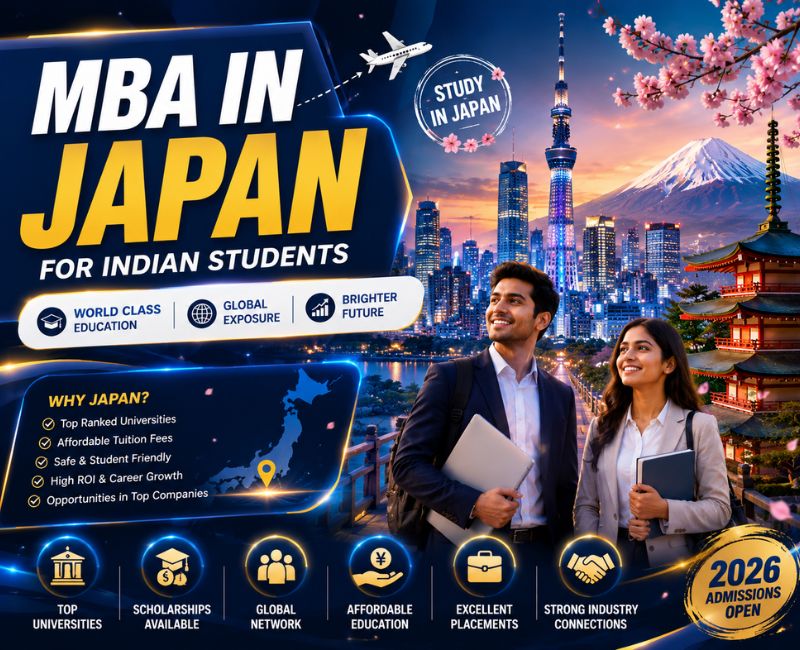
Table of Contents
MBA in Japan for Indian Students 2026: Highlights
For Indian students specifically, Japan has emerged as a genuinely underrated MBA destination — combining globally recognised business education with tuition costs that make even premium programs look budget-friendly compared to the US or UK. Over 1,300 Indian students are currently pursuing higher education in Japan, and that number keeps growing as awareness spreads beyond the country's traditional engineering and tech reputation into business education.
Why Study MBA in Japan for Indian Students?
Considering Japan for your MBA specifically as an Indian applicant? Here's why it makes strategic sense in 2026.
1. Dramatically more affordable than US/UK/Australia MBA programs
Where a US MBA can easily run ₹80 Lakhs-1.5 Crore, Japan's top programs range from ₹15-25 Lakhs in tuition — a genuine game-changer for Indian families weighing education loans against realistic ROI.
2. English-medium instruction removes the language barrier for coursework
Most top MBA programs are taught entirely in English, meaning Indian students with strong English proficiency (a genuine strength given India's English-medium education system) can apply and study without needing prior Japanese language skills.
3. GMAT flexibility genuinely benefits Indian applicants
Given how competitive GMAT scores can be among Indian applicants pursuing MBAs generally, Japan's more holistic approach — GLOBIS requiring no GMAT at all, Hitotsubashi ICS and Waseda accepting scores without mandating a minimum — reduces one major source of application pressure.
4. Genuinely strong post-MBA earning potential
Average salaries of ¥9M-13M (₹55-80 Lakhs) annually offer meaningful upside relative to program cost, particularly strong in consulting, finance, and technology sectors where Indian professionals often already have relevant skills.
5. A realistic long-term settlement pathway
Japan's 2026 immigration reforms have expanded the Highly Skilled Professional visa with faster permanent residency pathways — some qualifying for PR in as little as one year, offering Indian graduates a genuinely realistic long-term career and residency option beyond just the study period.
6. Growing Indian community and institutional familiarity
With over 1,300 Indian students already in Japan and growing university outreach specifically targeting Indian applicants, the pathway is becoming increasingly well-trodden rather than experimental.
The bottom line: For Indian students specifically weighing cost, career outcomes, and long-term settlement options together, Japan offers a genuinely compelling combination that's harder to match in traditional Western MBA destinations for 2026.
Benefits of Pursuing an MBA in Japan
Still weighing your options as an Indian applicant? Here's a clear breakdown of the key benefits for 2026.
1. Exceptional cost-to-outcome ratio
₹40 Lakhs is generally sufficient to complete an MBA in Japan, covering both tuition (₹15-25 Lakhs) and living expenses (₹10-15 Lakhs) — genuinely modest relative to comparable global programs, easing the education loan burden many Indian families navigate.
2. Direct access to Japan's manufacturing and technology strength
Schools like NUCB offer unique access to Japan's manufacturing and automotive sectors through direct proximity to companies like Toyota, Brother, and Noritake — valuable for Indian engineers or technical professionals transitioning into management.
3. Strong industry connections beyond Japan itself
Graduates benefit from strong industry connections in consulting, finance, and technology — sectors where Indian professionals often already carry relevant transferable experience.
4. Meaningful scholarship access specifically for Indian applicants
The MEXT Scholarship (fully covering tuition, living allowance, and airfare) and JASSO monthly stipends are genuinely accessible to Indian applicants who meet the eligibility criteria, alongside university-specific waivers reaching up to 80% of tuition at schools like NUCB.
5. Part-time work rights supporting Indian students during study
International students can work up to 28 hours/week during the semester, helping offset living costs — a genuine practical benefit for Indian students managing tight budgets during their program.
6. A distinctive career narrative
An MBA from Japan, backed by genuine cross-cultural business exposure between Asian and Western practices, offers Indian professionals a distinctive career story compared to more common US/UK MBA backgrounds — a genuine differentiator when competing for roles with international, Asia-Pacific-facing companies.
The takeaway: For Indian students specifically, an MBA in Japan combines financial practicality, genuine career upside, and a distinctive professional narrative — translating into strong overall value for 2026 applicants.
Eligibility Criteria for MBA in Japan for Indian Students
Before applying to MBA programs in Japan as an Indian student, make sure you meet the following eligibility requirements for 2026 admissions.
Academic qualification
- A completed bachelor's degree from a recognized Indian university, with a minimum GPA typically around 2.5 as a general baseline expectation (equivalent conversion may be needed depending on your specific university's grading system)
Work experience
- Most programs expect 2-5 years of professional work experience, though this requirement varies by school and program format.
Standardised test scores
- GMAT/GRE requirements vary significantly by school — GLOBIS University requires no GMAT at all, Hitotsubashi ICS and Waseda accept GMAT or GRE without mandating a minimum score, while Keio Business School treats GMAT/GRE as optional
English proficiency
- IELTS 6.5+ or TOEFL 80+ (internet-based) is generally recommended, though this requirement is typically waived if your earlier degree was taught in English — a genuine advantage for Indian applicants from English-medium undergraduate programs
Application essentials
- Academic transcripts, 2-3 Letters of Recommendation from academic or professional referees, a Statement of Purpose/essays articulating career goals, and a detailed professional CV
Visa-specific documentation
- Most universities require a Certificate of Eligibility for visa purposes, processed alongside your admission, followed by your actual student visa application at the Japanese embassy/consulate in India.
Our advice: Since your English-medium Indian undergraduate degree likely qualifies you for an English proficiency waiver at most schools, focus your preparation energy on your Statement of Purpose and interview performance instead — these carry genuine weight in Japan's more holistic admissions approach.
Admission Process for MBA in Japan 2026
Here's a step-by-step breakdown of what the admission process looks like specifically for Indian applicants in 2026.
Step 1: Choose your program and target schools. Prioritise schools based on program specialisation, global rankings, and GMAT flexibility — strong options for Indian applicants include NUCB, Hitotsubashi ICS, Waseda, IUJ, and GLOBIS.
Step 2: Take the GMAT or GRE if required (or beneficial)
While optional at many schools, submitting a GMAT/GRE score can strengthen your application and unlock better scholarship access even where not strictly mandatory.
Step 3: Secure English proficiency proof (or confirm your waiver eligibility)
Check whether your English-medium Indian degree qualifies you for a waiver, or take TOEFL/IELTS if required.
Step 4: Compile your application documents
Gather academic transcripts (with equivalency conversion if needed), a professional CV, recommendation letters, and draft a compelling Statement of Purpose articulating your career goals and motivation for choosing Japan specifically.
Step 5: Submit your application through the university's official portal
Complete the application form, upload all required documents, and pay the application fee — note that application windows vary significantly by school, with some offering multiple rounds throughout the year.
Step 6: Prepare for and attend your interview
If shortlisted, prepare for an interview (often conducted online, convenient for Indian applicants), which carries genuine weight in Japan's holistic evaluation process.
Step 7: Apply for scholarships alongside your admission process
Research MEXT Scholarship deadlines (typically February-May) and university-specific scholarship windows early, since these often run parallel to, not after, your admission process.
Step 8: Await your final admission decision, then begin visa preparation
Once accepted, start your Certificate of Eligibility and student visa application process at the Japanese embassy or consulate in India well ahead of your intended start date.
Our advice: Since MEXT Scholarship deadlines fall well before most program start dates, and application windows genuinely vary by school, begin your research and preparation 6-12 months ahead — this gives you enough runway to properly prepare test scores, documents, scholarship applications, and visa processing without unnecessary last-minute pressure specific to applying from India.
GMAT, GRE & English Language Requirements
Here's what Indian applicants specifically need to know about standardised testing and English proficiency for MBA programs in Japan in 2026.
GMAT/GRE requirements genuinely vary by school
- GLOBIS University: No GMAT required at all, making it genuinely accessible for Indian career changers or those without strong test-prep bandwidth
- Hitotsubashi ICS and Waseda: Accept GMAT or GRE but don't mandate a minimum score
- Keio Business School: Treats GMAT/GRE as an optional component
- NUCB: GMAT/GRE is generally expected but can be waived with 8+ years of work experience
What's a competitive score for Indian applicants specifically?
Given how competitive Indian applicant pools tend to be for GMAT in general (Indian students often post strong quant scores), an average GMAT score of 600 is generally considered good, though scholarship-focused applicants at schools like Hitotsubashi ICS report cohort averages closer to 685-695 — worth aiming higher if scholarship money is a priority.
English proficiency — a genuine Indian applicant advantage
IELTS 6.5+ or TOEFL 80+ is generally recommended, but this is typically waived entirely if your prior degree was taught in English — since most Indian undergraduate programs (engineering, commerce, and business degrees especially) are English-medium, a large share of Indian applicants can skip this requirement altogether, saving both time and money.
Documentation for the waiver
If claiming this waiver, you'll typically need an official letter from your Indian university confirming English was the medium of instruction throughout your degree — request this early, since university administrative offices in India can take weeks to process such letters.
Japanese language — not required, but worth considering
Since most MBA programs are taught entirely in English, Japanese proficiency isn't a coursework requirement. However, for Indian graduates hoping to build a long-term career in Japan (rather than just complete the MBA and leave), basic Japanese meaningfully broadens local job market access, particularly outside international-facing MNC roles.
Our advice: Indian applicants should specifically request their university's English-medium-instruction confirmation letter as early as possible in their application timeline — this single document can eliminate an entire testing requirement (and its associated cost and prep time) for a large share of Indian MBA applicants targeting Japan.
Top MBA Universities in Japan for Indian Students
Here's a rundown of Japan's leading MBA institutions that are genuinely well-suited to Indian applicants in 2026.
1. Hitotsubashi ICS (Tokyo)
Possibly the strongest ROI story available to Indian applicants globally — tuition as low as ¥535,800-1,071,600 (₹3.25-6.5 Lakh) against graduate salaries of ¥3.6M-8M. Accepts GMAT/GRE without a strict minimum, and an English waiver applies for Indian English-medium graduates.
2. NUCB Business School (Nagoya)
Japan's only Triple Crown-accredited school (AACSB + AMBA + EQUIS), offering up to 80% tuition waivers for strong GMAT/GRE scores — a genuine draw for well-prepared Indian applicants willing to submit a competitive score.
3. Waseda Business School (Tokyo)
Admits students from over 100 countries, with a large, genuinely international cohort that Indian students often find easier to integrate into given the program's diversity-first culture.
4. GLOBIS University
No GMAT required at all — a genuinely accessible option for Indian professionals from non-traditional MBA backgrounds (arts, humanities, or those without strong quant test scores) who still bring genuine business potential.
5. International University of Japan (IUJ)
One of Japan's earliest English-taught MBA programs, with a long track record specifically of training international students, including many from South Asia.
6. Doshisha University (Kyoto)
Small, intimate cohorts (around 20 students annually) — appealing to Indian applicants who prefer close faculty mentorship over larger program scale.
Our advice: If you're an Indian applicant with strong GMAT prep capacity, target NUCB for the accreditation-plus-scholarship combination. If your strength lies more in genuine business aptitude and work experience than standardised testing, GLOBIS or Hitotsubashi ICS offer more accessible, equally strong-value pathways.
MBA Specialisations in Japan
Here's what specialisation options genuinely resonate with Indian students' career backgrounds and goals in 2026.
1. Technology Management
Given how many Indian MBA applicants come from engineering or IT backgrounds, this specialisation builds directly on existing technical strength while adding business leadership skills — genuinely well-aligned with common Indian applicant profiles.
2. Finance
Strong given Tokyo's status as a major Asian financial hub — particularly relevant for Indian applicants with prior banking, consulting, or financial services experience wanting international exposure.
3. Manufacturing and Operations Management
A distinctive NUCB strength through its Chubu region connections to Toyota, Brother, and Noritake — genuinely valuable for Indian applicants from engineering or manufacturing sector backgrounds looking to transition into management.
4. International Business / Global Strategy
Appeals to Indian applicants specifically interested in Asia-Pacific business dynamics, given Japan's position as a bridge between Western and Asian business practices.
5. Innovation and Entrepreneurship
A genuine GLOBIS strength, appealing to Indian applicants with startup experience or entrepreneurial ambitions, backed by founder Yoshito Hori's venture capital background.
6. Marketing and Business Analytics
Increasingly relevant given rising demand for these functions in Japan's evolving digital economy — accessible to Indian applicants from diverse undergraduate backgrounds.
Our advice: Choose your specialisation based on genuine alignment with your existing professional background rather than perceived prestige — Indian applicants transitioning from technical roles (engineering, IT) often find Technology Management or Operations specialisations deliver stronger ROI than generic tracks, since they build on skills you already have.
MBA Fees in Japan for Indian Students
Planning your budget as an Indian applicant? Here's a realistic breakdown of costs for 2026.
Exceptional value tier
- Hitotsubashi ICS: ¥535,800 (1-year, ₹3.25 Lakh) or ¥1,071,600 (2-year, ₹6.5 Lakh)
Strong mid-tier options
- NUCB Business School: Approximately ¥2.7 million (₹15.4 Lakh), with up to 80% waivable based on GMAT/GRE score
- Doshisha University: Approximately ₹7.8 Lakh for the full program
Premium tier
- GLOBIS University: Approximately ¥5.8 million (₹33 Lakh), though generous scholarships can meaningfully reduce this
- Waseda Business School: ¥3.37-4.425 million for 2-year programs including fees
Total budget for Indian students (tuition + living combined)
₹40 Lakhs is generally sufficient to complete an MBA in Japan, covering both tuition (₹15-25 Lakhs) and living expenses (₹10-15 Lakhs) — for schools like Hitotsubashi ICS specifically, this total drops dramatically given the program's minimal base tuition.
Currency and payment planning
Since fees are quoted in Japanese Yen, factor in currency exchange fluctuations when planning your education loan or personal funding — even modest INR-JPY rate shifts can affect your actual rupee outlay over a 1-2 year program.
Education loan considerations for Indian students
Given Japan's comparatively low tuition relative to US/UK programs, many Indian students find their required education loan amount considerably smaller — worth highlighting to Indian banks/NBFCs during loan applications, since smaller loan amounts often process faster with fewer collateral requirements.
Our advice: Indian applicants should specifically pursue GMAT/GRE submission even at schools where technically optional, since this consistently unlocks the largest scholarship reductions (up to 80% at NUCB) — turning an already affordable program into an even more exceptional value proposition.
Cost of Living in Japan for Indian Students
Here's a realistic breakdown of monthly living expenses for Indian students across Japan's major MBA cities in 2026.
National comfortable budget benchmark
A comfortable monthly budget for an international student is approximately ¥150,000 (₹84,000), including modest rent in a non-central area — with yearly living costs (excluding tuition) for an Indian student typically running around ₹6.2 Lakhs (¥1.1 million).
City-by-city monthly breakdown
- Tokyo: ¥108,000-260,000 depending on lifestyle
- Nagoya (NUCB): ¥82,000, roughly 25-30% cheaper than Tokyo (~₹52,000-64,000/month)
- Kyoto (Doshisha): ¥89,000, roughly 25% cheaper than Tokyo
- Sapporo, Fukuoka: Among the most affordable smaller cities
Food considerations for Indian students specifically
Major Japanese cities, particularly Tokyo, Osaka, and Nagoya, have growing Indian grocery stores and restaurants, though smaller cities may require more adaptation — factor this into your city choice if maintaining familiar food habits matters to your daily comfort.
Part-time work as a genuine cost offset
International students can work up to 28 hours/week during the semester (40 during breaks) — at Tokyo's 2026 minimum wage (¥1,226/hr), this works out to roughly ¥137,000/month gross, materially offsetting living costs for budget-conscious Indian students.
Comparison to living costs Indian students might expect from US/UK programs
Japan is materially cheaper than the US, UK, Canada, and Australia for healthcare, public transport, and basic dining — genuinely relevant context for Indian families comparing total program costs across different study-abroad destinations.
Our advice: If you're an Indian student prioritising cost minimisation, choose Nagoya (NUCB) or Kyoto (Doshisha) over Tokyo — the 25-30% living cost difference compounds meaningfully over your program duration, and combined with part-time work rights, can substantially reduce your total out-of-pocket expenses for 2026.
Scholarships for MBA in Japan for Indian Students
Good news for Indian applicants — Japan offers genuinely accessible scholarship pathways for MBA students in 2026.
MEXT Scholarship (Monbukagakusho Scholarship)
Japan's flagship government scholarship fully covers tuition, provides a monthly living allowance, and pays for round-trip economy-class airfare from India to Japan. Applications for Indian students typically run through the Embassy of Japan in New Delhi (or the nearest Japanese consulate), following either the Embassy Recommendation or University Recommendation route, with deadlines generally falling between February and May for the following year's intake.
JASSO Scholarship
Provides a monthly stipend to help offset living costs — a genuinely useful complementary option even if you don't secure MEXT funding.
University-specific scholarships for Indian applicants
- NUCB Business School: Up to 80% of tuition waivable based on GMAT or GRE score — genuinely accessible to well-prepared Indian applicants
- Hitotsubashi ICS: Scholarship recipients report an average GMAT score around 695, suggesting strong scores meaningfully improve funding chances
- GLOBIS University: Offers generous scholarships reducing its comparatively higher tuition, without requiring GMAT submission at all
Eligibility basics relevant to Indian applicants
MEXT requires a CGPA equivalent to 2.30 or higher out of 3.00 (calculated by MEXT's own formula — you don't need to convert this yourself), and India maintains diplomatic relations with Japan, so Indian nationals are fully eligible to apply.
Application route specifics for Indian students
Indian applicants generally apply through the Embassy of Japan in India rather than directly to MEXT, submitting documents to their nearest Japanese embassy or consulate — late applications are not considered under any circumstances, so mark your calendar well in advance.
Our advice: Since India-specific application logistics (submitting through the Japanese Embassy in India rather than directly to universities) can involve extra processing time, start your MEXT scholarship research and document preparation at least 8-10 months before your intended intake — earlier than you might plan for university-only applications.
Student Visa Requirements for Japan
Here's what Indian students need to prepare for their Japan student visa application in 2026.
Visa type
Indian students pursuing an MBA in Japan apply for a College Student visa (Ryugaku), valid for the duration of your program.
Certificate of Eligibility (COE) — the essential first step
Before applying for your actual visa, your university sponsors and processes a Certificate of Eligibility (COE) on your behalf through Japan's Immigration Services Agency — this typically takes several weeks to a few months, so factor this timeline in well before your program start date.
Required documents for visa application (at the Japanese Embassy/Consulate in India)
- Valid passport
- Completed visa application form
- Certificate of Eligibility (COE) — original and copy
- University acceptance/admission letter
- Passport-sized photographs meeting specifications
- Proof of financial capability (bank statements, education loan sanction letter, or scholarship confirmation)
Financial proof requirements
You'll need to demonstrate sufficient funds to cover tuition and living expenses for at least the first year of your program — given Japan's comparatively lower total program cost, this requirement is often easier for Indian students to satisfy than for programs in the US or UK.
Where to apply
Indian applicants submit their visa application at the Embassy of Japan in New Delhi or one of Japan's consulates in India (Mumbai, Kolkata, Chennai, or Bengaluru), depending on your jurisdiction.
Processing timeline
Visa processing generally takes a few weeks once your COE and complete documentation are submitted — though delays can occur, so apply as soon as your COE is issued rather than waiting until close to your departure date.
Our advice: Since the COE processing step alone can take several weeks to months and must be completed before you even apply for your actual visa, work backwards from your program start date and begin this process the moment you receive your university admission offer — don't wait until your visa appointment to start.
MBA Placements in Japan
Here's what employment outcomes genuinely look like after completing an MBA in Japan in 2026.
Strong overall placement rates
At Hitotsubashi ICS specifically, about 85% of self-funded graduates find jobs in Japan, earning between ¥3.6M-8M (₹19.4-43 Lakhs) annually.
GLOBIS's standout placement speed
GLOBIS reports 85% of students finding jobs within three months of graduation, along with an average 58% salary bump after graduation.
Strong corporate network infrastructure
Japanese MBA colleges maintain genuinely strong corporate networks — Hitotsubashi ICS has links to companies like Mitsubishi UFJ and Toyota, Waseda works closely with SoftBank and Sony, and NUCB maintains exchange relationships with over 120 overseas partner schools.
International student advantage in admissions and placements
Japanese universities welcome international students with higher acceptance rates than domestic applicants at several programs, reflecting genuine institutional investment in international graduate success.
Relevance for Indian graduates specifically
Given many Indian applicants come from technical or engineering backgrounds, placements in technology management, manufacturing, and operations roles (particularly strong at NUCB given its Toyota/Brother/Noritake connections) often align especially well with existing Indian professional profiles.
Our advice: Since placement outcomes vary meaningfully by school, request each target school's actual published employment report, and specifically ask about placement outcomes for international (not just domestic Japanese) graduates, since these figures can differ meaningfully.
Top Recruiters Hiring MBA Graduates in Japan
Curious which companies actively hire MBA graduates from Japan's business schools? Here's a look at major employers for 2026.
Financial services
- Mitsubishi UFJ (direct Hitotsubashi ICS relationship)
Automotive and manufacturing
- Toyota (direct Hitotsubashi ICS and NUCB relationships)
- Brother, Noritake (NUCB's Chubu region connections)
Technology and telecommunications
- SoftBank (direct Waseda relationship)
- Sony (direct Waseda relationship)
International and multinational companies
Many international companies maintain offices in Japan alongside strong national companies headquartered domestically — creating dual access to both Japanese conglomerates and Western multinationals operating in the country.
In-demand specialisations driving recruitment
Finance, business analytics, technology management, marketing, IT, and international business remain the most in-demand MBA specialisations tied to recruiter interest.
Our advice: If you're specifically targeting a named employer (Toyota, SoftBank, Mitsubishi UFJ), prioritise the school with the direct, established recruiting relationship — these named partnerships genuinely matter more for landing specific-company roles than general "strong placements" claims.
Average MBA Salary in Japan
Here's a realistic breakdown of what you can expect to earn after completing an MBA in Japan in 2026.
Overall average salary range
Average post-MBA salaries range from ¥9M-13M per year (₹55-80 Lakhs), especially strong in consulting, finance, and technology sectors.
Hitotsubashi ICS-specific outcomes
Self-funded graduates report salaries between ¥3.6M-8M (₹19.4-43 Lakhs) annually.
Top-tier field-specific outcomes
Finance-related MBA specialisations can reach average salaries of ¥19M-23M for top performers.
GLOBIS-specific salary growth
Graduates see an average 58% salary bump after graduation.
What influences your salary as an Indian graduate specifically?
- Institute reputation and specific program strength
- Chosen specialisation (Technology Management and Finance often align well with Indian applicants' prior backgrounds)
- Prior work experience before pursuing the MBA
- Whether you learn Japanese, meaningfully broadening career prospects, especially at multinational corporations
ROI relative to Indian program alternatives
Given Japan's comparatively low tuition (₹15-25 Lakhs) against these salary outcomes, Indian graduates often see faster loan repayment and investment recovery than they might with equivalent-quality programs costing significantly more elsewhere.
Our advice: Since salary ranges vary meaningfully across sources and schools, treat the ¥9M-13M range as your realistic planning benchmark for Indian graduates, while recognising that Technology Management and Finance specialisations — areas where Indian professionals often already carry relevant experience — tend to command premium outcomes within this range.
Post-Study Work Visa After MBA in Japan
Here's what your post-graduation work options look like after completing an MBA in Japan in 2026.
The Designated Activities visa
Graduates can remain in Japan to seek employment by changing their visa status from "Student" to "Designated Activities." This visa is typically valid for six months and can be extended once for a total stay of up to one year to continue the job-hunting process.
Converting to a work visa
Once employed, you switch to a Work visa (Engineer/Specialist in Humanities/International Services) — the standard pathway for skilled foreign professionals, including Indian graduates, working in Japan.
Genuine fast-track to permanent residency
Japan's 2026 immigration reforms have expanded the Highly Skilled Professional visa with faster permanent residency pathways — some qualifying for PR in as little as one year, a genuinely distinctive advantage compared to many other countries' 5-year standard timelines.
Part-time work during your studies (before graduation)
International students can work up to 28 hours/week during the semester and up to 40 hours/week during school breaks — helping Indian students offset living costs and build local work experience even before formally graduating.
Relevance for Indian graduates specifically
Given the demand for English-speaking business professionals is growing rapidly in Japan, and Indian graduates often bring valuable technical and analytical backgrounds, this post-study window offers genuinely favourable conditions compared to more saturated Western job markets.
Our advice: Since the Designated Activities visa gives you up to one year to find work, and Japan's Highly Skilled Professional visa can fast-track permanent residency to as little as one year post-employment, treat Japan as a genuinely strong long-term settlement option for Indian graduates — not just a study destination — if career stability and residency matter to your decision.
Career Opportunities After MBA in Japan
Once you've completed your MBA in Japan, here's what your career path can genuinely look like for Indian graduates in 2026.
Working within Japan's business ecosystem
Japan offers no shortage of opportunities to pursue a business career, especially in international business, with many international companies maintaining offices in Japan alongside strong national companies headquartered domestically.
Strong corporate network advantage
Direct school-employer relationships genuinely matter — Hitotsubashi ICS connects to Mitsubishi UFJ and Toyota, Waseda works closely with SoftBank and Sony, and NUCB's Chubu region location gives graduates unique access to manufacturing and automotive sector employers.
Where Indian graduates often find the strongest fit
Given common Indian applicant backgrounds in engineering, IT, and technical roles, career pathways in technology management, operations, and manufacturing management (especially strong at NUCB) frequently align well with existing skill sets, easing the transition into Japan's business environment.
The Japanese language factor for long-term career growth
Learning Japanese further expands career prospects, especially in multinational corporations — while many roles are accessible with English alone initially, genuine fluency meaningfully broadens your opportunity pool as your career progresses.
Career progression path
- 0-3 years: Analyst/Associate roles across consulting, finance, or technology management
- 3-6 years: Manager-level positions, often within multinational corporations' Japan operations
- 6-10 years: Senior Manager or Director roles, potentially across broader Asia-Pacific operations
- 10+ years: VP/Executive leadership, particularly valuable given Japan's position as a bridge between Western and Asian business practices
Our advice: If your priority is a global career with no particular attachment to Japan, be realistic that even accredited Japanese programs aren't household names in New York or London — but if you're genuinely drawn to building a long-term career leveraging Japan's business culture and growing openness to international, particularly Indian, talent, few destinations offer better combined value.
ROI of MBA in Japan (Fees vs Salary)
Is your Japan MBA investment genuinely worth it for an Indian applicant? Let's break down realistic ROI for 2026.
Exceptional value tier (Hitotsubashi ICS)
At roughly ¥535,800-1,071,600 (₹3.25-6.5 Lakh) against self-funded graduate salaries of ¥3.6M-8M annually — this represents one of the most exceptional ROI equations available to Indian applicants globally, with investment recovery often achievable within the first few months of employment.
Strong mid-tier ROI (NUCB)
At approximately ¥2.7 million (₹15.4 Lakh) — with up to 80% waivable based on GMAT/GRE score — against Japan's broader ¥9M-13M average salary range, this delivers genuinely strong value, especially for Indian applicants who submit competitive test scores.
Premium tier ROI (GLOBIS, Waseda)
GLOBIS's higher tuition (~₹33 Lakh) is offset by generous scholarships and strong placement speed, while Waseda offers strong ROI backed by direct relationships with SoftBank and Sony.
The honest overall calculation for Indian students
₹40 Lakhs is generally sufficient to complete an MBA in Japan, covering both tuition and living expenses — genuinely modest compared to the ₹80 Lakh-1.5 Crore total investment often required for equivalent US programs.
Loan repayment advantage for Indian students
Given Japan's comparatively low total investment against strong salary outcomes, Indian students often see meaningfully faster education loan repayment timelines than they would with costlier Western program alternatives.
Our advice: Hitotsubashi ICS's genuinely tiny tuition relative to its salary outcomes makes it arguably the strongest ROI story available to Indian applicants in global MBA education — but weigh this against its more limited international brand recognition if your career ambitions extend well beyond Japan or Asia-Pacific.
Student Life in Japan for Indian Students
Beyond academics, here's what day-to-day student life genuinely looks like for Indian MBA students in Japan in 2026.
City-specific cost and lifestyle differences
- Tokyo: Most expensive (¥108,000-260,000/month) but offers the most networking density, top universities, and highest salary opportunities
- Nagoya (NUCB): 25-30% cheaper than Tokyo (~¥60,000-90,000/month excluding accommodation)
- Kyoto (Doshisha): Roughly 25% cheaper than Tokyo, with genuinely small, close-knit cohorts
- Sapporo, Fukuoka: Among the most affordable options for budget-conscious students
Food and cultural familiarity for Indian students
Major cities like Tokyo, Osaka, and Nagoya have growing Indian grocery stores and restaurants, easing the adjustment to daily life — smaller cities may require more adaptation, so factor this into your city preference if maintaining familiar food habits matters.
Existing Indian community
With over 1,300 Indian students already pursuing higher education in Japan, newer arrivals benefit from established peer networks, informal mentorship, and shared cultural events that ease the transition significantly.
Cultural adjustment considerations
MBA students quickly learn that punctuality is a vital part of Japanese business culture — a genuine adjustment worth preparing for, particularly for Indian students accustomed to more flexible timing norms.
Part-time work as both income and integration
Working up to 28 hours/week during the semester offers genuine financial relief while providing meaningful early exposure to Japanese workplace culture and professional norms.
Our advice: Even in English-taught programs, invest time building basic conversational Japanese and understanding workplace punctuality expectations early — this genuinely eases both daily life and your professional integration, and connecting with Japan's existing Indian student community before arrival can meaningfully smooth your transition.
How to Choose the Best MBA University in Japan
With Japan's genuinely distinctive mix of ultra-affordable and premium options, here's a practical framework for Indian applicants making this decision in 2026.
Step 1: Define your career goals and target specialisation
Decide whether Technology Management, Finance, Manufacturing/Operations, or International Business aligns best with your existing professional background and career direction.
Step 2: Honestly assess whether Japan-specific or global career mobility matters more
If global brand portability is your primary concern, NUCB is your best option among Japanese schools; otherwise, be realistic about Japan's brand recognition relative to European or American MBA programs.
Step 3: Verify GMAT policy per school and decide your testing strategy
Since policies range from mandatory-with-waivers (NUCB) to fully optional (Hitotsubashi ICS, Keio) to not required at all (GLOBIS), decide whether submitting a strong score makes sense for scholarship purposes given your specific profile.
Step 4: Confirm your English proficiency waiver eligibility
Request your English-medium-instruction letter from your Indian university early — this can eliminate an entire testing requirement for many Indian applicants.
Step 5: Calculate realistic total costs including scholarships
Factor in tuition, city-specific living costs, and actively research MEXT and university-specific scholarship eligibility through your local Japanese embassy in India.
Step 6: Consider city-lifestyle fit and cost of living
Decide whether Tokyo's networking intensity suits you better, or whether Nagoya, Kyoto, or other regional cities offer lower expenses meaningfully while still providing strong program quality.
Step 7: Verify direct employer partnerships aligned with your career goals
If targeting specific companies (Toyota, SoftBank, Mitsubishi UFJ), prioritise the school with the established, named recruiting relationship.
Step 8: Connect with current Indian students or alumni
Reach out through LinkedIn or university alumni networks specifically to Indian students who've completed the program — their firsthand experience navigating visa processes, cultural adjustment, and placement from an Indian applicant's perspective offers genuinely invaluable insight.
Our advice: Create a simple scoring system weighing career goal alignment, realistic budget fit (including loan considerations), and long-term settlement intent most heavily — these factors combined will determine both your genuine admission strategy and your actual long-term ROI as an Indian applicant pursuing an MBA in Japan for 2026.
Frequently Asked Questions (FAQs)
1. Is an MBA in Japan a good option for Indian students?
Yes, genuinely so — Japan offers globally recognised, English-taught MBA programs at a fraction of US/UK costs, with strong post-MBA salaries and increasingly favourable visa/PR pathways for international graduates.
2. Do I need to know Japanese to study or work in Japan after my MBA?
No, most top MBA programs are taught entirely in English, though learning Japanese meaningfully expands your career prospects afterwards, particularly at multinational corporations.
3. Is GMAT mandatory for Indian applicants to Japan's MBA programs?
It varies by school. GLOBIS requires no GMAT at all, Hitotsubashi ICS and Waseda accept scores without a strict minimum, and NUCB allows waivers for candidates with 8+ years of work experience.
4. What is the total cost of an MBA in Japan for Indian students?
Total costs range from as low as ₹3-6.5 Lakh at Hitotsubashi ICS to ₹15-25 Lakhs in tuition at most mainstream programs, with ₹40 Lakhs generally sufficient to cover tuition plus living expenses even at premium schools.
5. Can Indian students work in Japan after completing their MBA?
Yes, graduates receive a Designated Activities visa valid for six months, extendable once for a total of one year of job-hunting, after which you can convert to a Work visa upon securing employment.
6. Are scholarships available for Indian students pursuing an MBA in Japan?
Yes, including the fully-funded MEXT Scholarship, JASSO monthly stipends, and university-specific scholarships that can waive up to 80% of tuition at schools like NUCB.
7. Can Indian graduates apply for Permanent Residency in Japan after their MBA?
Yes, and Japan's 2026 immigration reforms have expanded the Highly Skilled Professional visa with faster PR pathways — some qualifying for permanent residency in as little as one year of qualifying employment.
8. Which Japanese MBA program is best suited for Indian applicants specifically?
It depends on your profile — Hitotsubashi ICS for exceptional ROI, NUCB for accreditation plus scholarship access for strong test-takers, and GLOBIS for applicants without strong GMAT scores but genuine business potential.
Conclusion
Japan has emerged as a genuinely compelling MBA destination specifically for Indian students in 2026, combining globally recognised, English-taught business education with tuition costs that make even premium programs remarkably accessible compared to Western alternatives. From Hitotsubashi ICS's exceptional ROI story to NUCB's Triple Crown accreditation and manufacturing-sector alignment with common Indian engineering backgrounds, Japan's business schools offer genuine variety matched to different Indian applicant profiles and career goals.