






MBA in Denmark for International Students 2026: Fees, Scholarships, and Career Scope
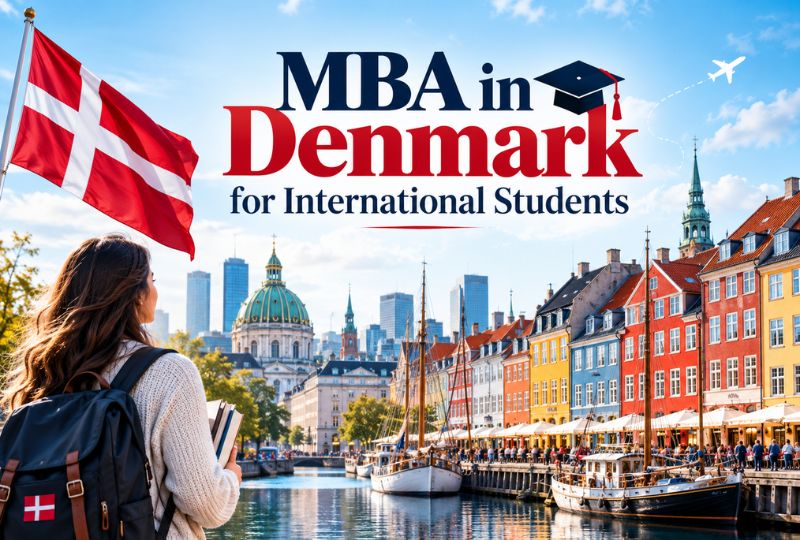
Table of Contents
MBA in Denmark for International Students: Highlights 2026
Denmark offers internationally oriented MBA and business programs through recognised universities and business schools, especially for students seeking European management education.
English-taught business programs
Many MBA and business programs are offered in English, making Denmark accessible to international students.
Strong business environment
Denmark has a developed economy with major companies in shipping, pharmaceuticals, renewable energy, technology and consulting.
Focus on practical learning.
MBA programs often include case studies, group projects, leadership development and real-world business problem-solving.
International classroom experience
Students can study alongside professionals and graduates from different countries and industries.
European career exposure
An MBA in Denmark can provide access to Nordic and wider European business networks and employment opportunities.
Why Study an MBA in Denmark as an International Student?
Denmark offers a combination of high-quality education, international business exposure and a strong innovation-focused economy.
Strong Nordic business ecosystem
Denmark is home to globally recognised companies across pharmaceuticals, shipping, renewable energy, technology and consumer industries.
English-friendly academic environment
Many postgraduate business programs are delivered in English, making them suitable for international applicants.
Innovation and sustainability focus
Danish business education often places strong emphasis on innovation, responsible leadership, sustainability and digital transformation.
Practical teaching approach
Students may work on business cases, team projects, presentations and company-related assignments rather than relying only on classroom theory.
International networking opportunities
MBA students can build connections with classmates, faculty, companies and professionals across Denmark and Europe.
Eligibility Criteria for MBA in Denmark
MBA eligibility in Denmark varies by university and program, particularly between full-time MBA and Executive MBA courses.
Bachelor's degree required
Applicants generally need a recognised undergraduate degree or an equivalent academic qualification.
Work experience is often important.
Many MBA programs prefer or require applicants to have several years of professional experience.
Executive MBA programs require stronger experience
Executive programs may expect managerial, leadership or substantial professional experience.
English-language proficiency
International applicants may need to demonstrate English proficiency through IELTS, TOEFL or another accepted qualification.
Strong overall profile
Universities may also assess academic performance, professional achievements, motivation and career goals.
Admission Process for MBA in Denmark 2026
The MBA admission process generally includes program selection, document submission and an individual assessment.
Step 1: Shortlist MBA programs
Compare universities based on tuition fees, work-experience requirements, duration, specialisations and teaching format.
Step 2: Check eligibility
Confirm academic qualifications, professional experience and English-language requirements.
Step 3: Prepare application documents
Applicants usually need degree certificates, academic transcripts, a CV, a motivation letter, a passport and language-test results.
Step 4: Submit the application
Complete the university's online application and upload all required documents before the deadline.
Step 5: Attend an interview
Some MBA programs may conduct an admissions interview to assess professional background, motivation and career objectives.
Step 6: Accept the admission offer
Successful candidates complete fee payment and begin the student residence-permit process where applicable.
Entrance Exams Required for MBA in Denmark
Entrance exam requirements for MBA programs in Denmark vary by university and program type.
GMAT may be required by some programs
Certain competitive MBA programs may request or recommend GMAT scores as part of the admission process.
GRE may be accepted
Some institutions may accept GRE scores as an alternative to GMAT where standardised testing is required.
Not every MBA requires GMAT or GRE.
Several programs place greater emphasis on academic background, professional experience and application quality instead of mandatory standardised test scores.
English-language tests are more common
IELTS, TOEFL or equivalent English-language proof may be required for international students whose previous education was not completed in English.
Executive MBA admissions can be profile-based
Executive programs often focus heavily on professional experience, leadership responsibilities and interviews.
Check each program individually. ally
Applicants should verify the exact 2026 requirements of each shortlisted MBA because test policies can differ significantly between institutions.
English Language Requirements for MBA in Denmark
International students applying for English-taught MBA programs in Denmark generally need to demonstrate sufficient English-language proficiency.
IELTS is commonly accepted
Many universities accept IELTS Academic scores, with minimum requirements varying by institution and program.
TOEFL is also widely recognised
TOEFL iBT is another common option for proving English proficiency for MBA admission.
Other English qualifications may be accepted.
Some institutions may also accept Cambridge English, PTE or equivalent recognised qualifications.
Previous English-medium education can help.p
Applicants who completed their previous degree fully in English may sometimes qualify for a waiver, depending on the university's policy.
Requirements vary by program
Executive MBA and professional programs may also assess English ability through interviews, academic background and professional experience.
Top MBA Colleges in Denmark for International Students
Denmark offers a limited but strong selection of MBA and Executive MBA programs, especially in Copenhagen and other major academic centres.
Copenhagen Business School
CBS is one of Denmark's best-known business schools and offers MBA and Executive MBA programs with strong international and corporate exposure.
Aarhus University
Aarhus University is a major Danish university with strong business and management education through Aarhus BSS.
University of Southern Denmark
SDU offers business and management programs that can be relevant for students seeking postgraduate management education.
Aalborg University
Aalborg University is known for problem-based learning and offers business-related postgraduate programs with an applied approach.
International learning environment
Many Danish institutions attract students and professionals from different countries, creating a globally oriented classroom experience.
Best MBA Universities in Denmark
Denmark's strongest management institutions combine academic quality, international exposure and links with the Nordic business ecosystem.
Copenhagen Business School
CBS is particularly recognised for business, management, finance, strategy and executive education.
Aarhus University
Aarhus BSS provides strong business education with emphasis on economics, management and research-based learning.
University of Southern Denmark
SDU offers internationally oriented business programs and access to Denmark's corporate and innovation ecosystem.
Aalborg University
Aalborg's problem-based teaching model focuses on practical projects, teamwork and real-world problem-solving.
Program type matters
Students should distinguish between a traditional MBA, Executive MBA and specialised Master's in Management before choosing a university.
Popular MBA Specialisations in Denmark
MBA and business programs in Denmark often focus on modern management areas connected with the Nordic economy.
General Management
Covers leadership, strategy, finance, marketing, operations and organisational management.
Finance
Focuses on corporate finance, investment, financial strategy and business decision-making.
International Business
Prepares students for global markets, cross-border operations and international strategy.
Digital Transformation
Covers technology-driven business models, digital strategy, innovation and organisational change.
Sustainability Management
Denmark's strong sustainability focus makes responsible business, ESG and sustainable management particularly relevant.
Entrepreneurship and Innovation
Suitable for students interested in startups, new ventures, product development and business growth.
Supply Chain and Operations
Relevant for careers in logistics, shipping, procurement and global operations.
MBA Fees in Denmark for International Students
MBA tuition fees in Denmark vary significantly depending on the university, program format and whether the course is a regular or Executive MBA.
Full-time MBA programs
International students may expect tuition of approximately €20,000 to €45,000 or more for a complete MBA, depending on the institution.
Executive MBA programs
Executive programs can cost around €40,000 to €60,000 or more, particularly at established business schools.
Specialised business Master's programs
Management-related Master's degrees may have different fee structures and can sometimes be more affordable than a traditional MBA.
Additional academic expenses
Students should also consider registration charges, books, study materials and possible international-module costs.
Living costs are separate.
Tuition does not normally include accommodation, food, transportation, health-related expenses and other day-to-day living costs in Denmark.
Bilkul — same style, same depth aur without resource links:
Cost of Living in Denmark for International Students
Living costs in Denmark are relatively high compared with many other European study destinations, so international students should plan their monthly budget carefully.
Average monthly living cost
International students may need around DKK 7,000–10,000 per month or more, depending on city, accommodation and lifestyle.
Accommodation
Housing is usually the largest expense. Copenhagen is generally more expensive than smaller Danish cities.
Food and groceries
Students can reduce costs by cooking at home, using student discounts and shopping at budget supermarkets.
Transportation
Public transport, cycling and student travel options can help manage commuting expenses.
Personal expenses
Students should also budget for mobile plans, study materials, clothing, entertainment and other everyday costs.
Copenhagen costs more
Students studying in Copenhagen should normally keep a higher monthly budget than those studying in Aarhus, Aalborg or smaller cities.
Affordable MBA Colleges in Denmark
Traditional MBA options in Denmark are relatively limited, so students looking for affordability should compare MBA programs with related business and management master's degrees.
Public university alternatives
Public universities may offer specialised Master's programs in Management, Finance, International Business or related areas at lower costs than premium Executive MBA programs.
University of Southern Denmark
SDU can be considered for internationally oriented business and management programs at comparatively moderate tuition levels.
Aalborg University
Aalborg University offers business-related postgraduate programs with its problem-based learning approach.
Aarhus University
Aarhus BSS offers strong management and business education, although students should compare individual program fees carefully.
Compare MBA and MSc optionsns
For cost-conscious students, a specialised MSc in Business or Management may sometimes provide better value than a traditional MBA.
Scholarships for MBA in Denmark
International students can explore university scholarships, Danish government funding and European scholarship programs.
Danish Government Scholarships
Danish universities receive a limited number of government scholarships for highly qualified full-degree students from outside the EU/EEA and Switzerland. These may include full or partial tuition waivers and, in some cases, support toward living expenses. Study in Denmark
University-specific scholarships
Individual universities may offer scholarships or tuition waivers based on academic merit and applicant profile.
Erasmus Mundus scholarships
Eligible international students may apply for Erasmus Mundus funding for selected joint Master's programs involving Danish institutions. Study in Denmark
Scholarships are competitive
Awards are limited, so strong academic performance and a well-prepared application are important.
MBA funding may differ
Executive MBA programs may have different scholarship arrangements from regular full-degree Master's programs, so applicants should check the specific course policy.
Documents Required for MBA Admission in Denmark
International MBA applicants generally need to submit academic, professional and language-related documents.
Academic documents
Bachelor's degree certificates and official academic transcripts are normally required.
Curriculum Vitae
Applicants usually submit an updated CV showing education, work experience and professional achievements.
Proof of work experience
MBA and Executive MBA programs may require employment certificates or other documentation confirming professional experience.
English-language proof
IELTS, TOEFL or another accepted English-language qualification may be required.
Motivation letter
Applicants may need to explain their career goals, reasons for choosing the MBA and how the program fits their professional plans.
Passport copy
A valid passport is generally required for both university admission and immigration procedures.
Additional documents
Some universities may request recommendation letters, GMAT/GRE results or an admissions interview depending on the program.
Student Visa & Residence Permit for International Students
Non-EU/EEA students admitted to higher education in Denmark generally need a Danish residence permit for study.
Residence permit for study
Students must be admitted to an eligible higher-education program before applying for their Danish study residence permit.
Proof of financial support
Applicants must demonstrate that they have sufficient funds to support themselves during their stay, according to the financial requirements applicable at the time of application.
Work rights during study
For students in a state-approved higher education program, the current rules allow work for up to 90 hours per month from September to May and full-time during June, July and August. Ny i Danmark
Important rule for non-state-approved programs
Students applying on or after 2 May 2025 for certain non-state-approved higher-education programs generally do not receive the same student work rights, so the approval status of the MBA program matters. Ny i Danmark
Post-study job-seeking period
For applications submitted on or after 1 October 2026, graduates of qualifying state-approved Danish degree programs will generally receive a 6-month or 1-year job-seeking period, depending on the qualification and residence basis. Ny i Danmark
Check the exact MBA status.
International students should verify whether their chosen MBA is a state-approved Danish degree program, because work rights and post-study residence options can depend on that classification.
Bilkul — same style, same depth aur without resource links:
MBA Placements in Denmark
MBA placements in Denmark depend on the university, prior work experience, specialisation, language skills and the strength of the student’s professional network.
Career support rather than campus placement
Danish universities generally provide career services, employer events, networking sessions and job-search support rather than the centralised placement model common in India.
Experienced candidates have an advantage.
Many MBA students already have professional experience, which can help them move into managerial, consulting or specialist roles after graduation.
Strong employment sectors
Opportunities are available across consulting, pharmaceuticals, shipping, renewable energy, technology, finance and international business.
Networking is important
Internships, alumni connections, company projects and professional events can play a major role in finding suitable employment.
Danish language can improprospectssss
Many international companies use English, but Danish proficiency can widen access to local employers and customer-facing roles.
Average MBA Salary in Denmark
Salary after an MBA in Denmark varies according to industry, work experience, job level and employer.
Entry and mid-level management roles
MBA graduates may commonly target salaries in the range of approximately DKK 450,000–650,000 per year, depending on profile and role.
Experienced professionals
Candidates with strong prior experience may earn around DKK 650,000–900,000 or more annually in specialised or managerial positions.
Higher-paying sectors
Consulting, pharmaceuticals, technology, finance and senior commercial roles can offer comparatively higher compensation.
Location matters
Copenhagen generally offers the largest concentration of multinational employers and business opportunities, although living costs are also higher.
Experience strongly influences salary... Previous work experience, leadership exposure, technical expertise and language ability can significantly affect earning potential.
Top Recruiters for MBA Graduates in Denmark
MBA graduates in Denmark can work with Danish multinational companies, consulting firms, financial institutions and technology businesses.
Pharmaceutical and healthcare companies
Companies such as Novo Nordisk and other life-sciences organisations recruit professionals for strategy, operations, finance and commercial roles.
Shipping and logistics companies
Denmark’s strong maritime sector creates opportunities with companies such as Maersk in logistics, supply chain, strategy and business development.
Consulting firms
Deloitte, PwC, EY, KPMG and other consulting firms hire management professionals for advisory, strategy and transformation roles.
Technology and industrial companies
Large technology, manufacturing and engineering companies recruit MBA graduates for product, operations and management positions.
Consumer and international businesses
Global companies operating in Denmark provide opportunities in marketing, finance, sales and international business.
Career Opportunities After MBA in Denmark
An MBA in Denmark can lead to careers across management, consulting, finance, sustainability and international business.
Management Consulting
Graduates can work in strategy, business transformation, operations improvement and advisory roles.
Finance and Corporate Strategy
Career opportunities include financial analysis, corporate finance, business planning and strategic management.
International Business
Denmark’s export-oriented economy creates roles in global sales, market expansion and international operations.
Sustainability and ESG
Denmark’s strong sustainability focus creates opportunities in ESG, sustainable business strategy and green transformation.
Supply Chain and Logistics
Shipping, manufacturing and distribution companies require professionals in procurement, logistics and supply-chain management.
Technology and Digital Business
Graduates can also pursue roles in product management, digital transformation and technology strategy.
Post-Study Work Opportunities in Denmark
International graduates may be able to remain in Denmark after completing an eligible higher-education program to look for work.
Job-seeking residence period
Eligible graduates of state-approved Danish higher-education programs can receive a post-study period to search for employment, subject to the rules applicable to their qualification and permit.
Work during the job-search period
Graduates may have limited work rights during the job-seeking period, depending on the residence conditions attached to their permit.
Full-time employment requires the correct permit
Once a suitable job is secured, graduates generally need to qualify for an appropriate Danish work and residence scheme.
High-demand sectors can help
Technology, engineering, pharmaceuticals, green energy, finance and consulting can offer stronger opportunities for international professionals.
Program approval matters
Students should verify whether their MBA is a state-approved degree program because post-study rights can depend on the course classification.
FAQs About MBA in Denmark for International Students
Is Denmark good for MBA students?
Denmark offers internationally oriented business education, strong corporate exposure and access to Nordic and European employers.
Is GMAT compulsory for MBA admission?
Not always. Some programs may require or recommend GMAT, while others focus more on academics, work experience and interviews.
Is Danish required for MBA admission?
For English-taught programs, Danish is generally not required for admission. However, learning Danish can improve local job opportunities.
How much does an MBA in Denmark cost?
Tuition can vary widely, with many MBA programs costing approximately €20,000–€45,000 or more, while Executive MBA programs may be more expensive.
Can international students work while studying?
Eligible students in approved programs can generally work part-time during the academic year and full-time during designated summer months, subject to residence-permit rules.
Can students stay in Denmark after an MBA?
Eligible graduates may receive a post-study job-seeking period if their program and residence status meet current Danish requirements.
Which industries hire MBA graduates in Denmark?
Consulting, pharmaceuticals, shipping, finance, technology, renewable energy and international business are among the major sectors.
Conclusion
Denmark can be a strong MBA destination for international students looking for Nordic business exposure, innovation-focused education and access to multinational employers.
Strong international business environment
Students gain exposure to global companies operating across pharmaceuticals, shipping, technology and consulting.
Multiple career pathways
Graduates can work in Consulting, Finance, Sustainability, International Business, Supply Chain and Digital Management.
Work experience matters
MBA outcomes are often strongest for candidates who combine the degree with prior professional experience and specialised skills.
Language can improve employability.
English is widely used in international business, but Danish proficiency can expand access to local roles.
Check post-study rules carefully
Before enrolling, international students should confirm the program’s approval status, work rights and post-study residence conditions for the 2026 intake.