







MBA in Canada Fees for Indian Students Tuition Fees, Living Costs & ROI

Table of Contents
MBA in Canada Fees for Indian Students: Highlights 2026
Canada has firmly established itself as one of the most practical MBA destinations for Indian students in 2026, combining globally ranked business schools with a genuinely predictable path to permanent residency. Canada has 6 MBA programs ranked in the QS Global MBA Rankings 2026, led by Rotman (University of Toronto) at #55 globally.
Total program fees for Indian students range from CAD 78,000 (₹53.69 Lakh) at Alberta to CAD 1,39,140 (₹95.77 Lakh) at Rotman, with post-graduation salaries of CAD 66,059–96,782 (₹45.48–66.62 Lakh) across finance, consulting, and tech roles. Overall, Indian students should expect an MBA in Canada to cost anywhere from about ₹40 Lakh to ₹90 Lakh+, depending on the university and lifestyle choices.
Average MBA Fees in Canada for Indian Students
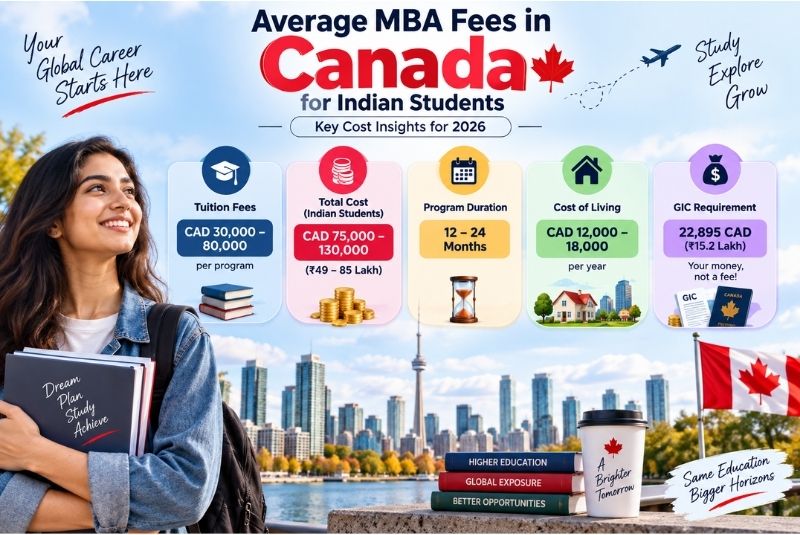
Here's a realistic breakdown of what you can expect to pay for 2026.
Overall tuition range
MBA in Canada fees for Indian students in 2026 typically range from CAD 30,000 to CAD 80,000, while the total cost including living expenses can reach CAD 45,000 to CAD 120,000.
Total all-in cost estimates
For Indian students, the MBA in Canada cost ranges between CAD 75,000–130,000 (₹49–85 Lakh) including tuition, living expenses, and mandatory fees, with the exact figure depending on the university, province, and lifestyle choices.
Program duration affects total cost.
Most MBA programs last 12 to 24 months and are offered in cities like Toronto, Vancouver, and Montreal, so factor in whether your target program is a compressed 1-year format or a fuller 2-year structure when comparing total costs.
Cost of living add-on
The cost of living for MBA students in Canada averages CAD 12,000 to CAD 18,000 per year, covering accommodation, food, transport, and utilities.
The GIC requirement — your money, not a fee
The Canadian government now requires a Guaranteed Investment Certificate (GIC) to show you can cover living costs. For 2026, the GIC requirement is 22,895 CAD (₹15.2 Lakh). This is your money, not a fee — the bank pays it back to you in monthly instalments once you arrive (around 1,200 CAD per month).
Our advice: Since the GIC is refundable money you'll receive back monthly after arrival, don't treat it as a sunk cost when budgeting — factor it into your upfront liquidity needs, not your total program investment.
MBA Tuition Fees in Canada: University-Wise Comparison
Here's how tuition compares across Canada's leading business schools for 2026.
Premium tier
- Rotman (University of Toronto): CAD 95,000 (2 years total) — most prestigious, highest cost, though total program fees for Indian students reach CAD 1,39,140 (₹95.77 Lakh) once all costs are included
- Ivey (Western University): CAD 72,000 for the accelerated 1-year HBA program, backed by a very strong alumni network
Mid-to-upper tier
- Sauder (UBC Vancouver): CAD 70,000 (2 years total) — strong Pacific Rim access
- Desautels (McGill): CAD 65,000 (2 years total) — bilingual city, affordable living
- Smith (Queen's): CAD 62,000 (2 years total) — strong employer relationships in Ontario
Budget-friendly tier
- Alberta School of Business: CAD 45,000 (2 years) — lower cost, oil/energy sector connections
- HEC Montréal: CAD 30,000 (2 years) — bilingual, GMAT waiver available, very affordable
Genuinely low-cost options
Several low-cost MBA schools like Memorial University and University of Manitoba offer MBAs in the CAD 10,000–20,000 (₹6.5–13 Lakh) range — far more affordable than elite programs.
GMAT score benchmarks by school tier
The average GMAT at Rotman is 672, Desautels is 675, and Ivey is around 670. Sauder and Smith average 650. For programs like Alberta and Sprott, average scores drop to 613-612. A score of 650+ gives you a competitive chance at Canada's top 6 programs; below 630, your best bets are mid-tier programs like HEC Montreal, Molson, and Alberta.
Top MBA Colleges in Canada and Their Fees
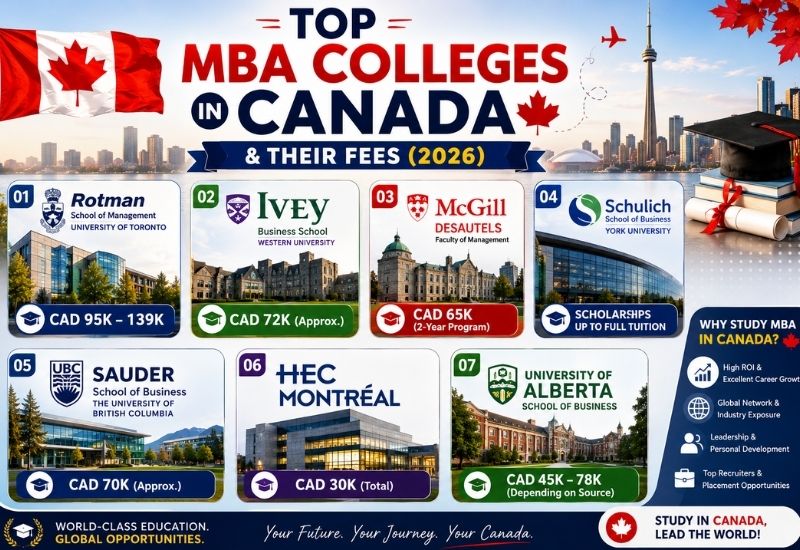
Here's a closer look at Canada's leading MBA programs and what they cost for 2026.
Rotman School of Management (University of Toronto)
Rotman is part of the University of Toronto and is one of the strongest MBA options in Canada, with its biggest advantage being its location in Toronto — Canada's main business hub for finance, consulting, technology, healthcare, and corporate roles. Fees reach CAD 95,000-139,140 depending on the specific cost breakdown used.
Ivey Business School (Western University)
Best for career outcomes by average salary, offering an accelerated 1-year HBA-style MBA at approximately CAD 72,000.
Desautels Faculty of Management (McGill)
Strongest for academic reputation at a lower price point, priced around CAD 65,000 for the full 2-year program.
Schulich School of Business (York University)
Named alongside Rotman as offering scholarships that can reach full tuition coverage for exceptional candidates.
UBC Sauder School of Business
Priced around CAD 70,000, offering strong Pacific Rim industry access given its Vancouver location.
HEC Montréal
The standout budget-conscious pick among genuinely reputable schools — CAD 30,000 total, bilingual environment, and a GMAT waiver option for eligible candidates.
University of Alberta School of Business
Recent reports show graduates earning an average of CAD 95,000 (₹60 Lakh), with a heavy concentration in prestigious strategy and consulting roles, despite Alberta sitting at the more affordable end of tuition (CAD 45,000-78,000 depending on source).
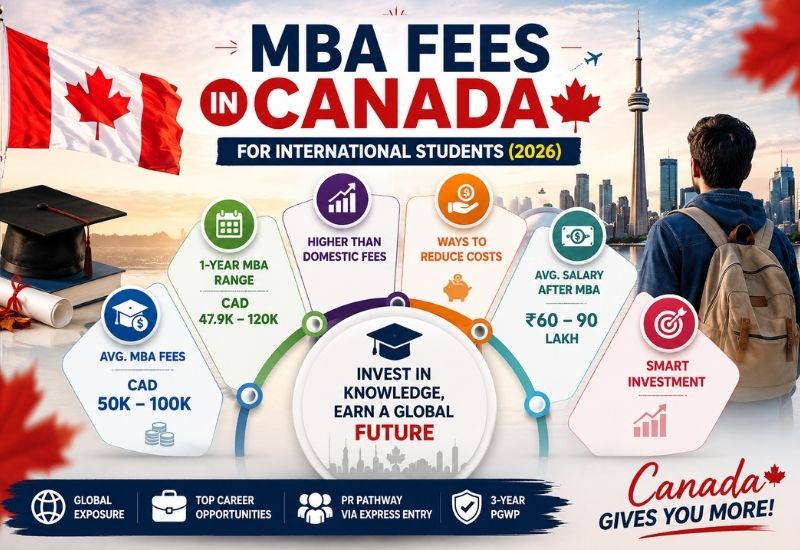
Here's what international students broadly — not just Indian applicants — should expect to budget for 2026.
Standard international tuition range
The average MBA fee at leading Canadian universities ranges from CAD 50,000 to 100,000 (₹31 Lakh to 62 Lakh). Note that international students typically pay a per-year tuition structure at most universities, though some structure fees per term or per course credit — always confirm directly with your target university's official website for the most current structure.
1-year MBA-specific range
Tuition fees for 1-year MBA programmes in Canada range from CAD 47,900 to CAD 120,000 (approximately ₹29–75 Lakh), with average living costs of ₹7–12 Lakh annually (CAD 12,000–20,000).
How international fees compare to domestic
International students typically pay higher tuition fees than domestic Canadian students — a standard structure across virtually every Canadian university, so always verify you're looking at the international/non-resident fee tier when researching costs.
Ways to genuinely reduce costs
Choosing budget universities (Memorial University, University of Manitoba) in the CAD 10,000–20,000 range, applying for merit/need-based scholarships (CAD 5,000–20,000 in reductions), and picking more affordable cities like Montreal, Calgary, or Winnipeg over Toronto or Vancouver (saving CAD 3,000–5,000 annually) are all genuinely effective cost-reduction strategies.
Post-study earning potential relative to cost
Graduates from 1-year MBA programmes in Canada earn an average salary of ₹60–90 Lakh annually (CAD 100,000–150,000), depending on their industry — a strong ROI signal relative to even premium-tier tuition costs.
Our advice: Since Canadian MBA programs cost CAD 35,000–90,000 in tuition — significantly less than US M7 programs — with the added advantage of a 3-year PGWP and a clear PR pathway via Express Entry, weigh Canada's overall value proposition (cost + salary + settlement pathway combined) rather than comparing tuition figures in isolation against other international MBA destinations.
Affordable MBA Colleges in Canada for Indian Students

- HEC Montréal — CAD 30,000 for the full 2-year program, bilingual environment, GMAT waiver available, one of the most affordable recognised options
- Memorial University, University of Manitoba, Concordia (John Molson) — Tuition in the CAD 10,000-20,000 range (₹6.5-13 lakh), offering solid academic training with good ROI
- University of Saskatchewan — Provides excellent academic training and valuable career opportunities without charging high fees.
- Alberta School of Business (University of Alberta) — CAD 45,000 (2 years), the cheapest top-ranked MBA in Canada, with strong oil/energy sector connections
- Desautels (McGill) — CAD 65,000 (2 years), considered the most affordable top-ranked option, located in a lower cost-of-living city (Montreal)
- Flexible admission pathways — Many affordable MBA colleges offer flexible admission for Indian students, including GMAT waivers depending on profile
- Standard eligibility for low-cost programs — 3-4 year undergraduate degree with a minimum GPA of ~3.0 (approx. 70%), 2-3 years of work experience preferred (though some accept fresh graduates), and English proficiency via IELTS/TOEFL.
Cost of Living in Canada for MBA Students

- National average range — CAD 12,000-25,000 per year across various sources, covering accommodation, food, transportation, insurance, and personal expenses
- Commonly cited mid-range figure — CAD 15,000-20,000/year (~₹9.9-13.3 lakh)
- Monthly estimate (per some sources) — An Indian student needs around ₹88,400-1,00,000 per month to cover living expenses, excluding house rent
- Mandatory health insurance — UHIP or equivalent costs around CAD 700-1,000/year extra, on top of general living expenses
- City-based variation — Toronto and Vancouver are the most expensive cities; Montreal and Calgary are considerably more affordable
- Reddit/Quora-sourced city insights — Montreal (McGill) is consistently highlighted as the most affordable city for MBA students, given significantly lower rent than Toronto or Vancouver; Edmonton (Alberta) also reports lower living costs and a growing, supportive Indian community
- Unexpected cost pocket — London, ON (home to Ivey) has higher-than-expected living costs for a smaller city, primarily due to limited affordable housing near campus
Accommodation Costs for Indian MBA Students in Canada
- Biggest line item in living costs — Accommodation typically represents the largest single monthly expense for international MBA students in Canada
- City-driven cost differences — Toronto and Vancouver command the highest rents nationally; Montreal offers meaningfully lower accommodation costs while still hosting a top-ranked program (McGill/Desautels)
- Campus-adjacent housing challenges — Even in smaller cities like London, ON (Ivey), limited affordable housing near campus can push accommodation costs higher than expected for the city's overall size
- Shared housing as a cost-reduction strategy — Many international students opt for shared apartments or roommate arrangements to reduce the accommodation portion of their monthly budget, particularly in high-cost cities
- Edmonton's affordability advantage — Indian students specifically report lower accommodation costs in Edmonton (home to the University of Alberta), paired with a growing Indian community that eases the settling-in process
- Budgeting approach — Since accommodation costs vary so significantly by city (sometimes more than tuition-tier differences), factoring city choice into your overall affordability calculation is often more impactful than comparing tuition fees alone
Food, Transportation & Other Living Expenses
- Combined non-rent living costs — Generally factored into the broader CAD 12,000-25,000/year living cost estimate alongside accommodation, though food and transport specifically make up a meaningful secondary portion of this figure
- Part-time work as an offset — International students can work up to 20 hours per week during the academic term and full-time during breaks, with many taking up on-campus or local community jobs specifically to help cover food, transport, and other daily living costs
- Personal and incidental expenses — Beyond food and transport, budgets should also account for personal expenses, study materials, and incidental costs, all bundled within the broader annual living-cost estimates cited by most sources
- Utilities — Some cost breakdowns specifically include utilities (electricity, internet, heating) as a distinct line item within the CAD 12,000-18,000/year living cost range
- Health insurance as an added cost — Mandatory UHIP or equivalent health insurance (CAD 700-1,000/year) sits outside the core "living cost" estimate in some breakdowns and should be budgeted separately.
Total Cost of Studying MBA in Canada
- Overall all-in cost range for Indian students — Broadly ₹40 lakh to ₹90 lakh+, depending on university tier and lifestyle choices, per several aggregated estimates
- Wider cited range — CAD 45,000 to CAD 120,000 total (tuition + living), or roughly ₹19.7 lakh to ₹82 lakh+ per other sources, with specialised 1-year programs specifically costing CAD 70,000-110,000 (₹45-71 lakh)
- Affordable-tier total cost example — HEC Montréal (CAD 30,000 tuition) combined with Montreal's comparatively lower living costs keeps total program cost meaningfully below elite-tier options
- Elite-tier total cost example — Rotman (Toronto) can reach ₹95 lakh-1.1 crore total when combining tuition (~CAD 95,000) with Toronto's higher living costs
- Mid-tier examples — Sauder (UBC): ₹75-90 lakh total; Desautels (McGill): ~₹65 lakh tuition plus Montreal's more affordable living costs, positioning it as the most affordable top-ranked option overall
- Value proposition vs. US/UK — Canada offers a strong combination of globally ranked programs (6 Canadian MBA programs feature in QS Global MBA Rankings 2026), affordable tuition relative to the US/UK, and a 3-year Post-Graduation Work Permit — notably longer than the UK's 2 years or the USA's 1-3 year OPT window
- PR pathway advantage — Canada's Express Entry Canadian Experience Class (CEC) pathway to Permanent Residency is generally considered faster and more predictable than equivalent routes in the USA or UK, adding long-term value beyond the immediate cost comparison.
MBA Fees in Canada in Indian Rupees
- Overall national fee range — ₹7 lakh to ₹70 lakh per year, varying significantly by university and program tier
- Elite-tier programs (INR) — Rotman (Toronto), Ivey (Western), and McGill (Desautels) charge roughly ₹59-82 lakh total for tuition alone
- Mid-tier programs (INR) — UBC Sauder and York Schulich fall in the ₹45-59 lakh bracket.t
- Affordable-tier programs (INR) — Memorial University, University of Manitoba, and Concordia (John Molson) offer tuition around ₹6.5-13 lakh, among the most budget-friendly recognised options.
- Total cost including living expenses — Ranges from ₹40 lakh to ₹90 lakh+ overall, with specialised 1-year programs specifically running ₹45-71 lakh
- Monthly living cost in INR — Roughly ₹88,400 to ₹1,00,000/month is commonly cited for covering living expenses, excluding house rent in some estimates
- Currency conversion caveat — Since CAD-to-INR figures shift with exchange rates, any quoted rupee amount should be treated as an approximate snapshot rather than a fixed number — always cross-check with the current exchange rate before finalising your budget.
Scholarships for MBA in Canada for Indian Students
- University-specific entrance scholarships — Most top Canadian business schools (Rotman, Ivey, Desautels, Schulich, Sauder) offer merit-based entrance scholarships ranging from partial tuition waivers to more substantial awards for exceptional applicants
- HEC Montréal GMAT waiver + affordability combo — Beyond its already low CAD 30,000 tuition, HEC Montréal's GMAT waiver option further reduces the effective cost and preparation burden for eligible candidates
- Need-based financial aid — Several universities offer need-based aid alongside merit scholarships, particularly for students who can demonstrate financial constraints
- Diversity and leadership scholarships — Many Canadian b-schools run specific scholarship categories recognising leadership potential, diversity contributions, or professional achievement, worth checking on each shortlisted school's official scholarships page
- External and government-linked options — Beyond university-specific awards, external scholarship bodies and Canadian government-linked funding programs occasionally offer support for international graduate students, though these are typically more competitive and limited in number.
- Application strategy — Since scholarship structures and deadlines vary significantly by school, applying early and directly through each university's official scholarship portal — rather than relying on generic assumptions — is essential to maximise funding chances
Education Loans for MBA in Canada
- Widely available financing route — Education loans from Indian banks (public and private sector) are a common and accessible way to fund an MBA in Canada, given the total cost often reaching ₹40-90 lakh+
- Public sector bank loans — Nationalised banks like SBI, Bank of Baroda, and others offer education loan schemes specifically for study-abroad programs, often with relatively lower interest rates but more documentation requirements.
- Private lenders and NBFCs — Options like HDFC Credila, Avanse, and similar specialised education-loan NBFCs offer faster processing and more flexible collateral requirements, often used to cover the gap beyond what public banks approve.
- Collateral considerations — Loan amounts and terms vary based on whether the loan is collateral-backed (property, fixed deposits) or unsecured, with collateral-backed loans typically offering better interest rates for larger loan amounts
- Covering tuition + living costs — Since total MBA cost in Canada includes both tuition (₹7-70 lakh+) and living expenses (₹9-16 lakh+/year), most students structure their loan to cover the full program cost rather than tuition alone
- Repayment planning consideration — Given Canada's strong post-study work rights (3-year PGWP) and generally solid MBA salary outcomes, many students plan loan repayment around securing Canadian employment shortly after graduation, though this should be balanced against realistic job-search timelines
Other Expenses for MBA Students in Canada
- Mandatory health insurance — UHIP or equivalent provincial health coverage costs around CAD 700-1,000/year, a required expense separate from general living costs
- Application and visa-related fees — Costs include university application fees (per school), study permit application fees, and biometric/processing charges as part of the pre-arrival budget
- Study materials and course-related costs — Textbooks, case study materials, and other academic resources add a modest but real ongoing expense throughout the program
- Utilities — Electricity, internet, and heating costs are sometimes bundled into broader living-cost estimates, but can also appear as a distinct line item depending on accommodation typ.e
- Travel costs — Initial flights to Canada, plus any travel home during breaks, should be factored into the overall budget separately from monthly living expenses.s
- Networking and career-related expenses — Costs associated with professional attire, case competition travel, or networking events (common in MBA programs) can add up over the course duration
- Part-time work as an offset — Since international students can work up to 20 hours/week during term and full-time during breaks, many use part-time earnings specifically to offset these smaller, recurring expenses rather than relying solely on loan/savings funds
MBA in Canada Fees: 1-Year vs 2-Year MBA
- Choosing format is a key decision — Deciding between a 1-year or 2-year MBA in Canada is one of the most crucial decisions for international students, directly affecting both total cost and time-to-completion
- 1-year program cost example — Ivey (Western University)'s accelerated HBA-linked MBA runs CAD 72,000 for the single year, reflecting a premium, compressed format with a very strong alumni network
- Specialised 1-year programs (broader cost) — Cost CAD 70,000-110,000 (₹45-71 lakh) overall, often positioned as intensive, career-accelerator options for candidates with substantial prior work experience
- 2-year program cost examples — Rotman (Toronto): CAD 95,000 total; Sauder (UBC): CAD 70,000 total; Desautels (McGill): CAD 65,000 total; Smith (Queen's): CAD 62,000 total; Alberta School of Business: CAD 45,000 total; HEC Montréal: CAD 30,000 total — all for the full 2-year program
- Cost-per-year comparison nuance — While 1-year programs often have a lower total sticker price than premium 2-year programs, the effective cost-per-year can be comparable or even higher, since compressed programs pack more into a shorter, more intensive timeframe
- Trade-off consideration — A 1-year MBA gets you into the job market faster (less opportunity cost from lost income), while a 2-year MBA typically allows for a summer internship, deeper specialisation, and more networking time — the right choice depends on your prior experience level and career-transition goals rather than cost alone