


MBA in Austria for International Students Top Business Schools, Fees, Eligibility, and Career Scope
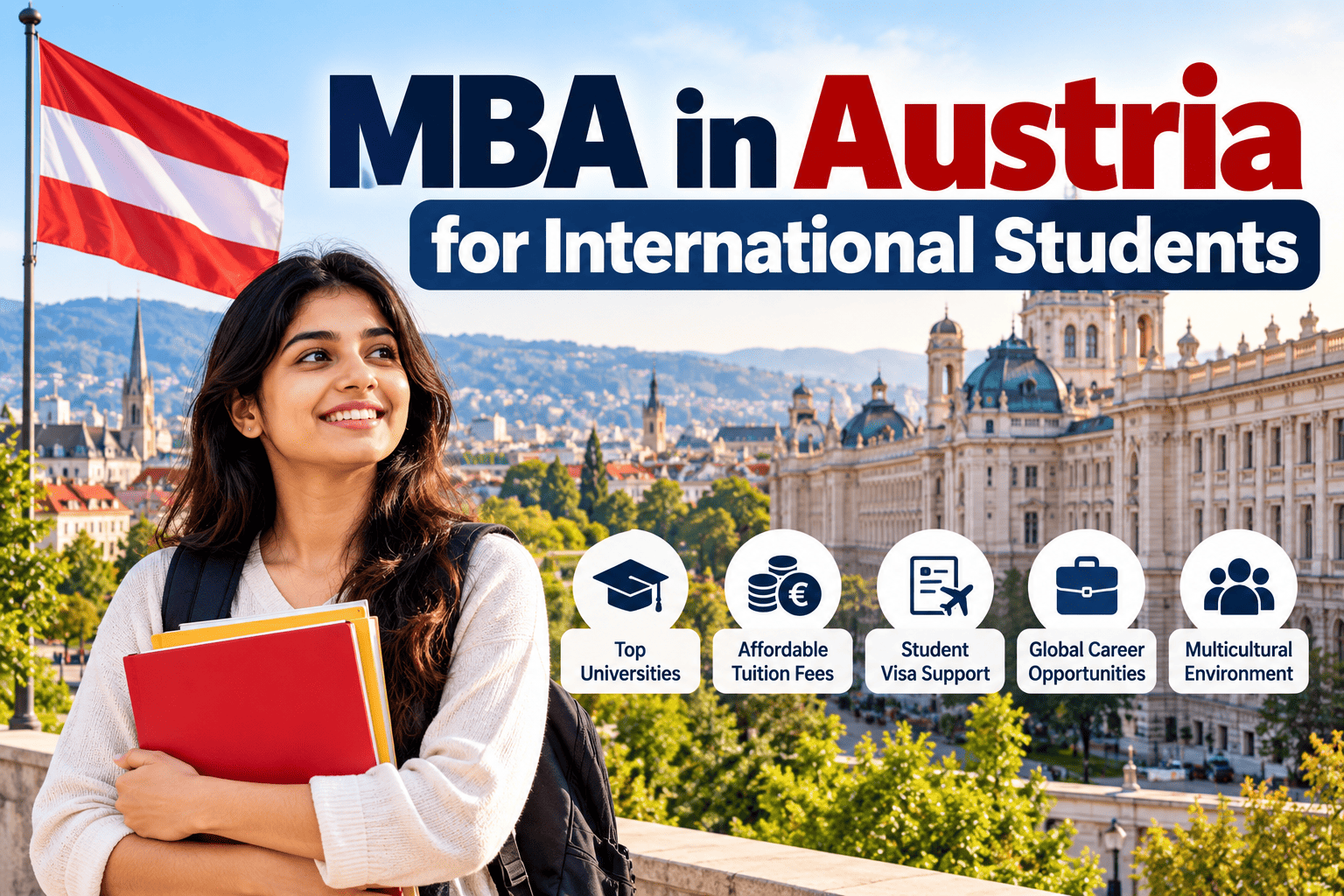
Table of Contents
Best Colleges for MBA in Austria for International Students: Highlights 2026
- Flagship school: WU Wien Executive Academy holds Triple Crown accreditation (EQUIS, AACSB, AMBA), an honour held by fewer than 1% of business schools worldwide. It ranks #46 in the FT European Business School rankings, and WU ranks #17 globally for Masters in Management
- Fee spread: WU’s Executive MBA runs €39,200-59,200 (about ₹35-53 lakh), while MCI, MODUL, and Webster run €20,000-35,000 (about ₹18-31.5 lakh)
- Admission style: Most programs waive GMAT/GRE and decide on work experience, transcripts, and an interview
- Salaries: €50,000-70,000 per year overall, and €70,000-100,000 for WU Executive Academy graduates
- Post-study route: A 12-month job-search extension, then the Red-White-Red Card, with no competitive points test for graduates
- Living costs: About €800-1,200 per month, with Vienna at the higher end
- Budget alternative: WU’s Master’s in International Management costs about €1,500 per year at public rates
Can You Pursue an MBA in Austria Without GMAT/GRE?
- Yes, at most schools: WU Wien, MCI, MODUL, and Webster generally do not require GMAT or G.RE.
- What replaces it: Professional experience (typically 2-5 years), a strong academic transcript, a CV, a Statement of Purpose, letters of recommendation, and a personal interview
- English test still matters: IELTS 6.5+ or TOEFL 90+ is the more consistent requirement, unless your prior degree was fully in English and a school accepts that as proof.
- Exceptions can exist: A school may still accept or recommend a score, especially for competitive tracks, so confirm the policy for your specific program.m
- Strategy: Since tests are optional, put your effort into a clear career narrative, a strong SOP, and interview preparation
Top English-Taught MBA Programs in Austria 2026
- WU Wien Executive Academy: The most prestigious option, with strong recruiter access (McKinsey, BCG, Erste Bank)
- MODUL University Vienna: MBA programs in International Management, Sustainable Development, and Entrepreneurship
- Webster Vienna Private University: A US-accredited MBA with an American-style curriculum and a global alumni network
- MCI (Management Centre Innsbruck): A recognised private option outside Vienna, in the €20,000-35,000 range
- FHWien University of Applied Sciences of WKW: Professional MBA programs in business and executive management
- Lauder Business School: Master’s programs with a strong business and finance focus
- Wider choice: Austria offers 200+ English-taught Master’s programs nationally, so German is not needed to study
Top Private MBA Colleges in Austria for Non-EU Students
- MODUL University Vienna: Fees in the €20,000-35,000 range, with partial merit-based scholarships for MBA candidates
- Webster Vienna Private University: Same fee bracket, suited to students who want a US-style degree without moving to the US
- MCI Innsbruck: An accessible private option with a professional focus
- FHWien and Lauder Business School: Practical, career-oriented options at moderate prices
- WU Executive Academy: The premium tier, at €39,200-59,200
- Broader private range: €12,000-40,000 total across the market
- Non-EU requirements: You will need the Residence Permit for Students, with roughly €12,707 per year in funds shown through a blocked account. Student loans, cryptocurrency, and cash are not accepted as proof, and processing can take 8-12 weeks
- Funding reality: Full scholarships are rare, so most students combine a partial award (OeAD, Ernst Mach Grants, university merit awards), part-time work, and family support
Public MBA Colleges in Austria: Tuition Fees for International Students
- Public MBAs are uncommon: Most dedicated MBA programs sit at private universities or at executive-level units, rather than as standard public-university degrees
- WU Wien: The university is public, but its Executive Academy MBA is priced at €39,200-59,200
- Public non-EU baseline: Tuition at public universities is typically around €726.72 per semester (about €1,453 per year), though this applies mainly to regular Master’s programs rather than flagship MBAs
- Best value route: WU’s Master’s in International Management costs about €1,500 per year while ranking #17 globally, a strong option if you don’t need the MBA label
- Check extras: Confirm whether semester fees, student union contributions, or program-specific charges apply to your course
- Working while studying: Non-EU students can work up to 20 hours per week on a valid permit, which helps offset costs
Note: Fees, funds thresholds, and program details vary by source and change each year. Please verify current 2026-27 details on the official websites (wu.ac.at, modul.ac.at, webster.ac.at, mci.edu) and with the Austrian migration authority before publishing.
MBA Eligibility Criteria for International Students in Austria
Academic Background: A bachelor’s degree (minimum 3 to 4 years) from a recognised university in business, engineering, or related fields.
Work Experience: Most Austrian business schools (like WU Wien, MCI, MODUL) require professional work experience ranging from 2 to 5 years, especially for executive or international MBA tracks.
English Proficiency: Mandatory submission of English language test scores such as IELTS 6.5+ or TOEFL 90+, unless your previous degree was fully taught in English.
GMAT/GRE Requirement: Generally not mandatory at top schools like WU Wien, MCI, MODUL, and Webster; professional background and interviews often replace test scores.
MBA Admission Process for International Students in Austria
Shortlisting Programs: Research and select English-taught MBA programs aligning with your career goals across top Austrian business schools.
Application Submission: Apply directly through the university’s portal by submitting academic transcripts, an updated CV, a Statement of Purpose (SOP), and Letters of Recommendation (LORs).
Interview Round: Shortlisted candidates undergo an online personal or panel interview assessing leadership potential, motivation, and career clarity.
Offer Letter & Deposit: Upon acceptance, secure your seat by paying the requisite tuition deposit or enrollment fee within the specified deadline.
Visa Processing: Receive the official admission confirmation letter to initiate your Austrian Student Residence Permit (Visa) application.
Required Entrance Exams for MBA Admission (GMAT, GRE, TOEFL, IELTS)
GMAT / GRE: Mostly optional across Austrian universities; schools focus more on work experience, past academics, and personal interviews. However, high scores can strengthen profiles for competitive tracks.
IELTS Requirement: A minimum overall score of 6.5 is consistently required by most institutions.
TOEFL Requirement: A minimum score of 90+ (iBT) is widely accepted as proof of English language proficiency.
Exemption Policy: Some universities waive English tests if the applicant completed their prior Bachelor's or Master's degree entirely in English, subject to institutional approval.
MBA Colleges in Austria and Admission Process
Top Institutions: Flagship schools include WU Wien Executive Academy, MODUL University Vienna, Webster Vienna Private University, and MCI (Management Centre Innsbruck).
Application Stages: The process involves filling out online application forms, uploading academic and professional documents, and clearing evaluation rounds.
Profile Evaluation: Admissions committees heavily weigh professional trajectory, management potential, and clarity of purpose over standardised test scores.
Deadlines: Rolling admissions or structured intake rounds (typically starting in Autumn/Spring) require international applicants to apply 4–6 months in advance for seamless visa processing.
MBA Eligibility Criteria for International Students in Austria
Academic Background: A recognised bachelor’s degree (minimum 3 to 4 years / 180 ECTS) in business, engineering, or related disciplines from an accredited institution.
Work Experience: Most top Austrian business schools (such as WU Wien Executive Academy, MCI, MODUL) require 2 to 5 years of professional work experience
. English Proficiency: Valid English test scores (IELTS 6.5+ or TOEFL 90+) are mandatory for non-native English speakers
. Standardised Tests: GMAT/GRE scores are generally optional or waived at major Austrian business schools, provided you have strong work experience and academic background
.
MBA Admission Process for International Students in Austria
University Shortlisting: Research and select English-taught MBA programs across top-ranked Austrian institutions
. Online Application: Submit the online application along with transcripts, updated CV, Statement of Purpose (SOP), and Letters of Recommendation (LOR)
. Interview Stage: Shortlisted candidates are invited for an online personal or panel interview to evaluate leadership experience and program fit
. Acceptance & Deposit: Receive the conditional/unconditional offer letter and pay the initial tuition deposit to confirm admission.
Visa Application: Use the official admission letter to apply for an Austrian Student Residence Permit / Visa.
MBA Colleges in Austria for Fresh Graduates vs. Experienced Professionals
For Fresh Graduates: Top business schools like WU Wien generally require 2+ years of work experience for traditional MBAs. However, freshers can opt for Master’s in Management (MiM) programs like WU’s MSc in International Management (ranked #17 globally, costing ~€1,500/year).
For Experienced Professionals: Programs like the WU Executive MBA or MCI Executive MBA target candidates with 3 to 5+ years of professional or managerial experience, focusing on strategic leadership.
Curriculum Focus: Fresh-graduate routes focus on core business foundations and internships, whereas Executive MBAs rely heavily on peer-to-peer learning, high-level case studies, and networking.
Career Trajectory: Experienced candidates use the Austrian MBA to move into senior roles (averaging €70,000–€100,000/year), while freshers build their initial European industry network.
Direct MBA Admission, Executive MBA, and Part-Time MBA Options
Direct MBA Admission: Many private universities (e.g., MODUL, Webster) offer direct entry without requiring GMAT/GRE scores, evaluating applicants based on past transcripts, SOP, and an interview.
Executive MBA (EMBA): Designed for senior professionals and executives, offered in blended or modular formats (e.g., WU Executive Academy) to allow participants to work while studying.
Part-Time MBA: Typically structured over 18 to 24 months with weekend classes or short residential modules, perfect for balancing work and education.
Full-Time vs. Part-Time Flexibility: International students on standard student visas can work up to 20 hours per week during full-time studies, while part-time EMBA formats cater to working professionals.
Required Documents for Austrian Student Visa Application
Valid Passport & Photos: Original passport valid for the duration of stay plus standard ICAO passport-sized photos.
Official University Admission Letter: Original "Letter of Admission" (Zulassungsbescheid) from a recognised Austrian institution.
Proof of Financial Means: Bank statements or savings showing sufficient funds to cover living expenses for 12 months in advance (~€1,308/month for applicants aged 24 and older).
Proof of Accommodation: A verified rental contract or student housing (Wohnrechtsvereinbarung) reserved for at least 3 months.
Travel Medical Insurance: Overseas medical insurance covering all Schengen risks with a minimum coverage of €30,000.
Clean Criminal Record: Police clearance certificate (PCC) issued by your home country, duly apostilled/translated.
MBA in Austria vs. MBA in Other European Countries
Cost Advantage vs. UK/France: Austrian Executive MBAs (€20,000–€59,000) offer triple-crown quality at a lower tuition and living cost compared to top-tier UK or French business schools (€100,000+).
Post-Study Work Route: Austria provides a 12-month Job Seeker extension post-graduation, leading directly to the Red-White-Red Card without a competitive points test for graduates.
Visa Processing Speed: Austrian student residence permit applications are generally processed faster (approx. 2–4 weeks) compared to neighbouring destinations like Germany.
Strategic Location: Located in Central Europe, Austria acts as a gateway to Western and Central-Eastern European (CEE) business markets like Germany, Switzerland, and Italy.
How to Choose the Best MBA College in Austria as an International Student?
Accreditations & Global Rankings: Look for prestigious triple-crown accreditations (EQUIS, AACSB, AMBA) or strong European rankings, such as WU Wien Executive Academy.
Budget & Program Cost: Compare high-end Executive MBAs (€20,000–€59,200) with subsidised or affordable Master's management alternatives based on your finances.
Work Experience Fit: Choose an Executive MBA track if you have 3–5+ years of managerial background, or a generalised Business Master's track if you are an early-career professional.
Location & Recruiter Access: Select universities situated in economic hubs like Vienna or Innsbruck to connect with major recruiters like McKinsey, BCG, Erste Bank, and Red Bull.
Language & Networking: Ensure 100% English-taught delivery while selecting institutions that offer basic German language modules for post-grad local employment.
Requirements for English Language Proficiency Tests (TOEFL / IELTS)
IELTS Academic: A minimum overall band score of 6.5 is the standard requirement across most Austrian business programs.
TOEFL iBT: A minimum score of 90+ is widely accepted as valid proof of English proficiency.
Alternative Tests: Select private institutions also accept PTE Academic or Cambridge English certificates (C1 Advanced).
Test Waiver / Exemption: Can be granted if your previous undergraduate degree was completed entirely in English from an accredited university.
Post-Study Work Visa (Red-White-Red Card / Job Seeker Visa) in Austria
12-Month Job Seeker Extension: Graduates of Austrian universities can extend their residence permit for 12 months post-graduation to search for employment.
Red-White-Red (RWR) Card: Once an adequate job offer matching your qualification is secured, you can switch directly to the RWR Card work permit.
No Competitive Points Test: International graduates of Austrian higher education institutions are exempt from the standard competitive points system applied to external applicants.
Pathway to RWR Card Plus: After holding the Red-White-Red Card and working for 24 months, graduates can upgrade to the Red-White-Red Card Plus, giving unlimited labour market access.
Living Expenses for International Students in Austria
Monthly Budget: Expect to spend between €800 and €1,200 per month on overall living costs, with Vienna being on the higher end.
Accommodation Costs: Student dorms or shared apartments (WG) typically cost €400 to €600 per month depending on the city and location.
Mandatory Student Health Insurance: Public student health insurance (ÖGK) costs around €75–€80 per month.
Food & Transport: Grocery costs average €250 to €350 per month, while discounted annual or semester transit passes for students cost around €30 to €50 per month.
5. FAQs About MBA in Austria for International Students
Q1: Can I study an MBA in Austria without knowing German?
Yes, Austria offers fully English-taught MBA programs, though basic German helps in everyday life and post-graduation job hunting.
Q2: Is GMAT mandatory for MBA admissions in Austria?
No, most Austrian business schools (WU Wien, MCI, MODUL, Webster) waive GMAT/GRE requirements in favour of work experience and interviews.
Q3: Can international students work while studying?
Yes, non-EU students holding a valid Student Residence Permit are legally allowed to work up to 20 hours per week.
Q4: Are scholarships available for international MBA students?
Yes, partial tuition waivers, merit-based grants, and institutional scholarships are offered by schools like WU Wien and MCI to high-achieving candidates.
6. Conclusion and Summary
High ROI Education: Austria combines top-tier European accredited management education with manageable tuition and living costs.
Career Growth: Flexible GMAT policies and strong industry links make it an ideal destination for developing international business expertise.
Seamless Settlement: Clear post-study work pathways via the 12-month job search extension and Red-White-Red Card make long-term European settlement highly accessible.