







MBA in Australia for Indian Students 2026: A Complete Guide

Table of Contents
Why Pursue an MBA in Australia?
Australia has emerged as one of the most preferred destinations for MBA aspirants worldwide, especially Indian students. With globally recognised universities, industry-oriented education, multicultural exposure, and excellent post-study work opportunities, pursuing an MBA in Australia can significantly enhance career prospects. Australian business schools focus on practical learning, leadership development, and real-world business challenges, making graduates highly employable across international markets.
Benefits of an Australian Education
Australian universities are known for their high academic standards, innovative teaching methods, and strong industry connections. Students benefit from world-class infrastructure, globally recognised degrees, practical learning experiences, and access to cutting-edge research facilities. Additionally, Australia's multicultural environment helps students develop international business perspectives and cross-cultural communication skills.
Advantages of Doing an MBA in Australia
An MBA in Australia offers numerous advantages, including shorter course durations, strong return on investment, flexible study options, and excellent employment opportunities. Students gain practical business knowledge, leadership skills, and global networking opportunities. Australia's stable economy and growing business sectors further enhance career prospects for MBA graduates.
Why Indian Students Choose Australia for MBA
Indian students prefer Australia for MBA studies due to its globally ranked universities, affordable education compared to other countries, post-study work visa options, and multicultural environment. The availability of scholarships, strong Indian student communities, and excellent career opportunities make Australia one of the top choices for management education abroad.
About MBA Programs in Australia
MBA programs in Australia are designed to develop leadership, strategic thinking, business management, and problem-solving skills. These programs combine theoretical knowledge with practical industry exposure through projects, internships, case studies, and business simulations, preparing students for leadership roles across industries.
How MBA Programs in Australia Are Structured
MBA programs in Australia follow a flexible curriculum structure that includes core business subjects, specialisation courses, industry projects, internships, and capstone projects. Students can customise their learning experience by choosing electives based on their career goals and professional interests.
Duration of MBA Programs in Australia
The duration of MBA programs in Australia typically ranges from 12 months to 24 months, depending on the university and program type. Accelerated one-year MBAs are popular among experienced professionals, while traditional two-year programs provide more comprehensive learning and internship opportunities.
Teaching Methodology and Curriculum
Australian MBA programs emphasise experiential learning through case studies, group projects, business simulations, presentations, industry collaborations, and internships. The curriculum focuses on leadership development, strategic management, finance, marketing, operations, business analytics, and entrepreneurship.

Australia offers multiple MBA formats to suit the needs of students, working professionals, and international applicants. Students can choose programs based on their career goals, budget, and availability.
Full-Time MBA
Full-time MBA programs are ideal for students seeking an immersive learning experience. These programs generally last between 12 and 24 months and provide extensive networking opportunities, internships, leadership training, and industry exposure.
Part-Time MBA
Part-time MBA programs are designed for working professionals who want to continue their careers while pursuing higher education. These flexible programs allow students to balance work commitments with academic learning.
Executive MBA (EMBA)
Executive MBA programs are specifically designed for experienced professionals and senior managers. These programs focus on advanced leadership, strategic management, innovation, and executive decision-making skills.
Online MBA
Online MBA programs offer flexibility and convenience for students and working professionals. These programs provide access to quality education through virtual classrooms, digital learning platforms, and interactive coursework.
Global MBA Programs
Global MBA programs provide international business exposure through overseas study tours, exchange programs, multicultural classrooms, and partnerships with international universities and corporations.
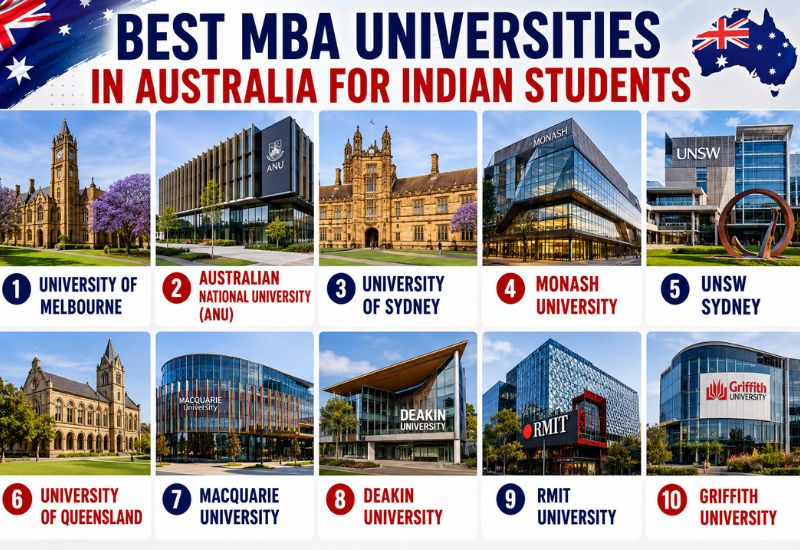
Australia is home to several globally recognised business schools that offer world-class MBA education, strong industry networks, and excellent career outcomes for international students.
University of Melbourne
The University of Melbourne is one of Australia's top-ranked universities, renowned for its prestigious MBA program, leadership development curriculum, and strong global industry connections. It is particularly recognised for business strategy, entrepreneurship, and innovation.
Australian National University (ANU)
Australian National University offers internationally recognised MBA programs with a strong focus on leadership, public policy, business strategy, and global management. Its research-driven approach makes it highly respected worldwide.
University of Sydney
The University of Sydney Business School offers highly competitive MBA programs that emphasise leadership, innovation, finance, and global business management. The university maintains strong partnerships with multinational companies and industries.
Monash University
Monash University provides industry-focused MBA programs designed to develop leadership, analytical thinking, and business decision-making skills. The university is particularly known for business analytics, marketing, and international business education.
UNSW Sydney
UNSW Sydney offers globally recognised MBA programs with a strong emphasis on technology, entrepreneurship, finance, and leadership. Its close industry connections provide excellent networking and employment opportunities.
University of Queensland
The University of Queensland delivers practical MBA programs focusing on leadership, innovation, strategic management, and global business practices. The university consistently ranks among Australia's top institutions.
Macquarie University
Macquarie University offers flexible and industry-oriented MBA programs designed for both recent graduates and experienced professionals. The university is particularly known for finance, management, and business analytics.
Deakin University
Deakin University provides affordable and practical MBA programs with strong industry engagement. It is widely recognised for online learning, business leadership, and management education.
RMIT University
RMIT University offers career-focused MBA programs emphasising innovation, entrepreneurship, digital transformation, and business management. The university maintains strong relationships with global employers.
Griffith University
Griffith University delivers internationally recognised MBA programs with a focus on leadership, sustainability, international business, and strategic management. It is considered an excellent option for international students seeking quality education at competitive costs.
Top MBA Specialisations in Australia
Australian universities offer a wide range of MBA specialisations that cater to the evolving demands of the global business market. Choosing the right specialisation can significantly impact your career growth, salary potential, and employment opportunities after graduation.

Finance
MBA in Finance is one of the most sought-after specialisations in Australia. It focuses on financial management, investment analysis, corporate finance, banking, risk management, and financial planning. Graduates can pursue careers as financial analysts, investment bankers, finance managers, and portfolio managers in multinational companies and financial institutions.
Marketing
An MBA in Marketing equips students with skills related to digital marketing, brand management, consumer behaviour, market research, advertising, and strategic marketing. This specialisation is ideal for students interested in building careers in marketing management, brand consulting, and business development.
Business Analytics
Business Analytics has become one of the fastest-growing MBA specialisations in Australia. The program focuses on data analysis, business intelligence, artificial intelligence, predictive analytics, and data-driven decision-making. Graduates are highly in demand across finance, healthcare, technology, and consulting industries.
Human Resource Management
MBA in Human Resource Management prepares students for leadership roles in talent acquisition, employee relations, performance management, organisational development, and strategic human resource planning. This specialisation is ideal for individuals interested in managing people and organisational growth.
International Business
International Business specialisation focuses on global trade, international marketing, cross-cultural management, international finance, and global business strategy. This specialisation is particularly beneficial for students aiming to work in multinational corporations and global markets.
Project Management
MBA in Project Management develops skills related to project planning, budgeting, risk assessment, leadership, operations, and strategic execution. Graduates can pursue careers in construction, IT, healthcare, consulting, and manufacturing industries.
Healthcare Management
Healthcare Management combines business administration with healthcare operations and management. Students learn about healthcare policies, hospital administration, healthcare finance, strategic planning, and healthcare leadership, preparing them for management roles in the healthcare sector.
Entrepreneurship
MBA in Entrepreneurship focuses on business innovation, startup management, venture capital, strategic planning, and business development. This specialisation is ideal for students who aspire to start their own businesses or manage entrepreneurial ventures.
MBA in Australia Admission Requirements
Admission requirements for MBA programs in Australia vary depending on the university and specialisation. However, most universities follow a standard set of admission criteria for international students.
Academic Qualifications
Applicants must possess a recognised bachelor's degree from an accredited university. Most Australian universities require applicants to have completed a three-year or four-year undergraduate degree with satisfactory academic performance.
Work Experience Requirements
Many top MBA universities in Australia prefer candidates with relevant professional work experience ranging from two to five years. However, several universities also offer MBA programs for fresh graduates and early-career professionals.
English Language Proficiency Requirements
International students must demonstrate English language proficiency through standardised tests such as IELTS, TOEFL, or PTE Academic. The required scores vary depending on the university and program.
GMAT/GRE Requirements
Some prestigious Australian business schools require GMAT or GRE scores for MBA admission. However, many universities have made these tests optional or provide admission without GMAT requirements, especially for experienced professionals.
Eligibility Requirements for MBA in Australia
Students planning to pursue an MBA in Australia must fulfil several eligibility criteria established by universities and immigration authorities.
Minimum Educational Qualification
Applicants must hold a bachelor's degree or equivalent qualification from a recognised university. Degrees in any academic discipline are generally accepted.
Academic Percentage Requirements
Most Australian universities require a minimum academic score of 55% to 65% in undergraduate studies. Highly ranked universities may require higher academic performance.
Work Experience Criteria
Depending on the university, applicants may need between two and five years of professional work experience. Some institutions offer MBA programs without mandatory work experience requirements.
English Language Requirements
Students must meet the minimum English language proficiency requirements by submitting valid IELTS, TOEFL, or PTE scores. Universities generally accept scores obtained within the last two years.
Other Eligibility Conditions
Additional eligibility criteria may include submission of a Statement of Purpose (SOP), Letters of Recommendation (LOR), updated resume, interview performance, leadership experience, and extracurricular achievements.
Entrance Exams Required for MBA in Australia
International students applying for MBA programs in Australia may need to submit scores from various standardised examinations depending on university requirements.
IELTS
The International English Language Testing System (IELTS) is the most widely accepted English proficiency examination in Australia. Most universities require an overall band score between 6.5 and 7.0 for MBA admissions.
TOEFL
The Test of English as a Foreign Language (TOEFL) is accepted by almost all Australian universities. Most MBA programs require TOEFL iBT scores ranging from 79 to 100.
PTE
The Pearson Test of English (PTE Academic) is another popular English proficiency examination accepted by Australian institutions. Most universities require scores between 58 and 65 for MBA admission.
GMAT
The Graduate Management Admission Test (GMAT) evaluates analytical writing, quantitative reasoning, verbal reasoning, and problem-solving skills. Top business schools may require GMAT scores ranging from 550 to 700.
GRE
Several Australian MBA universities accept the Graduate Record Examination (GRE) as an alternative to the GMAT. It measures verbal reasoning, quantitative reasoning, and analytical writing abilities.
Documents Required for MBA Admission in Australia
International students must prepare and submit several important documents during the MBA application process. Proper documentation significantly improves the chances of admission success.
Academic Transcripts
Applicants must submit official transcripts of all previous academic qualifications, including undergraduate and postgraduate studies, if applicable.
Degree Certificates
Universities require copies of degree certificates and provisional certificates to verify educational qualifications.
Resume/CV
A professional resume or curriculum vitae highlighting academic achievements, work experience, leadership roles, internships, certifications, and extracurricular activities is required.
Statement of Purpose (SOP)
The Statement of Purpose is one of the most important documents for MBA admission. It explains the applicant's educational background, career goals, motivation for pursuing an MBA, and reasons for selecting a specific university.
Letters of Recommendation (LOR)
Most universities require two or three recommendation letters from professors, supervisors, or employers who can evaluate the applicant's academic and professional capabilities.
Passport
Students must submit a valid passport with sufficient validity throughout the study period and visa application process.
English Proficiency Scores
Official IELTS, TOEFL, or PTE score reports must be submitted to demonstrate English language competency.
Work Experience Certificates
Applicants with professional experience must provide employment certificates, appointment letters, salary slips, or experience letters from employers.
Financial Documents
Students must provide proof of sufficient financial resources, including bank statements, education loan sanction letters, scholarship documents, or sponsorship affidavits to demonstrate their ability to cover tuition fees and living expenses.
Upcoming MBA Intakes in Australia 2026
Australian universities offer multiple intakes throughout the year, allowing international students to choose the admission cycle that best suits their academic preparation, exam scores, and career plans. Understanding the intake system is essential for planning your MBA journey effectively.
February Intake
The February Intake, also known as the Semester 1 Intake, is the primary and most popular intake for MBA programs in Australia. Most universities offer a wide range of MBA specialisations during this intake, along with better scholarship opportunities, internships, and networking events. Indian students generally prefer this intake due to greater course availability and smoother transition planning.
July Intake
The July Intake, commonly referred to as the Semester 2 Intake, is the second-largest admission cycle in Australia. Several top universities offer MBA programs during this period, making it a suitable option for students who miss the February intake or require additional time to prepare for admission requirements and visa applications.
November Intake
The November Intake is available at selected Australian universities and business schools. Although fewer MBA programs are offered compared to the February and July intakes, this intake provides additional flexibility for international students seeking faster admission opportunities.
Which Intake is Best for Indian Students?
For most Indian students, the February Intake is considered the best option due to the availability of more universities, wider course choices, increased scholarship opportunities, better internship access, and enhanced networking prospects. However, students should choose an intake based on their academic readiness, test scores, financial planning, and career goals.
Step-by-Step MBA Application Process for Indian Students
Applying for an MBA in Australia involves careful planning, proper documentation, and timely submission of applications. Following a structured application process can improve your chances of securing admission to top universities.
Step 1: Research Universities
Begin by researching Australian universities, MBA rankings, specialisations, tuition fees, scholarship opportunities, admission requirements, and career outcomes. Shortlist universities based on your academic profile, budget, and career aspirations.
Step 2: Check Eligibility
Review the eligibility criteria for each university carefully, including academic qualifications, work experience requirements, English language proficiency scores, and GMAT or GRE requirements if applicable.
Step 3: Prepare for Exams
Register and prepare for standardised examinations such as IELTS, TOEFL, PTE, GMAT, or GRE depending on university requirements. Achieving competitive scores can improve both admission and scholarship opportunities.
Step 4: Arrange Documents
Collect all necessary documents, including academic transcripts, degree certificates, resume, Statement of Purpose (SOP), Letters of Recommendation (LOR), work experience certificates, passport, and financial records.
Step 5: Submit Applications
Complete the university application forms accurately and submit all required documents before the application deadlines. Students are generally advised to apply to multiple universities to increase their chances of admission.
Step 6: Receive Offer Letter
After successful evaluation, universities issue conditional or unconditional offer letters. Students must carefully review the admission conditions, tuition fees, and enrollment procedures before accepting the offer.
Step 7: Apply for Student Visa
Once the admission offer is accepted, students can apply for an Australian Student Visa (Subclass 500). The visa application process includes submitting financial documents, health insurance details, and other supporting documentation.
Step 8: Plan Accommodation and Travel
After obtaining the visa, students should arrange accommodation, book flight tickets, purchase health insurance, attend pre-departure orientation sessions, and prepare for their academic journey in Australia.
MBA Fees in Australia for Indian Students
The cost of pursuing an MBA in Australia varies depending on the university, program duration, specialisation, and city of residence. Although tuition fees can be substantial, the strong career outcomes and post-study work opportunities often provide excellent return on investment.
Tuition Fees at Top Universities
The tuition fees for MBA programs at top Australian universities generally range from AUD 40,000 to AUD 100,000 for the entire program. Prestigious institutions such as the University of Melbourne, UNSW Sydney, and the University of Sydney typically charge higher tuition fees due to their global reputation and industry connections.
Average Annual Cost of Study
On average, international students can expect to spend between AUD 35,000 and AUD 60,000 per year on MBA tuition fees. The total cost depends on the university ranking, course duration, and chosen specialisation.
Additional University Expenses
Apart from tuition fees, students should budget for additional academic expenses such as student service fees, library fees, course materials, textbooks, technology fees, examination charges, and graduation costs. These expenses may range from AUD 1,000 to AUD 5,000 annually.
Cost of Living in Australia for Indian Students
The cost of living in Australia varies significantly depending on the city, lifestyle preferences, and accommodation choices. Students planning to pursue an MBA should carefully consider living expenses while preparing their financial budget.
Accommodation
Accommodation is usually the largest expense for international students. Depending on the city and housing type, accommodation costs can range from AUD 800 to AUD 2,500 per month. Students may choose university hostels, shared apartments, private rentals, or homestay options.
Food and Groceries
Monthly expenses for food and groceries generally range from AUD 300 to AUD 700. Students can reduce costs by preparing meals at home and taking advantage of student discounts offered by supermarkets and restaurants.
Transportation
Public transportation costs vary by city but typically range between AUD 100 and AUD 250 per month. Most Australian cities provide discounted transportation passes for international students.
Health Insurance
International students are required to purchase Overseas Student Health Cover (OSHC), which usually costs between AUD 500 and AUD 800 per year, depending on the provider and duration of coverage.
Miscellaneous Expenses
Additional expenses include mobile bills, internet services, entertainment, clothing, personal care, study materials, and recreational activities. Students should allocate approximately AUD 200 to AUD 500 per month for miscellaneous expenses.
Total Cost of MBA in Australia (Tuition + Living Expenses)
The total cost of pursuing an MBA in Australia depends on factors such as the university, course duration, city of residence, and lifestyle choices. On average, Indian students can expect to spend between AUD 60,000 and AUD 120,000 for their complete MBA journey, including tuition fees and living expenses. While the initial investment may seem substantial, Australia's strong job market, competitive salaries, and post-study work opportunities often provide an excellent return on investment.
| Expense Category | Estimated Annual Cost (AUD) |
|---|---|
| MBA Tuition Fees | AUD 35,000 – AUD 60,000 |
| Accommodation | AUD 10,000 – AUD 20,000 |
| Food & Groceries | AUD 3,000 – AUD 6,000 |
| Transportation | AUD 1,200 – AUD 3,000 |
| Health Insurance | AUD 500 – AUD 800 |
| Miscellaneous Expenses | AUD 2,000 – AUD 5,000 |
| Total Estimated Cost | AUD 60,000 – AUD 120,000 |
Scholarships and Financial Aid for MBA Students
Several scholarships and financial aid options are available for international students pursuing an MBA in Australia. These scholarships help reduce the financial burden and make quality education more accessible.
University Scholarships
Many Australian universities offer scholarships specifically for international MBA students based on academic excellence, leadership qualities, professional experience, and extracurricular achievements. These scholarships may cover partial or full tuition fees.
Australian Government Scholarships
The Australian Government provides various scholarship programs for international students, including Australia Awards Scholarships and other funding initiatives. These scholarships may cover tuition fees, living expenses, travel costs, and health insurance.
Merit-Based Scholarships
Merit-based scholarships are awarded to students with exceptional academic records, strong professional achievements, leadership experience, and outstanding entrance examination scores. Many business schools prioritise high-achieving applicants for these awards.
Need-Based Financial Aid
Some universities and organisations provide financial assistance to students facing financial constraints. Eligibility is generally assessed based on financial background, academic performance, and supporting documentation.
Scholarships that Reduce MBA Fees in Australia
Popular scholarships that can significantly reduce MBA costs include:
Australia Awards Scholarships
Destination Australia Scholarships
Melbourne Business School Scholarships
Monash International Merit Scholarships
UNSW International Scholarships
Macquarie University Scholarships
University of Sydney International Scholarships
Deakin International Scholarships
These scholarships can reduce tuition fees by 20% to 100%, depending on the institution and applicant profile.
Work Opportunities During an MBA in Australia
Australia allows international students to work while pursuing their studies, helping them gain practical experience and manage living expenses. Work opportunities also enhance employability after graduation.
Part-Time Jobs for International Students
International students can work in various sectors, including hospitality, retail, customer service, administration, tutoring, and university support services. Part-time employment helps students develop professional skills, build local networks, and earn additional income.
Internship Opportunities
Many MBA programs in Australia incorporate internships, consulting projects, industry placements, and corporate collaborations. These experiences provide practical exposure, industry connections, and valuable work experience that improve career prospects after graduation.
Work Regulations for Students
International students studying in Australia are generally permitted to work according to the current student visa regulations established by the Australian Government. Students should always verify the latest work rights and employment conditions before accepting any job opportunities.
Post-Study Work Visa After MBA in Australia
One of the major advantages of studying in Australia is the availability of post-study work opportunities for international graduates. MBA students can gain valuable professional experience after completing their degree.
Temporary Graduate Visa (Subclass 485)
The Temporary Graduate Visa (Subclass 485) allows eligible international students to live, work, and gain professional experience in Australia after completing their studies. This visa is one of the key reasons why many Indian students choose Australia for higher education.
Duration of Post-Study Work Rights
The duration of post-study work rights varies depending on the qualification level, study location, and government policies. MBA graduates may receive opportunities to work in Australia for several years after completing their degree, enabling them to gain international work experience.
Permanent Residency Opportunities
Many MBA graduates explore pathways toward permanent residency through skilled migration programs, employer sponsorships, and regional migration options. Australia's demand for skilled professionals creates favourable long-term career opportunities for qualified graduates.
Career Opportunities After MBA in Australia
An MBA from an Australian university opens doors to diverse career opportunities across multiple industries and international markets. Graduates are highly valued for their leadership skills, strategic thinking, and practical business knowledge.
Top Industries Hiring MBA Graduates
Several industries actively recruit MBA graduates in Australia, including:
Financial Services
Banking
Management Consulting
Information Technology
Healthcare
Marketing and Advertising
Supply Chain Management
Human Resources
Manufacturing
Entrepreneurship and Startups
Career Opportunities for Indian Students
Indian students can pursue various managerial and leadership roles after completing an MBA in Australia, including:
Business Analyst
Management Consultant
Marketing Manager
Financial Analyst
Project Manager
Operations Manager
Human Resource Manager
Business Development Manager
Investment Analyst
Entrepreneur
Emerging Career Trends in 2026
The demand for MBA graduates continues to evolve due to technological advancements and global business transformation. Some of the fastest-growing career areas in 2026 include:
Business Analytics
Artificial Intelligence Management
Digital Marketing
FinTech
Healthcare Administration
Sustainability Management
Supply Chain Analytics
Data-Driven Business Strategy
Cybersecurity Management
Technology Consulting
Average Salary After MBA in Australia
MBA graduates in Australia enjoy competitive salaries and strong career growth opportunities. Salary packages vary depending on specialisation, industry, experience, and employer.
Salary by Industry
Different industries offer varying salary ranges for MBA graduates:
Management Consulting: AUD 90,000 – AUD 150,000
Finance and Banking: AUD 85,000 – AUD 140,000
Information Technology: AUD 80,000 – AUD 130,000
Healthcare Management: AUD 75,000 – AUD 120,000
Marketing and Sales: AUD 70,000 – AUD 110,000
Salary by Specialisation
The choice of MBA specialisation significantly impacts salary potential:
MBA in Finance: AUD 90,000 – AUD 150,000
MBA in Business Analytics: AUD 85,000 – AUD 140,000
MBA in Project Management: AUD 80,000 – AUD 130,000
MBA in Marketing: AUD 70,000 – AUD 120,000
MBA in International Business: AUD 75,000 – AUD 125,000
Salary by Experience Level
MBA salaries also vary according to professional experience:
Entry-Level Professionals: AUD 60,000 – AUD 90,000
Mid-Level Managers: AUD 90,000 – AUD 140,000
Senior Management Professionals: AUD 140,000 – AUD 250,000+
Top Companies Hiring MBA Graduates in Australia
Several multinational corporations and leading Australian organisations actively recruit MBA graduates every year due to their leadership capabilities and business expertise.
Deloitte – Management consulting, finance, strategy, and business advisory roles.
PwC – Consulting, risk management, taxation, and business transformation services.
EY – Strategy consulting, assurance, technology, and business advisory careers.
KPMG – Audit, consulting, finance, and corporate advisory positions.
– Operations management, product management, and business leadership roles.
– Business strategy, digital marketing, and technology management opportunities.
– Product management, consulting, and technology leadership positions.
– Management consulting, digital transformation, and business operations careers.
Commonwealth Bank – Finance, banking, investment, and strategic management roles.
ANZ Bank – Corporate banking, financial analysis, and leadership opportunities.
Career Outcomes and Return on Investment (ROI)
Pursuing an MBA in Australia is a significant financial investment, but for many international students, especially Indians, the long-term career benefits and earning potential justify the cost. Australian MBA graduates benefit from strong industry connections, global exposure, leadership training, and access to international job markets.
Salary Growth After MBA
One of the primary reasons students pursue an MBA in Australia is the potential for substantial salary growth. Many professionals experience salary increases ranging from 30% to 100% after completing their MBA, depending on their industry, specialisation, work experience, and employer. Graduates entering consulting, finance, technology, and management roles often secure some of the highest salary packages.
Return on Investment Analysis
The return on investment (ROI) of an MBA in Australia depends on several factors, including university reputation, specialisation, prior work experience, and career progression. Although the total investment can range from AUD 60,000 to AUD 120,000, many graduates recover their educational expenses within a few years through competitive salaries and career advancement opportunities.
Long-Term Career Benefits
An MBA from an Australian university offers long-term advantages beyond salary growth. Graduates develop leadership skills, strategic thinking abilities, professional networks, international business exposure, and management expertise that contribute to sustained career progression and global employment opportunities.
MBA in Australia vs MBA in USA vs MBA in UK
Choosing the right study destination requires comparing important factors such as program duration, cost, career opportunities, and immigration pathways.
Duration
MBA programs in Australia typically range from 12 to 24 months. In comparison, most MBA programs in the USA require two years, while MBA programs in the UK generally take one year to complete. Australia's flexible program structure provides students with multiple study options.
Tuition Fees
The tuition fees for MBA programs vary significantly across countries. Australia offers relatively affordable MBA options compared to top universities in the USA while providing globally recognised education. The UK offers shorter programs but may have higher living expenses in major cities.
Work Opportunities
Australia provides strong employment opportunities for international students through internships, part-time jobs, graduate employment programs, and post-study work visas. While the USA and UK also offer employment opportunities, Australia's student-friendly work policies remain highly attractive.
Salary Potential
MBA graduates in all three countries can earn competitive salaries. However, salary packages vary based on industry, work experience, specialisation, and geographical location. Australia offers strong salary potential combined with excellent quality of life.
Immigration Opportunities
Australia is considered one of the most favourable destinations for international graduates seeking long-term settlement opportunities. Various skilled migration pathways, employer-sponsored visas, and regional programs create additional opportunities for MBA graduates.
Cost vs Value for Indian Students
Before pursuing an MBA abroad, students should carefully evaluate the overall cost of education against the potential career outcomes and future earning opportunities.
Is an MBA in Australia Worth the Investment?
For students seeking global exposure, practical business education, strong post-study work opportunities, and long-term career growth, an MBA in Australia can be a worthwhile investment. The value of the degree increases significantly when students select the right university, specialisation, and career pathway.
Financial Planning Tips
Indian students should create a comprehensive financial plan before beginning their MBA journey. Important considerations include:
Estimating tuition and living expenses.
Applying for scholarships and financial aid.
Exploring education loan options.
Planning emergency funds.
Considering part-time employment opportunities.
Evaluating return on investment before selecting a university.
Common Myths and Tough Realities About MBA in Australia
Many students make decisions based on incomplete information or unrealistic expectations. Understanding both the opportunities and challenges is essential before pursuing an MBA in Australia.
Popular Myths
Several myths exist regarding MBA education in Australia, including:
Every MBA graduate automatically receives a high-paying job.
Permanent residency is guaranteed after graduation.
Work experience is not important.
All universities offer similar career outcomes.
Studying in Australia guarantees international employment.
Real Challenges Faced by Students
International students may encounter several challenges during their studies, including:
Adapting to a new educational system.
Managing high living expenses.
Balancing academics and part-time work.
Building professional networks.
Competing in the graduate job market.
Managing financial pressure and career expectations.
Expert Advice Before Applying
Students should conduct thorough research before selecting an MBA program. Factors such as university rankings, industry connections, specialisation options, tuition fees, scholarship availability, career support services, and employment outcomes should be carefully evaluated before making a final decision.
Downsides of Studying an MBA in Australia
Although Australia offers many advantages, students should also understand the potential drawbacks associated with pursuing an MBA abroad.
High Tuition Costs
MBA programs at leading Australian universities can be expensive, requiring significant financial investment. Students should evaluate scholarship opportunities and financing options before applying.
Competitive Job Market
The Australian job market is highly competitive, especially for management and consulting roles. Building professional networks, gaining practical experience, and developing specialised skills are essential for career success.
Cost of Living
Major cities such as Sydney and Melbourne have relatively high living expenses, which can increase the overall cost of education significantly.
Visa Regulations
International students must comply with Australian immigration regulations and visa requirements. Policy changes may affect work rights, post-study opportunities, and long-term immigration pathways.
Work Experience Requirements
Many top-ranked MBA programs prefer applicants with prior professional experience. Students without sufficient work experience may face limitations in admission opportunities and employment prospects.
Is an MBA in Australia Right for You?
Choosing to pursue an MBA in Australia depends on your career objectives, financial situation, professional experience, and long-term goals.
Who Should Consider an MBA in Australia?
An MBA in Australia may be ideal for:
Working professionals seeking career advancement.
Students interested in global business exposure.
Individuals pursuing leadership and management roles.
Professionals planning international careers.
Entrepreneurs seeking business and innovation skills.
Students interested in post-study work opportunities.
Who Should Explore Other Options?
Students may consider alternative options if:
Budget constraints are significant.
They prefer shorter or lower-cost programs.
They lack interest in management careers.
They are not prepared for international relocation.
Their career goals align better with other educational pathways.
Final Thoughts
Summary of Key Points
Australia remains one of the leading destinations for MBA education due to its globally recognised universities, industry-focused curriculum, multicultural environment, strong employment opportunities, and favourable post-study work options. Students benefit from practical learning experiences, international exposure, and excellent career development prospects.
Future Opportunities for Indian Students
As global businesses continue to expand, the demand for skilled management professionals is expected to grow significantly. Emerging sectors such as business analytics, artificial intelligence, fintech, healthcare management, sustainability, and digital transformation will create substantial opportunities for MBA graduates in the coming years.
Expert Recommendations for 2026
Before applying for an MBA in Australia, students should carefully assess their career goals, financial resources, university rankings, specialisation preferences, and long-term plans. Selecting the right university and program can significantly influence career outcomes, return on investment, and future professional success. With proper planning and informed decision-making, pursuing an MBA in Australia can be a transformative investment for Indian students in 2026.
Conclusion
Pursuing an MBA in Australia in 2026 can be a life-changing decision for Indian students seeking global exposure, quality education, and strong career opportunities. Australia offers internationally recognised universities, flexible MBA programs, excellent post-study work options, and access to a thriving job market across industries such as finance, consulting, technology, healthcare, and business analytics.
While the cost of studying in Australia may seem high, the long-term benefits, including competitive salaries, career advancement, international networking opportunities, and potential immigration pathways, often provide a strong return on investment. From choosing the right specialisation and university to understanding admission requirements, scholarships, and career prospects, careful planning is essential for maximising the value of your MBA journey.
If you are looking for a globally recognised business degree with practical learning, multicultural exposure, and promising career outcomes, an MBA in Australia could be the perfect choice for your academic and professional goals in 2026.
Frequently Asked Questions (FAQs)
1. Is an MBA in Australia worth it for Indian students in 2026?
Yes, an MBA in Australia is considered a worthwhile investment for Indian students due to its globally recognised universities, strong employment opportunities, post-study work rights, competitive salaries, and excellent return on investment.
2. What is the average cost of pursuing an MBA in Australia for Indian students?
The total cost of an MBA in Australia, including tuition fees and living expenses, typically ranges between AUD 60,000 and AUD 120,000, depending on the university, city, and lifestyle preferences.
3. Which are the best MBA universities in Australia for Indian students?
Some of the top MBA universities in Australia include the University of Melbourne, Australian National University (ANU), University of Sydney, Monash University, UNSW Sydney, University of Queensland, and Macquarie University.
4. Can Indian students study MBA in Australia without GMAT?
Yes, many Australian universities offer MBA programs without requiring GMAT scores. Admission is often based on academic performance, work experience, English language proficiency, and overall applicant profile.
5. What is the average salary after completing an MBA in Australia?
MBA graduates in Australia can expect average annual salaries ranging from AUD 70,000 to AUD 150,000 or higher, depending on their specialisation, industry, professional experience, and employer.