







MBA Colleges in Finland Top Universities, Fees, Admission, Scholarships & Placements
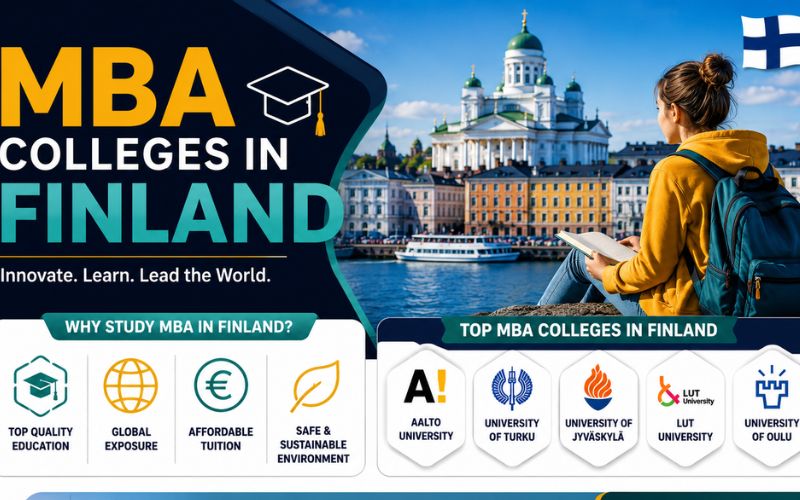
Table of Contents
MBA Colleges in Finland: Highlights 2026
- Top-ranked universities — University of Helsinki (#116 QS 2026), Aalto University (#114), University of Turku (#366), and University of Oulu (#342) attract Indian students across business, management, and STEM programs
- Top MBA-specific institutes — Aalto University School of Business, University of Helsinki Business School, and Turku School of Economics rank among the top choices for MBA in Finland
- Tuition fee range — Non-EU students typically pay €6,000-€20,000 per year (~₹5.4-18 lakh), varying by program and university, though MBA-specific programs can run €10,000-€25,000 per year
- Monthly cost breakdown — Average monthly tuition works out to around EUR 2,230 (~₹1,99,600), with average monthly living expenses around EUR 1,210
- Indian student presence — More than 2,600 Indian students are currently pursuing programs in Finland, as per Government of India data
- English-medium instruction — Finland offers over 600 English-taught programs in 2026, making the transition smoother for Indian applicants
- Curriculum focus — MBA and management programs emphasise innovation, leadership, and EU business networks, with affordable tuition compared to US schools
- Test requirements vary — Finland does not mandate GRE or GMAT for most programs, though some universities do require GMAT (625) or GRE (310) scores depending on the specific school.
Why Choose MBA Colleges in Finland?
- Strong global rankings at lower cost — Access to top-100-adjacent QS-ranked universities at a fraction of the cost of US or UK MBA programs
- EU business network access — Programs are designed with strong ties to European industries, giving graduates a foothold into the broader EU job market
- Innovation-focused education system — Finland is globally recognised for its education quality and innovation-driven teaching style, particularly relevant for tech-adjacent MBA specialisations.
- Growing Indian student community — With 2,600+ Indian students already in Finland, incoming students benefit from an established peer support network.
- Good sector prospects post-MBA — Prospects for MBA graduates are generally good in Finland, with technology, consulting, and finance being the most well-represented sectors.s
- Scholarship-friendly environment — Multiple scholarship options exist specifically to attract talented international students financially
- Flexible test requirements — Since GMAT/GRE aren't mandatory everywhere, candidates without strong standardised test scores still have solid university options available.
Eligibility Criteria for MBA Colleges in Finland
- Undergraduate degree — A bachelor's degree in any field is usually required, with a minimum percentage requirement of 55-70%+ depending on the university.
- Work experience — Most universities prefer applicants with at least two to three years of work experience
- English proficiency — IELTS score of 6.5 or TOEFL score of 90-100 typically needed for MBA admission
- Standardised tests — GMAT or GRE competitive scores are essential at several universities, though Finland does not mandate this requirement for most overall programs
- Specific test benchmarks — Some universities specify a GMAT score around 625 or GRE score around 310 as a target
- Recommendation letters — Two letters of recommendation are typically required, ideally a mix of professional and academic references
- Statement of Purpose — A clear personal statement explaining career goals and program choice is a standard requirement.
- Updated resume/CV — Covering educational background, work experience, skills, and achievements
Admission Process for MBA Colleges in Finland 2026
- Step 1: Shortlist universities — Compare based on QS ranking, fees, specialisation, and GMAT/GRE requirement
- Step 2: Confirm eligibility — Check each university's specific work experience, standardised test, and academic score requirements
- Step 3: English proficiency test — Take IELTS, TOEFL, PTE, or Duolingo English Test as accepted by your target university
- Step 4: GMAT/GRE (if required) — Prepare and take the test only if your target university mandates it
- Step 5: Compile application documents — Academic transcripts, work experience proof, resume/CV, letters of recommendation, and Statement of Purpose
- Step 6: Submit application — Applications are typically completed through the university's own portal or the national joint application portal, Studyinfo.fi, during specified application periods
- Step 7: Interview (if applicable) — Some programs include personal interviews to assess motivation and leadership suitability
- Step 8: Offer and scholarship application — Apply separately for scholarships like Erasmus Mundus or Finnish government grants where eligible
- Step 9: Visa application — Apply for the Finnish student residence permit, ensuring academic, personal, and financial documents are ready for both admission and residence permit stages
GMAT, GRE & English Language Requirements for MBA Colleges in Finland
- GMAT requirement varies by school — Some universities require a GMAT score around 625, while others don't mandate it at all
- GRE as an alternative — Accepted at several universities, with a target score around 310 at institutions that require standardised testing
- Not universally mandatory — Finland does not mandate GRE or GMAT for most overall programs, making it more accessible than GMAT-heavy destinations like the US
- English proficiency tests accepted — IELTS, TOEFL, PTE, and Duolingo English Test are all commonly accepted across Finnish universities
- Typical score thresholds — IELTS 6.5 overall, or TOEFL 90-100, are the most commonly cited benchmarks
- Finnish-medium exception — For programs taught in Finnish rather than English, proficiency in Finnish would be required instead — though the vast majority of MBA programs for international students are English-taught
- Program-specific variation — Since GMAT/GRE and English test cutoffs differ by university and specific program, confirming exact requirements directly with your shortlisted schools is essential before applying
Note: MBA fees, GMAT/GRE requirements, aur visa/residence permit rules Finland mein university-wise aur regularly update hote hain — publish se pehle official university websites aur Studyinfo.fi se latest 2026 figures confirm kar lena strongly recommend karta hoon.
Top MBA Colleges in Finland
- Aalto University School of Business — Consistently ranked as one of the top universities in Finland, with a strong international reputation; MBA program known for its focus on innovation, design, and technology; a public university
- Hanken School of Economics — A specialised business school located in Helsinki and Vaasa, known for strong programs in finance, marketing, and management, with a tight-knit community and strong industry connections
- University of Helsinki Business School — Primarily known for humanities and sciences, but also offers business-related programs with a strong focus on research and academic excellence.
- Turku School of Economics (University of Turku) — Recognised among Finland's top business schools, offering solid academic rigour at comparatively lower fees than Helsinki-based institutions.s
- University of Jyväskylä — Offers a range of MBA programs in a student-friendly city with a lower cost of living than Helsinki.
- Lappeenranta-Lahti University of Technology (LUT) — Named among Finland's notable universities for business and technology programs
- University of Vaasa & University of Eastern Finland — Also feature among the top B-schools per Shiksha Popularity Rankings 2025
- NexStudy's top pick — Based on QS rankings and student outcomes, Aalto University is currently rated the highest-ranked university for MBA & Business in Finland.
Best Public MBA Colleges in Finland
- Aalto University — A public university established in 2010, with over 17,000 students and strong affiliations including AACSB, AMBA, and EQUIS accreditation; fees around €15,000-17,000/year
- University of Helsinki — Public university with strong research focus; fees around €13,000-18,000/year
- University of Turku — Public university; fees around €8,000-12,000/year, more budget-friendly than Helsinki-based options
- University of Oulu — Public university; fees around €10,000-13,000/year
- Tampere University — Public university; fees around €6,000+/year, among the more affordable public options
- University of Jyväskylä — Public university with lower living costs due to its location outside Helsinki
- Public universities in Finland are generally triple/international-accredited and tend to offera better fee-to-reputation ratio compared to specialised private business schools
Best Private MBA Colleges in Finland
- Hanken School of Economics — A specialised, independently-run business school (though publicly regulated) known for finance, marketing, and management specialisations, with strong employer recognition
- Finland's higher education system is overwhelmingly public-university dominated, unlike countries like the US or UK — genuinely private, for-profit MBA institutions are rare.
- Business schools like Hanken function more as specialised public-interest institutions rather than private commercial universities, though they operate with more independence in program design than general public universities
- Early Commitment discount — Hanken offers a discount on tuition fees for students who commit early to their offer, which can meaningfully reduce the effective cost
- Since almost all reputable MBA options in Finland are public or quasi-public, "private vs. public" is a less meaningful distinction here than in markets like India or the US — the more relevant comparison is specialised business school (Hanken) vs. general public university business faculty (Aalto, Helsinki, Turku)
MBA Colleges in Finland: Fees Comparison
- Aalto University — €15,000-17,000/year
- University of Helsinki — €13,000-18,000/year
- University of Oulu — €10,000-13,000/year
- University of Turku — €8,000-12,000/year
- Tampere University — €6,000+/year (among the lowest of the well-known institutions)
- Overall MBA-specific range — €10,000-€25,000/year for MBA programs specifically, somewhat higher than general master's tuition due to program positioning
- Monthly average tuition equivalent — Around EUR 2,230/month (~₹1,99,600), when annualised across a typical program
- Fee exemption note — Citizens of EU/EEA countries or Switzerland, and holders of certain Finnish residence permits, are exempt from tuition fees entirely — this applies only to a small subset of international applicants, with most Indian students required to pay full non-EU tuition.
MBA Colleges in Finland: Cost of Living & Scholarships
- Average monthly living expenses — Around EUR 1,210 (~₹1,08,300), covering accommodation, food, and daily costs
- City-based variation — Helsinki is the most expensive city to live in; Jyväskylä and Turku offer a comparatively lower cost of living
- Erasmus Mundus Scholarship — Offers full scholarships for the duration of studies for eligible Indian and international students.
- EDUFI Scholarships — Cover living expenses and may include a partial tuition fee waiver for full-degree and exchange program students
- University-specific scholarships — Options like the Aalto University Scholarship, Hanken School of Economics Scholarships, and University of Turku Scholarships offer merit-based support for tuition or living costs
- External/foundation funding — Various external organisations and international agencies also provide scholarships for students studying in Finland.
- Part-time work support — International students can work part-time up to an average of 25 hours per week, helping offset living costs, though most local jobs do require some Finnish language skills
- Scholarship value can meaningfully reduce the overall €10,000-25,000/year MBA cost, so applying early and to multiple scholarship schemes is advisable given the competitive, merit-based selection process.
Note: MBA fees, scholarship availability, aur public/private distinctions university-wise vary karte hain aur regularly update hote hain — publish se pehle official university websites (Aalto, Hanken, Helsinki, etc.) se latest 2026 figures confirm kar lena strongly recommend karta hoon.
MBA Colleges in Finland: Placements
- Average salary offered to MBA graduates — Around EUR 60,000 per year (~₹53.7 lakh), based on aggregated data across top Finnish business schools
- Top recruiters — Valmet, TietoEVRY, and EY (Ernst & Young) are among the companies actively recruiting MBA graduates in Finland.
- Strong sectors for placements — Technology, consulting, and finance are the most well-represented sectors for MBA graduate hiring in Finland.
- Innovation and startup culture — Finland's strong entrepreneurship ecosystem means many MBA graduates also pursue startup founding or early-stage venture roles rather than purely corporate placements
- Networking-driven hiring — Being based in cities like Helsinki puts students close to corporate leaders and successful entrepreneurs, which often translates into strong internship-to-job conversion
- Placement data caveat — Unlike US or UK business schools, most Finnish universities don't publish detailed placement percentage statistics, so recruiter names and average salary figures are the more reliable data points to rely on
- Labour market context — Finland currently faces sector-specific talent shortages in IT, engineering, and specialist management roles, which can work in favour of MBA graduates with relevant technical or analytical specialisation
MBA Colleges in Finland: ROI (Fees vs Salary)
- Tampere University — Fees: ~€6,000+/year vs Avg salary €60,000/year → Strongest ROI, given the lowest fee bracket among well-known institutions
- University of Turku — Fees: €8,000-12,000/year vs Avg salary €60,000/year → Very strong ROI, especially given Turku School of Economics' reputation
- University of Oulu — Fees: €10,000-13,000/year vs Avg salary €60,000/year → Good ROI, moderate fee bracket
- University of Helsinki — Fees: €13,000-18,000/year vs Avg salary €60,000/year → Moderate ROI, offset by strong academic/research brand value
- Aalto University — Fees: €15,000-17,000/year vs Avg salary €60,000/year → Moderate ROI, offset by strongest overall global ranking and innovation-focused reputation
- General ROI trend — Given tuition costs are notably lower than in the US, UK, or Australia, most Finnish MBA programs recover their cost within 1-2 years of average post-MBA salary, making Finland one of the stronger value-for-money MBA destinations in Europe.
- Living cost factor — Choosing a lower-cost city like Jyväskylä, Turku, or Tampere over Helsinki can meaningfully improve overall ROI by reducing the living-expense side of total program cost
Top MBASpecialisations Offered by MBA Colleges in Finland
- Innovation & Design Management — Signature strength at Aalto University, blending business with technology and design thinking
- Finance — Core specialisation at Hanken School of Economics, aligned with strong employer recognition in the finance sector
- Marketing & Management — Also a strength at Hanken, with practical, industry-connected coursework
- International Business — Offered widely across Finnish business schools, useful for students targeting EU-wide or global careers
- Business Analytics — Growing specialisation aligned with Finland's strong technology sector demand
- Energy & Environment / Sustainability Management — Reflects Finland's institutional focus on sustainable business practices and clean-tech innovation
- Entrepreneurship — A natural fit given Finland's recognised startup and innovation culture, with strong support from university incubators
- Supply Chain & Operations, Human Resources — Offered at several universities as core or elective specialisation tracks
- Specialisation choice should align closely with Finland's strongest employment sectors — technology, consulting, and finance — for the best post-MBA outcomes
Student Visa Requirements for MBA Colleges in Finland
- Visa/permit type — Indian and other non-EU/EEA students need a Finnish residence permit for studies, applied for through the national visa/permit system
- Application documents — Academic acceptance letter, proof of tuition fee payment (where applicable), and proof of sufficient funds for living expenses are core requirements
- Financial proof — Applicants must demonstrate sufficient funds to cover living costs for the duration of study, in line with Finland's minimum monthly income guidelines
- Application timing — Permits must be applied for well before the program start date, since processing times can vary
- Application channel — Typically submitted online via Finland's national immigration authority (Migri) portal, followed by a biometric appointment where required
- Health insurance — Non-EU/EEA students are generally required to arrange valid health insurance coverage for the duration of their studies
- Language requirement note — No Finnish/Swedish language proficiency is required for the student visa itself, since most MBA programs are taught fully in English
- Requirements and processing times can change, so confirming the latest checklist directly on Migri's official website before applying is strongly advised.
Post-Study Work Opportunities After MBA in Finland
- Residence permit to look for work or start a business — Available to graduates after completing a degree in Finland, allowing them to stay and search for employment or start a company
- Duration — Reported as up to 2 years by several sources, though at least one source describes a 12-month non-renewable job-seeking permit — this detail varies by source and is worth confirming directly with Migri for the most current rule
- Financial requirement — Applicants must show sufficient funds during the permit period — for example, at least EUR 1,210/1,090/1,030 per month depending on region as per 2026 guidelines, or a minimum of €19,200 for a 2-year permit under certain calculations
- Unrestricted work rights — During this job-seeking period, graduates are generally allowed to work without restrictions while searching for employment.
- Fast-track options for skilled roles — High-skilled professionals, especially in IT, engineering, and research, may access fast-tracked work permits with processing times as short as two weeks once employed
- In-demand sectors — Information Technology (software development, data analytics, cybersecurity) and select specialist/management roles are currently facing labour shortages in Finland, improving job prospects for relevant MBA specialisations.
- Path to Permanent Residence — Graduates who secure employment and build sufficient work history in Finland (commonly citing 2, 4, or 6-year continuous-permit pathways depending on route) can eventually apply for permanent residency
- Entrepreneurship route — Graduates wanting to start their own business can apply for a residence permit for entrepreneurs, including support through Finland's dedicated start-up permit program via Business Finland
Note: Placement figures, ROI estimates, aur especially post-study work/residence permit durations alag-alag official aur aggregator sources ke beech thoda vary kar rahe hain (jaise 12-month vs 2-year job-seeking permit) — publish se pehle Migri.fi (Finnish Immigration Service) aur specific university placement offices se latest 2026 confirm kar lena strongly recommend karta hoon.
Top Recruiters Hiring MBA Graduates in Finland
- Valmet — Major technology and engineering company, actively recruiting MBA graduates into management and strategy roles
- TietoEVRY — Leading IT services and consulting firm, drawing MBA talent into technology-adjacent management positions
- EY (Ernst & Young) — Global professional services firm with a strong consulting-sector recruitment pipeline for MBA graduates
- Sector concentration — Technology, consulting, and finance remain the three strongest-recruiting sectors for MBA talent in Finland.
- Startup ecosystem hiring — Finland's vibrant startup culture also means many graduates find opportunities at early-stage tech and innovation-focused companies, not just large corporations.s
- Talent-shortage sectors — IT (software development, data analytics, cybersecurity) is currently experiencing labour shortages, creating additional openings for MBA graduates with relevant technical specialisation
- Networking-driven access — Since many programs (especially at Aalto and Hanken) emphasise direct engagement with corporate leaders and entrepreneurs, alumni and faculty networks play a meaningful role in landing roles at these recruiters.
Average Salary After Graduating from MBA Colleges in Finland
- Overall average salary offered — Around EUR 60,000 per year (~₹53.7 lakh), based on aggregated data across Finland's top business schools
- Sector-based variation — Consulting and finance roles typically report the highest starting packages, followed by technology-sector management roles.
- City-based variation — Helsinki-based roles generally offer higher compensation, reflecting both higher living costs and a greater concentration of large employers and multinational headquarters.
- India-comparison value — For Indian students, an MBA abroad is often associated with a meaningful salary jump compared to pre-MBA earnings, similar to broader global MBA trends
- Data limitation — Finnish universities don't uniformly publish detailed post-MBA salary breakdowns by program, so the EUR 60,000 figure should be treated as an aggregated estimate rather than a program-specific guarantee
- Long-term growth potential — Experienced MBA professionals in high-demand sectors like consulting and specialist IT management can see salaries grow well beyond the average starting figure over a multi-year career
Student Life at MBA Colleges in Finland
- Diverse, international cohorts — With 2,600+ Indian students already in Finland and 600+ English-taught programs available, MBA classrooms tend to be genuinely international
- Innovation-driven learning culture — Programs emphasise practical, hands-on learning and direct exposure to corporate leaders and entrepreneurs, rather than purely theoretical instruction
- City-based experience varies — Helsinki (Aalto, Hanken, University of Helsinki) offers a vibrant, networking-rich urban environment, while cities like Jyväskylä, Turku, and Tampere offer a quieter, more affordable, student-friendly experience
- Safety and quality of life — Finland is consistently ranked among the world's safest and happiest countries, offering a stable, low-stress environment for international students
- Part-time work culture — Students can work part-time (generally up to 25 hours/week on average) alongside studies, helping offset living costs while gaining local work exposure
- Strong student support systems — Universities typically offer dedicated international student services, career support, and integration programs, including Finnish language courses
- Startup and entrepreneurship exposure — Finland's active startup ecosystem means students have access to incubators, hackathons, and networking events beyond the standard curriculum
Compare MBA Colleges in Finland
| University | Type | Fees (per year) | Notable Strength |
|---|---|---|---|
| Aalto University | Public | €15,000-17,000 | Innovation, design, technology; highest-ranked overall |
| Hanken School of Economics | Specialized/Public-regulated | Fee + Early Commitment discount available | Finance, marketing, strong industry ties |
| University of Helsinki | Public | €13,000-18,000 | Research and academic excellence |
| University of Turku (Turku School of Economics) | Public | €8,000-12,000 | Strong ROI, solid academic reputation |
| University of Oulu | Public | €10,000-13,000 | Balanced cost and quality |
| Tampere University | Public | €6,000+ | Most affordable well-known option |
| University of Jyväskylä | Public | Moderate | Lower cost of living, practical focus |
- Best for global brand + innovation focus: Aalto University
- Best for finance/marketing specialisation: Hanken School of Economics
- Best for ROI: Tampere University, University of Turku
- Best for research-oriented MBA: University of Helsinki
- Best for lower cost of living: University of Jyväskylä, Tampere
How to Choose the Best MBA College in Finland
- Check QS/global rankings alongside specialisation fit — Aalto's strength in innovation/design may suit tech-focused careers better than a generalist program elsewhere.
- Compare total cost, not just tuition — Factor in city-specific living costs, since Helsinki is considerably pricier than Jyväskylä, Turku, or Tampere.e
- Confirm GMAT/GRE policy early — Since requirements vary significantly by university, prioritise schools matching your test-score profile or academic strength.
- Evaluate scholarship eligibility — Programs like the Aalto University Scholarship, Hanken scholarships, and Erasmus Mundus can meaningfully reduce your effective cost — apply early given competitive selection.
- Check recruiter alignment — If targeting consulting, tech, or finance, look at which universities have the strongest ties to recruiters like EY, TietoEVRY, or Valme.t
- Consider public vs. specialised business school format — Decide between a broad public-university business faculty (Aalto, Helsinki, Turku) versus a specialised business school (Hanken) based on your specific career focus.
- Factor in post-study work and PR pathway needs — If long-term settlement in Finland matters to you, review current residence-permit-after-graduation rules directly with Migri, since terms can change.e
- Talk to current students or alumni — Especially useful given how much placement and salary data varies across sources — first-hand insight helps set realistic expectations.ns
Frequently Asked Questions (FAQs)
Q1. Is GMAT mandatory for MBA in Finland?
Not universally — some universities require GMAT (around 625) or GRE (around 310), while Finland does not mandate this for most overall programs, so it depends heavily on the specific school.
Q2. How much does an MBA in Finland cost for Indian students?
Tuition ranges from roughly €6,000 (Tampere) to €17,000+ (Aalto) per year, with MBA-specific programs sometimes running up to €25,000/year depending on the school.
Q3. Can I work while studying an MBA in Finland?
Yes, non-EU/EEA students on a study residence permit can generally work part-time, averaging up to 25 hours per week.
Q4. What is the average salary after an MBA in Finland?
The reported average salary offered to MBA graduates is around EUR 60,000 per year, though this varies by sector, university, and individual profile.
Q5. Can I stay back and work in Finland after my MBA?
Yes, graduates can apply for a residence permit to look for work or start a business after completing their degree. However, the exact duration (commonly cited as up to 2 years, though some sources note 12 months) should be confirmed with Migri.fi.
Q6. Which are the best universities for MBA in Finland?
Aalto University, Hanken School of Economics, University of Helsinki, and Turku School of Economics are among the most recognised choices for international MBA students.
Q7. Is Finland a good MBA destination compared to the UK, US, or Australia?
It offers considerably lower tuition than the US, UK, or Australia, strong ROI, and a safe, innovation-driven environment — though the overall MBA job market is smaller in scale than these larger economies, and Finnish language skills can help with broader local job access.
Conclusion
An MBA from Finland offers a distinctive combination of globally-ranked education, an innovation-and-design-forward curriculum, and meaningfully lower tuition costs compared to traditional MBA destinations like the US, UK, or Australia. With average post-MBA salaries reported around EUR 60,000 and strong recruiter ties across technology, consulting, and finance, Finland presents a compelling ROI case, especially for students who choose cost-efficient cities like Tampere, Turku, or Jyväskylä over pricier Helsinki. That said, prospective students should treat salary, placement, and post-study visa duration claims with some caution, since these figures vary across sources and Finland's overall job market is smaller in scale than larger MBA destinations.