




IELTS vs PTE vs TOEFL – Which Is Best for Study Abroad in 2026?
Table of Contents
IELTS vs PTE vs TOEFL – Which Is Best for Study Abroad in 2026?
Introduction: Why This Question Still Confuses Students in 2026
Every year, thousands of Indian students walk into counselling sessions with the same question, regardless of whether they are aiming for the USA, UK, Canada, Australia, Europe, or even Asia:
“IELTS vs PTE vs TOEFL – which exam should I take?”
After more than three decades of counselling students and parents, I can say this with absolute clarity:
There is no universally “best” English language test.
There is only the right test for the right student, country, university, and visa pathway.
Unfortunately, most students choose an exam based on:
What friends are taking
Coaching centre recommendations
Short-term “easy exam” myths
Random social media advice
This often leads to retakes, wasted money, delayed intakes, and visa stress.
This blog is written to give you clear, honest, 2026-relevant guidance—not marketing talk, not exam-centre propaganda, and not unrealistic promises.
Why English Proficiency Tests Matter for Study Abroad
Before comparing exams, students must understand why these tests exist and how universities and visa officers actually view them.
English language tests are used to assess:
Academic readiness (lectures, assignments, research)
Communication ability (seminars, presentations, group work)
Visa compliance (especially in countries like the UK, Canada, and Australia)
They are evaluated at three levels:
University admissions
Visa authorities
Professional bodies (law, healthcare, teaching, etc.)
This is why choosing the wrong test—or scoring just “bare minimum”—can create problems later.
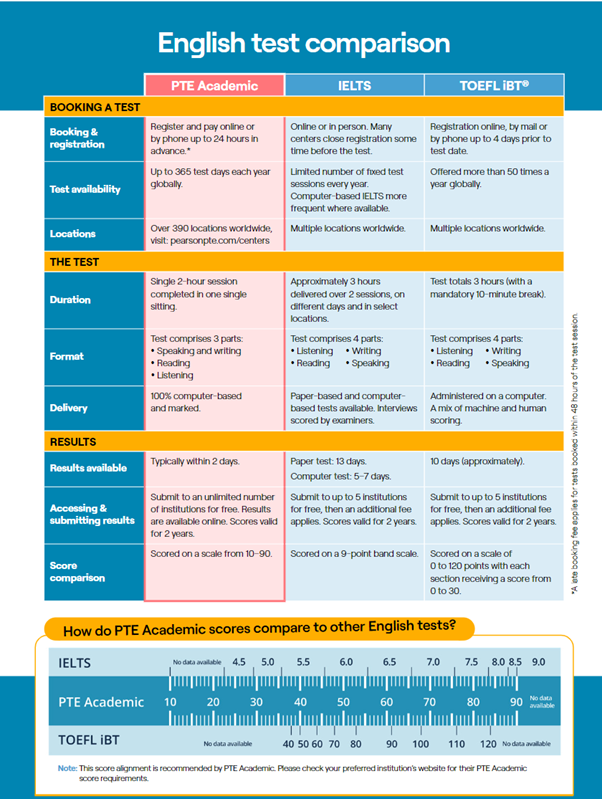
Overview of the Three Major Exams (2026 Context)
Exam | Conducting Body | Test Mode | Global Acceptance |
|---|---|---|---|
IELTS | IELTS | Paper / Computer | Very High |
PTE Academic | Pearson | Computer only | High (growing) |
TOEFL iBT | ETS | Computer | High (USA-focused) |
All three tests are valid, recognised, and accepted in 2026. The difference lies in how they test you, not whether they are “good or bad”.
IELTS Explained: Who Should Choose IELTS in 2026?
What IELTS Really Tests (Beyond the Brochure)
IELTS is not just a language test—it is a real-world English evaluation.
It assesses:
How well you understand accents
How clearly you organise ideas
How naturally you communicate with humans
IELTS Test Structure
Section | Format | Duration |
|---|---|---|
Listening | Audio-based | 30 minutes |
Reading | Academic texts | 60 minutes |
Writing | Task 1 & Task 2 | 60 minutes |
Speaking | Face-to-face interview | 11–14 minutes |
Key Strengths of IELTS
Accepted by almost every university worldwide
Strongly preferred for the UK, Australia, and New Zealand
Trusted by visa officers
Human interaction in speaking (important for real communication)
Where Students Struggle in IELTS
From counselling experience:
Writing Task 2 (idea clarity, coherence)
Speaking confidence (especially for introverted students)
Listening accents (British, Australian, mixed)
Who IELTS Is Best For
IELTS is ideal if you:
Are comfortable speaking to a real examiner
Prefer structured writing
Are you applying to the UK, Australia, or New Zealand
Are in law, psychology, humanities, education, and management
PTE Academic Explained: The Reality Behind “Easy Exam” Myths
What PTE Actually Measures
PTE focuses on:
Speed
Pronunciation clarity
Consistency
Computer interaction
It is not “easy”—it is different.
PTE Test Structure
Skill | Assessment Style |
|---|---|
Speaking | Recorded responses |
Writing | Integrated tasks |
Reading | Automated scoring |
Listening | Computer-based |
Advantages of PTE in 2026
Fast results (often within 24–48 hours)
Fully computer-based (no human bias)
Strong acceptance in Australia & Canada
Preferred by students comfortable with technology
Hidden Challenges of PTE
This is where counselling experience matters:
Strict pronunciation scoring
Mic sensitivity issues
Time pressure causes panic
Repetition-based tasks confuse overthinkers
Who Should Choose PTE
PTE is suitable if you:
Speak clearly and confidently
Are comfortable with computers
Want faster results
Are you applying mainly to Australia or Canada
Prefer objective, algorithm-based scoring
TOEFL iBT Explained: Still Relevant or Losing Ground?
TOEFL’s Academic Focus
TOEFL was designed with American universities in mind.
It emphasizes:
Academic listening
Campus-style lectures
Structured responses
TOEFL Test Structure (2026)
Section | Style |
|---|---|
Reading | Academic passages |
Listening | University lectures |
Speaking | Recorded responses |
Writing | Integrated & independent |
Strengths of TOEFL
Strong acceptance in the USA
Familiar format for science & engineering students
Good for those used to American accents
Limitations of TOEFL Today
Less preferred in the UK visa pathways
Speaking feels unnatural to many students
Longer test duration causes fatigue
Best Candidates for TOEFL
TOEFL works best if you:
Are targeting USA universities
Have a strong academic background
Are comfortable typing and listening for long durations
Are in STEM fields
Country-Wise Preference: What Universities Actually Accept in 2026
Country | Preferred Tests | Counsellor Insight |
|---|---|---|
UK | IELTS (strongly) | Visa officers trust IELTS most |
Australia | IELTS / PTE | PTE growing fast |
Canada | IELTS / PTE | IELTS still safest |
USA | TOEFL / IELTS | TOEFL still popular |
Germany | IELTS / TOEFL | Depends on university |
Ireland | IELTS | Clear preference |
New Zealand | IELTS | Strong acceptance |
Visa Perspective: This Is Where Students Make Mistakes
Universities may accept all tests, but visa officers think differently.
Key observations from real cases:
Borderline scores raise questions
IELTS is often viewed as “communication ready”
PTE scores must be comfortably abovethe minimum
TOEFL sometimes needs extra explanation for UK visas
Never choose a test purely on university acceptance. Visa perspective matters.
Course-Wise Recommendations (Experience-Based)
Course Type | Best Fit |
|---|---|
MBA / Management | IELTS |
Psychology / Law | IELTS |
Engineering / IT | TOEFL / IELTS |
Healthcare | IELTS |
Hospitality | IELTS |
Data Science | TOEFL / PTE |
Common Student Myths (That Cost Time & Money)
Myth 1: PTE is easier than IELTS
Reality: Different skills, not easier
Myth 2: Minimum score is enough
Reality: Competitive profiles need higher scores
Myth 3: Retakes don’t matter
Reality: Visa officers notice patterns
How to Choose the Right Exam
Ask yourself:
Which country am I applying to?
Which course am I pursuing?
How strong is my spoken English?
Am I comfortable with computers and speed?
Do I need fast results?
What does my visa pathway prefer?
Your answers will point clearly to the right exam.
Why Choose Your Global Mentors
Choosing the right course, country, university, or exam is not a decision that should be made based on trends, peer pressure, or short-term convenience. At Your Global Mentors, guidance is rooted in clarity, long-term outcomes, and real admission and visa realities. Students and parents are supported with structured counselling that considers academic background, career goals, financial planning, visa regulations, and post-study opportunities—rather than one-size-fits-all advice. The focus remains on helping students make informed, sustainable decisions that reduce the risk of rejections, course changes, or future regret, while ensuring alignment with evolving global education and immigration frameworks.
Final Verdict: Which Is “Best” in 2026?
Let me be very clear, as someone who has guided thousands of successful students:
IELTS → Most balanced, safest, universally trusted
PTE → Fast, tech-driven, good for Australia & Canada
TOEFL → Academic-focused, best for the USA
The “best” test is the one that:
Matches your strengths
Aligns with your destination
Strengthens your visa profile
Reduces future risk
Final Counsellor Advice to Students & Parents
English tests are not hurdles.
They are filters.
Choosing wisely once is better than:
Retaking exams
Missing intakes
Facing visa refusals
Losing confidence
Treat this decision as a strategic step, not a formality.