





How to Get Scholarship to Study Abroad for Indian Students in 2026: Complete Step-by-Step Guide
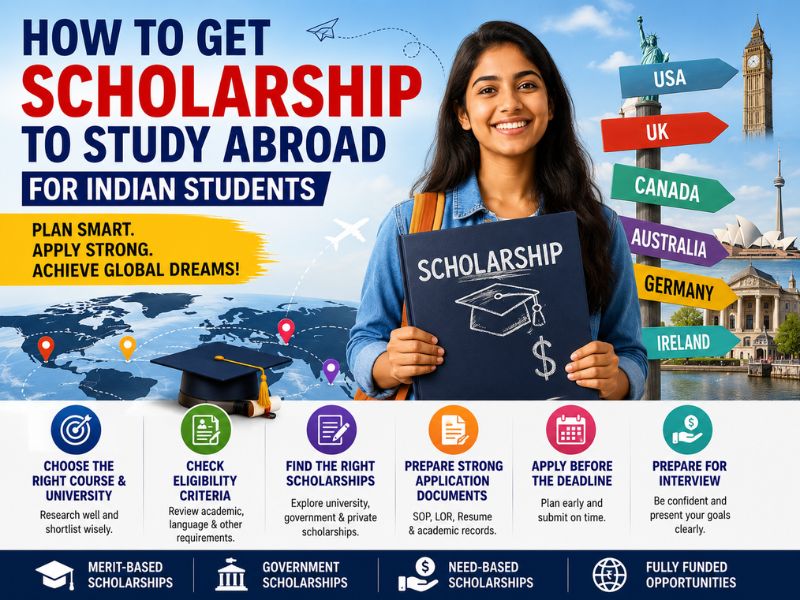
Table of Contents
Scholarships for Indian Students to Study Abroad: Highlights 2026
Studying abroad remains a top aspiration for Indian students, but the cost can be a major barrier — which is exactly where scholarships make the difference. Over 1.3 million Indian students are currently studying abroad in 2026, and the number continues to rise every year, driving universities and governments worldwide to expand their scholarship offerings to attract talented Indian applicants.
In 2026, opportunities span the full spectrum — from prestigious, ultra-competitive government scholarships like Fulbright and Chevening to university-specific merit awards and private trust funding. Fully funded scholarships can be merit-based, need-based, or university-specific, giving students multiple pathways depending on their profile and target country.
A defining feature of 2026's scholarship landscape is the sheer geographic diversity of options — hundreds of scholarships are available across the United Kingdom, United States, Germany, Australia, Japan, China, Switzerland, New Zealand, and Türkiye, letting students match funding opportunities to their preferred study destination rather than being limited to one or two countries.
Timing matters significantly this year. The best time to apply for a scholarship to study abroad is at least 12-18 months before your intended admission, making early planning essential rather than optional for serious applicants targeting the 2026-27 academic cycle.
What is a Scholarship for Indian Students to Study Abroad?
A scholarship for Indian students to study abroad is financial aid awarded by governments, universities, or private organisations specifically to help Indian nationals pursue higher education outside India, without bearing the full financial burden themselves.
A fully funded scholarship or 100% scholarship is financial aid offered to students that covers 100% or nearly all of the essential costs associated with higher education abroad. This typically includes tuition fees, accommodation, travel costs, and sometimes additional allowances for books, health insurance, or research expenses.
Not all scholarships offer full funding, though. Partially funded scholarships offer just a portion of your total expenses — it could be the entire tuition fee, or a percentage like 20% or 50%, or just cover living expenses. These are commonly offered by private companies, corporates, brands, and universities.
Scholarships for Indian students specifically span nearly every academic discipline. There are scholarship opportunities for Indian students across all disciplines, ranging from arts and humanities to engineering to social sciences. Some are targeted directly by the Indian government based on merit, financial need, or minority status — for instance, the Indian government has launched a scheme called Padho Pardesh to support Indian students planning to study abroad.
Understanding this distinction between fully funded, partially funded, government, university, and private scholarships is the first step toward building a realistic funding strategy for your international education in 2026.
Why Scholarships are Important for Indian Students
Scholarships do far more than reduce costs — they fundamentally change what's possible for Indian students pursuing international education in 2026.
Removing financial barriers
Fully funded scholarships for Indian students to study abroad can ease the financial burden that comes with pursuing an international education, allowing students to put their entire focus into studying rather than worrying about how to cover costs.
Enabling unbiased college choices
One of the most underrated benefits is decision-making freedom. Students can make better choices in selecting the right college and course, since upon securing a full scholarship, their decision won't be biased toward courses with lower fees — meaning students can choose based on genuine fit rather than affordability alone.