







Highest Paying Jobs in Australia 2026: Top Careers, Salary, Skills & Future Opportunities
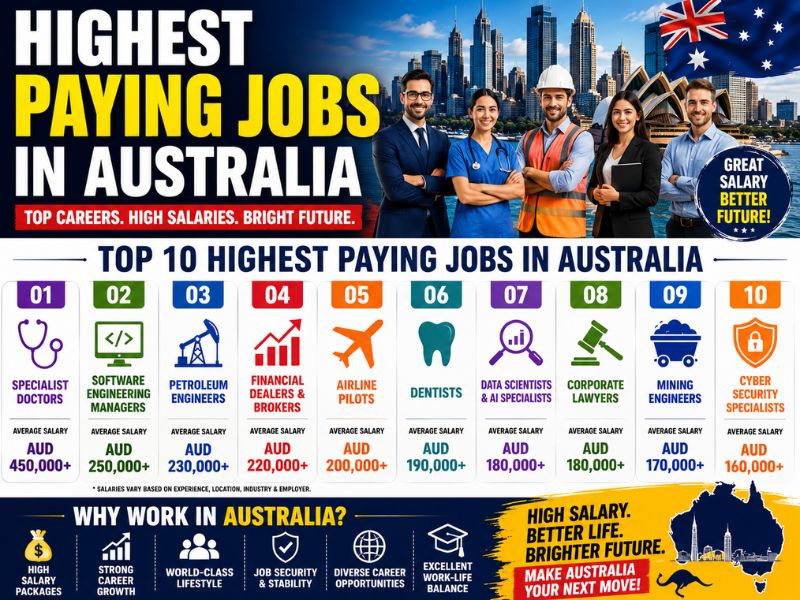
Table of Contents
Highest Paying Jobs in Australia: Highlights 2026
Australia's job market in 2026 continues to reward specialised expertise, with healthcare, finance, mining, and technology sectors leading the salary charts. According to ATO taxable income data, surgeons declare an average taxable income of about $472,475 a year, more than six times the national average of $74,240.
| Highlight | Details |
|---|---|
| Top-Paying Field | Healthcare (Surgeons, Anaesthetists, Psychiatrists) |
| Highest Salary Range | $400,000 - $700,000+ (Neurosurgeons, private practice) |
| Non-Medical Leader | Financial Dealers (~$355,000) |
| Fastest-Growing Sector | Technology (Cloud, Cybersecurity, AI roles) |
| No-Degree Highest Pay | Air Traffic Control ($140K-$210K) |
Medical specialists hold seven of the ten highest-earning occupation groups in ATO records, reflecting the long training pathways and chronic shortages behind these figures. Beyond medicine, financial dealers average about $355,233 a year, ahead of chief executives and managing directors at roughly $194,987, with Sydney concentrating most of these high-paying finance roles.
Mining and technology round out the top-paying sectors, driven by resource-sector demand in Western Australia and Queensland, along with growing enterprise investment in cloud and AI infrastructure. For job seekers and skilled migrants, 2026 offers strong earning potential across multiple specialised career paths.

Australia remains one of the most attractive destinations for skilled professionals worldwide, combining a strong economy with consistently high-paying job opportunities across multiple sectors. Australia continues to attract skilled professionals from around the world with its strong economy and high-paying job opportunities, with several industries offering impressive salaries due to skill shortages, technological growth, and increased demand for experienced workers.
| Reason | Details |
|---|---|
| Strong Economy | Stable job market with skill shortages driving up pay |
| High Salaries | Top roles exceeding AUD 400,000+ annually |
| Visa Pathways | PR routes via skilled occupation lists (491, 482, 485) |
| Work-Life Balance | Strong labour protections, generous leave entitlements |
| Diverse Opportunities | Healthcare, mining, tech, finance, trades |
From healthcare and engineering to IT and data science, understanding which roles offer the highest pay can help you plan your career or migration pathway wisely. The country's skilled migration programs also make it accessible for international professionals to build long-term careers, particularly in fields facing acute shortages like psychiatry, mining engineering, and specialised nursing.
Beyond salary, Australia offers excellent quality of life, robust healthcare and education systems, and multicultural cities like Sydney, Melbourne, and Perth that provide strong professional networks. For 2026, the combination of high earning potential, skill shortage visas, and long-term settlement pathways makes Australia a compelling choice for ambitious professionals across nearly every industry.

Working in Australia offers far more than just competitive salaries — it provides a holistic combination of financial security, career growth, and lifestyle advantages that attract professionals globally.
| Benefit | Details |
|---|---|
| High Salaries | Many roles exceed $150K-$400K+ annually |
| Superannuation | Employer-contributed retirement savings on top of salary |
| Work-Life Balance | Strong minimum leave entitlements, regulated work hours |
| Regional Incentives | 10-20% salary premiums in remote/regional roles |
| Career Progression | Clear pathways from graduate to specialist/executive roles |
| PR Pathways | Skilled visas (482, 491, 485) for long-term settlement |
One major advantage is superannuation, Australia's mandatory retirement savings scheme, which employers contribute to on top of base salary, effectively boosting total compensation. Salaries include superannuation; regional often 10–20% higher, making remote and regional roles particularly attractive for those willing to relocate.
Australia also offers strong job security in shortage occupations, with sectors like healthcare, mining, and technology providing consistent demand-driven pay growth. Skilled migrants benefit from established visa pathways, including employer-sponsored and points-based permanent residency options, allowing many professionals to build long-term careers and eventually settle permanently, making Australia a genuinely rewarding destination for both locals and international workers in 2026.
Industries with the Highest Salaries in Australia
Several industries in Australia consistently dominate salary rankings, driven by skill shortages, complex qualifications, and high-stakes responsibilities. Healthcare dominates the top of the list, and that is not an accident, as specialist medicine combines a decade or more of training, strict registration, and a national shortage of practitioners.
| Industry | Salary Range (Approx.) | Key Roles |
|---|---|---|
| Healthcare | $240K - $700K+ | Surgeons, Anaesthetists, Psychiatrists |
| Finance | $250K - $410K+ | Financial Dealers, CFOs, Heads of Treasury |
| Mining & Resources | $150K - $450K+ | Mining Engineers, Site Managers (FIFO) |
| Technology | $110K - $260K+ | Cloud Architects, Cybersecurity Specialists |
| Executive/C-Suite | $200K - $9M | CEOs, CFOs, Managing Directors |
| Legal | $180K - $600K+ | Partners, Senior Legal Practitioners |
Finance produces the highest-paid non-medical earners in the country, with financial dealers averaging about $355,233 a year, concentrated largely in Sydney. Mining and resources remain lucrative too, particularly in Western Australia and Queensland, where roles tied to fly-in fly-out rosters carry the biggest allowances.
Technology salaries have also climbed sharply, with SEEK data putting the average cloud architect at $125,000 to $130,000, while senior contractors bill far higher, with cloud architects charging $175 to $250 an hour in 2026. Executive and C-suite roles, along with legal partnerships, round out the highest-paying industry categories for 2026.
Top 20 Highest Paying Jobs in Australia
Based on ATO taxable income data, Hays Salary Guide FY26/27, and SEEK advertised salaries, here are the top-paying roles in Australia for 2026:
| Rank | Job Title | Salary Range (AUD) |
|---|---|---|
| 1 | Surgeon/Neurosurgeon | $472,475 avg. / $600K-$700K+ (private) |
| 2 | Head of Treasury | $410,000 (up to $510K) |
| 3 | Anaesthetist | $386K - $850K+ |
| 4 | Energy Project Director | ~$330,000 |
| 5 | Psychiatrist | $450K (public) / $550K+ (private) |
| 6 | Project Development Director | ~$320,000 |
| 7 | Defence Sales Director | ~$320,000 |
| 8 | Internal Medicine Specialist | $350,000+ |
| 9 | CFO | Up to $350,000 |
| 10 | Financial Dealer | ~$355,233 |
| 11 | Construction Manager | ~$300,000 |
| 12 | CEO/Managing Director | $194,987 - $9M (top-tier) |
| 13 | Head of People & Culture | $200,000 - $330,000+ |
| 14 | Legal Partner | $180,000 - $600,000+ |
| 15 | IT Manager/CIO | $170,000 - $220,000+ |
| 16 | Mining Engineer | $145,000 - $250,000+ |
| 17 | Engineering Manager | $183,100 - $200,000 |
| 18 | Principal Architect | ~$250,000 |
| 19 | Cybersecurity Architect | $180-$260/hour (contract) |
| 20 | Air Traffic Controller | $140,000 - $210,000 |
Heads of Treasury recorded the highest typical salaries across Australia out of all professions, with those in Sydney earning an impressive $410,000 on average and upper salary bands reaching up to $510,000. Meanwhile, Energy Project Directors were in second place, with typical salaries reaching $330,000 nationally, reflecting continued investment in large-scale infrastructure projects.
Note: Figures are approximate estimates compiled from ATO data, Hays Salary Guide, and SEEK reports, and can vary significantly by location, experience, and employer. Always verify current figures through official salary guides before making career decisions.
Highest Paying Jobs in Australia for Indian Students
Australia continues to be a top destination for Indian students seeking well-paying careers post-graduation, offering structured pathways into healthcare, technology, engineering, and finance sectors. As of early 2026, there are approximately 330,000-350,000 open job roles available across Australia, with particular strength in healthcare, technology, and engineering.
| Job Role | Approx. Salary (AUD) | Suggested Field |
|---|---|---|
| Data Scientist/Analyst | $90,000 - $140,000 | STEM, MBA |
| Software Engineer | $90,000 - $140,000 | Computer Science |
| Healthcare Manager | $100,000 - $150,000 | Health Management |
| Business Analyst | $85,000 - $120,000 | MBA, Business Analytics |
| Civil/Construction Engineer | $100,000 - $150,000 | Civil Engineering |
| Accountant (CPA/ACCA) | $75,000 - $110,000 | BCom, MBA |
Healthcare managers, clinical care managers, data scientists, ML experts, IT project managers, software programmers, and construction managers are among the most in-demand jobs in Australia in 2026 for Indian graduates. Top employers actively recruiting international talent include Deloitte, Commonwealth Bank, Telstra, and Atlassian.
To succeed, Indian students should align their qualifications with Australia's Skilled Occupation List, obtain relevant skills assessments, and build a locally-tailored resume. Strong English proficiency through IELTS or PTE, combined with degrees in STEM, business, or healthcare fields, significantly improves job prospects and access to employer-sponsored visa pathways for 2026 graduates.
Highest Paying Jobs in Australia Without a Degree
Not every high-paying job in Australia requires a university degree — several trade and skilled roles offer strong salaries through apprenticeships, certifications, or specialised training instead.
| Job Role | Approx. Salary (AUD) | Entry Pathway |
|---|---|---|
| Air Traffic Controller | $140,000 - $210,000 | Airservices Australia training |
| Mining Machine Operator/Driver | $120,000 - $180,000 | On-site training, FIFO roles |
| Boilermaker/Welder (Mining) | $100,000 - $150,000 | Trade certification |
| Licensed Electrician | $85,000 - $130,000 | Apprenticeship |
| Construction Site Manager | $100,000 - $150,000 | Industry experience |
| Commercial Pilot | $100,000 - $200,000 | Flight school |
| Licensed Plumber | $80,000 - $120,000 | Apprenticeship |
Air traffic control is widely considered the top no-degree role, with total packages of $140,000 to $210,000. Mining machine operators and drivers also earn impressively, particularly through fly-in fly-out (FIFO) roles in Western Australia and Queensland, where remote-site allowances significantly boost total pay.
These careers typically require a trade qualification, apprenticeship, or specialised training program rather than a 3-4 year university degree, making them accessible pathways for those seeking high income without pursuing higher education. Skilled trades like electricians and boilermakers also offer strong long-term earning potential, especially with additional specialisation or by starting an independent trade business in high-demand regions.
Highest Paying Jobs in Australia After MBA
An MBA in Australia can significantly enhance earning potential, with graduates commonly securing roles in finance, consulting, technology, HR, and marketing. Most MBA graduates secure employment within 3-6 months, depending on networking efforts, internships, and job search strategy.
| Industry | Salary Range (AUD) | Common Roles |
|---|---|---|
| Finance | $120,000 - $160,000 | Investment Banking, Asset Management, Risk |
| Technology | $110,000 - $170,000 | Product Manager, Business-Tech Lead |
| Consulting | $100,000 - $150,000 | Strategy, Operations Consultant |
| Marketing | $90,000 - $130,000 | Brand/Digital Marketing Manager |
| E-commerce/Retail | $90,000 - $120,000 | Supply Chain, Retail Operations |
MBA graduates in Australia earn between AUD 90,000-200,000 annually, with top roles in investment banking and private equity commanding the highest packages. Sydney and Melbourne lead with AUD 85,000-130,000 average salaries, while consulting firms like Deloitte, EY, KPMG, and PwC typically start consultants between AUD 65,000-75,000, rising quickly with experience.
Finance and technology sectors offer the highest salaries for MBA grads, valuing the leadership, analytics, and problem-solving skills gained during the program. Following graduation, students can apply for the Temporary Graduate Subclass 485 visa, allowing them to stay in Australia for up to 18 months (or longer depending on eligibility) to gain local work experience and build toward permanent residency pathways in 2026.
Highest Paying IT Jobs in Australia
Technology remains one of Australia's fastest-growing high-salary sectors in 2026, driven by enterprise cloud adoption, AI integration, and rising cybersecurity threats across industries.
| Job Role | Salary Range (AUD) | Notes |
|---|---|---|
| Cloud Architect | $125,000 - $130,000 (avg.) | Contractors bill $175-$250/hour |
| Cybersecurity Architect | $150,000 - $260,000+ | Contractors bill $180-$260/hour |
| IT Manager/CIO | $170,000 - $220,000 | Senior leadership role |
| Software Engineer/Developer | $90,000 - $140,000+ | High demand, AI-integration skills valued |
| Data Scientist | $100,000 - $150,000+ | 25-65% AI wage premiums reported |
| Business/Data Analyst | $85,000 - $130,000 | STEM, MBA graduates |
SEEK data puts the average cloud architect salary at $125,000 to $130,000, yet senior contractors bill far higher, with cloud architects charging $175 to $250 an hour and cybersecurity architects $180 to $260 an hour in 2026. IT managers and CIOs also command strong salaries, generally ranging between $170,000 and $220,000, reflecting the strategic importance of technology leadership roles.
Software engineering remains in huge demand, with roles increasingly requiring skills in integrating AI models into products alongside traditional coding and system-building expertise. Data scientists are seeing particularly strong wage growth, with AI-related premiums pushing salaries well above standard tech roles, making 2026 an excellent year for IT professionals with in-demand, future-focused skill sets.
Highest Paying Healthcare Jobs in Australia
Healthcare dominates Australia's highest-paying job categories in 2026, driven by chronic workforce shortages, an ageing population, and the extensive specialised training required for many roles.
| Job Role | Salary Range (AUD) | Notes |
|---|---|---|
| Surgeon/Neurosurgeon | $472,475 (avg.) / up to $700,000+ | Private practice significantly higher |
| Psychiatrist | $450,000 (public) / $550,000+ (private) | Acute national shortage |
| Anaesthetist | $386,000 - $850,000+ | Consultant-level, private practice |
| Internal Medicine Specialist | $350,000+ | Hospital & private clinics |
| General Practitioner (GP) | $350,000 - $400,000 | Higher in regional areas (WA, NSW) |
| Registered Nurse | $85,000 - $110,000 | +40,000 new jobs, +13.9% growth |
There is a huge demand for psychiatrists in Australia, with job ads for this occupation increasing by almost 90% from 2019 to 2025, making psychiatrists one of the highest-paid occupations today. Psychiatrists in the public sector can become Clinical Directors and earn up to $450,000 per annum, while those in private specialist clinics can earn $550,000 or more annually.
Surgeons remain Australia's highest overall earners, with ATO data showing average taxable incomes around $472,475, and neurosurgeons in private practice often exceeding $600,000. Registered nurses, while earning considerably less at $85,000-$110,000, remain in extremely high demand, with over 40,000 new nursing jobs projected, offering strong job security and accessible visa sponsorship pathways for skilled migrants in 2026.
Highest Paying Engineering Jobs in Australia
Engineering remains one of Australia's most reliable high-paying fields in 2026, particularly in mining, energy, and construction sectors where regional demand drives significant salary premiums.
| Job Role | Salary Range (AUD) | Notes |
|---|---|---|
| Mining Engineer | $145,000 - $250,000+ | Higher with FIFO rosters (Perth premium) |
| Engineering Manager | $183,100 - $200,000+ | Leadership, project oversight |
| Energy Project Director | ~$330,000 | Large-scale energy transition projects |
| Project Development Director | ~$320,000 | Energy sector |
| Civil/Construction Engineer | $100,000 - $150,000+ | Sydney/Brisbane premiums |
| Chemical Engineer | $95,000 - $160,000 | Resources & manufacturing sector |
Mining engineers typically earn $145,000 to $165,000 on average per SEEK data, with graduates starting around $91,000 to $109,000 and experienced engineers reaching $188,000 to $250,000 or more, especially on FIFO rosters in Western Australia and Queensland. Engineering Managers and Mining Engineers remain the highest-paid jobs in Australia for non-medical professionals in many regional hubs.
Energy Project Directors and Project Development Directors also command exceptional salaries, reflecting continued investment in large-scale energy transition and infrastructure projects nationwide. Graduates entering regional hubs like WA and QLD often see uplift pay and site allowances push starting salaries past AU $120,000 immediately after graduation, making engineering one of the most financially rewarding fields for both local and international students in 2026.
Skills Required for High-Paying Jobs in Australia
Securing a high-paying job in Australia in 2026 requires more than just a degree — employers increasingly prioritise specific technical and soft skills tailored to their industry's evolving needs.
| Skill Category | Examples |
|---|---|
| Technical/Digital Skills | Python, SQL, Cloud Computing, AI/ML, Data Visualisation |
| Industry Certifications | CPA, ACCA, PMP, CSCP, White Card (construction) |
| Clinical/Healthcare Skills | Clinical diagnosis, patient care, pharmaceutical knowledge |
| Engineering Skills | CAD software, EIA, project management, sustainable design |
| Leadership & Soft Skills | Strategic thinking, stakeholder management, communication |
| Language Proficiency | IELTS/PTE (for visa & employment purposes) |
For technology roles, strong programming skills in Python, SQL, and cloud platforms are essential, alongside growing demand for expertise in integrating AI models into business systems. Industry-specific certifications like CPA or ACCA for finance roles, and PMP or CSCP for project and supply chain management, significantly improve employability and salary potential.
Healthcare roles demand clinical diagnosis skills, pharmaceutical knowledge, and crisis management abilities, particularly for high-paying specialisations like psychiatry and anaesthesiology. Beyond technical skills, strong English proficiency through IELTS or PTE remains essential for visa and employment purposes, while leadership, strategic thinking, and stakeholder management skills are critical for senior executive and management-level roles commanding the highest salaries in 2026.
Best Courses to Get High-Paying Jobs in Australia
Choosing the right course plays a decisive role in accessing Australia's highest-paying career paths, with certain degrees offering significantly better salary-to-tuition returns than others.
| Course | Leads To | Salary Potential (AUD) |
|---|---|---|
| MBBS/MD | Surgeon, Psychiatrist, Anaesthetist | $350,000 - $700,000+ |
| Bachelor/Master in Mining Engineering | Mining Engineer | $145,000 - $250,000+ |
| MBA | Finance, Consulting, Tech Management | $90,000 - $200,000 |
| BSc/MSc Computer Science, Data Science | Software Engineer, Data Scientist | $90,000 - $170,000+ |
| Bachelor of Commerce + CPA/ACCA | Accountant, Financial Analyst | $75,000 - $160,000+ |
| Civil/Chemical Engineering | Construction/Chemical Engineer | $95,000 - $160,000+ |
Medical careers such as surgeons, psychiatrists, and anaesthetists require the longest and most structured training pathway, typically starting with an undergraduate medical degree (MBBS or MD) spanning 5-6 years, followed by postgraduate internship and residency. For non-medical high-paying roles, an MBA remains one of the most versatile courses, opening doors to finance, consulting, and technology management roles.
Degrees in mining, chemical, civil, or electrical engineering offer strong regional demand, particularly in Western Australia and Queensland. For students pursuing IT-related high-paying roles, a bachelor's or postgraduate qualification in Computer Science, Data Science, or Analytics, combined with strong programming skills, offers excellent long-term earning potential and career flexibility in Australia's fast-evolving 2026 job market.
Top Universities in Australia for High-Demand Careers
Selecting the right university significantly impacts access to top employers, internships, and structured career support, especially for high-demand fields like engineering, business, and technology.
| University | Known For |
|---|---|
| University of Western Australia (UWA) | Mining & Resources Engineering |
| University of Queensland | Engineering, Mining |
| University of Sydney | MBA, Business, Finance |
| Australian National University (ANU) | MBA, Public Policy, Research |
| Macquarie University | MBA, Business, Actuarial Studies |
| University of Melbourne | Medicine, Law, Business |
| Monash University | Engineering, IT, Data Science |
The University of Western Australia (UWA) and the University of Queensland are particularly popular for mining and resources-focused engineering degrees, given their strong industry placements in Western Australia and Queensland's resource-rich regions. Graduates from Sydney, ANU, and Macquarie earn between AUD 98,000 and 130,000 annually in MBA-related roles, reflecting these universities' strong employer connections in finance and business.
Many universities maintain exclusive industry partnerships that offer direct placements into top-tier firms, making university choice as important as the course itself for accessing high-paying roles. For medical career aspirants, universities offering integrated MBBS/MD pathways provide structured routes into Australia's highest-earning specialist positions, while technology-focused universities like Monash increasingly emphasise AI, data science, and cybersecurity training to match industry demand in 2026.
Average Salaries by Profession in Australia
Salary levels across Australian professions vary dramatically based on industry, specialisation, location, and experience, with healthcare and executive roles consistently topping the charts.
| Profession | Average Salary (AUD) |
|---|---|
| Surgeon | $472,475 |
| Anaesthetist | $386,000 - $850,000+ |
| Psychiatrist | $450,000 (public) / $550,000+ (private) |
| Financial Dealer | $355,233 |
| CEO/Managing Director | $194,987 (avg.) - $9M (top-tier) |
| Mining Engineer | $145,000 - $250,000 |
| IT Manager/CIO | $170,000 - $220,000 |
| Software Engineer | $90,000 - $140,000 |
| MBA Graduate (avg.) | $98,400 |
| Registered Nurse | $85,000 - $110,000 |
| National Full-Time Average | ~$104,500 |
Surgeons declare an average taxable income of about $472,475 a year, which is more than six times the national average of $74,240 (now trending closer to $104,500 in 2026 full-time figures). Financial dealers average about $355,233 annually, ahead of CEOs and managing directors at roughly $194,987, though top-tier ASX executives can earn into the millions.
For a broader perspective, a $70,000 salary is considered a decent entry-level or mid-range wage, particularly for a single person, though it sits below the 2026 national full-time average of roughly $104,500. Comparing these figures helps job seekers and skilled migrants set realistic salary expectations while identifying which industries offer the strongest long-term earning potential in Australia's evolving 2026 job market.
Work Visa Options in Australia
Australia offers a range of work visa pathways for international graduates and skilled professionals, each suited to different career stages and long-term goals.
| Visa Type | Subclass | Purpose |
|---|---|---|
| Temporary Graduate Visa | 485 | Post-study work rights for international graduates |
| Temporary Skill Shortage Visa | 482 | Employer-sponsored, MLTSSL/STSOL occupations |
| Employer Nomination Scheme | 186 | Permanent, employer-nominated |
| Skilled Independent Visa | 189 | Permanent, points-based, no sponsorship needed |
| Skilled Nominated Visa | 190 | State/territory-nominated PR |
| Skilled Work Regional Visa | 491 | Regional nomination, extra points |
| Working Holiday Visa | 417/462 | For ages 18-30, work + travel |
Following MBA or other postgraduate study, students can apply for the Temporary Graduate Subclass 485 visa, which allows them to stay in Australia for up to 18 months to gain local work experience. For employer-sponsored roles, the 482 visa occupation list determines eligibility, with medium-term stream occupations offering a four-year visa and direct pathway to permanent residency after three years.
The Skilled Independent visa (189) and Skilled Nominated visa (190) remain popular routes for skilled professionals not requiring employer sponsorship, while the Skilled Work Regional visa (491) gives 15 extra points from regional nomination, making it one of the most accessible PR-pathway visas for many skilled workers in 2026.
PR Pathways for Skilled Professionals
Australia's permanent residency system in 2026 remains strongly tied to skilled occupation demand, with occupation lists determining which visa pathways applicants can pursue based on genuine workforce shortages.
| PR Pathway | Requirement |
|---|---|
| Subclass 189 (Independent) | Occupation on MLTSSL, points-based, no sponsorship |
| Subclass 190 (State Nominated) | State/territory nomination + occupation match |
| Subclass 491 (Regional) | Regional nomination, extra 15 points |
| Subclass 186 (Employer Nomination) | Employer sponsorship, 3 years on 482 visa (medium-term) |
| Subclass 494 (Regional Employer Sponsored) | Employer sponsorship in regional areas |
Australia set its 2025-26 permanent migration intake at 185,000 places, with around 132,200 (71%) reserved for the Skilled stream, including independent, state-nominated, and regional visas. If an occupation appears on the Medium and Long-Term Strategic Skills List (MLTSSL), applicants gain access to Australia's strongest PR pathways, including the 189, 190, and 491 visas.
For those on the 482 Temporary Skill Shortage visa, medium-term stream occupations provide a direct pathway to the 186 Employer Nomination Scheme visa for permanent residency, while short-term stream (STSOL) occupations require three years with the sponsor first. Skilled workers should complete a skills assessment through the relevant authority (Engineers Australia, ACS, VETASSESS, CPA, etc.) and submit an Expression of Interest via SkillSelect to begin their PR journey in 2026.
Job Search Tips for International Students
Finding a high-paying job in Australia requires more than academic qualifications — strategic preparation, networking, and understanding local hiring practices significantly improve success rates for international students.
| Tip | Why It Matters |
|---|---|
| Align skills with the Skilled Occupation List | Improves visa eligibility and employer interest |
| Build an Australian-standard resume | Local formatting improves recruiter response rates |
| Use platforms like SEEK, Indeed, LinkedIn | Widest job listing coverage in Australia |
| Leverage university career centres | Direct access to employer partnerships, internships |
| Consider regional locations | Less competition, additional visa points |
| Gain local experience via internships | Employers prefer candidates with Australian work history |
Sponsorship is competitive, and not all businesses can afford or obtain the necessary licenses to support foreign talent, while major cities like Sydney and Melbourne face intense competition — making regional locations worth considering for more opportunities. Local experience matters significantly, as candidates with prior Australian job experience are frequently preferred by businesses over those without.
University career centres and platforms like GradConnection and Workforce Australia offer targeted support for students seeking graduate positions and internships. Persistence is key, as getting turned down several times before the first break is common; students should also focus on strong English proficiency (IELTS/PTE) and tailor their resumes specifically to Australian standards to stand out in a competitive job market in 2026.
Top Recruiters in Australia
Several leading organisations across finance, technology, consulting, and healthcare sectors actively recruit both local and international talent in Australia, offering strong career growth and competitive packages.
| Recruiter | Sector | Common Roles |
|---|---|---|
| Deloitte, EY, KPMG, PwC | Consulting | Strategy, Analytics, Consulting |
| Commonwealth Bank | Finance/Banking | Financial Analyst, Risk, Data |
| Telstra | Telecommunications | IT, Data, Project Management |
| Atlassian | Technology | Software Engineering, Product |
| Qantas | Aviation | Pilots, Operations, Management |
| Big 4 Banks (CBA, Westpac, ANZ, NAB) | Finance | Debt Markets, Investment Banking |
Australia is home to several leading organisations that regularly recruit MBA talent for strategic, leadership, and managerial roles, including major consulting firms like Deloitte, EY, KPMG, and PwC, which typically start consultants between AUD 65,000-75,000, rising quickly with experience. Commonwealth Bank, Telstra, and Atlassian are also frequently cited as top employers for data, analytics, and technology graduates.
These companies offer strong career growth, competitive packages, and diverse roles across consulting, banking, tech, and retail, making them excellent starting points for international students exploring jobs after graduation. Big 4 banks continue to lead debt markets and investment banking recruitment, while Qantas remains a top employer in aviation, offering strong career pathways for pilots and operations specialists in Australia's competitive 2026 job market.
Future Job Market Trends in Australia
Australia's job market in 2026 is projected to maintain strong demand for skilled labour, with expectations of over 1 million new and replacement jobs to be created over the decade leading up to 2026–2030. As of early 2026, approximately 330,000-350,000 open job roles are available, with particular strength in healthcare, technology, and engineering sectors.
| Trend | Details |
|---|---|
| AI Integration | 44% of tech postings mention AI; premium pay for AI skills |
| Healthcare Growth | +40,000 nursing jobs (+13.9%), +74,000 aged care roles (+28%) |
| Tech Sector Growth | Software roles +27% (+42,000 jobs) |
| Regional Migration Focus | Growing emphasis on regional visa pathways (491, 494) |
| Skilled Occupation List Updates | Focus on healthcare, IT, engineering, trades, aged care |
Technology salaries have climbed sharply as Australian enterprises move legacy systems into cloud and AI environments, with data scientists seeing 25-65% AI wage premiums. Healthcare dominates with strong nurse and aged care job growth, reflecting Australia'sageingg population and ongoing workforce shortages in this sector.
Why Choose Your Global Mentors for Studying in Australia?
Planning a study-abroad journey to Australia involves far more than picking a university — it requires expert guidance on course selection, visa processes, and long-term career alignment. Your Global Mentors brings dedicated expertise to simplify this complex journey for aspiring students.
| Reason | Details |
|---|---|
| Personalized Counselling | Tailored course and university recommendations based on career goals |
| Visa & Documentation Support | End-to-end assistance with student visa applications |
| University Tie-Ups | Access to partner universities across Australia |
| Career-Focused Guidance | Alignment with Skilled Occupation List for PR pathways |
| Test Preparation Support | IELTS/PTE coaching and mock sessions |
| Post-Study Pathway Planning | Guidance on 485 visa, PR routes, and job search strategy |
With Your Global Mentors, students receive personalised counselling that goes beyond university shortlisting, factoring in future career prospects, PR pathways, and return on investment for the course chosen. Their team helps align academic choices with Australia's Skilled Occupation List, ensuring students pursue degrees that open strong migration and employment pathways after graduation.
From application submission to visa documentation and pre-departure briefings, Your Global Mentors provides comprehensive, step-by-step support throughout the process. Their focus on career-outcome-driven guidance — rather than just admission assistance — makes them a valuable partner for students seeking not just a degree, but a genuine long-term future in Australia.
FAQs
Q1. What is the highest-paying job in Australia in 2026?
Surgeons remain the highest paid, with ATO data showing an average taxable income of about $472,475 annually, and neurosurgeons in private practice often exceeding $600,000.
Q2. Is NEET or GATE required to study in Australia?
No, Australian universities generally require IELTS/PTE for English proficiency and relevant academic transcripts rather than exams like NEET or GATE, though specific programs may have their own entry requirements.
Q3. Can international students work in Australia after graduation?
Yes, graduates can apply for the Temporary Graduate Visa (Subclass 485), which allows them to stay and work in Australia for a defined period after completing their studies.
Q4. Which fields offer the best salary and PR prospects in Australia?
Healthcare, engineering, IT, and skilled trades offer the strongest combination of high salaries and permanent residency pathways, given their presence on the Skilled Occupation List.
Q5. How much does an MBA graduate earn in Australia?
MBA graduates typically earn between AUD 90,000 and 200,000 annually, depending on industry, city, and experience level.
Q6. Is Australia a good option for Indian students?
Yes, Australia offers strong post-study work rights, competitive salaries, and clear PR pathways, making it a popular choice among Indian students seeking global career opportunities.
Q7. What is the average salary in Australia in 2026?
The national full-time average salary is approximately AUD 104,500 per year, though this varies significantly by profession, location, and experience.
Conclusion
Australia continues to stand out as one of the world's most rewarding destinations for skilled professionals and international students in 2026, offering a powerful combination of high salaries, strong job security, and clear pathways to permanent residency. From healthcare and engineering to technology and finance, nearly every high-demand sector offers competitive compensation backed by genuine workforce shortages.
For students and professionals aiming to build a long-term future in Australia, success depends on aligning career choices with the Skilled Occupation List, gaining relevant certifications, and building strong English proficiency alongside academic qualifications. Visa pathways like the 485, 482, 189, 190, and 491 provide structured routes from study or employment to permanent residency, making the journey more predictable than in many other countries.