


Education Loan for Study Abroad: Banks, Interest Rates & Key Details (2026 Guide)
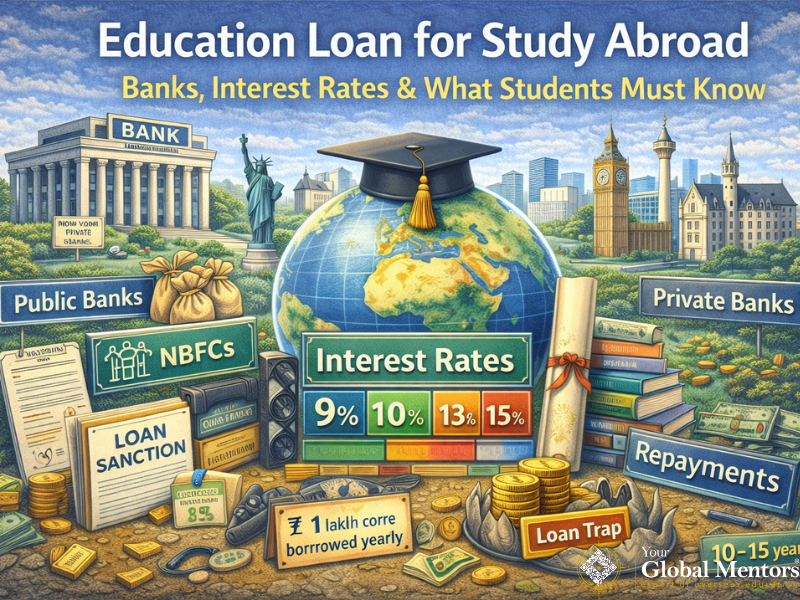
Table of Contents
Education Loan for Study Abroad – Banks, Interest Rates & What Students Must Know (2026 Guide)
For most Indian students planning to study abroad, education loans are not a choice—they are a necessity. With rising international tuition fees and living costs, even financially stable families often require structured funding support to make overseas education possible.
Yet, education loans are also one of the most misunderstood aspects of studying abroad.
Students and parents commonly ask:
Which bank is best for an education loan for abroad studies?
Are public banks better than private banks or NBFCs?
What are the actual interest rates, not the advertised ones?
Is collateral mandatory?
How risky is taking a loan for study abroad?
How does repayment really work after graduation?
This comprehensive guide is written to help Indian families understand education loans clearly, responsibly, and realistically, without pressure or misinformation.
Why Education Loans Are Common for Study Abroad
Studying abroad is a long-term investment, not an expense. However, the upfront cost can be significant.
Typical Costs for Study Abroad
Tuition fees: ₹15–50 lakhs (depending on country and course)
Living expenses: ₹8–15 lakhs per year
Visa, insurance, travel, and setup costs
Very few families want to:
Liquidate all savings
Sell assets
Compromise financial stability
Education loans allow families to:
Spread costs over time
Preserve savings
Let the student repay after becoming financially independent
A well-planned education loan is a financial tool, not a financial burden.
Who Should Consider an Education Loan?
An education loan is suitable for:
Students pursuing UG or PG abroad
Families with partial funding available
Students planning careers with strong earning potential
Those going to countries with post-study work opportunities
It may not be suitable for:
Short-term, low-value courses
Countries with weak job prospects
Poorly planned academic choices
Types of Education Loan Providers in India
In India, study abroad education loans are offered by three main categories:
Public Sector Banks
Private Banks
NBFCs (Non-Banking Financial Companies)
Each has its own strengths and limitations.
1. Public Sector Banks (Government Banks)
Examples include:
State Bank of India (SBI)
Bank of Baroda
Punjab National Bank
Union Bank of India
Key Features
Lower interest rates
Government-backed credibility
Tax benefits under Section 80E
Interest Rate Range (2026)
9% – 11.5% (floating, depends on loan type)
Loan Amount
Up to ₹1.5 crore (with collateral)
Collateral Requirement
Mandatory for higher loan amounts
Property or fixed deposits are usually required
Pros
Lower long-term interest
Stable repayment structure
Trusted by visa authorities
Cons
Slower processing
Extensive documentation
Less flexible for unconventional courses
Best for:
Students with collateral and sufficient processing time.
2. Private Sector Banks
Examples include:
HDFC Bank
ICICI Bank
Axis Bank
Interest Rate Range (2026)
10.5% – 13.5%
Loan Amount
₹40 lakhs to ₹1 crore (varies by bank)
Collateral
Required for larger amounts
Partial unsecured options available
Pros
Faster processing
Better digital experience
More flexible documentation
Cons
Higher interest than public banks
Stricter credit evaluation
Best for:
Students who need faster sanction and have strong academic profiles.
3. NBFCs (Non-Banking Financial Companies)
Examples include:
Avanse
Auxilo
Credila
InCred
Interest Rate Range (2026)
11.5% – 15.5%
Loan Amount
Up to ₹75 lakhs (mostly unsecured)
Collateral
Often not required
Loan based on:
Student profile
University ranking
Course employability
Pros
No collateral
Fast approvals
Suitable for top global universities
Cons
Higher interest
Aggressive recovery if planning is poor
Best for:
Students without collateral are going to high-ranking universities.
Comparison: Banks vs Private Banks vs NBFCs
Factor | Public Banks | Private Banks | NBFCs |
|---|---|---|---|
Interest Rates | Lowest | Medium | Highest |
Collateral | Mostly required | Sometimes | Rare |
Processing Time | Slow | Moderate | Fast |
Flexibility | Low | Medium | High |
Visa Acceptance | Very High | High | High |
Secured vs Unsecured Education Loans
Secured Loans
Require collateral
Lower interest
Higher loan amount
Safer long-term
Unsecured Loans
No collateral
Higher interest
Depends on the student & university profile
Higher EMI pressure
Key advice:
Always prefer secured loans if collateral is available.
Interest Rates – What Students Must Understand
Interest rates are usually:
Floating, not fixed
Linked to:
Repo rate
MCLR
Bank policies
What Increases Your Interest Rate
Unsecured loans
Low university ranking
Weak academic background
Non-STEM courses
What reduces the interest rate
Collateral
High-ranking universities
Strong academic history
STEM and employability-focused courses
Loan Amount Coverage – What Is Included
Most education loans cover:
Tuition fees
Living expenses
Exam fees
Travel cost
Insurance
Laptop (within limits)
Always confirm:
Country-wise coverage
Currency disbursement rules
Moratorium Period Explained
Moratorium = Time during which you don’t have to repay EMIs
Typically includes:
Course duration
6 to 12 months after course completion
During the moratorium:
Interest still accrues
Can choose:
Simple interest payment
No payment (interest added to principal)
Smart strategy:
Pay at least interest during the moratorium to reduce future burden.
Repayment Period
Usually 10–15 years
EMI depends on:
Loan amount
Interest rate
Repayment duration
Tax Benefits on Education Loans
Under Section 80E of the Income Tax Act:
The entire interest paid is tax-deductible
Available for 8 years
Applicable to parents or the student (whoever repays)
Education Loan and Visa Approval
Education loans from:
Public banks
Recognised private banks
Established NBFCs
are generally accepted by embassies, provided:
The sanction letter is clear
Funds meet visa norms
For countries like:
USA
Canada
UK
Australia
Germany
Loan acceptance is routine if the documentation is proper.
Common Mistakes Students Make with Education Loans
Taking a higher loan than required
Ignoring interest accumulation
Choosing NBFCs without ROI planning
Not reading repayment clauses
Believing “a loan is free money”
How to Choose the Right Education Loan (Step-by-Step)
Finalise country & university first
Estimate total cost, not just tuition
Check collateral availability
Compare at least 3 lenders
Read the sanction letter carefully
When Education Loans Become Risky
Loans become risky when:
The course has weak employability
The country has limited post-study work
Student avoids skill-building
EMI planning is unrealistic
A loan is only as safe as the career plan behind it.
Why Choose Your Global Mentors for Education Loan Guidance
Education loans should never be taken in isolation. At Your Global Mentors, students receive integrated guidance covering course selection, country planning, employability outlook, and loan suitability, ensuring that financing decisions align with long-term career outcomes. The focus is not on maximising loan amount, but on minimising financial risk while enabling global education.
Final Conclusion: Are Education Loans for Study Abroad Worth It?
Yes—when planned responsibly.
An education loan can:
Enable global education
Reduce family financial pressure
Empower students to invest in themselves
But success depends on:
Right course choice
Right country selection
Right loan structure
Clear repayment planning
A study abroad loan is not a shortcut—it is a commitment to disciplined career growth. When used wisely, it can transform both education and life outcomes.