
Complete Guide to Pursuing an MBA in Latvia for International Students
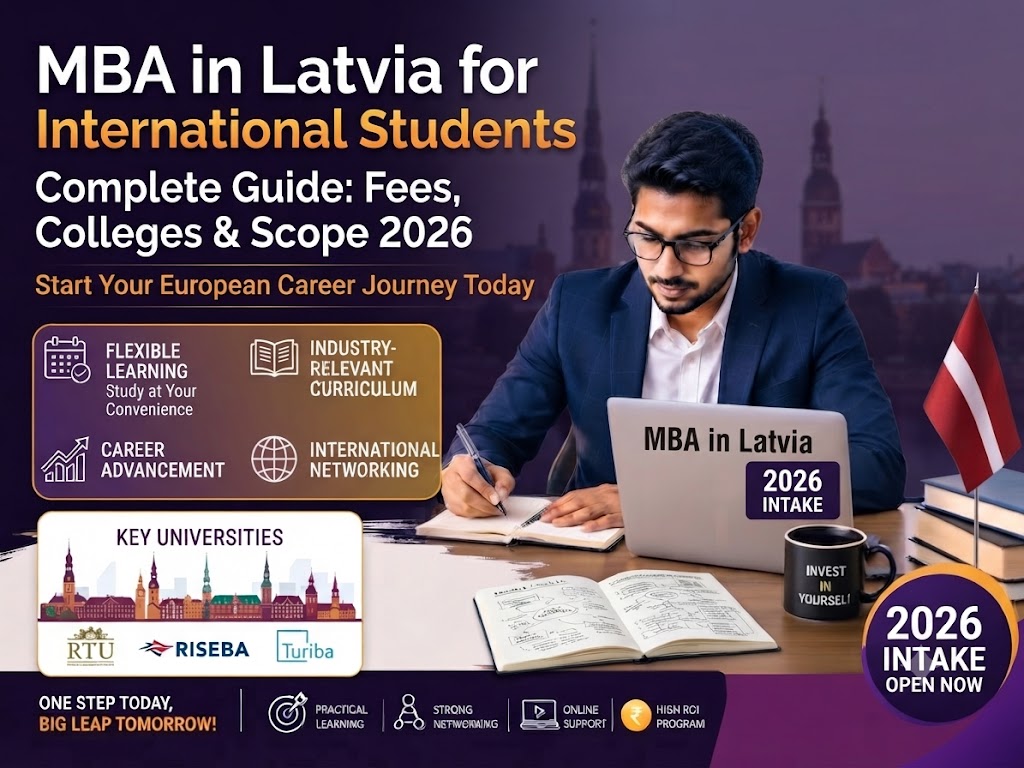
Table of Contents
MBA in Latvia for International Students: Highlights 2026
Latvia has emerged as a genuinely affordable, English-friendly European MBA destination for international students in 2026.This. This country offers meaningfully lower costs than most of Western Europe meaningfully while still delivering EU-recognized degrees. The cost of studying an MBA in Latvia typically ranges between €15,000-25,000 per year, though broader Business Administration courses vary more widely, from €1,500-8,000 per year at some universities to over €10,000 per year at others.
Leading institutions include the University of Latvia (a public university in Riga with an acceptance rate of 38%, ranked #560 globally and #2 in Latvia per Shiksha Popularity Rankings) and Riga Technical University (with an MBA acceptance rate of 51%, ranked #1 in Business & Management Studies in Latvia per Shiksha). Latvia stands out as one of the most affordable countries in Europe for international students overall, with average program costs (excluding MBA/Medicine) between €3,000-5,000 per year, and living expenses ranging from €350-850 per month depending on city and lifestyle.
Why Study an MBA in Latvia?
Considering Latvia for your MBA? Here's why it makes strategic sense in 2026.
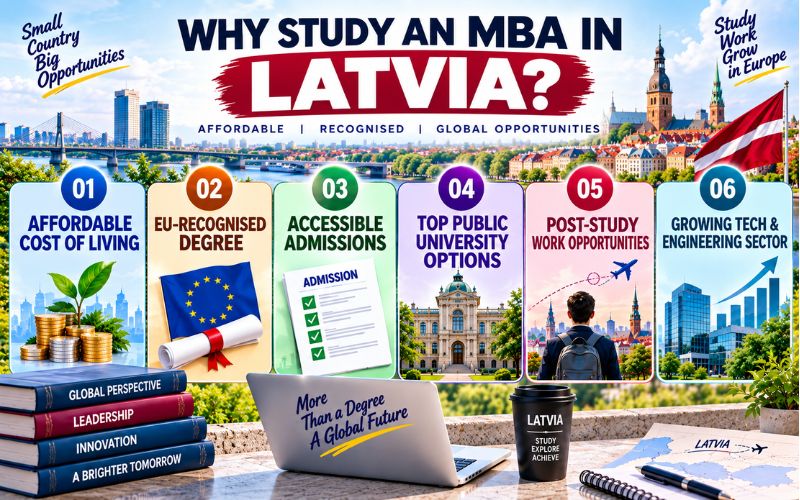
1. Genuinely affordable relative to Western Europe
Latvia is one of the most affordable countries in Europe for students, with the cost of living lower than in many other EU countries — a meaningful advantage for students weighing total program investment.
2. EU-recognized degrees at accessible pricing
Even at the higher end (€15,000-25,000/year for MBA specifically), Latvia's costs remain genuinely competitive against Western European MBA destinations, while still delivering a degree recognised across the EU.
3. Holistic, achievable admissions process
At institutions like Riga Technical University, the admission process takes a holistic approach, considering multiple factors in the student's profile rather than relying on rigid cutoffs alone — with a genuinely accessible 51% acceptance rate.
4. Strong public university option with wide program breadth
The University of Latvia offers more than 130 state-accredited degree programs for international students — genuine institutional depth beyond just its MBA offering.
5. Post-study work opportunities
International students studying in Latvia are granted the opportunity to work in the country once they graduate, thanks to post-study work privileges — though these rights are contingent upon acquiring the necessary residence and work permits.
6. Growing tech and engineering sector alignment
Since Latvia's IT and Engineering sectors are genuinely growing, MBA graduates with technical or engineering backgrounds can find meaningful crossover opportunities in Engineering Management roles specifically.
The bottom line: If you want a genuinely affordable, EU-recognized MBA with accessible admissions and real post-study work potential, Latvia offers a compelling, budget-conscious choice for 2026.
Eligibility Criteria for MBA in Latvia
Before applying to MBA programs in Latvia, make sure you meet the following eligibility requirements for 2026 admissions.
Academic qualification
- A relevant bachelor's degree with a strong academic profile is recommended — at Riga Technical University specifically, while the graduate school doesn't set a strict test-score minimum for admission, individual departments may have their own minimum requirements.
English proficiency
- Non-native English-speaking applicants need to submit IELTS or TOEFL scores, since this determines your ability to engage with coursework delivered in English.
Standardised test scores
- GRE and GMAT are compulsory at several institutions, though requirements might vary depending on the specific course you choose — always verify your target program's exact stance rather than assuming uniform requirements
Application essentials
- A Statement of Purpose (SOP) or Personal Statement explaining your motivations and career goals, two or more Letters of Recommendation from professors, employers, or supervisors, a detailed CV/Resume, a valid passport/ID, and passport-sized photographs are all standard requirements across Latvia's MBA-offering universities.
Admission Process for MBA in Latvia 2026
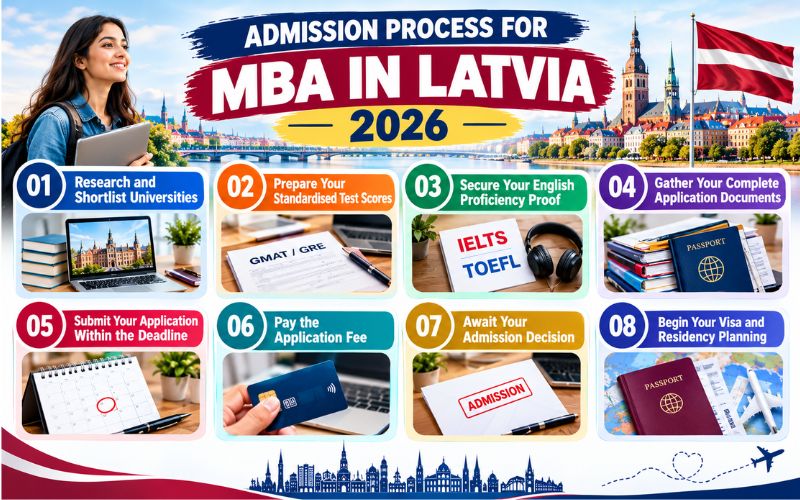
Here's a step-by-step breakdown of what the admission process looks like for 2026.
Step 1: Research and shortlist universities
Compare Latvia's MBA-offering institutions — University of Latvia, Riga Technical University, and other options — based on fees, program structure, and your specific eligibility profile.
Step 2: Prepare your standardised test scores (where required)
Take the GMAT or GRE if required by your specific target program, and confirm current policy directly since requirements vary by course.
Step 3: Secure your English proficiency proof
Complete IELTS or TOEFL, since non-native English speakers must demonstrate proficiency for admission.
Step 4: Gather your complete application documents
Prepare your academic transcripts, SOP/Personal Statement, Letters of Recommendation, CV/Resume, passport/ID, and passport-sized photographs.
Step 5: Submit your application within the correct deadline window
Deadlines vary by institution — the University of Latvia's application deadline for international students for the September intake is July 31, 2026, giving you a useful reference point for planning your equivalent timeline.
Step 6: Pay the application fee
Certain universities in Latvia charge a non-refundable application fee for international students, typically between €150-200.
Step 7: Await your admission decision
Given Latvia's genuinely accessible acceptance rates (38% at University of Latvia, 51% at Riga Technical University), admissions are meaningfully less competitive than many Western European alternatives, though a strong academic profile remains recommended.
Step 8: Begin your visa and residency planning
Once accepted, start your student visa and residency permit application process well ahead of your intended start date, ensuring you understand Latvia's specific documentation requirements.
Our advice: Since Latvia's application deadlines (like the University of Latvia's July 31 cutoff for a September intake) fall relatively close to the actual intake date compared to some other European destinations, you have somewhat more flexibility in your planning timeline — though starting your document preparation early remains genuinely wise to avoid last-minute complications.
GMAT, GRE & English Language Requirements
Here's what you need to know about standardised testing and English proficiency for MBA programs in Latvia in 2026.
GMAT/GRE requirements genuinely vary by institution and course
While the graduate school itself may not set a strict test-score minimum, individual departments may have their own minimum requirements — and other standardised examinations like GRE and GMAT are compulsory at some institutions, though this might vary depending on the specific course an applicant chooses.
When GMAT/GRE becomes relevant
If a university requires an entrance exam such as GMAT or GRE, you'll need to provide official exam scores as part of your application — the exam score is often used to assess your aptitude for business studies specifically.
English proficiency — the more consistently required element
Applicants need to give IELTS or TOEFL if they're from a non-English-speaking native country — this requirement appears more uniformly applied across Latvia's institutions than GMAT/GRE, which shows genuine course-by-course variation.
Holistic evaluation beyond test scores
The admission process at institutions like Riga Technical University takes a holistic approach, considering multiple factors in the student's profile — meaning a strong overall application (SOP, recommendations, academic record) can meaningfully offset a less competitive standardised test score.
Top MBA Universities in Latvia for International Students
Here's a rundown of Latvia's leading MBA institutions worth considering for 2026 — nearly all concentrated in Riga, the country's capital and educational hub.
1. Riga Business School
Founded in 1991 by Riga Technical University and SUNY Buffalo, this school genuinely holds a distinctive North American academic heritage. In 1993, RTU, SUNY Buffalo, and the University of Ottawa formed a three-sided partnership, founding the school's language centre, library, and MBA courses taught by instructors from North America. The school employs both local and international faculty, including professors from North America, and holds International Quality Assurance (IQA) accreditation. Since summer 2025, it's located on the RTU student campus in Riga.
2. Stockholm School of Economics in Riga
Offers a specific Executive MBA track, bringing genuine Scandinavian business school pedigree to the Baltic region.
3. Riga Technical University (RTU)
The oldest technical university in the Baltics and the largest university in Latvia by student numbers, including the highest number of foreign students across the globe. RTU offers a Part-Time Innovation and Entrepreneurship MBA and has been ranked in QS Stars University, QS University Ranking: EECA, U-Multirank, and UI GreenMetric Ranking, among others.
4. RISEBA University of Applied Sciences
A private international business school established in 1992, accredited by EFMD, comprising three schools — Business, Media and Communication, and Architecture and Design — genuinely positioning it as "where business meets arts."
5. Turiba University
The largest private university in the Baltic states, established in 1993, with three branches beyond Riga (Liepāja, Cēsis, and Talsi). Turiba focuses on practical aspects more than theoretical learning, providing internships and student exchange programs.
6. BA School of Business and Finance
Now formally part of the University of Latvia as of September 2025, following a Cabinet of Ministers-approved merger — BA maintains its brand, name, and academic autonomy while operating as the University of Latvia's dedicated business school.
Our advice: If you want North American-style MBA teaching, prioritise Riga Business School. If Scandinavian business pedigree matters, Stockholm School of Economics in Riga stands out. For the widest student population and technical-crossover strength, RTU offers genuine scale and international diversity.
Best MBA Colleges in Latvia
Here's what genuinely distinguishes Latvia's top MBA options for 2026.
Riga Business School — best for North American-style MBA teaching
Genuinely unique among Latvia's options given its founding partnership with SUNY Buffalo and the University of Ottawa, delivering MBA courses with instructors from North America.
Stockholm School of Economics in Riga — best for executive-level, Scandinavian pedigree
Offers a specifically Executive MBA track, appealing to working professionals wanting Nordic business school standards within the Baltic region.
Riga Technical University — best for scale and international diversity
As the largest university in Latvia by student numbers, including the highest number of foreign students across the globe, RTU offers genuine institutional scale and a diverse international cohort, alongside its Innovation and Entrepreneurship MBA.
RISEBA — best for interdisciplinary business-arts crossover
A genuinely distinctive choice if you want your business education alongside exposure to media, communication, or architecture and design — EFMD-accredited with internationally recognised degrees.
Turiba University — best for practical, internship-driven learning
As the largest private university in the Baltics, Turiba specifically emphasises practical exposure over pure theory, with built-in internships and student exchange programs, and is recognised in the labour market and approved by both employers and international students.
BA School of Business and Finance (University of Latvia) — best for public-university backing with dedicated business focus
Now integrated into the University of Latvia while maintaining its own brand and academic autonomy, offering a genuine blend of public-institution credibility and specialised business-school focus.
Our advice: Since nearly all of Latvia's MBA options concentrate in Riga, your genuine differentiator becomes institutional character rather than city choice — decide whether North American teaching style (Riga Business School), Scandinavian executive focus (Stockholm School of Economics in Riga), or practical/interdisciplinary learning (Turiba, RISEBA) best matches your priorities.
MBA Specialisations in Latvia
Here's what specialisation options are genuinely available across Latvia's MBA landscape in 2026.
1. General/Global Marketing
A core component of Turiba University's MBA, providing versatile knowledge enhancing overall professional development.
2. Human Resource Management and Development
Also core to Turiba's program, alongside broader offerings across Latvia's business schools.
3. Crisis Management
A genuinely distinctive in-depth focus area at Turiba, reflecting practical, real-world business resilience training.
4. Sustainable Development and Innovation
Increasingly emphasised across Latvia's MBA landscape, aligning with broader EU regulatory and cultural priorities.
5. Innovation and Entrepreneurship
A dedicated specialisation track specifically offered at Riga Technical University, appealing to students with startup ambitions.
6. Finance
Consistently available across Latvia's institutions, with dedicated coverage at schools like BA School of Business and Finance.
7. Supply Chain Management
Available at select institutions, part of the broader specialisation landscape when browsing MBA programs by specialisation in Latvia.
8. Consulting
Also part of Latvia's broader MBA specialisation offerings, alongside Finance and Supply Chain Management.
9. Strategic Management Technologies
Turiba's program specifically emphasises acquiring professional knowledge and competencies in strategic management technologies to achieve higher business efficiency in today's conditions.
Our advice: If crisis management and sustainable development genuinely interest you, Turiba University's specific curriculum focus stands out. If you're drawn to startup and innovation-focused careers, Riga Technical University's dedicated Innovation and Entrepreneurship MBA track offers the clearest specialisation match.
MBA Fees in Latvia for International Students
Understanding the fee landscape helps you budget realistically across Latvia's MBA programs for 2026.
MBA-specific fee range
The cost of studying for MBA and Medicine courses in Latvia can vary between €15,000-25,000 per year — notably higher than Latvia's general program average, reflecting the specialised nature of MBA education even within an otherwise affordable country.
Broader Business Administration course range
Costs genuinely vary depending on the university and specific program — some universities charge between €1,500-8,000 per year, while others charge over €10,000 per year, giving you meaningful choice across budget tiers.
General national average (non-MBA specific)
The average cost of studying in Latvia for international students overall is between €3,000-5,000 per year, though MBA and Medicine programs specifically run higher than this baseline.
Application fee
Certain universities in Latvia charge a non-refundable application fee for international students, typically between €150-200 — a modest additional cost worth budgeting for during your application phase.
Cost comparison context
Latvia is quite an affordable study-abroad destination for international students compared to other European countries — even at the higher MBA-specific price point (€15,000-25,000/year), this remains genuinely competitive against premium Western European MBA destinations.
Our advice: Since Business Administration program costs genuinely span from €1,500/year at the most affordable end to over €25,000/year for premium MBA-specific tracks, clearly identify whether you're comparing a general Business Administration master's or a dedicated MBA program — these carry meaningfully different price points even within the same country.
Cost of Living in Latvia for MBA Students
Here's a realistic breakdown of monthly living expenses across Latvia's major MBA cities for 2026.
Overall national range
Living expenditures for students in Latvia range from €350-850 per month, depending on the city and your personal lifestyle choices.
What genuinely drives cost variation
Since virtually all of Latvia's MBA programs concentrate in Riga, your cost variation will primarily come from accommodation type and lifestyle choices (shared vs. private housing, dining habits) rather than city-to-city differences the way you'd see in larger countries.
Latvia's overall affordability advantage
Latvia is one of the most affordable countries in Europe for students, with the cost of living lower compared to many other EU countries — a genuine, consistent advantage across accommodation, food, and daily expenses.
Budget planning by lifestyle tier
- Budget-conscious students: Toward the €350/month end, likely through shared accommodation and modest dining habits
- More comfortable lifestyle: Toward the €850/month end, reflecting private accommodation and more frequent dining out or leisure spending
Our advice: Since Latvia's cost-of-living range (€350-850/month) genuinely reflects lifestyle choice more than geographic variation (given Riga's dominance as the country's educational hub), budget realistically based on your personal spending habits rather than assuming location alone will determine your costs — shared accommodation and home cooking can keep you comfortably toward the lower end of this range
Scholarships for MBA in Latvia
- Latvian State Scholarships — €500/month (~₹44,000) for Bachelor's and Master's students, and €700/month (~₹61,600) for PhD students
- Liepaja University Scholarships — Monthly stipend of €430-500 (~₹38,000-44,200) specifically for Master's degree students
- University of Latvia Foundation Scholarships — Amount and duration vary depending on the specific scholarship.
- Riga Technical University Scholarships — Amount and duration vary based on agreements and the student's academic qualification.s
- K.C. Mahindra Education Trust Scholarship — An India-specific external scholarship offering up to ₹10 lakh, applicable for MBA/PGDM and other programs, with application deadlines around April
- External/broader options — India's ICCR scholarships and Erasmus Mundus (which offers fully funded Master's programs, sometimes partly in Latvia) are additional avenues worth exploring
- University-driven merit scholarships — Many universities in Latvia offer scholarships or financial aid to outstanding MBA students based on academic merit, leadership potential, or other achievements — apply directly through each shortlisted school. ol
MBA in Latvia for Indian Students
- Significant cost advantage over UK/other Western destinations — Indian students spend between ₹1.75L-₹7L (€2,000-€8,000) on postgraduate programs in Latvia, compared to ₹7L-₹36L for equivalent UK postgraduate programs
- Globally recognised universities — Latvia hosts universities featuring in the QS World University Rankings top 1,000, such as Riga Technical University (ranked 761-770), offering internationally recognised degrees.
- English-taught programs widely available — Many universities offer programs in English, especially at the Master's and doctoral levels, easing the transition for Indian applicants.
- Strong job market prospects — Latvia's strong economy offers solid job prospects for graduates, an important consideration for Indian students weighing post-study career options
- MBA fee benchmark specifically — Around €10,000/year (~₹9,58,800/year) on average, with elite MBAs (globally-tied or executive-customised programs) potentially exceeding €20,000/year (~₹19,11,600)
- Riga as the primary hub — Riga, the capital, hosts most of the country's top business schools (Riga Business School, Riga Technical University, University of Latvia), concentrating opportunities, internships, and student life in one city.
- Affordable overall cost of living — Combined with lower tuition, Latvia's cost of living (~€700-800/month) makes it a genuinely budget-friendly European MBA destination for Indian applicants.s
MBA in Latvia Without GMAT
- GMAT often optional — At most Latvian universities, GRE/GMAT scores are optional for admission, though they may be required for specific business schools like Stockholm School of Economics (Riga campus)
- Riga Technical University's approach — While GRE and GMAT are compulsory at some level, requirements vary depending on the specific course chosen, and the graduate school doesn't have a strict universal test minimum — individual departments may set their own requirements
- Holistic admission approach — Riga Technical University's admission process takes a holistic view, considering multiple factors in the student's profile beyond just standardised test scores, with a reported MBA acceptance rate of 51%
- Riga Business School's flexible policy — For most MBA programs (aside from the Executive MBA, which requires significant professional experience), work experience may be beneficial but is not mandatory, and GMAT isn't listed as a strict requirement
- English proficiency is still required — Even without GMAT, applicants from non-English-speaking countries must still submit IELTS or TOEFL scores as part of the application.
- Strong academic profile matters more — Since standardised tests are frequently optional, a strong GPA and academic transcript record become the more decisive factor in admission decisions at most Latvian business schools.
Part-Time Work Opportunities for International Students in Latvia
- Standard work-hour limit — International students (bachelor's level) can work up to 20 hours per week during the academic term and full-time (40 hours/week) during official holidays
- Master's and doctoral students get unrestricted work rights — Unlike bachelor's students, full-time Master's or doctoral students in Latvia have the right to work with no hour restrictions at all — a notable advantage for MBA students specifically.
- Residence permit requirement — A valid residence permit explicitly stating part-time work rights is mandatory; non-EU students should ensure this is clearly documented before starting any job
- No separate work permit needed for EU/EEA citizens — EU/EEA or Swiss students generally don't need a separate work permit to work in Latvia, including for internships.
- Typical earnings — Students generally earn €3-5/hour in standard part-time roles, with tech support or design-related jobs paying more (€6-8/hour); full-time holiday work can bring in €500-700/month
- Popular student job sectors — Hospitality, cafes, retail, customer support, and international call centres are common sectors hiring international students, particularly in Riga.
- Post-graduation job-search extension — After completing studies, Master's/doctoral students receive a residence permit for the study period plus an additional 4 months to seek a post-graduation job, with a possible further extension of up to 9 months.
MBA Course Duration & Curriculum in Latvia
- Standard duration — Most MBA programs run 1-2 years, with the majority following the 2-year format
- Riga Technical University's program — A comprehensive 2-year MBA program, drawing on RTU's broader reputation for excellence in engineering and technology
- Riga Business School curriculum breadth — Offers a range of programs including Bachelor's, Master's, and professional courses specifically in business administration and management.
- Executive MBA distinction — EMBA programs specifically require significant prior professional experience, unlike standard MBA tracks where work experience is beneficial but not mandatory.y
- Faculty and learning environment — Students benefit from learning under experienced faculty members alongside guest lecturers from international institutions, adding a global perspective to coursework
- Extracurricular integration — Various student clubs focused on entrepreneurship, finance, marketing, and other interests are built into the broader curriculum experience, particularly at Riga Business School.l
- Intake timing — Main intake generally falls around September/October (applications typically October-February), with some universities offering a secondary February/March intake.
Note: Fees, scholarship amounts, aur work-permit rules multiple sources ke beech thoda vary kar rahe hain (currency conversion aur university-specific policies ke hisaab se) — publish se pehle official university websites (rbs.lv, rtu.lv, lu.lv) aur OCMA (Office of Citizenship and Migration Affairs) se latest 2026 figures cross-verify kar lena strongly recommend karta hoon.
MBA Course Duration & Curriculum in Latvia
- Standard duration — Most MBA programs run 1-2 years, with the majority following the full 2-year format
- Riga Technical University's program — A comprehensive 2-year MBA, drawing on RTU's broader reputation for excellence in engineering and technology
- Riga Business School curriculum breadth — Offers a range of programs including Bachelor's, Master's, and professional courses specifically in business administration and management.t
- Executive MBA distinction — EMBA programs specifically require significant prior professional experience, unlike standard MBA tracks where work experience is beneficial but not mandatory. ry
- Faculty and learning environment — Students benefit from learning under experienced faculty members alongside guest lecturers from international institutions, adding a global perspective to coursework
- Extracurricular integration — Various student clubs focused on entrepreneurship, finance, marketing, and other interests are built into the broader curriculum experience, particularly at Riga Business School.
- Intake timing — Main intake generally falls around September/October (applications typically October-February), with some universities offering a secondary February/March intake.
MBA Placements in Latvia
- Strategic location advantage — Latvia's Baltic coastal position, EU/eurozone/Schengen/NATO membership, and strong transport links (Riga's major port and international airport) support genuine career mobility across Northern Europe
- Advanced digital infrastructure — Latvia has one of Europe's most advanced digital infrastructures, supporting strong placement pipelines into IT, fintech, and tech-adjacent management roles
- Sector demand for foreign talent — Latvia is openly seeking to attract foreign workers, freelancers, and entrepreneurs to address a shortage of skilled labour, working in favour of internationally trained MBgraduateste.s
- Startup ecosystem strength — Average salaries across various positions in Latvian startups reached €2,775 gross even back in 2020, reflecting a genuinely competitive, growing startup job market
- Riga as the placement hub — Nearly all meaningful corporate, consulting, and startup opportunities concentrate in Riga, given its status as the capital and largest Baltic city.
- Placement data caveat — Since Latvian business schools don't publish detailed MBA-specific placement percentage statistics the way larger markets do, role-specific salary ranges (rather than placement rate percentages) are the more reliable data points available
Average MBA Salary in Latvia
- Role-specific benchmarks — Management Consultant: €25,000-45,000/year; Marketing Manager: €25,000-40,000/year; Financial Analyst: €20,000-35,000/year; HR Manager: €25,000-40,000/year; Business Development Manager: €25,000+/year; Project Manager: €25,000-40,000/year
- National average wage (2026) — Around €1,835 gross/month (~€22,020/year) nationally, though this is statistically skewed upward by high earners in Riga — the median trails the average by €300-400/month
- Riga vs. regional pay gap — Workers near Riga earn an average of €2,400/month, while those in surrounding areas earn around €1,700/month — location matters significantly for salary expectations
- Gross vs. net distinction — A gross salary of €1,835/month translates to roughly €1,360 net after taxes — an important distinction when budgeting, since Latvia's tax wedge is substantial.l
- IT/Tech sector premium — The strongest-paying sector for skilled professionals, with senior developers and leads commanding €3,800-5,000+/month — relevant for MBA graduates with tech-adjacent specialisations.
- Finance sector stratification — Compliance officers and AML specialists (high demand) earn €2,500-3,500/month, reflecting strong niche demand within finance
- Minimum wage reference — €780/month as of January 1, 2026, useful as a floor reference when evaluating any job offer
Student Visa & Residence Permit for Latvia
- Type D long-stay visa — Required for non-EU/EEA students studying longer than 90 days; visa application fee around €60
- Temporary residence permit — Required after arrival for stays covering the full study period; application fee approximately €100, plus a €4.27 OCMA registration fee within 30 days of arrival
- Core application documents — Letter of acceptance from the Latvian university, proof of sufficient financial means for tuition and living expenses, and standard identity/academic documentation
- Financial proof requirement — Applicants must demonstrate access to at least €6,000-780/month (roughly €1,685/month per some 2026 sources, equating to ~€20,220 for a standard one-year program, excluding tuition) — showing 20% above the minimum is recommended for a stronger application
- Processing time — Typically 15-30 days, though busy periods (including some 2026 intake seasons) can stretch this to 60 days — applying 2-3 months before classes start is recommended
- Health insurance requirement — Mandatory for residence permits and visas, with minimum coverage of €42,600 as per 2026 requirements
- Post-arrival registration — Students with a D visa staying more than 90 days must register with OCMA (Office of Citizenship and Migration Affairs) and apply for their temporary residence permit
- Master's/doctoral advantage — Unlike bachelor's students, full-time Master's or doctoral students receive unrestricted work rights during their studies, a genuine benefit for MBA candidates specifically.
Career Opportunities After MBA in Latvia
- Management Consulting — MBA graduates can provide expert advice to businesses on strategic planning, operations, and organisational improvements, with salaries ranging €25,000-45,000/year
- Marketing Management — A strong pathway for graduates with a marketing specialisation, overseeing strategy, product development, and promotional activities
- Financial Analysis — Suited for finance-specialisation graduates, analysing data and conducting investment research, particularly strong given Latvia's stratified, high-demand finance sector
- Entrepreneurship / Startup Founding — A genuinely viable path given Latvia's vibrant, growing startup ecosystem and historically competitive startup-sector salaries
- Human Resources Management — Responsible for recruitment, talent development, and employee relations, with salaries in the €25,000-40,000/year range
- Business Development — Identifying growth opportunities and strategic partnerships for companies, a role well-suited to MBA graduates' broad business training
- IT/Tech-adjacent management roles — Given Latvia's advanced digital infrastructure and IT sector strength, MBA graduates with tech specialisation can access some of the country's highest-paying opportunities
- Regional EU mobility — Latvia's Baltic location and EU/Schengen membership create natural pathways to careers across the Nordics, Poland, Germany, and the broader European market beyond Latvia alone.
Post-Study Work Opportunities in Latvia
- Post-graduation residence permit — Master's and doctoral students receive a residence permit for their study period plus an additional 4 months to apply for a post-graduation course or seek a job
- Extension possibility — A further extension of up to 9 months can be requested specifically to look for a job, giving graduates meaningfully more time than the initial 4-month window
- Work permit for long-term employment — Requires close cooperation with an employer ready to enter into an employment contract; salary thresholds vary by sector, with some categories requiring EUR 3,630 or sector-specific wage benchmarks under OCMA rules.
- No blanket minimum salary figure — Since required remuneration is often linked to the average gross monthly wage in the relevant sector rather than a single generic number, checking OCMA's sector-specific wage rules for your target role is essential.
- Digital Nomad Visa alternative — For remote workers employed by companies in OECD member states, Latvia offers a Digital Nomad Visa route, requiring at least 6 months of work history and a monthly income above 2.5x the national average (~€4,200 as of 2025)
- Taxation on post-study earnings — Personal income tax in Latvia is progressive, ranginfrom 20- 31%1% depending on total annual income, relevant for post-study salary planning
- EU-wide mobility advantage — Since Latvia is an EU, eurozone, and Schengen member, graduates who secure the right to work can also explore opportunities in neighbouring markets (Estonia, Lithuania, Poland, Germany, Nordic countries) more easily than from many non-EU study destinations
ROI of MBA in Latvia (Fees vs Salary)
- Standard MBA tier — Fees: ~€10,000/year (~₹9.58 lakh/year) vs. role-specific salaries of €25,000-45,000/year → Reasonable ROI, particularly favourable given Latvia's lower cost of living relative to Western Europe
- Elite/executive MBA tier — Fees: up to €20,000+/year vs. stronger managerial/consulting salary outcomes → Moderate ROI, dependent on securing a senior role post-graduation
- Cost-of-living advantage boosts real ROI — Latvia's cost of living index sits around 49 (against 100 for New York), among the more affordable in the EU, meaning nominal salary figures stretch further than in higher-cost Western European destinations.
- Comparison tothe UK for context — Since Indian students spend ₹1.75-7 lakh on Latvian postgraduate programs versus ₹7-36 lakh for equivalent UK programs, the upfront investment is dramatically lower — improving payback speed even against more modest Baltic salaries
- Unrestricted work rights as an ROI enabler — Since Master's/doctoral students face no work-hour restrictions during study, many can offset living costs through part-time or full-time work throughout the program, effectively reducing the net cost of the MBA
- Sector choice significantly affects ROI — IT/tech and finance compliance roles pay more than general management or HR tracks, making specialisation choice a major lever in the overall ROI calculation.
- Honest positioning — Latvia isn't a peak-salary MBA destination compared to the US, UK, or even the Netherlands/Germany — its ROI case rests on dramatically lower upfront cost, unrestricted work rights during study, and a genuinely lower cost of living, rather than high absolute earning potential
Frequently Asked Questions (FAQs)
Q1. How much does an MBA cost in Latvia for Indian students?
Indian students typically spend ₹1.75-7 lakh (€2,000-8,000) on postgraduate programs, with standard MBAs averaging around €10,000/year and elite/executive MBAs potentially exceeding €20,000/year.
Q2. Is GMAT mandatory for MBA admission in Latvia?
Not universally — GRE/GMAT scores are optional at most universities, though some specific business schools (like Stockholm School of Economics's Riga campus) may require them; admission generally takes a holistic approach.
Q3. What is the average salary after an MBA in Latvia?
Role-specific salaries typically range €20,000-45,000/year depending on specialisation, with management consultants and marketing managers at the higher end and financial analysts slightly lower.
Q4. Can I work while studying an MBA in Latvia?
Yes — bachelor's students can work up to 20 hours/week during term, but full-time Master's and doctoral students (which covers most MBA candidates) have unrestricted work rights during their studies.
Q5. Can I stay and work in Latvia after my MBA?
Yes, Master's/doctoral graduates receive their study-period residence permit plus an additional 4 months to seek employment, with a possible extension of up to 9 months.
Q6. Are scholarships available for Indian MBA students in Latvia?
Yes — options include Latvian State Scholarships (€500-700/month), Liepaja University Scholarships, university-specific merit awards, and India-specific external scholarships like the K.C. Mahindra Education Trust Scholarship (up to ₹10 lakh).
Q7. Is Latvia a good MBA destination compared to the UK or Netherlands?
It offers dramatically lower upfront cost (₹1.75-7 lakh vs. ₹7-36 lakh for the UK), unrestricted work rights during study, and EU/Schengen mobility, though salaries and overall brand recognition remain more modest than larger Western European MBA destinations.
Q8. Which city should I choose for an MBA in Latvia?
Riga is by far the primary hub, hosting nearly all top business schools, internship opportunities, and the strongest job market — salaries near Riga also run notably higher than in surrounding regions.
Conclusion
An MBA in Latvia occupies a genuinely budget-conscious niche within the European business education landscape — dramatically lower tuition than the UK or Western Europe, an accessible admissions process that often skips GMAT requirements, and a distinctive advantage of unrestricted work rights for Master's-level international students throughout their studies. Riga, as the country's capital and business hub, concentrates nearly all meaningful opportunities — from Riga Business School and Riga Technical University's programs to the strongest job market access across consulting, marketing, finance, and Latvia's growing IT and startup sectors.