
Best Universities in Russia for MBBS Top Medical Colleges, Fees, Admission & Eligibility
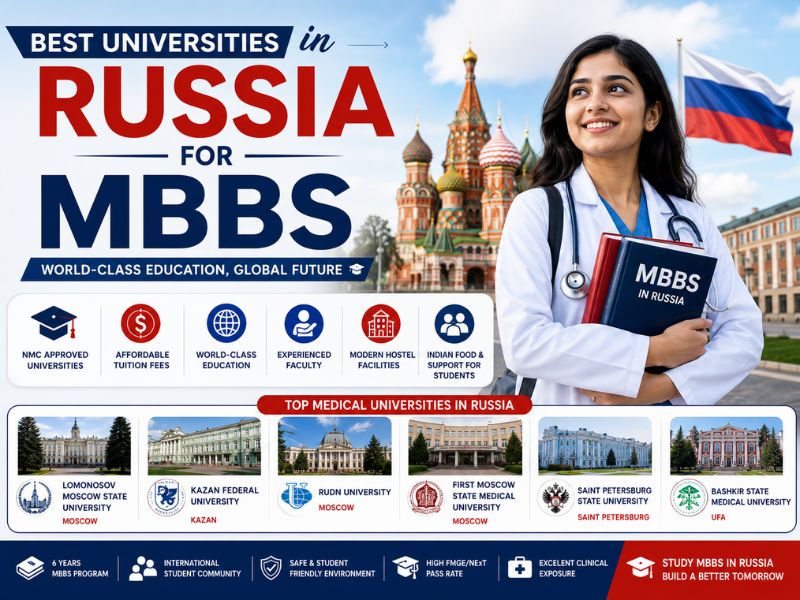
Table of Contents
Best Universities in Russia for MBBS 2026: Highlights
Russia remains one of the most popular destinations for Indian students pursuing MBBS abroad in 2026, backed by decades of established medical education infrastructure, WHO-recognized universities, and comparatively affordable tuition. The country hosts numerous state medical universities that have trained thousands of Indian doctors over the years, making it a well-trodden, reliable pathway for medical aspirants.
Russian medical universities are known for their strong emphasis on theoretical foundations combined with structured clinical training, English-medium instruction for international students, and modern laboratory infrastructure. Many universities maintain dedicated international student departments, easing the transition for Indian students navigating a new country and culture.
Why Choose the Best Universities in Russia for MBBS?
Considering Russia for your MBBS journey? Here's why it remains a strong choice for Indian students in 2026.
1. Long-established track record
Russia has been training Indian medical students for decades, giving it a proven, well-understood pathway with predictable outcomes compared to newer, less-established destinations.
2. Strong WHO and NMC recognition
Many Russian medical universities are consistently listed in the World Directory of Medical Schools and recognised by India's National Medical Commission, providing a genuine pathway toward Indian practice, provided you've qualified for the NEET.
3. Affordable, transparent tuition
Compared to private medical colleges in India or Western study destinations, Russian universities generally offer significantly lower tuition costs for a comparable quality medical education.
4. Large, established Indian student community
With thousands of Indian students already studying across Russian medical universities, newcomers benefit from strong peer networks, cultural support, and readily available guidance from seniors who've navigated the same journey.
5. English-medium instruction
Reputable Russian medical universities conduct their MBBS programs entirely in English for international students, removing language as a barrier to academic success.
6. Strong theoretical and clinical foundation
Russian medical education is generally known for rigorous theoretical grounding combined with structured clinical exposure through partnered teaching hospitals.
7. Straightforward admission process
Since most universities admit based on academic merit rather than competitive entrance exams, the admission process itself tends to be more predictable and accessible.
The bottom line: If you're looking for an established, WHO/NMC-recognized, and comparatively affordable MBBS destination with strong peer support, Russia remains a genuinely solid choice for 2026 — as long as you've secured your NEET qualification beforehand.
Benefits of Studying MBBS at the Best Universities in Russia
Still weighing your options? Here's a clear breakdown of the key benefits studying MBBS in Russia offers.
1. Cost-effective medical education
Russian universities generally offer significantly lower tuition and living costs compared to private medical colleges in India or MBBS programs in Western countries, without necessarily compromising education quality.
2. Established recognition pathway
With decades of Indian students graduating from Russian medical universities and successfully clearing FMGE/NExT, there's a well-documented, predictable pathway back to practising in India.
3. Modern medical infrastructure
Many Russian universities have invested in modern laboratories, simulation centres, and updated medical equipment, providing genuinely strong practical training facilities.
4. Diverse clinical exposure
Students often gain access to a wide variety of patient cases through partnered hospitals, contributing to a well-rounded clinical education.
5. Strong administrative support for international students
Universities with decades of experience hosting Indian students typically have well-developed international student offices, visa support systems, and dedicated staff familiar with Indian students' specific needs.
6. Safe, structured campus environments
Most Russian medical universities offer dedicated hostels or dormitories with structured, secure living arrangements for international students.
7. Cultural and culinary accessibility
Given the long history of Indian students in Russia, most university towns have Indian grocery stores, restaurants, and cultural community support, easing the adjustment process.
8. Strong alumni networks
With thousands of successful graduates now practising in India and elsewhere, Russian medical university alumni networks provide valuable mentorship and professional connections.
The takeaway: Russia's combination of affordability, established infrastructure, and a large support network makes it a genuinely practical choice for Indian students — provided they enter the process with NEET qualification secured and careful attention to university-specific NMC recognition status.
Eligibility Criteria for MBBS in Russia 2026
Before applying to Russian medical universities, make sure you meet the following eligibility requirements for 2026 admissions.
NEET-UG qualification (mandatory for Indian recognition)
- Must clear the qualifying percentile: 50th percentile (General/EWS category) or 40th percentile (OBC/SC/ST categories)
- Your NEET score remains valid for 3 years, giving you flexibility in timing your admission to Russia
- Important: while Russian universities themselves typically don't require NEET for admission, qualifying it remains mandatory for your degree to be recognised for practising medicine in India
Academic qualification
- Completion of 12th grade with Physics, Chemistry, and Biology (PCB) as core subjects
- Minimum aggregate marks typically required: 50% for General category, 40% for reserved categories, though specific universities may set slightly different thresholds.
Age requirement
- Most Russian universities require candidates to be at least 17 years old at the time of admission, with no strict upper age limit at most institutions.s
University compliance requirements
- The university must be listed in the World Directory of Medical Schools (WDOMS)
- Must hold recognition from the World Health Organisation (WHO)
- Program duration must meet the NMC's minimum requirement of 54 months of academic study plus 12 months of internship
Additional documentation
- Valid passport with sufficient validity for your program duration
- Medical fitness certificate
- Proof of financial capability to cover tuition and living expenses
Our advice:
Since Russian universities generally don't ask for NEET during their own admission process, it's easy for students to overlook this requirement — make qualifying NEET your priority before beginning any university application process for 2026.
Admission Process for MBBS in Russia 2026
Here's a step-by-step breakdown of what the admission process actually looks like for 2026.
Step 1: Qualify NEET-UG first
Before researching universities, appear for and clear the NEET-UG qualifying cutoff. Since your score remains valid for 3 years, this gives you flexibility in planning your admission timeline.
Step 2: Research and shortlist WHO/NMC-recognized universities
Identify Russian medical universities listed in the World Directory of Medical Schools and confirmed as currently NMC-recognized.
Step 3: Verify program duration compliance
Confirm your shortlisted university's program meets the mandatory 54 months of academic plus 12 months internship structure required under 2026 NMC rules.
Step 4: Apply directly to the university
Submit your application along with academic transcripts, passport copy, and photographs — most Russian universities have streamlined application processes for international students.
Step 5: Receive your invitation/offer letter
Once accepted, the university issues an official invitation letter confirming your admission, program details, and fee structure — this document is essential for your visa application.
Step 6: Apply for a Russian student visa
Submit your invitation letter, financial proof, medical fitness certificate, and other required documents to the Russian consulate or embassy for visa processing.
Step 7: Complete pre-departure preparations
Arrange travel, accommodation confirmation, health insurance, and any pre-departure orientation offered by your university or education consultant.
Step 8: Complete on-arrival formalities
Upon arrival, complete local registration, medical check-ups, and any orientation programs before beginning your coursework.
Our advice:
Given how straightforward Russian university admission itself tends to be, students sometimes rush this process without securing NEET qualification first — resist that urge, since reversing this order is the most common and costly mistake Indian students make when pursuing MBBS in Russia for 2026.
Documents Required for MBBS Admission in Russia
Having accurate, complete documentation ready significantly smooths your Russia MBBS application process. Here's your checklist for 2026.
Academic documents
- 10th and 12th grade mark sheets and certificates (with PCB as core subjects)
- NEET-UG scorecard showing qualifying percentile (mandatory for future Indian recognition, even though Russian universities don't require it for admission)
Identity and travel documents
- Valid passport with sufficient validity covering your entire 6-year program duration
- Passport-sized photographs meeting Russian visa specifications
- Birth certificate
Application essentials
- Completed university application form
- Academic transcripts, often requiring notarization or apostille depending on the university.
Financial documents
- Bank statements or education loan approval letters proving sufficient funds
- Fee payment receipts once admission is confirmed
Medical and health documents
- Medical fitness certificate
- HIV test certificate (commonly required for Russian student visas)
- Updated vaccination records
- Health insurance enrollment proof
Visa-specific documents
- University invitation/offer letter (issued after admission confirmation)
- Visa application form
- Proof of accommodation arrangements (university hostel confirmation)
2026-specific consideration for certain student batches
If you're joining a university where earlier batches (2020-2022) had online coursework components, request written clarification from the university regarding any "compensation training" requirements that might apply to your specific program structure under recent NMC guidance.
Our advice: Start organising these documents at least 3-4 months before your intended admission cycle, and specifically confirm notarization/apostille requirements with your target university, since Russian institutions can have slightly different documentation standards compared to other MBBS abroad destinations.
Best Universities in Russia for MBBS 2026: Top 10 Universities
Here's a look at Russia's most established and widely recognised medical universities for Indian students in 2026.
1. Sechenov University, Moscow
One of Russia's most prestigious medical universities, known for a strong academic reputation and extensive clinical training infrastructure in the capital.
2. Kazan State Medical University
A well-established institution with a strong track record of training international students, recognised by NMC, WHO, and other major accrediting bodies.
3. Volgograd State Medical University
Founded in 1935 and ranking among Russia's top 10 medical universities, this institution has over 12,000 students, including 2,000+ international students from 70+ countries, backed by 1,100+ lecturers across 87 departments.
4. Voronezh State Medical University
One of Russia's oldest educational institutions, founded in 1930, offering a 6-year English-medium MBBS program with more than 8,000 students and recognition from WHO, NMC, and ECFMG.
5. Siberian State Medical University
An NMC-approved university known for modern infrastructure and experienced faculty, popular among Indian medical aspirants.
6. Kemerovo State Medical University
Another strong NMC-approved option offering globally accepted MBBS degrees with solid infrastructure.
7. Northern State Medical University
Founded in 1932, this government university is recognised by multiple medical bodies, including WHO and UNESCO.
8. Lomonosov Moscow State University
One of Russia's oldest and most well-known universities, offering MBBS at competitive tuition fees with strong educational standards.
9. Pavlov University (St. Petersburg)
A historically significant medical university accredited by NMC, WHO, and WFME, known for strong clinical training traditions.
10. Orenburg State Medical University
A reputable regional university offering quality medical education with relatively accessible tuition compared to Moscow or St. Petersburg-based institutions.
Our advice: Beyond name recognition, verify each university's current NMC approval status directly, since accreditation lists can occasionally change — don't rely solely on a university's historical reputation without confirming its present-day standing.
MBBS Fees at the Best Universities in Russia
Understanding realistic fee ranges helps you budget accurately and spot red flags. Here's a breakdown for 2026.
Overall fee range
Total MBBS fees in Russia for the complete 6-year program generally range from ₹15 Lakhs to ₹80 Lakhs, with most reputable universities falling between ₹22-45 Lakhs depending on the specific institution and city.
Annual tuition breakdown
Annual tuition fees typically start from approximately $3,000 to $7,000 (roughly ₹2.5-6 Lakhs) per year, varying significantly by university reputation and city — Moscow and St. Petersburg-based universities generally charge more than regional universities.
Regional vs. metro city cost differences
Universities in regional cities (like Volgograd, Voronezh, Kemerovo) tend to offer more budget-friendly tuition, generally in the ₹3-13 Lakhs per year range, compared to premium Moscow-based institutions.
What's typically included in tuition
- Academic coursework and lectures
- Basic laboratory and practical session access
- In some packages, hostel accommodation is bundled with tuition
Important warning about subsidised fee schemes
Be cautious of agents promoting so-called "subsidised fees" involving upfront lump-sum payment for the full 6-year program at a discount — this isn't an official scheme offered by Russian medical universities, and such offers should be independently verified directly with the university before any payment.
Our advice: Request a complete, itemised fee breakdown directly from your shortlisted university's official admissions office rather than relying solely on consultant-provided figures, and specifically clarify whether hostel fees, health insurance, and examination fees are included in the advertised tuition or charged separately.
Living Costs for Indian Students in Russia
Beyond tuition, here's what you can realistically expect to spend on living expenses while studying MBBS in Russia in 2026.
Monthly living expense range
Living costs for Indian students in Russia typically range from $150 to $250 per month (roughly ₹12,000-21,000), covering food, local transportation, and basic personal expenses, though this varies by city.
City-based cost differences
- Moscow and St. Petersburg: Higher living costs, potentially reaching the upper end of the range or beyond, given these are Russia's most expensive cities
- Regional university towns (Volgograd, Voronezh, Kemerovo, Orenburg): Generally more budget-friendly, often falling toward the lower end of the range
What's typically covered in hostel/accommodation costs
Most universities offer dormitory-style accommodation, often bundled into overall program costs or charged as a modest separate annual fee, providing a safe, structured living environment for international students.
Food expenses
Many Indian students report food costs around $100 (approximately ₹8,500) per month, particularly manageable in university towns with established Indian student communities offering access to familiar groceries and Indian restaurants.
Overall program cost estimate (tuition + living combined)
Including tuition, accommodation, and living expenses together, the total cost of MBBS in Russia typically amounts to approximately $25,000+ for the full program at the more affordable end, scaling upward significantly for premium Moscow-based universities.
Additional costs to budget separately
- Health insurance (often mandatory and charged separately)
- Winter clothing and seasonal essentials, given Russia's cold climate
- Travel costs for periodic trips home
Our advice: Budget using the higher end of these ranges for your first year, since unfamiliarity with local costs, currency exchange fluctuations, and initial setup expenses (winter clothing, essentials) typically push actual first-year spending above standard estimates.
Scholarships Offered by the Best Universities in Russia
Good news for Indian students — several Russian universities offer scholarship opportunities to reduce your overall MBBS investment in 2026.
University-specific merit scholarships
Many Russian medical universities offer merit-based tuition waivers, with scholarship opportunities that can reduce your tuition fee by 50% or higher, typically based on your 12th-grade academic performance.
Early admission incentives
Some universities offer reduced fees or priority hostel allocation for students completing their admission process well ahead of standard deadlines.
Government seat allocations
The Russian government has offered around 10,000 or more seats in recent academic sessions specifically for Indian students, some of which come with more favourable fee structures compared to standard international student rates.
What to verify before counting on a scholarship
- Confirm the scholarship is officially offered by the university itself, not just promised by an education consultant or agent.t
- Understand exactly what percentage of tuition (not living costs) the scholarship actually covers
- Check whether the scholarship is guaranteed for the full 6-year duration or requires maintaining a minimum academic performance each year to continue. ue
A note of caution
Be wary of unusually generous scholarship claims from agents that seem disconnected from the university's own official policies — always verify scholarship offers directly through the university's official admissions communication, not just through third-party consultants.
Our advice: Since dedicated scholarships specifically for MBBS in Russia vary significantly by university and change year to year, directly contact your shortlisted university's international admissions office to confirm current scholarship availability and exact eligibility criteria before finalising your 2026 admission decision.
MBBS Course Duration and Curriculum in Russia
Understanding exactly what you'll study — and for how long — helps set realistic expectations for your MBBS journey in Russia in 2026.
Program duration
MBBS in Russia is structured as a 6-year program, comprising 5 years of classroom and clinical studies plus a mandatory 1-year internship, aligning with the NMC's required minimum of 54 months of academic study plus 12 months of internship.
Language of instruction
The primary medium of instruction is English, and notably, Russian medical universities generally don't require an English language proficiency test for admission, since programs are specifically designed for international students.
Core subjects covered
The curriculum aligns closely with Indian MBBS standards, covering:
- Anatomy
- Physiology
- Biochemistry
- Pathology
- Pharmacology
- Microbiology
- Community Medicine
- Internal Medicine
- Surgery
- Pediatrics
- Obstetrics and Gynaecology
- Psychiatry
- Dermatology
- ENT (Otorhinolaryngology)
- Ophthalmology
Typical structure breakdown
- Years 1-2: Pre-clinical foundational subjects (Anatomy, Physiology, Biochemistry)
- Years 3-4: Para-clinical and clinical subjects (Pathology, Pharmacology, Medicine, Surgery)
- Year 5: Advanced clinical rotations across specialities
- Year 6 (Internship): Mandatory 12-month supervised internship, completed within the same university/country
Some universities offer additional Indian clinical exposure
Certain programs now include exclusive Indian clinical training components during vacation periods, in partnership with Indian hospital networks, specifically designed to strengthen FMGE/NExT readiness and overall employability.
Our advice: Before enrolling, request your specific university's detailed year-wise curriculum breakdown in writing, and confirm whether any Indian clinical exposure components are included, since these can meaningfully strengthen your eventual licensing exam preparation.
NMC Guidelines, FMGE & NExT for MBBS in Russia
This is the most important section to understand thoroughly before committing to MBBS in Russia — here's the regulatory framework specifically relevant to Russian medical universities in 2026.
University recognition requirement
Your chosen university must be listed in the World Directory of Medical Schools (WDOMS) and recognised by the WHO, along with holding current NMC approval status — most established Russian universities meet these criteria, but always verify directly.
FMGE: the current licensing exam
After completing your MBBS in Russia, you must clear the Foreign Medical Graduate Examination (FMGE) to register with the NMC and legally practice medicine in India.
The shift to NExT
From 2027 onwards, the National Exit Test (NExT) will replace FMGE as the licensing exam for foreign medical graduates, so students should stay updated on how this transition affects their specific graduation timeline.
NEET remains the foundational requirement
Even though Russian universities themselves don't require NEET for admission, qualifying NEET-UG remains mandatory for Indian students who want their Russian MBBS degree recognised for practice in India.
Important 2026 update on online coursework (highly relevant for Russia)
In March 2026, the NMC introduced a significant clarification specifically affecting students who joined Russian, Kazakh, Georgian, and certain other countries' universities between 2020 and 2022 and completed some coursework online during pandemic disruptions. This time may not fully count toward your required duration unless you also complete additional "compensation training" — mandatory in-person training at the same university to make up for the online period.
What to do if this applies to you
If you or someone you know joined a Russian medical university during this 2020-2022 window, don't assume online semesters are automatically settled — contact the university directly and request written confirmation on whether compensation training applies to your specific batch, since resolving this proactively is far easier than discovering the issue after graduation.
No mid-program transfers
Switching universities partway through your MBBS program in Russia isn't permitted under current NMC regulations.
Our advice: Given Russia's specific relevance to this 2026 online coursework clarification, current and recent students should treat this as a priority action item — get written clarification from your university now rather than waiting until closer to graduation.
Student Life at the Best Universities in Russia
Beyond academics, here's what day-to-day student life looks like for Indian students studying MBBS in Russia in 2026.
Large, established Indian student community
With thousands of Indian students currently enrolled across Russian medical universities, newcomers benefit from strong peer networks, readily available mentorship from seniors, and established support systems specifically familiar with Indian students' needs.
Accommodation
Most universities provide dormitory-style hostel accommodation, offering a structured, secure living environment, often bundled with tuition or available at modest additional cost.
Safety and security
Russian universities are known for maintaining 24/7 security systems and dedicated international student support offices, contributing to a genuinely safe campus environment for international students.
Cultural and culinary accessibility
Given the long history of Indian students studying in Russia, most university towns have established Indian grocery stores, restaurants, and cultural community associations, easing the adjustment process significantly compared to less-established destinations.
Climate adjustment
Russia's cold climate, particularly harsh winters, requires genuine preparation — budgeting for proper winter clothing and adjusting to significantly different weather patterns than most Indian students are accustomed to.
Multicultural environment
Universities like Volgograd State Medical University host international students from 70+ countries, providing genuinely diverse cultural exposure alongside your medical education.
Extracurricular and community activities
Indian student associations at most universities organise festivals, cultural events, and support networks, helping maintain cultural connection while studying abroad.
Our advice: Connect with current Indian students at your shortlisted university before finalising your decision — platforms like social media groups or direct outreach through education consultants can provide genuine, unfiltered insight into daily student life beyond official university marketing materials.
Career Opportunities After MBBS from Russia
Once you've completed your MBBS in Russia and navigated the necessary licensing requirements, here's what your career path can look like in 2026.
Practising medicine in India
After clearing FMGE/NExT and registering with the NMC, graduates can:
- Work as General Practitioners in private clinics or hospitals
- Join government hospitals through relevant recruitment processes
- Pursue postgraduate (PG) specialisation through NEET-PG
- Work in public health, community medicine, or preventive healthcare roles
Practise in Russia or internationally
Depending on additional local licensing requirements, some graduates pursue certification to practice in Russia itself or explore international opportunities through further exams like USMLE (USA) or PLAB (UK).
Further specialization
Many graduates pursue MD/MS specialisation either in India (via NEET-PG) or internationally, leveraging their strong theoretical foundation from Russian medical education.
Research and academic careers
Graduates interested in medical research or teaching can pursue positions in medical colleges, research institutions, or pharmaceutical companies, building on their clinical training background.
Strong track record advantage
Given Russia's decades-long history of training Indian medical graduates, there's a well-established, predictable pathway with substantial alumni data on FMGE/NExT outcomes — helping you make more informed decisions about specific universities based on genuine historical performance.
Realistic career timeline
- Years 1-6: MBBS program in Russia (academic study plus internship)
- Post-graduation: FMGE/NExT preparation and clearance (typically 6-12 months)
- NMC registration: Final step enabling legal practice in India
Our advice: Leverage Russia's strong alumni network by connecting with graduates who've successfully cleared FMGE/NExT — their firsthand experience with the transition from Russian medical education to Indian licensing can provide invaluable, practical preparation insights.
Salary After Completing MBBS from Russia
Here's a realistic look at salary expectations after completing MBBS from Russia and successfully practising in India for 2026.
Starting salary in India (after NMC registration)
Fresh graduates from Russian medical universities, once registered with the NMC, typically start with salaries comparable to any MBBS graduate — generally in the range of ₹4-8 LPA in private hospitals or clinics.
Government sector salaries
Doctors joining government hospitals through relevant recruitment processes generally receive salaries as per government pay scales, often in the range of ₹6-10 LPA, along with strong long-term benefits and job security.
Salary by practice setting
- Private clinics/hospitals (entry-level): ₹4-8 LPA
- Government hospitals: ₹6-10 LPA (as per pay scale)
- Corporate hospital chains: ₹6-12 LPA, often with performance incentives
Post-specialization earning potential
After pursuing MD/MS specialisation via NEET-PG, earning potential rises significantly, with specialists often earning ₹10-25 LPA depending on specialisation, location, and years of experience.
Practising in Russia instead (if pursued)
If choosing to practice in Russia rather than returning to India, salaries vary based on local licensing requirements and the specific region, generally reflecting Russian healthcare sector compensation standards rather than Indian benchmarks.
What influences your salary?
- Whether you practice in government, private, or corporate healthcare settings in India
- Your chosen specialisation (general practice vs. specialised fields)
- Location within India (metro cities generally offer higher packages)
- Years of experience and reputation built over time
The bigger picture
Since your salary outcome in India depends entirely on successfully clearing FMGE/NExT rather than which country you studied in, graduates from reputable, NMC-recognized Russian universities generally see salary trajectories comparable to any other MBBS graduate — provided they've navigated the recognition and licensing process correctly.
Our advice: Focus your financial planning on the complete picture — factor in Russia's genuinely lower upfront program costs alongside standard Indian doctor salary trajectories, rather than expecting the country of study itself to influence your eventual earning potential once practising in India.
Advantages and Disadvantages of Studying MBBS in Russia
Making an informed decision requires an honest look at both sides. Here's a balanced breakdown for 2026.
Advantages
1. Significantly lower tuition costs
Russian universities typically offer 70% lower fees compared to private medical colleges in India, with total program costs often ranging from ₹15-45 Lakhs compared to ₹50 Lakhs-1 Crore+ at private Indian colleges.
2. Established, decades-long track record
Russia has trained Indian medical students for generations, providing a well-understood, predictable pathway with substantial historical data on outcomes.
3. Strong WHO/NMC recognition across many universities
Numerous Russian medical universities maintain consistent recognition status, backed by accreditation from WHO, NMC, WFME, and ECFMG.
4. Large, supportive Indian student community
Thousands of Indian students currently studying across Russian universities provide strong peer networks and mentorship, easing cultural adjustment significantly.
5. English-medium instruction without language testing
Programs are specifically designed for international students, with no separate English proficiency test required for admission.
6. Modern infrastructure and clinical training
Many universities have invested in updated laboratories, simulation centres, and partnered hospital networks for genuine clinical exposure.
Disadvantages
1. Additional licensing hurdle
Like all MBBS abroad options, graduates must clear FMGE/NExT before practising in India — an extra step requiring dedicated preparation beyond your degree itself.
2. Harsh winter climate adjustment
Russia's cold winters require genuine physical and psychological adjustment, particularly challenging for students unfamiliar with extreme cold weather.
3. Cultural and language barriers outside the university
While coursework is in English, daily life outside campus often involves navigating Russian language and cultural differences, which can initially feel isolating.
4. 2026 compensation training complications
Students who joined between 2020-2022 and completed online coursework during pandemic disruptions may face additional mandatory in-person training requirements, adding time and complexity to their program.
5. Geopolitical and travel considerations
Depending on international relations and travel connectivity, students should stay informed about any evolving travel advisories or logistical considerations related to studying in Russia.
6. Variable quality across universities
With 60+ medical universities offering MBBS programs, quality and clinical training standards vary significantly — careful university-specific research remains essential rather than assuming uniform quality across the country.
Our advice: Weigh these factors against your specific circumstances — financial situation, climate tolerance, and risk comfort — while recognising that Russia's core value proposition (affordability plus established recognition) remains genuinely strong for well-prepared, well-researched applicants in 2026.
How to Choose the Best Universities in Russia for MBBS
With 60+ medical universities to choose from, here's a practical framework for making this decision in 2026.
Step 1: Verify current NMC and WHO recognition
Before considering any other factor, confirm your shortlisted university's current listing in WDOMS and NMC-approved status directly through official sources — accreditation status can occasionally change, so don't rely on outdated information.
Step 2: Check the university's FMGE/NExT track record
Research historical pass rates and outcomes for graduates from your specific target university, since this reflects genuine curriculum quality and clinical training effectiveness.
Step 3: Compare total costs realistically
Factor in tuition, hostel fees, living expenses, health insurance, and winter clothing costs together, rather than comparing headline tuition figures alone across universities.
Step 4: Assess clinical training infrastructure
Research whether your target university has strong hospital partnerships providing genuine patient exposure, and check if it offers additional Indian clinical training components during vacations.
Step 5: Evaluate the university's Indian student community size
Larger, more established Indian student populations generally provide better peer support, easier cultural adjustment, and access to mentorship from students who've successfully navigated FMGE/NExT.
Step 6: Consider city and climate factors
Weigh whether you prefer a major city (Moscow, St. Petersburg) with higher costs but more amenities, versus a regional university town with lower costs but a quieter environment.
Step 7: Verify 2026-specific compliance clarity
If your intended joining timeline overlaps with any pandemic-era online coursework considerations, get written confirmation from the university about compensation training requirements before enrolling.
Step 8: Directly contact current students
Reach out to current Indian students at your shortlisted universities through education consultants or student communities to get genuine, unfiltered insight beyond official marketing materials.
Our advice: Create a simple scoring system across these factors for your top 3-4 university choices, weighing NMC recognition and FMGE/NExT track record most heavily, since these directly determine your eventual career outcome regardless of other conveniences.
Why Choose Your Global Mentors?
Navigating MBBS admissions in Russia — with NEET requirements, university verification, evolving NMC compliance rules, and visa processes — involves genuinely high stakes. That's where Your Global Mentors makes the difference.
1. Honest, compliance-focused guidance
We prioritise your long-term career outcome, ensuring you understand NEET requirements and current NMC compliance rules (including the 2026 compensation training clarification) before making any commitment.
2. Verified university shortlisting
We help you shortlist genuinely WHO/NMC-recognized Russian universities with strong FMGE/NExT track records, rather than relying on marketing claims or outdated recognition lists.
3. End-to-end application support
From document preparation and notarization guidance to application submission and visa processing, we handle every step of your Russia MBBS journey with precision.
4. Transparent fee and cost guidance
We help you understand complete, itemised costs upfront — tuition, hostel, living expenses, health insurance — helping you avoid the "subsidised fee" scams some agents promote.
5. Direct connection to current students
We facilitate genuine conversations with current students at your shortlisted universities, giving you unfiltered insight into daily student life and academic quality.
6. NEET and FMGE/NExT preparation guidance
Beyond just admissions, we connect you with resources to prepare effectively for both NEET qualification and your eventual licensing exam.
7. Proven track record
With years of experience guiding students through successful, compliant MBBS admissions in Russia, we bring honest, practical advice to every step of your journey.
The bottom line: MBBS in Russia is a significant life decision with real regulatory complexity — partnering with Your Global Mentors ensures your investment translates into a genuinely usable medical career in 2026 and beyond.
Frequently Asked Questions (FAQs)
1. Do Russian universities require NEET for admission?
No, most Russian medical universities admit based on 12th-grade academic merit. However, NEET qualification remains mandatory for Indian students who want their degree recognised for practising medicine in India.
2. How long does MBBS take in Russia?
The program takes 6 years total — 5 years of academic and clinical studies plus a mandatory 1-year internship, meeting NMC's required minimum duration.
3. Is MBBS in Russia cheaper than in India?
Compared to private Indian medical colleges, yes — Russia offers roughly 70% lower fees. However, government MBBS colleges in India remain the cheapest option overall if you can secure a seat through NEET.
4. What is this new "compensation training" rule I've heard about?
It's a March 2026 NMC clarification requiring students who took online classes during 2020-2022 (due to pandemic disruptions) to complete additional in-person training at the same university to fully count that period toward their degree.
5. Is it safe for Indian students to study in Russia?
Most established universities maintain 24/7 security systems and dedicated international student support, with large existing Indian student communities providing additional safety through numbers and peer support.
6. Can I clear FMGE/NExT after studying in Russia?
Yes, provided you've qualified NEET before enrolling and your university maintains current NMC/WHO recognition — Russia has a strong historical track record of graduates successfully clearing India's licensing exam.
7. What is the total cost of MBBS in Russia including living expenses?
Total costs, including tuition and living expenses, typically range from approximately $25,000 at the more affordable end to significantly higher figures for premium Moscow-based universities, generally translating to ₹15-45 Lakhs overall.
Conclusion
Russia remains one of the most established, reliable, and cost-effective destinations for Indian students pursuing MBBS abroad in 2026. With decades of experience hosting international medical students, strong WHO/NMC-recognized universities, significantly lower tuition compared to private Indian colleges, and a large, supportive Indian student community, Russia offers a genuinely practical pathway into medicine.
That said, success in this journey depends entirely on getting the fundamentals right — qualifying NEET before enrolling, choosing a currently NMC-recognized university, staying informed about evolving compliance requirements like the 2026 compensation training clarification, and preparing early for FMGE/NExT. Approach this decision with the same careful research you'd apply to any major medical career choice.