


Best MBA Colleges in Switzerland Fees, Rankings, and Career Guide

Table of Contents
Best MBA Colleges in Switzerland: Highlights 2026
Switzerland offers a genuinely elite, if premium-priced, MBA landscape for 2026 — MBA colleges here offer globally recognised, triple-accredited (AACSB, EQUIS, AMBA) degrees, with over 10 business schools and top institutions like IMD Business School and the University of St. Gallen ranked among the top 55 globally in QS MBA Rankings 2026. IMD specifically holds top-25 positions on both QS (#11) and Financial Times (#22) global business school rankings.
Fee ranges genuinely span a wide spectrum — from CHF 730 to CHF 115,000, with IMD's 2025 MBA program alone costing CHF 97,500 (one of Europe's priciest programs, second only to London Business School at roughly €141,617). Despite the premium cost, Switzerland delivers genuinely strong ROI, with average salaries of CHF 100,000-150,000, 90-95% placement within 3 months, and cost recovery in around 30 months due to short 10-12 month programs and strong demand in finance, consulting, pharma, and tech sectors.
The top MBA colleges in Switzerland include IMD Business School (Lausanne), International Institute in Geneva (IIG), University of St. Gallen (HSG), SBS Swiss Business School (Zurich), and Geneva Business School — recognised for rigorous coursework and a strong focus on global business management, technology, and sustainability leadership.
Why Choose MBA Colleges in Switzerland?
Considering Switzerland for your MBA? Here's why it makes strategic sense in 2026.
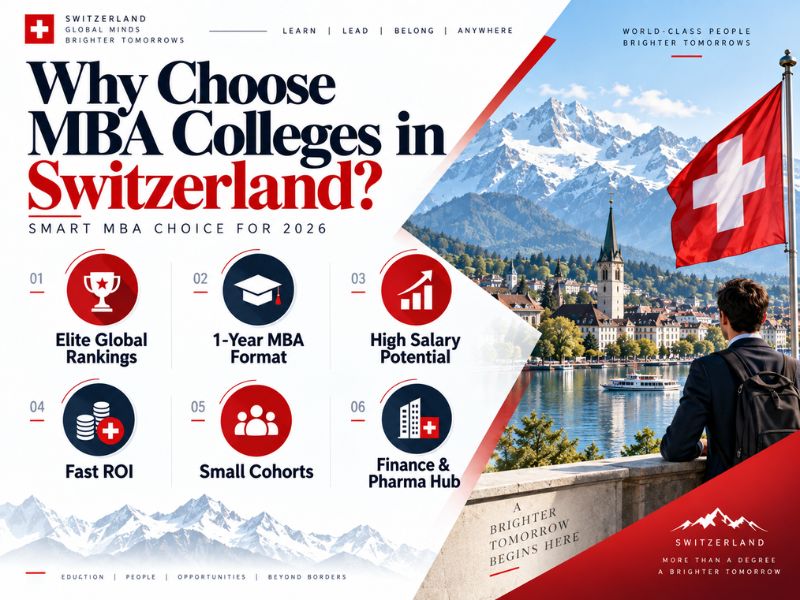
1. Genuinely elite global rankings at the top tier
IMD Business School is recognised as a top-25 school as per QS and FT, with ranks of 11 and 22 respectively for the top business schools in the world — placing Switzerland's leading program among the world's genuine elite.
2. Shorter program duration reducing opportunity cost
Access to top-ranked business schools such as IMD, St. Gallen, and HEC Lausanne comes with a shorter MBA duration (usually 1 year), saving both time and total opportunity cost compared to longer two-year formats elsewhere.
3. Genuinely strong post-MBA earning potential
Average salaries after an MBA in Switzerland range between CHF 100,000-160,000 (₹1.2 crore-1.92 crore approx.) in consulting, finance, and strategy roles — among the highest globally.
4. Fast ROI relative to program cost
MBA in Switzerland delivers high ROI with 90-95% placement within 3 months and cost recovery in around 30 months, despite the premium tuition investment.
5. Genuinely selective, small-cohort learning environment
At IMD specifically, there are only 90 students per cohort, showing that the university is quite competitive and selective for international students — this small scale translates into personalised learning and strong corporate networking opportunities.
6. Strategic position in global finance and pharma industries
Switzerland's business ecosystem genuinely aligns with high-demand sectors — finance, consulting, pharma, and tech — giving graduates direct access to some of the world's most prestigious multinational employers.
The bottom line: If you want genuinely elite global rankings, a fast one-year program format, and access to Switzerland's premium finance and pharma industries, Switzerland's top MBA colleges offer a compelling — though genuinely expensive — choice for 2026.
Eligibility Criteria for MBA Colleges in Switzerland
Before applying to MBA colleges in Switzerland, make sure you meet the following eligibility requirements for 2026 admissions.
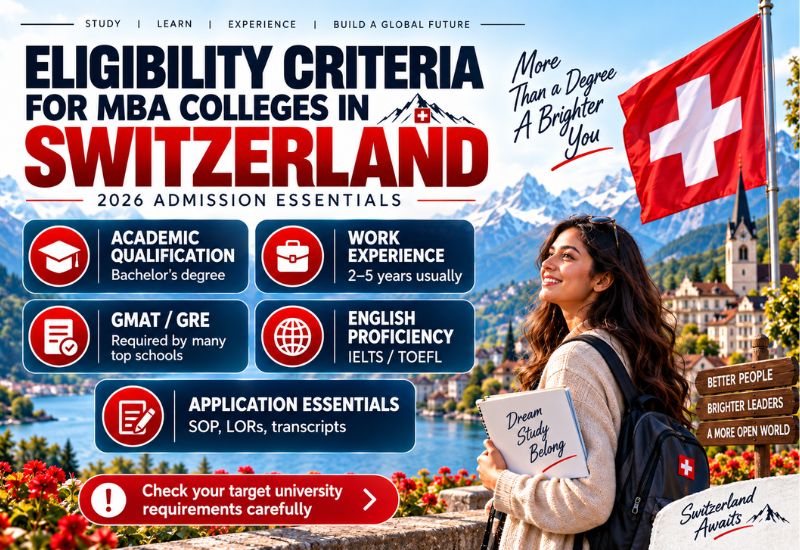
Academic qualification
- A bachelor's degree (180 ECTS, roughly 3-4 years) from a recognised university in any discipline is required, with a minimum of 60-65% aggregate marks generally expected.
Work experience
- Most MBA programs require 2-5 years of full-time work experience, with top schools like IMD expecting 5+ years, while Executive MBA programs require 8-10+ years.
Standardised test scores
- A competitive GMAT (typically 550-700) or GRE score is expected, particularly for elite institutions like IMD or St. Gallen — IMD specifically looks for scores between 585-805 for GMAT or equivalent GRE results, though most successful applicants score between 550-680. St. Gallen's average class profile in GMAT ranges even higher, from 700-720, reflecting the program's genuine selectivity.
English proficiency
- Non-native English speakers must show proof through IELTS (6.5-7.5+) or TOEFL (90-105+), though some schools may waive this if prior education was conducted in English.
Application essentials
- Original diplomas and transcripts with grading scales (translated to English/French), letters of recommendation, a Statement of Purpose, and application fees (CHF 150 for IMD, CHF 100 for St. Gallen) are standard requirements.s
Our advice: Since GMAT expectations genuinely vary by institution tier — from a broad 550-700 range to St. Gallen's notably higher 700-720 average — honestly benchmark your own test readiness against your specific target school rather than assuming a single "good enough" score applies uniformly across Switzerland's top programs.
Admission Process for MBA in Switzerland 2026
Here's a step-by-step breakdown of what the admission process looks like for 2026.
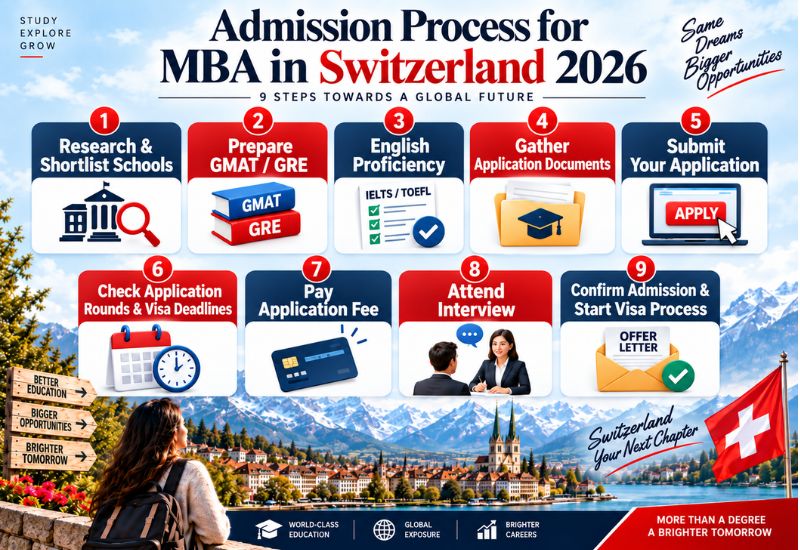
Step 1: Research and shortlist your target schools
Compare Switzerland's top MBA colleges based on fees, program duration, specialisation strength, and your realistic GMAT/work-experience profile fit.
Step 2: Prepare your standardised test scores
Take the GMAT or GRE as required, targeting your specific institution's expected range — 550-680 for most successful IMD applicants, or 700-720 for St. Gallen's typical cohort.
Step 3: Secure your English proficiency proof
Complete IELTS (6.5-7.5+) or TOEFL (90-105+) as required, or confirm whether your prior English-medium education qualifies you for a waiver.
Step 4: Gather your complete application documents
Prepare original diplomas and transcripts (translated to English/French where required), letters of recommendation, and a compelling Statement of Purpose.
Step 5: Submit your application within the correct round
IMD Business School's MBA program starting January 2026 accepts applications through five rounds, while the University of St. Gallen welcomes Fall 2025 applications in four fixed rounds — apply in earlier rounds where possible, since later rounds typically have fewer available seats.
Step 6: Watch visa-related application deadlines closely
Students from non-EU/EEA countries who need visas should submit their applications by May 1 for that year's intake — the school processes later applications on a rolling basis until July, depending on seat availability, so international (including Indian) applicants should prioritise the earlier deadline.
Step 7: Pay your application fee
Application fees vary by institution — CHF 150 for IMD, CHF 100 for St. Gallen — submit all documents together, since missing items could push your application to the next deadline.
Step 8: Attend your interview
Shortlisted candidates undergo an admissions interview assessing career goals, leadership potential, and program fit.
Step 9: Confirm admission and begin your visa process
Accept your offer, pay any required deposit, and begin your Swiss student visa application process well ahead of your intended start date.
Our advice: Since non-EU/EEA applicants face a genuinely earlier visa-related deadline (May 1) compared to the broader rolling admission window (through July), Indian applicants specifically should treat May 1 as their real target deadline rather than assuming they have until the later rolling cutoff.
Entrance Exams & English Language Requirements
Here's what you need to know about testing requirements for MBA colleges in Switzerland in 2026.
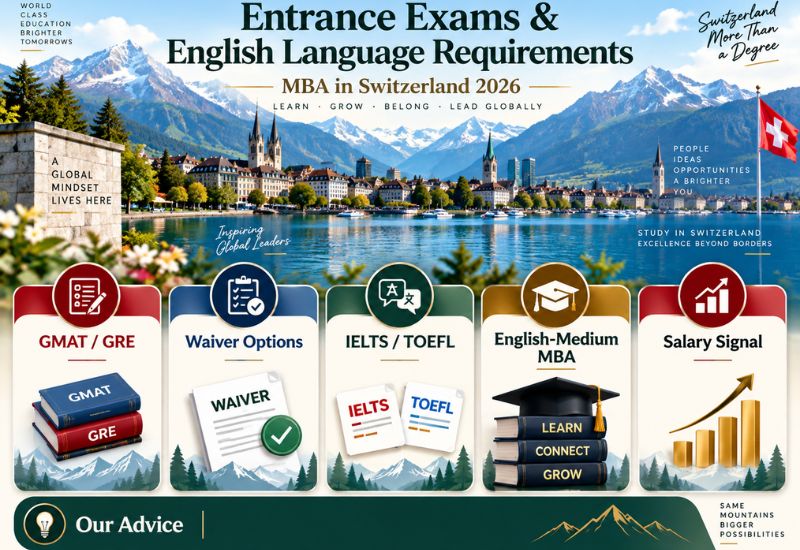
GMAT/GRE requirements genuinely vary by institution tier
A competitive GMAT or GRE score is required by some schools — IMD looks for scores between 585-805, with most successful applicants scoring between 550-680, while St. Gallen's average class profile sits notably higher at 700-720, reflecting its distinct MIM (Master in Management) program specifically.
Genuine waiver pathways exist.
While GMAT/GRE scores (~600+) are commonly expected, some universities offer waivers based on strong academic or professional profiles — worth confirming directly with your specific target school if your test score falls short of the typical range.
English proficiency requirements
TOEFL and IELTS minimum requirements are commonly cited as 90 and 6.,5 respective, ly at institutions like Geneva School of Economics and Management, with some programs setting slightly higher benchmarks (IELTS 6.5-7.5+, TOEFL 90-105+) depending on program selectivity.
English-medium instruction as standard
Geneva School of Economics and Management specifically offers courses in English, making it extremely viable for international students — this pattern of English-medium instruction holds broadly across Switzerland's top MBA programs, easing the transition for non-French/German/Italian-speaking applicants.
Salary outcomes linked to program strength
Students at St. Gallen get an average package of about $110,000, with students studying here seeing pay packages jump 150% — one of the largest such increases compared to all colleges in Europe, reflecting genuine value even against the country's premium tuition costs.
Our advice: Since GMAT expectations genuinely differ by hundreds of points between programs (IMD's 550-680 range versus St. Gallen's 700-720 average), invest in an honest self-assessment of your test readiness before choosing your target school — and don't rule out Switzerland if you fall short of the top tier, since mid-range programs like EU Business School and Business School Lausanne (CHF 30,000-45,000) offer meaningfully more accessible entry points while still delivering genuine Swiss business education value.
Affordable MBA Colleges in Switzerland
- Public universities offer the true low-cost route — Tuition fees at Swiss public universities go as low as CHF 500 per semester, though genuinely comprehensive full-time MBA programs remain rarer at public institutions compared to private business schools.
- EU Business School — Offers a wide range of MBA specialisations (Marketing, Finance, Entrepreneurship) with innovative teaching methods (case studies, group projects, practical workshops), positioned as a more accessible entry point than IMD or St. Gallen.
- City choice affects affordability significantly — St. Gallen and Bern are considered comparatively affordable cities, while Zurich and Geneva are notably expensive — choosing your city matters as much as choosing your schoo..l
- General MBA fee range in the country — CHF 20,000-70,000 (₹18.3-64.2 lakh) for the entire course across most schools, though this still sits well above what "affordable" means in most other MBA destinations
- Honest positioning — Switzerland doesn't compete on volume or affordability — with just a handful of MBA programs compared to dozens in the UK or US, it has positioned itself as a boutique, premium destination rather than a budget-friendly one; even its "affordable" tier remains costly relative to most of Europe or Asia
- Scholarship-driven cost reduction is the primary affordability lever — Since no school here is genuinely cheap, merit scholarships and grants (reducing fees by 20-50%) are the realistic path to making a Swiss MBA more accessible, rather than seeking out a low-fee institution.ion
Cost of Living for MBA Students in Switzerland
- City-based variation is significant — Zurich and Geneva are the most expensive cities, while St. Gallen and Bern offer comparatively lower living c.osts
- Lausanne-specific example (IMD) — Monthly living costs of CHF 3,000-3,500 (~₹2.75-3.2 lakh), with over the full one-year MBA program adding CHF 30,000-42,000 (~₹27.5-38.5 lakh) to total tuition investment
- National average earnings context — Swiss workers earn CHF 6,502 (~$7,140) per month on average, among the highest in the OECD — useful context for understanding why living costs run so high
- Total combined cost (tuition + living) — For Indian students, total MBA cost including living expenses rafrom ₹ 35- 9535-95 lakh depending on the specific program and city
- Visa financial proof requirement — Applicants must show approximately CHF 21,000/year (~₹19 lakh) in available funds as part of the student visa application
- Visa processing cost — Total visa-related cost, including VFS fees and embassy charges, is approximately ₹12,000-13,000, a relatively modest add-on compared to the overall program investment.
- Budgeting reality — Given how dramatically city choice affects cost, choosing a program in St. Gallen or Bern over Zurich or Geneva can meaningfully reduce your total living expense burden without sacrificing program qqualityy
Scholarships for MBA in Switzerland
- Swiss Government Excellence Scholarship — A highly competitive, full scholarship covering tuition and living costs — genuinely rare and difficult to secure given the competition
- IMD MBA Scholarship — Up to CHF 30,000 (~₹27.5 lakh), one of the more substantial merit-based awards available at a top-tier school
- Nestlé MBA Scholarship / Nestlé MBA Scholarships for Women — Specifically targeted at candidates from developing countries and women applicants, reflecting corporate-sponsored diversity funding
- Typical partial tuition waivers — Most universities provide partial tuition waivers ranging from CHF 10,000-50,000 (~₹9-45 lakh), which can meaningfully reduce the effective cost even at premium schools
- Fee reduction range for Indian applicants — Merit-based scholarships, university-specific grants, and external funding can reduce tuition fees by approximately 20-50%, depending on eligibility.
- Limited government-funded options — Scholarships provided by the government for international students are comparatively limited versus other countries, making university-specific and corporate-sponsored awards the more realistic funding pathway
- Application strategy — Since full scholarships are rare, most students should plan around a combination of partial scholarships, personal savings, and education loans rather than expecting to fully offset tuition through funding alone
MBA Colleges in Switzerland for Indian Students
- IMD Business School (Lausanne) — One-year program (January-December); Fees: CHF 90,000-97,500 (2025-26 figures); 95% of graduates employed within three months; median starting salary CHF 130,000-150,000; integrates real-world consulting projects and an International Consulting Project sending student teams abroad
- University of St. Gallen (HSG) — Strong connection to the corporate world through partnerships with leading companies for internships, networking, and job placements; full-time program runs 1 year, part-time 2-3 years for working professionals
- EU Business School — Offers diverse MBA specialisations (Marketing, Finance, Entrepreneurship) with a more accessible positioning than IMD/St. Gallen
- Smaller Indian alumni network caveat — Indian alumni report strong placement in Swiss and European multinationals, though the Indian alumni network at Swiss schools is notably smaller than at comparable US schools — worth factoring into your networking expectations
- English-taught programs widely available — Combined with a multicultural environment and exposure to global companies, this makes adaptation easier for Indian students academically and professionally.
- Application process specifics — IMD's application fee is CHF 150, St. Gallen's is CHF 100; IMD accepts applications through five rounds for its January 2026 intake, while St. Gallen uses four fixed rounds for Fall intake; non-EU/EEA applicants needing visas should apply by May 1 for a Fall intake
MBA Placements & Career Opportunities in Switzerland
- Overall salary outcomes — MBA graduates can expect starting salaries between CHF 100,000-120,000, with top-tier schools like IMD reporting median starting salaries of CHF 130,000-150,000 (~USD 145,000-165,000)
- IMD-specific placement strength — 95% of graduates employed within three months of graduation — an exceptionally strong outcome rate
- Common post-MBA role distribution (IMD) — Consulting (35-40%), Industry (30-35%), and Technology (15-20%) collectively account for the vast majority of graduate placements
- Global corporate presence — Switzerland is home to global giants like Nestlé, Google, and Roche, creating direct access to blue-chip multinational employers for MBA graduates
- St. Gallen's corporate-embedded model — Strong partnerships with leading companies translate directly into internship pipelines and job placement support built into the program structure
- Post-study work rights — Graduates receive a six-month renewable residence permit to look for a full-time job after completing their degree; once an employer offers a role matching their qualification, the employer can apply for a work permit to transition the graduate from student to professional status
- During-study work rights — Non-EU/EFTA students (including Indians) can work up to 15 hours/week during the semester and full-time during vacations, though only starting 6 months after their studies begin — with Switzerland's high minimum wage (CHF 22-28/hour) offering a meaningful income supplement once eligible
Note: Fees, scholarship amounts, aur salary figures IMD, St. Gallen, aur EU Business School ke beech significantly vary karte hain, aur currency conversion source ke hisaab se bhi differ karta hai — publish se pehle official school websites (imd.org, unisg.ch, euruni.edu) se latest 2026 intake, deadlines, aur exact fee/scholarship details verify kar lena strongly recommend karta hoon.
Average MBA Salary in Switzerland
- National salary range — MBA graduates in Switzerland can expect starting salaries between CHF 100,000-120,000, among the highest globally for MBA graduates
- IMD-specific benchmark — Median starting salaries of CHF 130,000-150,000 (~USD 145,000-165,000), reflecting the school's premium positioning and strong recruiter access
- Overall market context — Some sources cite an even broader top-end range of ₹1-1.35 crore per year in industries like finance, consulting, and technology, though this likely reflects total compensation for stronger candidates rather than a universal average
- National average earnings context — Swiss workers earn CHF 6,502 (~$7,140) per month on average, among the highest in the OECD, providing useful context for why Swiss MBA salaries sit at the global premium end
- Role-based salary distribution — Consulting roles (35-40% of graduates) and technology roles (15-20%) tend to command the strongest starting packages, while industry-track roles (30-35%) offer solid but somewhat more variable compensation.n
- High cost-of-living offset — Given Switzerland's notably high living costs (especially in Zurich and Geneva), these headline salary figures should be evaluated net of living expenses rather than as pure take-home gain.
- Currency and tax consideration — Swiss income tax rates and cantonal variations affect actual take-home pay, so gross salary figures shouldn't be mistaken for net earnings when planning your post-MBA budget
Student Visa & Residence Permit for MBA Students
- Visa type — Non-EU/EFTA students, including Indians, need a national (Type D) student visa for programs longer than 90 days
- Financial proof requirement — Approximately CHF 21,000 per year (~₹19 lakh) in available funds must be demonstrated as part of the visa application
- Core application documents — Proof of admission, financial resources, health insurance, and confirmed accommodation
- Processing time — Typically 8-12 weeks, so applications should be submitted well in advance of your intended intake — non-EU/EEA applicants for a Fall intake are often advised to apply by May 1
- Visa cost — Total cost, including embassy fees and VFS service charges, comes to approximately ₹12,000-13,000
- Mandatory health insurance — Required as part of both the visa application and ongoing residence in Switzerland
- Work rights during study — Non-EU/EFTA students can work up to 15 hours/week during the semester and full-time during vacation periods, though work is only permitted starting 6 months after the commencement of studies
- Post-study residence permit — Upon successful degree completion, graduates can apply for a six-month renewable residence permit specifically to look for a full-time job in Switzerland.d
Top Recruiters for MBA Graduates in Switzerland
- Nestlé — A major Swiss multinational actively recruiting MBA graduates, and also a scholarship sponsor (Nestlé MBA Scholarship, including a dedicated award for women from developing countries)
- Roche — A global pharmaceutical giant headquartered in Switzerland, offering strong opportunities for MBA graduates targeting healthcare/pharma management roles
- Google — Reflects the strong technology-sector presence in Switzerland, aligning with the 15-20% of IMD graduates who move into technology roles.
- Consulting firms (broad category) — The single largest recruiting sector at top schools like IMD, absorbing 35-40% of graduates into strategy and management consulting roles
- Swiss and European multinationals (broader category) — Indian alumni specifically report strong placement success at these firms, even though the overall Indian alumni network in Switzerland remains smaller than at comparable US business schools.ls
- Sector concentration overall — Consulting, technology, and global industrial/consumer giants (Nestlé, Roche) collectively form the strongest recruiting pillars, reflecting Switzerland's status as a hub for both multinational headquartersand specialisedd consulting practice.
ROI of Best MBA Colleges in Switzerland
- IMD Business School — Fees: CHF 90,000-97,500 (1-year program) plus CHF 30,000-42,000 living costs vs. median starting salary CHF 130,000-150,000 → Strong ROI given exceptionally high 95% employment rate within 3 months, though total investment (often exceeding many 2-year US programs once living costs are included) demands a genuinely premium salary outcome to justify
- University of St. Gallen (HSG) — Comparatively lower cost structure vs. strong corporate-partnership-driven placement outcomes → Solid ROI, particularly for the part-time format (2-3 years) that lets working professionals continue earning during study
- EU Business School — More accessible fee positioning vs. moderate placement outcomes → Reasonable ROI for candidates prioritizing specialization variety over elite brand prestige
- Scholarship-adjusted ROI — Since typical partial tuition waivers (CHF 10,000-50,000) can reduce fees by 20-50%, securing even a partial scholarship meaningfully improves the overall payback calculation at any of these schools
- Overall positioning — Switzerland represents the high end of the global MBA investment spectrum — it doesn't compete on affordability, but on quality, precision, and career outcomes that are specifically designed to justify a premium investment for candidates targeting elite consulting, finance, or global corporate leadership roles
- Risk consideration — Given the total cost can reach ₹35-95 lakh, ROI depends heavily on securing one of the strong post-MBA outcomes (consulting, tech, or multinational leadership) rather than a general management role — making this a higher-risk, higher-reward investment compared to more moderately-priced European destinations
Compare the Best MBA Colleges in Switzerland
| School | City | Duration | Fees | Avg Starting Salary | Notable Strength |
|---|---|---|---|---|---|
| IMD Business School | Lausanne | 1 year | CHF 90,000-97,500 | CHF 130,000-150,000 | 95% employed in 3 months; real-world consulting projects |
| University of St. Gallen (HSG) | St. Gallen | 1 yr FT / 2-3 yr PT | Moderate (more affordable city) | CHF 100,000-120,000 range | Strong corporate partnerships, flexible format |
| EU Business School | Multiple campuses | Standard | More accessible | Moderate | Diverse specialisations (Marketing, Finance, Entrepreneurship) |
- Best for elite brand + placement rate: IMD Business School
- Best for corporate connections + flexible format: University of St. Gallen
- Best for accessibility + specialisation variety: EU Business School
- Best affordable cities: St. Gallen, Bern (versus expensive Zurich, Geneva)
FAQs About Best MBA Colleges in Switzerland
Q1. How much does an MBA cost in Switzerland for Indian students?
Total cost, including tuition and living expenses, ranges from ₹35-95 lakh, with IMD's flagship one-year program alone costing CHF 90,000-97,500 in tuition plus CHF 30,000-42,000 in living costs.
Q2. What is the average salary after an MBA in Switzerland?
Starting salaries typically range from CHF 100,000-120,000, with top schools like IMD reporting median starting salaries of CHF 130,000-150,000.
Q3. Are scholarships available for Indian MBA students in Switzerland?
Yes — options include the IMD MBA Scholarship (up to CHF 30,000), Nestlé MBA Scholarships (including one specifically for women from developing countries), and typical partial tuition waivers of CHF 10,000-50,000 at most schools.
Q4. Can I work while studying an MBA in Switzerland?
Yes, non-EU/EFTA students can work up to 15 hours/week during the semester and full-time during vacations, though only starting 6 months after your studies begin.
Q5. Can I stay and work in Switzerland after my MBA?
Yes, graduates can apply for a six-month renewable residence permit to look for a full-time job, after which an employer can sponsor a work permit for you.
Q6. Which are the most affordable cities for MBA study in Switzerland?
St. Gallen and Bern are considered comparatively affordable, while Zurich and Geneva are notably more expensive.
Q7. Is Switzerland a good MBA destination compared to the UK or US?
Switzerland doesn't compete on affordability or program variety like the UK or US, but offers boutique, premium programs with exceptionally strong placement rates (95% at IMD) and among the highest global MBA starting salaries — best suited for candidates prioritising elite outcomes over cost efficiency.
Q8. What is the visa financial proof requirement for Switzerland?
Applicants must demonstrate approximately CHF 21,000/year (~₹19 lakh) in available funds as part of the student visa application process.
Conclusion
An MBA in Switzerland sits firmly at the premium end of the global business education spectrum — this is a country that doesn't compete on affordability or program variety, but instead offers a small, carefully curated set of institutions like IMD and the University of St. Gallen that deliver exceptional career outcomes justifying their high cost. With total investment reaching ₹35-95 lakh and IMD alone reporting a 95% employment rate within three months alongside median starting salaries of CHF 130,000-150,000, Switzerland's value proposition rests on precision and quality rather than volume — a genuinely different positioning from countries offering dozens of MBA programs across a wide price spectrum. Direct access to global giants like Nestlé, Roche, and Google, combined with St. Gallen's deeply embedded corporate partnership model, gives graduates real pathways into elite consulting, technology, and multinational leadership roles. That said, prospective students should approach this destination with clear eyes: