





Best Law Colleges in India 2025: NIRF Rankings, Fees, Courses & Entrance Exams
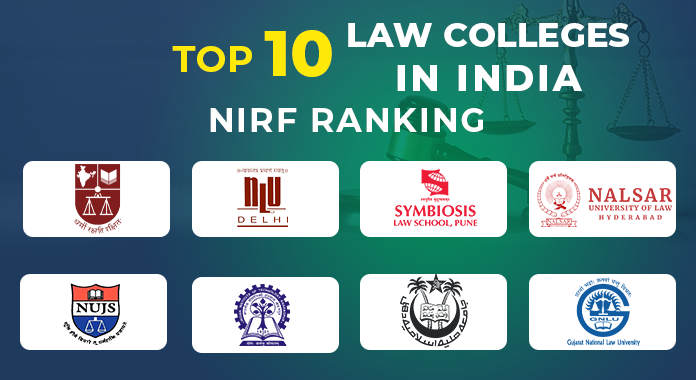
Table of Contents
Information video on a law exam. Tap Here
In India, the legal profession is very prominent in everyday life. Considering the number of Lawyers, Judges, Paralegals, Judicial services, Legal journalists, Legal Advisors and Legal Analysts, it’s no surprise that law schools have become popular among students – especially in recent years. The problem, however, is finding out which law schools in India are worth your time and money. To keep you on track with what’s available today, this article will provide you with a list of the best Indian law schools.
Changing the nation’s political and social framework through the law is an opportunity. While numerous new graduate school graduates enter the labour force in the space of prosecution or at large organisations, others have their sights set on the legal branch and are planning to take the passing tests led by the Public Help Commission. Moreover, there is a wide exhibit of scenes, from government offices to non-legislative associations, where you can affect strategies and guidelines. To find success in this area, be that as it may, you’ll need to be under tension and organise your time really well. Then again, you have the choice to strike out all alone and contribute essentially to the battle for equal freedoms for all individuals.
EDUCATION AT INDIA’S EMINENT UNIVERSITIES
An estimated 1,721 law institutions can be found in India. Among these institutions, 920 are Private Law schools, and 383 are Government law schools, where 248 are Private Universities, and 170 are Government Universities.
National Law University
National Law Universities (NLUs) are profoundly viewed as a portion of India’s most prestigious educational organisations, particularly in the legal and academic community. These publicly funded universities have affiliations with the Bar Council of India. These programmes are simply open to high school graduates who perform well on the various law school entrance exams, except for NLU-Delhi; no other standardised test scores are considered for confirmation of admission. The courses are intended to give students a strong groundwork from which to confront the difficulties they will face in the real-world legal environment. NLUs continue to be centrally governed and have the best instruction and research offices, productive administration, and cutting-edge infrastructure, which is the reason many aspiring lawyers dream about attending one. A student keen on the law should not make going to an NLU their main choice, particularly since around private graduate schools have outperformed a few NLUs and procured high NIRF rankings lately.
Pros of Studying from an NLU
Competitive attitude and culture
Finest infrastructure
Better placement opportunities
Nominal ffeestructure
Best facilities of the ot court
Cons of Studying from an NLU
Old and traditional pedagogy of teaching
Tough competition
NIRF RANKINGS
NIRF stands for National Institute Ranking Framework. The primary edition of the NIRF evaluation and, therefore, the first rank scores were made available in 2016. NIRF ranks educational institutions in India, which is supported ed a range of critical criteria, which include:
· Outcomes (GO)
· Research and Professional Practice (RP)
· Outreach and Inclusivity (OI)
· Teaching, Learning and Resources (TLR)
Here are the top 8 Institutes according to NIRF
S. No | Name of Institute | Score | Rank |
|---|---|---|---|
1. | National Law School of India University, Bengaluru | 78.00 | 1 |
2. | National Law University, New Delhi | 73.96 | 2 |
3. | Symbiosis Law School, Pune | 73.73 | 3 |
4. | NALSAR University of Law | 73.05 | 4 |
5. | The West Bengal National University of Juridical Sciences, Kolkata | 70.72 | 5 |
6. | Indian Institute of Technology, Kharagpur | 67.27 | 6 |
7. | Jamia Millia Islamia, New Delhi | 63.62 | 7 |
8. | Gujarat National Law University, Gandhinagar | 60.78 | 8 |
LIST OF TOP NIRF RANKING INSTITUTES
Details of the best law NIRF Institutes
National Law School of India University, Bengaluru
 Bengaluru, law college image by gyc
NLSIU was the first National Law University, which commenced from 1988 to pioneer legal education reforms in India.
Address: Gnana Bharathi Main Rd, opp. NAAC, Teachers Colony, Naagarabhaavi, Bengaluru, Karnataka 560072.
Fees Structure:
COURSE | FEES( p.a.) | ELIGIBILITY |
|---|---|---|
L.L.M | 1.52L | L.L.B.(50%)+ CLAT |
L.L.D | 85,000 | POST GRADUATION |
Ph.D | 85,000 | POST GRADUATION |
FEES STRUCTURE OF NLSIU
National Law University, Delhi
 Delhi, law college image by gyc
National Law University, NLU New Delhi, commenced in 2008, offering courses at the undergraduate and postgraduate levels.
Address: Golf Course Rd, Pocket 1, Sector 1a, Dwarka, New Delhi, Delhi 110078
Fees Structure:
COURSE | FEES(p.a.) | ELIGIBILITY |
|---|---|---|
BA L.L.B. (HONS.) | 1.38L | 10+2 (50%) + AILET |
L.L.M. | 1.39L | L.L.B.(55%) + AILET |
Ph.D | 73,000 | POST GRADUATION |
FEES STRUCTURE OF NLU
Symbiosis Law School, Pune
 Symbiosis Law College, Pune image by gyc
Symbiosis Law School, Pune, is a law school with campuses located in Pune, Hyderabad, and Nagpur in India. The law school was established in 1977.
Address: Survey No 227, Rohan Mithila, New VIP Road, Plot No. 11, Symbiosis Law School Rd, Opposite Pune Airport, Viman Nagar, Pune, Maharashtra 411014
Fees Structure:
COURSE | FEES(p.a.) | ELIGIBILITY |
|---|---|---|
L.L.B. | 2.5L | Graduation (45%) + SET |
BA L.L.B (hons.) | 3.73L | 10+2 (45%)+ SET |
BBA LLB (hons.) | 3.73L | 10+2 (45%)+ SET |
LLM | 1.65L | LLB |
FEES STRUCTURE OF SYMBIOSIS LAW SCHOOLNALSARr University of Law
 NALSAR Law College image by gyc
The National Academy of Legal Studies and Research is a public law school and a National Law University located in Shamirpet, Hyderabad, Telangana, India. The five-year integrated undergraduate legal degree, postgraduate law degree, and doctoral law degree are among the initial programmes offered by this university.
Address: Justice City, Shamirpet, Hyderabad, Telangana 500101
Fees Structure:
COURSE | FEES(p.a.) | ELIGIBILITY |
|---|---|---|
BA LLB (hons.) | 2.42L | 10+2 (45%) + CLAT |
LLM | 1.75L | LLB |
LLM+ PhD. | 32,000 | LLB |
FEES STRUCTURE OF NALSAR UNIVERSITY OF LAW
West Bengal National University of Juridical Sciences
 West Bengal Law College image by GYC
The West Bengal National University of Juridical Sciences(WBNUJS) is a premier public law school in India, also known as the Columbia of the East, and is an elite National Law University located in Bidhannagar, Kolkata, West Bengal, India
Address: 12, LB Block, Sector III, Bidhannagar, Kolkata, West Bengal 700098
Fees Structure:
COURSE | FEES(p.a.) | ELIGIBILITY |
|---|---|---|
B.SC+ LLB | 2.44L | 10+2 (45%) + CLAT |
BA LLB (hons.) | 2.42L | 10+2 (45%) + CLAT |
LLM | 1.44L | LLB |
FEES STRUCTURE OF WBNUJS
Indian Institute of Technology
 IIT college, Kharagpur, law college image by gyc
Indian Institute of Technology Kharagpur is a public research university established by the Government of India in Kharagpur, West Bengal, India. The institute was the first IIT to open its doors in 1951 and is recognised as an Institute of National Importance.
Address: Kharagpur, West Bengal 721302
Fees Structure:
COURSE | FEES(p.a.) | ELIGIBILITY |
|---|---|---|
LLM | 1.46L | LLB |
FEES STRUCTURE OF IITK
Jamia Millia Islamia
 Jamia College of la, Okhla, New Delhi
In New Delhi, India, there is a major university called Jamia Millia Islamia. Initially founded in 1920 at Aligarh, United Provinces, it was relocated to its current location in Okhla in 1935. It was given the deemed status by the University Grants Commission in 1962.
Address: Jamia Millia Islamia, Jamia Nagar, Okhla, New Delhi, Delhi 110025
Fees Structure:
COURSE | FEES(p.a.) | ELIGIBILITY |
|---|---|---|
LLM | 1.44L | LLB (50%) |
FEES STRUCTURE OF JMI
Gujarat National Law University
 Gujrat Law University, Koba, Gujrat image by gyc
The Gujarat National Law University is a public law school and a National Law University established under the Gujarat National Law University Act, 2003, in the state of Gujarat.
Address: Attalika Avenue Knowledge Corridor, PDPU Rd, Koba, Gujarat 382421
Fees Structure:
COURSE | FEES(p.a.) | ELIGIBILITY |
|---|---|---|
B.SC+ LLB | 1.86L | 10+2 (50%) + CLAT |
BA LLB (hons.) | 1.86L | 10+2 (45%) + CLAT |
B.com LLB (Hons.) | 1.86L | 10+2 (45%) + CLAT |
BSW LLB | 1.86L | 10+2 (45%) + CLAT |
LLM | 1.47L | LLB |
FEES STRUCTURE OF GLU
BASIC ADMISSION REQUIREMENTS OF LAW COLLEGES
To apply to any Institution in India, you should initially have finished the 12th grade and procured a confirmation from an Indian school education board or an approved equivalent qualification. A candidate should have no less than 45% on their 12th-grade examinations to qualify if they are from the General, OBC, or uniquely able classes. The standard is brought down to 40% for individuals from the SC and ST communities.
There is no standard set for college entrance tests. Entrance tests are expected of students who wish to sign up for a specific college or university. After the tests, colleges use interviews and group discussions to limit the pool of candidates.
ENTRANCE EXAMS FOR LLB/LAW COLLEGES
COMMON LAW ADMISSION TEST (CLAT)
This entrance exam is regarded to be among the best in India. Before 2019, CLAT was administered annually by a different NLU; however, starting in 2019, the exam was managed centrally by the Consortium of National Law Universities (CLNU). Scores on CLAT are accepted by numerous Indian law schools and universities in addition to NLUs. Countless students take this exam because it is offered only once a year. There is a minimum score needed to even be taken into consideration because there is such high demand for the limited number of open positions. Online information submission is required before the application deadline. For further information, visit- https://consortiumofnlus.ac.in/clat-2023/
ALL INDIA LAW ADMISSION TEST (AILET)
The National Law University in Delhi conducts a yearly written test. It’s more challenging than CLAT, yet just for one university. NLU Delhi has chosen to eliminate Elementary Mathematics and Legal Aptitude from the AILET test format starting in 2022. Considering this, the AILET test will include three distinct parts: English Language, Logical Reasoning, and Current Affairs and General Knowledge. Likewise, changed is the general significance of the different AILET test segments. For more information, visit- https://nludelhi.ac.in
LAW SCHOOL ADMISSION TEST (LSAT)
Law School Admission Test (LSAT) – It is an Indian entrance test directed by the Law School Admission Council (LSAC) for admissions to undergraduate and postgraduate law courses. The test is directed to waitlist law aspirants for confirmation in undergraduate and postgraduate level courses offered at different regulatory universities in India. For more information, visit- https://discoverlaw.in
MAHARASHTRA COMMON ENTRANCE TEST (MHCET LAW)
The State Normal Entry Test (CET) Cell, Maharashtra, endorses the MHCET regulation qualification models 2022 for 5-year LLB programs presented by different regulation universities. The MHCET regulation 2022 qualification standards cover the basic circumstances that are a necessity to satisfy before completing the application form. The exam pattern of MHT CET 2023 includes details like exam mode, sections, duration, type of questions, total marks, marking scheme and more. The MHT CET 2023 exam will be an online computer-based test. For more information, visit- https://ctet.co.in/mh-cet-law-2022
CHRIST UNIVERSITY LAW ENTRANCE EXAM (CULEE)
Christ University administers the CULEE Exam, a university-level test. Candidates who desire to take the CULEE must meet the requirements set forth by Christ University’s School of Law for admission to law programmes, including BA LLB and BBA LLB.
The undergraduate courses have about 300 places available. The test lasts for two hours. Visit https://ctet.co.in/culee -2022 for more details.
SYMBIOSIS LAW APTITUDE TEST (SLAT)
Candidates are interested in the B.A. LL.B. (Hons), B.B.A. LL.B. (Hons), B.A. LL.B. or B.B.A. LL.B. programmes provided by Symbiosis International (Deemed University) must take the common, required computer-based test (CBT). Since 2018, the Symbiosis Law Admission Test has replaced the SET-Law test (SLAT). Computer-based test (CBT) modality is used to administer this across several Indian cities.
An applicant must register for both the SLAT 2022 exam as well as the institutions offering the programmes of his or her choice by paying separate registration fees for each programme. If selected, he or she would then have to go to the subsequent admissions process held by each of these institutes separately. For more information, visit- https://bit.ly/3CBICen
For more information about various law school entrance exams, visit- getyourcollege
Law schools in India provide students with an excellent opportunity to learn about the legal system and to develop their knowledge, skills and abilities. For many interested in becoming a lawyer, this is the first step they need to take before they can start looking forward to careers as lawyers.