







Best countries for MBBS abroad for Indian students with world map, international medical universities, doctor, and study abroad concept
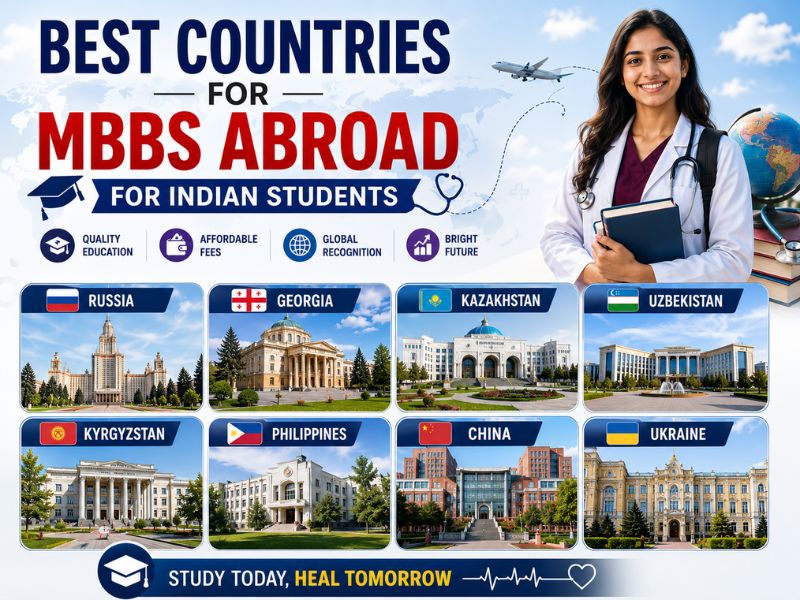
Table of Contents
Best Country for MBBS Abroad for Indian Students: Highlights 2026
Choosing the right country for your MBBS abroad journey is one of the most consequential decisions in your medical career, directly affecting your education quality, budget, and future licensing prospects in India. In 2026, several countries continue to stand out as genuinely strong options for Indian medical aspirants.
Countries like Georgia, Russia, the Philippines, Uzbekistan, and Kyrgyzstan remain popular choices, each offering distinct advantages — affordable tuition, English-medium instruction, WHO/NMC-recognized universities, and relatively straightforward admission processes based on academic merit rather than competitive entrance exams.
That said, "best" shouldn't be judged purely on cost. The right country for you depends on multiple factors: university recognition status, clinical training quality, cultural adaptability, safety, proximity to India, and — critically — the track record of graduates successfully clearing India's FMGE/NExT licensing exam after returning.
A crucial 2026 development worth understanding is the NMC's tightened enforcement around program duration (54 months academic plus 12 months internship) and stricter scrutiny of online coursework, meaning students must now verify these compliance factors more carefully than in previous years before selecting their destination.
Ultimately, the best country for you balances affordability, education quality, and — most importantly — a clear, verified pathway back to practising medicine in India, provided you've qualified NEET before enrolling.
Why Choose the Best Country for MBBS Abroad for Indian Students?
Choosing your MBBS destination carefully genuinely matters — here's why getting this decision right is so important in 2026.
1. Directly impacts your recognition and licensing outcome
Not all countries or universities offer the same FMGE/NExT pass rates. Choosing a country with a strong track record of clinical training quality significantly improves your chances of successfully practising in India after graduation.
2. Significant cost variation across countries
Total program costs can vary by ₹10-20 Lakhs or more between destinations, making country selection a major financial decision, not just an academic one.
3. Clinical exposure quality differs substantially
Some countries offer robust hospital access and diverse patient case studies. In contrast, others provide more limited practical exposure — this directly affects how prepared you'll be for both FMGE/NExT and actual medical practice.
4. Safety and living conditions matter for a 5.5-year commitment
Given the lengthy program duration, your chosen country's safety, healthcare infrastructure, and overall living conditions significantly impact your day-to-day wellbeing throughout your studies.
5. Visa and immigration policies vary
Some countries offer smoother, more transparent visa processes for Indian students, while others involve more bureaucratic complexity — worth researching before committing.
6. Cultural and language adaptability
Countries with established Indian student communities often provide easier cultural transitions, better support networks, and more familiar food options.
The bottom line: Since you're committing 5.5+ years and a significant financial investment, choosing the right country deserves the same careful research you'd apply to choosing a career path itself.
Benefits of Choosing the Best Country for MBBS Abroad for Indian Students
Making the right country choice delivers benefits that compound throughout your medical career. Here's what's genuinely at stake in 2026.
1. Stronger clinical training foundation
Countries with well-established medical education systems and strong hospital partnerships provide genuinely better hands-on clinical exposure, directly improving your real-world medical competency.
2. Better FMGE/NExT preparation and pass rates
Universities and countries with strong curriculum alignment to Indian medical standards tend to produce graduates who perform better on India's licensing exams.
3. More manageable financial planning
Choosing a country with transparent, predictable fee structures (rather than hidden costs that emerge later) makes budgeting for your entire 5.5-year journey significantly easier.
4. Stronger peer and alumni networks
Popular destinations with larger Indian student communities often provide better peer support, established alumni networks, and easier access to mentorship from previous graduates who've successfully navigated the FMGE/NExT process.
5. Smoother visa renewal and stay processes
Countries with established, transparent student visa systems reduce administrative stress throughout your program duration.
6. Better long-term career flexibility
Some countries offer genuine dual pathways — the option to practice locally if you choose, alongside the standard route back to India — providing valuable career flexibility.
7. Cultural and logistical convenience
Geographically closer countries (like Nepal or Bangladesh) offer easier, more affordable travel home during breaks, an underrated but meaningful quality-of-life factor over several years.
The takeaway: The right country choice isn't just about saving money upfront — it's about setting yourself up for genuine success in both your education and your eventual medical career in India.
Entrance Exams Required for MBBS Abroad for Indian Students
Understanding exactly which exams matter — and when — helps you plan your MBBS abroad journey correctly in 2026.
1. NEET-UG (the foundational, non-negotiable exam)
This remains the single most important exam for Indian students, regardless of which country or university you choose. While your host university might not require it for admission, NEET qualification is mandatory for future Indian medical registration and practice.
2. University-specific entrance tests (where applicable)
Some universities, particularly in Russia and certain European countries, may conduct their own basic academic assessment or interview, though these are generally less rigorous than India's competitive entrance landscape.
3. English proficiency tests (for non-native English speakers)
While most Indian students are already comfortable with English, some universities may still request basic English proficiency verification, particularly if your 12th-grade education wasn't conducted in English.
4. FMGE/NExT (post-graduation, not pre-admission)
This isn't required before you go abroad, but it's essential to understand as part of your overall exam journey — this is the licensing exam you'll need to clear after completing your MBBS abroad to practice in India. From 2027 onwards, NExT will replace FMGE for this purpose.
What's notably NOT required by most foreign universities
Unlike Indian medical colleges, most MBBS abroad universities don't require additional standardised entrance exams like separate aptitude tests — admission is typically based on your 12th-grade academic performance and NEET qualification status (even if not formally required for admission, having it strengthens your application and protects your future).
Our advice: Treat NEET-UG as your primary and most important exam in this entire journey — everything else (university-specific tests, English proficiency checks) is secondary in comparison, since NEET alone determines your long-term ability to legally practice medicine in India after completing your MBBS abroad.